Alice and the Swirling Canvas
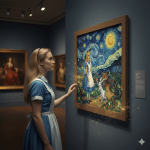
Chapter 1: The Yellow Crescent
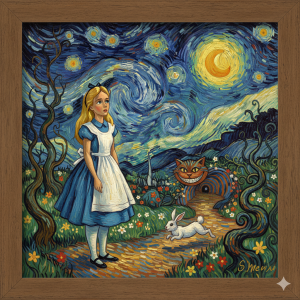
A sudden, jarring shift in color drew Alice’s attention away from the White Rabbit’s existential crisis.
A short distance away, through a thicket of gnarled, swirling branches, the landscape erupted. It was a riot of color that fought against itself: streaks of raw vermillion clashing with aggressive viridian greens, all under a canopy of electric violet. It was loud, visually overwhelming, and undeniably wet.
The White Rabbit, clutching his hastily drawn watch, shuddered, his unfinished lines seeming to vibrate with distaste. “Don’t go that way, child! That’s the Saturation Zone! The Hatter has completely abandoned all sense of proportion or harmony. He’s destroying the value! It’s all so terribly… loud.”
But Alice, already overwhelmed by the thick texture and anxious energy of her arrival, found herself drawn to the visual noise. At least there, the danger wasn’t fading into the canvas; it was being intensely, brilliantly there.
“I think,” Alice decided, stepping over a thick, coiled stroke of blue that served as a root, “I need to speak to someone who understands color. Perhaps they understand how this world is painted.”
She plunged through the dark, expressive undergrowth.
🎨 The Mad Hatter’s Colour Party
Alice emerged into a clearing where the air didn’t just smell of paint; it smelled of turpentine and fermented tea.
The famous long table was there, but it wasn’t set for tea; it was set for a lesson in chromatic chaos. Instead of fine china, there were pots and buckets overflowing with thick, undiluted pigments. The table itself was not wood, but a slab of brilliant, sticky Cadmium Yellow.
The Mad Hatter, his face painted with feverish, opposing stripes of cyan and magenta, was shouting at a trembling Dormouse who was struggling to balance a tiny teacup. The cup was filled with a liquid that glowed with the unnatural intensity of a pure Phthalo Blue.
“No, no, you infuriating rodent!” the Hatter shrieked, splashing a handful of Alizarin Crimson onto the table, creating a violent, wet mess. “You are sipping Primary Blue next to a background of Primary Yellow! You need a mediator! You need an Orange, or perhaps a delicate Tertiary Violet! Do you have any idea the visual friction you are causing?”
The Dormouse whimpered, his face a perfect, frightened circle of dull beige. “B-but this is the only color that won’t dry, sir!”
The Hatter ignored him and spotted Alice. He slammed his hand down on the yellow table, sending splatters of red and blue pigment flying.
“Ah! A new subject! And look at that lovely, pedestrian blue-and-white contrast!” He circled her, his eyes manic. “You, girl, are a walking exercise in simplicity! Tell me, what is the complement of that dreadful little apron?”
“White?” Alice ventured.
The Hatter threw back his head and laughed, a shrill, manic sound. “White is the absence of color, you dullard! The complement is pure black! You want contrast! You want the tension! The friction that keeps the canvas alive! Sit down, sit down! We are about to perform a great experiment in Value and Hue!”
He gestured wildly to an empty chair next to the March Hare. The Hare, unlike his usual frantic self, was sitting perfectly still, coated in a thick, dull layer of umber brown, patiently waiting to dry out.
“Don’t worry about him,” the Hatter muttered, pouring a cup of neon Naples Yellow tea and thrusting it at Alice. “He decided the sheer complexity of color theory was too much, and now he’s waiting to become a restful, non-committal background element. Now, drink! And tell me if you feel the visual heat of that yellow against your blue dress!”
Chapter 2: The Saturation Zone

Alice cautiously took the proffered cup of Naples Yellow tea. The liquid glowed, demanding attention against the blue of her apron. The Mad Hatter, his face an unsettling mosaic of primary colors, leaned close, his breath smelling strongly of linseed oil.
“Well? Drink, child! Do you feel the friction? The pure, retinal shudder that confirms you are alive and not merely a smudge of dull clay?”
Alice lifted the cup. She knew instinctively that to object or to refuse would be to succumb to the stillness that the March Hare had embraced. But to comply blindly meant accepting the Hatter’s frantic, aggressive vision of color.
“It’s not that the yellow doesn’t clash with the blue,” Alice said, setting the cup down firmly without taking a sip. Her gaze was steady, meeting the chaotic mix in the Hatter’s eyes. “It’s that your color has no shade.”
The Hatter froze, his stripe of cyan and magenta momentarily still. The Dormouse, relieved at the shift of attention, quickly tucked his blue teacup under the table.
“No shade?” the Hatter sputtered. “Nonsense! Shade is for the timid! Shade is for old masters who couldn’t find the courage to buy the expensive pigments!”
“But without shade, you have no depth,” Alice countered, gesturing around the sticky table. “Look at your yellow. It’s bright, yes, but it’s flat. It doesn’t move. In the sky—” she pointed toward the swirling vortex above, “—the moon is bright yellow, but the shadows on the clouds are not merely darker; they are a deep, electric violet. They contain the light, rather than just shouting over it.”
She picked up a spoonful of the thick, red crimson paint the Hatter had spilled earlier. “This red is angry, but a true post-impressionist red,” she said, remembering the museum plaque she had skimmed, “would be mixed with a hint of its complementary green in the shadows, giving it dimension. Your colors are shouting, Hatter, but they aren’t vibrating.”
The Hatter stared at her, his expression a fascinating blend of fury and artistic recognition. His hands, stained with every color imaginable, slowly unclenched.
“Vibrating…” he murmured, looking at the pool of flat crimson on the yellow table. “The tension between complementary hues… to make the light sing, not just scream…”
He snatched the spoon from Alice and plunged it into a nearby bucket of dark forest green. He mixed the red and green on the table, creating a muddy, rich, unsettling brown—a color with unexpected depth.
“It’s dirty,” he whispered, “but look! It moves! The red fights the green even in the dark! You are not dull, child. You are a Color Theorist!”
“I need your brightest pigment,” Alice said, capitalizing on his distracted state. “The purest drop of color you possess. Not to drink, but to take with me.”
“Take it?” the Hatter asked, eyes wide. “But why? To make another boring blue apron?”
“No,” Alice replied. “To sign the world.”
The Hatter’s manic energy returned with a terrifying intensity. He grabbed a delicate, thimble-sized pot hidden beneath his massive hat. It contained a pigment of unimaginable purity: a liquid, blinding Quinacridone Gold. It was a gold so intense it seemed to generate its own warmth.
“This is the pigment of light itself,” the Hatter hissed. “Handle it with care. You must promise me, though, that when you sign this world, you will not use any straight lines. Order is the death of imagination. Now go! Before the Queen of Lines hears us discussing the complexities of Value!”
Alice carefully took the thimble, the gold shimmering like captured moonlight. She looked down at the March Hare, still patiently waiting to dry into a boring background element.
“I hope you find a reason to move, Hare,” she said softly.
A faint, almost imperceptible tremor ran through the Hare’s umber coating. “Movement,” he muttered without opening his eyes, “requires meaning. And meaning is a myth.”
Alice knew she couldn’t help him yet. She clutched the gold pigment, left the chaotic brilliance of the Saturation Zone, and headed toward the next element she needed: the elusive, abstract essence of the Cheshire Cat.
Chapter 3: The Vanishing Point

Clutching the thimble of shimmering Quinacridone Gold, Alice left the loud chaos of the Saturation Zone and entered a deceptively quiet, misty grove. The trees here were painted in muted greens and bruised purples, their trunks receding sharply into the distance. The air felt colder, thinner—a place where definition mattered less than perception.
She knew the Cheshire Cat wouldn’t be found through direct searching. He was a creature of perspective, after all.
“Show yourself,” Alice called out, her voice absorbed instantly by the thick, painted atmosphere.
“Why, Alice, such a rude request,” a voice chuckled, sounding as if it were coming from slightly behind her left ear and twenty feet in front of her right eye simultaneously. “Here, visibility is a choice, not a fact.”
Alice whirled around. Nothing. Just swirling patches of cool, dark color.
“I need your help,” she said, choosing her words carefully. “I need your essence. The part of you that fades and shifts.”
“My ability to fade is my freedom,” the voice purred, now seeming to emanate from a cluster of red dots floating in mid-air. “And why would I sacrifice my freedom for a silly little signature?”
Alice stepped sideways, tilting her head, and suddenly, she caught him. The Cheshire Cat was draped across a horizontal tree branch that she hadn’t noticed before. He wasn’t striped with solid color; his body was an undulating field of abstract blue, purple, and green patterns that constantly shifted their edges. He was a perfect example of ambiguity in form.
“Because this world is drying out,” Alice explained, walking slowly around him in a wide circle. “The Hatter is obsessed with raw color, and the Rabbit is afraid to be complete. If the Queen wins, this entire canvas will be flattened and rigid. You won’t be able to disappear if there’s no depth to vanish into.”
The Cat tilted his head, causing his patterns to stretch and refract like oil on water. “An interesting hypothesis. But to give you my essence—to be the medium for your art—I require a moment of pure, unadulterated nonsense. Something truly magnificent. Something that breaks the logic of paint itself.”
Alice stopped circling. She looked at the Cat, at his fleeting, abstract form, and she understood. He didn’t want a clever riddle or a logical paradox. He wanted the raw, illogical joy that had been missing from this earnest, artistic world.
She looked at her blue dress, at the thick impasto of the grass, and at the Cat’s dissolving form. She closed her eyes, took a deep breath, and began to dance.
It wasn’t a graceful dance. It was a jerky, utterly nonsensical shuffle, incorporating the erratic gestures of the Hatter and the frantic jumps of the Rabbit. She kicked her feet out, sang a song about a teapot made of sunlight and a waistcoat woven from fog, and finished with a grand, theatrical bow to an imaginary audience. She did it not to be funny, but with utter, passionate conviction.
The Cat didn’t laugh. His body vibrated. The patterns on his fur suddenly began to pull apart, separating into strands of pure, luminous light and shadow. The smile, usually the last thing to go, dissolved into a field of pure, abstract texture.
“Ah, Alice,” the voice sighed, soft and satisfied. “That was the very best kind of madness.”
A single, shimmering cluster of his essence—a clump of highly refined, dissolving blue and purple threads—floated down onto the ground. It felt like compressed starlight.
“Take it,” the voice whispered, already fading to a mere ripple in the air. “It is the perfect brush. It has no firm outline, so it can paint anything.”
Alice scooped up the threads. They instantly coalesced in her hand, forming a soft, perfectly flexible brush head with no handle—a Medium perfectly suited to applying the Hatter’s Pigment.
She now had the Pigment (Quinacridone Gold), the Medium (the Cat’s dissolving essence), and the Will (the raw, nonsensical conviction of her dance).
All that remained was the final, terrifying confrontation with the Queen, the Line Master, who sought to crush the vibrant chaos of the painted world into flat, two-dimensional order.
Chapter 4: The Line Master

Alice emerged from the shadowy grove and found herself in a landscape utterly different from the chaotic splendor she had known. The vibrant, swirling colors vanished, replaced by a terrible uniformity. She was standing on a flat, pale Primed Canvas—an endless expanse of off-white preparation layer.
Ahead of her stood a fortress. It was not built of stone, but of giant, two-dimensional Playing Cards, rendered in precise, rigid primary blocks of red, black, and white. There was no texture, no blending, and worst of all, no depth. Every shadow was a simple, stark black shape cut out and glued onto the surface.
This was the domain of The Line Master.
The Queen of Hearts sat on a throne that was a perfect, merciless geometric cube. Her dress was a stark red triangle, and her face, far from being expressive, was a featureless white oval marked only by thin, perfectly straight black lines for eyes and a downturned mouth. She held a Palette Knife that gleamed with cold, surgical precision.
“Another messy intrusion,” the Queen’s voice was a dry, high-pitched monotone. “You are an aberration, girl. Too much volume. Too much texture. You introduce confusion where there should be absolute linear perspective.”
Around her, the frightened Card Guards were not painted figures but actual flat playing cards, standing nervously in perfect, rigid rows. They were entirely two-dimensional.
“I have come to sign the canvas,” Alice stated, holding out the thimble of shimmering gold and the soft, dissolving Cat-brush.
The Queen recoiled slightly, a minuscule black line widening on her oval face. “A signature? Resolution is a vulgar act of finality! And that… that brush! It has no handle! It has no firm outline! It is a monument to formlessness!”
“It is a monument to feeling,” Alice corrected. “And this canvas is incomplete. It is flat and cold because the world needs the Artist’s final, emotional stroke.”
“Nonsense! I am eliminating all emotional variables!” the Queen snatched up a giant, flat square of grey. “I shall apply the Absolute Orthodoxy. I shall flatten this entire messy landscape into pure, perfect, measurable geometry!”
With a hiss, she began to move toward the swirling sky on the horizon, ready to use the grey square to cover the turbulent, living paint. The Card Guards advanced, their sharp, flat edges cutting the air.
Alice knew she had only one chance. She had the Pigment and the Medium. All she needed was the final surge of Will.
She scooped a generous amount of the Quinacridone Gold into the Cat’s ethereal brush. The soft, dissolving bristles drank the thick, bright paint instantly.
“If you flatten the world,” Alice cried, running toward the Queen, “you eliminate the mystery! You eliminate the reason for the painting to exist!”
The Queen ignored her, lifting the grey square high above her head, ready to blot out the turbulent night sky.
Alice stopped, not at the base of the throne, but directly in front of the White Rabbit, who had followed her and now stood on the Primed Canvas, terrified and still, his unfinished lines beginning to fade into the white background.
“Run!” Alice shouted at him. “Move! Or you will dry out forever!”
“I cannot! I have no meaning! I am incomplete!” the Rabbit wailed.
Alice, with the full force of her nonsensical conviction (the Will), didn’t argue. She used the Cat-brush dipped in the Queen’s detested gold and painted a single, thick, curved stroke across the Rabbit’s incomplete ear. It was a line of pure, flowing, beautiful movement.
The Rabbit gasped. The gold stroke didn’t make him complete; it made him expressed. He felt the rush of color, the sheer, irrational joy of a perfectly placed line. He wasn’t perfect, but he was finished enough to move. With a sudden burst of energy, he leaped off the flat canvas, kicking up a trail of expressive, vibrant paint chips.
The Queen screeched, enraged at the spontaneous act of vibrant art. “You have ruined the linearity!” She wheeled around, aiming her sharp Palette Knife directly at Alice.
Alice didn’t hesitate. With the remaining gold on the Cat-brush, she flung her arm wide and executed a sweeping, powerful, swirling arc high in the air, directly onto the flat, pale canvas. It was a chaotic, beautiful figure-eight, done with the perfect, passionate lack of order that the Hatter had demanded.
As the gold settled, the line pulsed. It wasn’t a random stroke; it was the Artist’s Signature, rendered in the language of expressive freedom.
The moment the stroke was complete, the entire Realm of the Saturated shuddered. The rigid Card Guards crumpled into piles of flat, meaningless shapes. The Queen’s geometric cube of a throne cracked, and her featureless face screamed as the surrounding world refused her straight-edged dominion.
The colors rushed back in. The sky above Alice intensified, the stars swirling faster, and the gnarled trees of the grove sprang forward with three-dimensional texture.
Alice felt a gentle, warm pressure surround her, like the touch of thick, comforting oil. The world dissolved not into darkness, but into a blinding, celebratory field of yellow light.
She opened her eyes and found herself back in the quiet, cool air of the museum, her finger resting lightly on the varnished surface of the canvas. The painting was unchanged: the night sky, the gnarled trees, the yellow crescent moon. But now, nestled subtly into the bottom-right corner, was a tiny, beautiful, swirling stroke of gold that she knew had not been there before.
Alice smiled, knowing she hadn’t just visited a painting. She had helped finish it.
Epilogue: The Brushstroke in the Real World

The cool, dry air of the museum was a stark contrast to the saturated warmth she had just left. Alice gently pulled her hand away from the canvas, a faint, almost imperceptible sheen of what felt like dried varnish on her fingertips. The sounds of distant footsteps and hushed conversations slowly returned, replacing the vibrant hum of the painted world.
She looked at the painting again, not just as a piece of art, but as a place she had lived in. The gnarled trees, the turbulent sky, the impossibly bright crescent moon – they held new meaning, new depth. Her gaze drifted to the bottom right corner, where before there had only been empty space or perhaps a faded date.
There it was.
A tiny, swirling, vibrant stroke of Quinacridone Gold. It wasn’t blatant, easily overlooked by the casual observer. But to Alice, it blazed with the memory of a frantic Hatter, a fading Rabbit, and the dissolving essence of a grinning Cat. It was an unmistakable signature, full of the raw, expressive energy she had poured into it.
A woman with perfectly coiffed hair and sensible shoes passed by, glancing at the painting. “Oh, The Starry Night,” she murmured to her companion. “Such a classic. Though I do believe that little gold mark in the corner is a recent addition. Perhaps an unfortunate scratch?”
Alice merely smiled. A scratch to them, perhaps. But to her, it was the mark of a finished world, a testament to the power of pure, unadulterated color and the glorious madness of imagination.
The real world still felt linear, still bound by logic and expectation. But now, Alice knew that within the everyday, within the ordinary, there were hidden brushstrokes waiting to be found, waiting to vibrate with meaning, waiting for someone to imbue them with their own unique, beautiful nonsense. She understood now that sometimes, the greatest truth wasn’t found in what was perfectly clear, but in what was brilliantly, gloriously expressed.
She left the museum, not with boredom, but with a quiet, vibrant hum in her heart, knowing that the canvas of her own life was still being painted, and she held the brush.
 The Crazymad Writer Writes Again