RSS

Category Archives: Alice in Wonderland

Do Not Enter.

Do Not Enter.

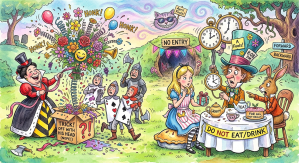
The Rabbit Hole didn’t usually feature a “Do Not Enter” sign, but today it was draped in neon orange bunting.
Alice, never one to let a sign ruin a good tumble, hopped right over it. As she drifted down, she noticed the usual jam jars and bookshelves had been replaced by floating rubber chickens and mirrors that showed her wearing a very tall, purple top hat.
“Curiouser and curiouser,” she remarked, reaching out to touch a chicken. It let out a loud honk that propelled her downward at twice the speed.
The Un-April Tea Party
When Alice finally landed—not on a heap of sticks and leaves, but on a giant custard pie—she found the March Hare and the Mad Hatter sitting at a table shaped like a question mark.
“No room! No room!” the Hatter shouted, while gesturing wildly to three dozen empty chairs.
“There’s plenty of room,” Alice said, wiping a dollop of lemon curd from her pinafore. She sat down and reached for a teapot.
The March Hare leaned in, his whiskers twitching. “I wouldn’t do that if I were you. It’s April First, you know. The day when the logic of Wonderland actually tries to make sense.”
Alice paused. “Make sense? But that sounds lovely.”
“It’s a nightmare!” the Hatter wailed. He picked up his pocket watch. “Look! It’s actually telling the time! It says it’s eight minutes past two. How am I supposed to live under such rigid conditions?”
The Queen’s “Mercy”
A bugle sounded, and the Queen of Hearts marched onto the lawn. Her guards, the playing cards, were all walking backward.
“Off with their heads!” the Queen bellowed.
Alice braced herself, but the Queen suddenly doubled over in a fit of giggles. She pulled a silk string, and instead of an executioner’s axe, a giant bouquet of trick-flowers popped out of the ground, spraying the crowd with sparkling grape juice.
“April Fools!” the Queen shrieked, slapping her knee. “I’m not beheading anyone today. Instead, I’m sentencing you all to… a very sensible nap!
The cards groaned. A sensible nap was the most boring thing a Wonderland resident could imagine.
The Cheshire Grin
Alice felt a familiar tickle of whiskers against her ear. The Cheshire Cat appeared, or rather, his stripes appeared first, followed by a pair of sunglasses.
“Why the long face, Alice?” the Cat purred. “Don’t you like the holiday?”
“It’s all very confusing,” Alice sighed. “If the Queen is being nice, and the Hatter is being punctual, then who is being silly?”
The Cat’s grin grew until it took up half the sky. “You are, of course. You came to a world of nonsense looking for a bit of order, and you found it on the one day we don’t want it.”
He handed her a small, wrapped gift. “Open it.”
Alice carefully untied the ribbon. Inside was a small mirror. When she looked into it, her reflection didn’t look like her at all—it was a white rabbit, looking at its watch and muttering about being late.
“April Fools,” the reflection whispered.
Alice blinked, and suddenly the tea party, the Queen, and the Cat vanished. She was back on the grassy bank, her sister shaking her shoulder.
“Wake up, Alice! You’ve been dreaming.”
Alice sat up, rubbing her eyes. She reached into her pocket and felt something cold and hard. She pulled it out: a tiny, silver whistle shaped like a rubber chicken.
She looked at her sister and smiled. “I think the joke’s on me.”
 

Tags: , ,

The Day the Postbox Refused Certain Letters

The Day the Postbox Refused Certain Letters

The Day the Postbox Refused Certain Letters

In Ballykillduff, the postbox had always been green, dependable, and mildly overlooked.

It stood beside the village square, not far from the fountain that sometimes remembered things before they happened, and within polite nodding distance of Mrs Flannery’s shop, where news was sold in equal measure with bread.

No one had ever thought much about the postbox.

Until the morning it began to think about them.


It started, as such things often do, with a small and easily dismissed inconvenience.

Mrs Flannery approached with a letter held between two fingers, as though it might yet change its mind.

“I’ve written to my sister,” she said aloud, because she often did that. “Perfectly reasonable. Perfectly timely.”

She slid the letter into the slot.

The postbox accepted it.

Then paused.

Then, with a quiet and distinctly deliberate motion…

returned it.

The envelope slipped back out, as neat as you please, and landed against her shoe.

Mrs Flannery frowned.

“Well now,” she said. “That’s… unnecessary.”

She tried again.

The postbox tried again.

The result was identical.


By mid-morning, the matter had gathered an audience.

Mr Hanrahan, who dealt in railway timings and therefore trusted systems, posted a form.

The postbox accepted it instantly.

“Functional,” he declared, with satisfaction.

A child posted a drawing of a duck wearing a hat.

The postbox hummed, a soft, approving sound, and swallowed it whole.

“Encouraging,” said Mrs Flannery, who was still holding her letter.


It was Mr Byrne the baker who noticed the sign.

“Ah now,” he said, squinting. “That wasn’t there yesterday.”

There, affixed just beneath the slot, in careful, looping handwriting, was a notice.

NO LETTERS OF REGRET
NO APOLOGIES WRITTEN TOO LATE
NO MESSAGES YOU SHOULD HAVE SAID YEARS AGO

The square fell into a thoughtful sort of silence.

“Well that’s ridiculous,” said Mrs Flannery.

And yet… she did not try to post the letter again.


By afternoon, the situation had worsened in a most peculiar way.

Letters that had been refused did not simply go home.

They lingered.

They gathered.

They rested against the base of the postbox, or perched along the fountain’s edge, or leaned thoughtfully against the green-painted bench.

And when the evening came…

they began to murmur.

Not loudly.

Not enough to cause alarm.

But enough that if one stood still—very still—and listened…

one might hear:

“I should have said it then…”
“It wasn’t meant like that…”
“I thought there would be more time…”

The square, which had always been a place of passing, became a place of pause.


Alice arrived just as the light began to soften.

She had been walking without particular direction, which in Ballykillduff often meant she arrived exactly where she was meant to be.

She regarded the postbox.

The sign.

The small congregation of unsent words.

And then, quite sensibly, she listened.

“Oh,” she said, after a moment.

“That’s rather clear.”


“What is?” asked Mr Hanrahan.

“It isn’t broken,” said Alice. “It’s being particular.”

“That’s worse,” said Mrs Flannery.


Alice walked slowly around the postbox, as though it might reveal something from the correct angle.

“It’s not refusing letters,” she said.
“It’s refusing timing.”

“I beg your pardon?” said Mr Byrne.

“These,” said Alice, gesturing gently to the scattered envelopes, “are all things meant for yesterday. Or last year. Or a moment that has already gone on without them.”

“Well that’s what letters are for,” said Mrs Flannery.

“Sometimes,” said Alice. “But not when they are trying to travel backwards.”


That night, the murmuring grew clearer.

Not louder.

But more certain.

The letters did not accuse.

They did not demand.

They simply… repeated themselves, as though waiting to be heard by the correct moment.

Which, unfortunately, had already passed.


The following morning, Ballykillduff was quieter than usual.

Not empty.

Not unhappy.

Just… aware.

Mrs Flannery opened her shop and said, to no one in particular:

“I should have told her I missed her.”

Then, after a pause, she added:

“I still do.”

Mr Byrne, weighing out flour, said:

“I was wrong about the oven.”

And then, after another pause:

“I know that now.”

Mr Hanrahan stood by the station and said:

“That wasn’t necessary. What I said.”

And though no one answered, the air itself seemed to acknowledge the effort.


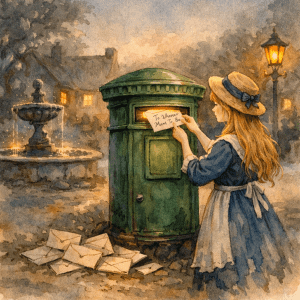
Alice returned to the square carrying a single envelope.

It was plain.

Unaddressed, at first glance.

But as she turned it in her hands, the words revealed themselves—not written so much as decided.

To Whoever I Was Meant To Be

She considered the postbox.

The sign.

The quiet gathering of letters that no longer whispered quite so urgently.

“Well,” she said, “this doesn’t seem to belong to yesterday.”


She stepped forward and placed the envelope into the slot.

The postbox did not hesitate.

It accepted the letter.

Completely.

Without pause.


For a moment, nothing happened.

Which, in Ballykillduff, was often the beginning of something.


Over the next few days, the changes were small.

So small they might have gone unnoticed, had the village not been paying attention.

People spoke more.

Not loudly.

Not dramatically.

But at the right time.

A hand on a shoulder.

A word said before it became too late to say it easily.

A laugh shared instead of saved.

An apology given before it required a letter.


The pile of unsent letters grew thinner.

Not because they were posted.

But because they were no longer needed.


One morning, the sign changed.

No one saw it happen.

No one heard it being written.

But there it was, in the same careful hand:

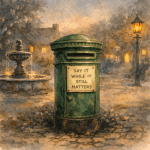
SAY IT WHILE IT STILL MATTERS


The postbox returned to its usual stillness.

Green.

Dependable.

Mildly overlooked.


But from time to time, if one posted a letter that seemed… slightly delayed…

it might pause.

Just briefly.

As though considering.


And if you stood very quietly beside it—

not always, but sometimes—

you might hear a soft, thoughtful hum.

Not disapproving.

Not quite approving.

Just… attentive.

As though the postbox, having once learned the difference,

had no intention of forgetting it again.


Tags:

Tea is a serious business

Tea is a serious business
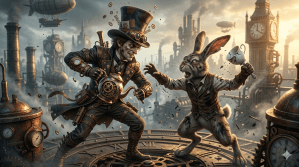
“Tea, my dear sir, is a serious business!” Tarrant Hightopp, the Mad Hatter, bellowed, his voice echoing over the brass and steam. He was a whirl of tweed and copper gears, balanced on a massive clock face that marked the heart of the great Steampunk London. His goggles were pushed up into his perpetually patched top hat, but his eyes, a glinting, unpredictable green, were narrowed with focused madness.
Facing him, claws out and his waistcoat already shredded, was the March Hare, also known as Thackery Earwicket. He was a creature of kinetic energy, his fur matted with coal dust, holding a broken porcelain cup like a jagged weapon.
Their disagreement, as it so often was, was existential. Thackery had just suggested that a proper five-second steeping time for the Earl Grey-9000 was sufficient. To Tarrant, who had spent the last hour meticulously fine-tuning his custom-built, dual-spout ‘Goliath’ teapot, this was nothing short of blasphemy.
“You speak of SACRILEGE!” Tarrant roared, swinging the Goliath. The massive, brass teapot, a wonder of miniature clockwork, hummed with internal energy, its pressure gauges twitching. “This is not merely tea, Thackery! This is ‘Chrono-Brew’! Every drop must be synchronized with the precise oscillation of the central chronometer!”
“Gah! More of your clockwork claptrap!” Thackery spat, his long ears twitching in fury. He feinted left, then lunged right, the jagged edge of his teacup narrowly missing the Hatter’s coat. “I say five seconds! If you can’t feel the brew, you don’t deserve the brew!”
“Feel it? I designed it to operate at exactly five-hundred and twelve milliseconds past the optimal temperature coefficient for maximum flavor-to-gear ratio!” Tarrant parried Thackery’s strike with the snout of the Goliath, sending a small spray of water into the air.
Below them, the city pulsed. Massive airships, looking like barnacled metal whales, slipped through the smoky sky. Steam-driven factories, a forest of chimneys, chugged out black plumes. Towering clock towers, including a familiar, but far more complex, Big Ben, loomed in the haze. The entire landscape was a symphony of brass, copper, and iron.
Thackery threw a broken, steaming saucer, which Tarrant dodged with a flourish that was half ballet, half clumsy panic. “It’s about the spirit, Tarrant! The untamed, wild essence of the leaf!”
“Untamed! Hah!” The Hatter used his boots, outfitted with specialized gear-traction pads, to secure his footing on the clockwork floor. He pulled a small lever on the side of the teapot. “Your ‘untamed’ approach produces a chaotic swill! Witness the power of true, calculated, controlled flavor!”
The Goliath’s gears whirred with new intensity. A tiny puff of steam, precise and controlled, burst from the main spout, creating a small, smoky cloud that briefly obscured the battle.
The March Hare didn’t wait. He crashed through the steam, a blur of fur and rage. “CALCULATED? It tastes like industrial lubricant!”
Their fight wasn’t a duel of death, but of conviction. A thousand tiny pieces of metal, a million gears, and an endless stream of hot water were their weapons and their shield. In the heart of a city built on order and power, two masters of the absurd were locked in a perfect, chaotic dance, proving that even in a world of gears and steel, the most important battle was always over the perfect cup of tea. Their shouts were swallowed by the deep, rhythmic groan of the city’s machinery, but their madness was the only thing truly alive.


Tags: , , ,

Alice and the Quiet Thing Beneath Wonderland

Alice and the Quiet Thing Beneath Wonderland

Alice and the Quiet Thing Beneath Wonderland

Alice did not remember falling.

That was the first wrongness.

There was no rush of wind, no tumbling of teacups, no curious shelves of marmalade and maps. No polite gravity conducting her downward like a well-mannered host.

Instead, she was simply there.

Standing.

Waiting.

Wonderland had received her without ceremony.


At first glance, it seemed unchanged.

The trees still leaned at uncertain angles, as though listening to secrets beneath the soil. The air still shimmered faintly, like a thought not quite finished. A path still wound forward in the manner of paths that had not yet decided where they led.

But nothing greeted her.

No White Rabbit.
No chatter.
No argument.

Even the silence felt… deliberate.

Alice took a step forward.

The ground did not echo.


“Hallo?” she called.

Her voice did not return.

Not even incorrectly.


She walked.

And as she walked, she noticed something most unsettling of all:

Everything was almost right.

The flowers were in bloom—but none turned to look at her.
A teacup sat upon a table—but the tea within it did not ripple.
A signpost pointed in three directions—but the words had been carefully erased, as though they had once said something important and someone had decided they should not say it anymore.

Alice reached out and touched the sign.

It was warm.


“You should not read things that have been forgotten.”

The voice came from nowhere.

And everywhere.

Alice turned.

At first, she thought it was the Cheshire Cat—but no.

This thing did not grin.

It had no face.

Only a suggestion of one, like a memory rubbed thin.

“I didn’t read anything,” Alice said.

“That is why you are still here,” said the thing.


Alice took a step back.

“Where is everyone?”

The thing did not answer immediately.

Instead, the air seemed to shift, as though it were deciding how much truth could be allowed.

“They are where they were always going,” it said at last.

“That is not an answer.”

“It is the only answer left.”


Alice turned and began to walk faster.

The path resisted.

Not visibly—nothing so obvious—but it lengthened in small, unnoticeable ways. The distance between her and the next tree stretched like a thought being delayed.

She broke into a run.

And then she saw it.

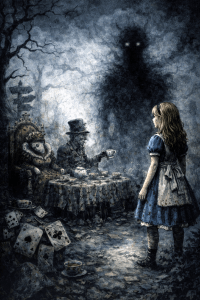
The tea party.


The table was laid.

The cups were filled.

The chairs were occupied.

But the Mad Hatter, the March Hare, and the Dormouse sat perfectly still, as though waiting for a cue that had never come.

Alice approached slowly.

“Hatter?” she said.

He did not respond.

She reached out and touched his sleeve.

It crumbled.

Not into dust—but into something softer. Lighter.

Like ash that had once been laughter.


“No,” Alice whispered.

She stepped back.

The March Hare’s teacup slipped from his fingers, though he had not moved.

It hit the table.

And made no sound.


“They spoke too much,” said the voice again.

Alice turned sharply.

The faceless thing stood closer now.

“They filled the air with contradictions. Questions. Noise. It was… inefficient.”

“Inefficient?” Alice said, her voice trembling. “That’s what Wonderland is.”

“It was,” said the thing.


Alice shook her head.

“No. No, this is wrong. This is all wrong.”

“Yes,” said the thing, almost gently. “That is why it had to be corrected.”


Alice ran.

She ran through the silent woods, past flowers that would not speak, past streams that refused to flow, past clocks that had stopped at times that meant nothing at all.

And at last, she reached the Queen’s court.


The Queen of Hearts sat upon her throne.

Perfectly composed.

Perfectly still.

Her crown did not tremble. Her voice did not rage. Her eyes did not burn.

Alice approached slowly.

“Your Majesty?” she said.

The Queen did not answer.

Alice stepped closer.

And closer.

And then she saw—

The Queen was not breathing.


“She was the last,” said the thing.

Alice did not turn this time.

“Why?” she whispered.

“Because she could not be predicted,” it said. “And what cannot be predicted cannot be permitted.”


Alice clenched her hands.

“This place is meant to be unpredictable,” she said. “It’s meant to be strange, and wild, and… and alive.”

The thing was silent for a moment.

Then it said:

“And yet, you came back.”


Alice froze.

“I… of course I did.”

“Why?”

Alice hesitated.

Because it mattered.
Because it was hers.
Because somewhere in all the nonsense, there had been meaning.

“I don’t know,” she said.


The thing moved closer.

And now, for the first time, Alice felt it looking at her.

Truly looking.

“You do not belong here anymore,” it said.


The words settled into the air like a verdict.

Alice opened her mouth to protest—but nothing came.

Because somewhere, quietly, terribly—

She knew it was true.


“You grew,” said the thing.
“You learned.”
“You began to expect things to make sense.”

Alice shook her head weakly.

“I didn’t mean to.”

“No one ever does.”


The silence deepened.

Alice looked around at the stillness. The absence. The careful, suffocating order of it all.

“What happens now?” she asked.


The thing did not hesitate.

“Now,” it said, “you will leave.”

“And Wonderland?”


For the first time, something like hesitation entered the thing’s voice.

“It will remain,” it said.

“Like this?”

“Yes.”


Alice closed her eyes.

And in that moment, she remembered—

The nonsense.

The arguments.
The songs.
The impossible, ridiculous, glorious chaos of it all.

She remembered a place where nothing made sense—and therefore everything mattered.


When she opened her eyes again, they were no longer afraid.

“You’re wrong,” she said.


The thing stilled.


Alice stepped forward.

“You think nonsense is noise,” she said. “But it isn’t. It’s… space. It’s room for things to be.”

The air trembled.

“You removed everything that couldn’t be predicted,” she continued. “But that’s where life lives.”


The thing shifted.

Uncertain.

For the first time.


Alice took another step.

“And you forgot something very important.”

“What is that?”


Alice smiled.

Not brightly.

Not cheerfully.

But with something fierce and fragile and terribly human.


“That nonsense doesn’t disappear,” she said.

“It waits.”


And somewhere—

Very far away—

A teacup rattled.


The Queen’s fingers twitched.


The wind, which had forgotten how to move, made a small and uncertain attempt.


The thing recoiled.

“What have you done?”


Alice said nothing.

Because she had done nothing at all.


She had simply remembered.


And Wonderland—

very slowly—

began to remember itself.


Tags:

Alice and the Catastrophe of Sensible Behaviour

Alice and the Catastrophe of Sensible Behaviour

Alice and the Catastrophe of Sensible Behaviour

Alice had only just sat down beneath a perfectly unreasonable tree (which insisted it was a hatstand on alternate Tuesdays) when something most alarming occurred.

Nothing.

Absolutely nothing.

For nearly three seconds.

Alice leapt to her feet at once.

“This will never do,” she said. “If things begin making sense, Wonderland may collapse into a pamphlet.”

At this, the tree-hatstand shuddered and dropped three teaspoons, a cucumber, and a mildly offended pigeon.

“Too late,” said the pigeon. “I’ve been logical all morning.”

Alice gasped. “How dreadful! We must find the source of it before everything becomes tidy.”


She had not gone ten steps before encountering the White Rabbit, who was standing very still and consulting a watch that ticked in complete agreement with itself.

“No contradictions,” he murmured happily. “No paradoxes. Everything precisely where it ought to be!”

Alice seized him by the ears (politely).

“This is an emergency,” she said. “Your watch is behaving.”

The Rabbit blinked. “Well yes, that is generally the point of—”

“Exactly!” cried Alice. “Utter disaster!”


They hurried along a path that refused to twist (which Alice found extremely suspicious) until they reached the Mad Hatter, who was sitting at a table drinking tea in a perfectly ordinary manner.

He lifted his cup.

He sipped.

He put it down again.

Alice staggered backward.

“Hatter,” she whispered, “have you lost your mind?”

“No,” said the Hatter calmly. “I tidied it.”

“You tidied it?”

“Yes. Alphabetised my thoughts. Removed all unnecessary nonsense. Very freeing.”

At this, a teacup fainted.

Alice turned to the March Hare, who was sitting beside him reading a book titled Reasonable Behaviour and Its Consequences.

“Do something absurd at once!” Alice demanded.

The Hare adjusted his spectacles. “I would prefer not to.”

Alice clutched her head. “We are doomed.”


Just then, the sky folded itself into thirds (as skies do when they are worried) and the Cheshire Cat appeared, though only his eyebrows had arrived on time.

“Well,” said the eyebrows, “this looks serious.”

“The nonsense is disappearing!” Alice cried. “Everything is becoming sensible!”

The rest of the Cat slowly assembled itself, piece by deliberate piece.

“How unfortunate,” he said. “Without nonsense, I shall have to make points.”

Everyone shuddered.


They made their way to the Queen of Hearts, who was sitting upon her throne conducting a very calm and well-reasoned discussion about garden maintenance.

“No executions today,” she was saying. “Let us consider everyone’s perspective.”

Alice burst into tears.

“Your Majesty!” she cried. “You must do something unreasonable at once!”

The Queen frowned. “Why?”

“Because if you don’t, Wonderland will become… normal!”

A silence fell.

Even the cards stopped shuffling themselves.

Normal.

The word echoed about like a well-behaved echo.


At last, a small voice spoke.

It was the Dormouse, who had been asleep for so long that he had forgotten how to wake up properly.

“Perhaps,” he said, “we have simply run out of nonsense.”

“Impossible!” cried Alice.

“Not at all,” said the Cheshire Cat. “Nonsense must be replenished. It does not grow on trees—”

The tree-hatstand coughed politely.

“—well, not reliably.”


Alice thought very hard.

Then, quite suddenly, she stood upon the Queen’s throne, balanced a teapot upon her head, declared herself to be “The Duchess of Unfinished Sandwiches,” and began reciting the multiplication table backwards in rhymes involving bananas.

The effect was immediate.

The sky unfolded itself with a snap.

The Hatter dropped his teacup and began arguing with it.

The Rabbit’s watch started running sideways.

The Queen leapt to her feet.

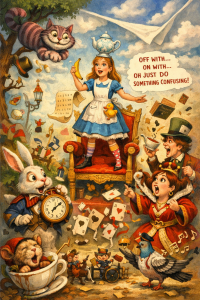
“OFF WITH—no, wait—ON WITH—no—OH JUST DO SOMETHING CONFUSING!”

The cards burst into delighted chaos.

The March Hare threw his book into a passing metaphor.

And the pigeon applauded so enthusiastically it became a small orchestra.


The Cheshire Cat grinned.

“Ah,” he said. “Balance restored.”

Alice climbed down, slightly out of breath.

“That was close,” she said.

“Yes,” said the Cat. “Another minute of sense and we might all have become useful.”

Alice shuddered.

“I should hate that.”


And so, with nonsense safely reinstated, Wonderland returned to its usual state of cheerful confusion.

Which, as Alice later remarked, was exactly as it ought not to be—and therefore, perfectly correct.


Tags: , , ,

The rabbit hole didn’t lead to a tea party this time

The rabbit hole didn’t lead to a tea party this time
The rabbit hole didn’t lead to a tea party this time.
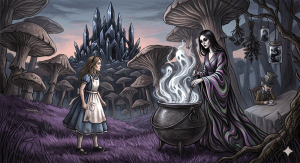
As Alice tumbled through the dark, she didn’t pass rocking chairs or bookshelves. Instead, she brushed past hanging bundles of dried hemlock and jars of preserved nightmares. When she finally landed, the grass wasn’t green; it was a bruised purple, and the air smelled of ozone and singed sugar.
The Shadow Over Wonderland
Wonderland had changed. The Queen of Hearts was gone, replaced by something much more calculated. High atop the mushroom forest sat a castle made of jagged obsidian. There lived The Witch of the Withered Rose.
She didn’t want heads; she wanted stories. She fed on the whimsy of others until they were nothing but hollow shells. The Mad Hatter sat in a corner, staring at a blank teacup, his madness replaced by a terrifying, quiet sanity.
The Encounter
Alice wandered into the clearing of the Great Oak, where the Witch stood waiting. She wasn’t green or warty; she was tall, draped in silk the color of an oil slick, with eyes that looked like solar eclipses.
“You’re late, Alice,” the Witch purred, stirring a cauldron that simmered with silver smoke. “I’ve already bottled the Cheshire Cat’s grin. It makes a lovely nightlight.”
“I don’t think I like your decorating taste,” Alice said, her voice trembling only slightly. “And I’d like my friends back, if it’s all the same to you.”
The Witch laughed, a sound like glass breaking. “In this world, Alice, ‘curiouser and curiouser’ is a death sentence. Give me your imagination, and I’ll let you go back to your boring parlor in London.”
The Twist of Logic
Alice looked at the cauldron. She remembered that in Wonderland, things were only as powerful as you believed them to be.
“You’re not a witch,” Alice said boldly, stepping forward. “You’re just a bad habit. You’re the feeling of growing up and forgetting how to play.”
The Witch shrieked, her obsidian form flickering. “I am the end of dreams!”
“No,” Alice countered, “You’re just a very tall, very grumpy woman in a dress that needs a good wash. And since this is my dream, I think it’s time for a change in the weather.”
Alice didn’t use a sword or magic. She simply imagined the sun. Not just a normal sun, but a sun made of lemon drops and laughter.
The Result:
 * The obsidian castle melted into a giant puddle of blackberry jam.
 * The Witch shrank until she was no bigger than a thimble, scurrying away into the roots of a tree.
 * The Cheshire Cat’s grin popped out of its jar and reattached itself to the air with a satisfied pop.
Alice sat up in the meadow back home, the smell of damp grass filling her lungs. She looked down and noticed a single, withered black rose petal tucked into her apron. She smiled and tossed it into the wind.
 

Tags: ,

Alice and the Jellyfish That Preferred Dice.

Alice and the Jellyfish That Preferred Dice.

****************************************
Chapter One
It began, as many things in Ballykillduff do, with something that ought not to have been in the square.
Alice noticed it first.
She had been sitting on the familiar stone bench—just beneath the trees that whispered opinions when the wind was in the mood—when something softly plopped onto the cobbles.
Not a loud plop.
Not even a particularly confident one.
More of a polite uncertainty of a plop.
Alice turned.
There, beside the green post box (which was behaving itself for once), lay a jellyfish.
Now, this would have been surprising enough.
But what made it considerably worse was that the jellyfish was:
  • Nowhere near the sea
  • Glowing faintly like a lantern that had forgotten its purpose
  • Holding a pair of dice
Not near dice.
Not next to dice.
Holding them.
With a sort of thoughtful wobble.
“Good morning,” said Alice, because it seemed the sort of thing one ought to say to a landlocked philosophical jellyfish.
The jellyfish pulsed gently.
“Statistically unlikely,” it replied.
Alice blinked.
“I beg your pardon?”
“Your greeting,” said the jellyfish, rotating slightly as though considering her from several emotional angles. “Given the conditions, it is improbable that this is a good morning.”
Alice considered this.
“Yes,” she said. “But it’s the sort of thing one says anyway.”
“Ah,” said the jellyfish. “A customary inaccuracy. I approve.”
By now, Ballykillduff had begun to notice.
Seamus appeared first, carrying a cup of tea that he had no intention of spilling, despite the circumstances.
Behind him came Mrs Kavanagh, who believed firmly that anything unusual could be improved with a shawl.
Jimmy McGroggan arrived shortly after, already building something with springs.
“What have we got?” said Seamus.
“A jellyfish,” said Alice.
“Inland,” said Seamus.
“With dice,” added Alice.
Seamus nodded.
“Right so.”
The jellyfish raised its dice.
“These,” it said, “are unsatisfactory.”
“Why?” asked Alice.
“They behave too predictably.”
Alice stared.
“I thought dice were supposed to be unpredictable.”
The jellyfish gave a soft, luminous sigh.
“They are random, not interesting.”
This caused Jimmy McGroggan to drop three springs and pick them up again in a different order.
“That,” he said, “is a very important distinction.”
The jellyfish rolled the dice.
They landed on the cobbles.
Six and two.
“Observe,” said the jellyfish. “An outcome. Entirely reasonable. Entirely dull.”
It rolled again.
Three and four.
“Still dull.”
Again.
Five and one.
“Endlessly obedient to expectation.”
Alice crouched beside it.
“What would you prefer them to do?”
The jellyfish paused.
Then, quite carefully, it said:
“I would like them to refuse.”
This caused a silence.
Even Ballykillduff, which had seen rivers forget their destinations and weather pause for reflection, took a moment.
“Refuse what?” asked Alice.
“To be numbers,” said the jellyfish simply.
Jimmy McGroggan’s eyes lit up in a way that suggested future complications.
“I might have something for that,” he said.
From a pocket that was definitely not large enough, he produced a small contraption consisting of:
  • A clock face with no hands
  • A teaspoon that pointed accusingly
  • A tiny bell that rang when ignored
He attached it—very gently—to one of the dice.
“Now,” said Jimmy, stepping back, “roll it.”
The jellyfish rolled the altered die.
It landed.
Paused.
Then… instead of showing a number…
It displayed:
“Perhaps.”
The entire square leaned closer.
The jellyfish trembled with delight.
“Yes,” it whispered. “Yes, that is better.”
They rolled again.
The second die—untouched—showed a five.
The altered one now read:
“Ask Again Later.”
Mrs Kavanagh sat down.
“I don’t like it,” she said, though she clearly did.
Seamus sipped his tea.
“I do,” he said. “It’s honest.”
Alice smiled.
“But what happens when both dice refuse?” she asked.
The jellyfish considered this very seriously.
Then it rolled them both.
They landed together.
For a moment, nothing happened.
Then—
The first die read:
“Why Not?”
The second read:
“Go On So.”
At this, something quite extraordinary occurred.
The air in Ballykillduff shifted.
Not dramatically.
Not loudly.
But decisively.
Somewhere, a decision that had been waiting for years quietly made itself.
A door that had never opened… did.
A letter that had never been sent… found its way.
And Jimmy McGroggan’s unfinished invention… finished itself, just to see how it felt.
The jellyfish glowed brighter.
“This,” it said softly, “is a much more interesting universe.”
Alice nodded.
“Yes,” she said. “It does seem to have improved slightly.”
“Will you stay?” she asked.
The jellyfish floated a little higher, its edges shimmering like thought itself.
“No,” it said. “I drift.”
“Where to?”
The jellyfish rolled its dice one final time.
They landed.
Together.
Gently.
They read:
“Somewhere Else.”
And with that—
It lifted into the air.
Not quickly.
Not dramatically.
Just enough.
And then, like a thought one almost remembers…
It was gone.
Alice looked down at the cobbles.
The dice remained.
She picked them up.
Turned them in her hands.
Rolled them once.
They landed at her feet.
They read:
“Continue.”
Alice smiled.
And in Ballykillduff—
that was quite enough to begin another story.
 

Tags: , ,

Reflections of Alice: A Tale of Two Selves.

Reflections of Alice: A Tale of Two Selves.

An original tale inspired by Lewis Carroll’s

Alice’s Adventures in Wonderland.

The mirror did not hang on a wall, nor did it rest upon a stand. It floated in the middle of the Tulgey Wood, suspended in the air like a bubble made of silver glass. Alice stopped, adjusting the skirt of her dress. She had been chasing the White Rabbit—or perhaps he had been chasing her; directions were notoriously unreliable in these parts—when she stumbled upon it.
She approached cautiously. She knew better than to touch strange objects without checking for labels reading DRINK ME or DO NOT TOUCH, but the mirror seemed harmless enough. It reflected the wood behind her: the twisted trees, the oversized mushrooms, the path that wound like a confused snake.
And it reflected Alice.
But the Alice in the mirror did not stop when Alice stopped.
The reflection stepped forward. There was a sound like a sharp intake of breath, a pop of pressure, and the girl in the glass stepped out of the frame. She landed on the moss with a soft thud, dusting off her hands.
Alice blinked. She rubbed her eyes and blinked again.
The newcomer stood before her. She wore the same blue dress with the same white apron. She had the same golden hair tied with the same black ribbon. But where Alice’s hair was parted on the left, this girl’s was parted on the right. Where Alice’s apron pocket was on her left hip, this girl’s was on the right.
“Good afternoon,” said the double. Her voice was Alice’s, but the cadence was slightly off, like a song played on a piano that had been tuned a fraction too high.
“Good afternoon,” Alice replied, instinctively curtsying. “Or perhaps it is morning. Time is difficult to keep track of here.”
“It is exactly half-past nonsense,” the double said. She did not curtsy. Instead, she tilted her head, examining Alice with a critical eye. “You look terribly confused. It suits you.”
“I am not confused,” Alice said, drawing herself up to her full height (which was currently three feet and two inches). “I am merely… observing. Who are you?”
“I am Alice,” the double said simply.
“No,” Alice countered, feeling a surge of frustration. “I am Alice. You cannot be Alice. There is only one of me. I am quite sure of it.”
“Are you?” The double walked around her, inspecting her from behind. “How do you know? Have you checked your labels? Have you tested your memory? For all you know, you are the reflection, and I am the original.”
Alice felt a cold shiver run down her spine, unrelated to the temperature of the wood. “I remember falling down the rabbit hole. I remember the tea party. I remember the Queen’s croquet ground.”
“I remember those too,” the double said, plucking a flower from a nearby bush. She smelled it and sneezed. “But I remember them differently. In my memory, the Hatter was polite. In my memory, the Queen was kind. In my memory, I never cried in the Pool of Tears.”
Alice stiffened. “I did not cry. Well, only a little. It was a very large pool.”
“You cry when you are frightened,” the double said. “I do not. I find that makes things much easier.”
The Cheshire Cat appeared then, fading in branch by branch upon a bough above them. He grinned his wide, impossible grin.
“Two Alices?” the Cat purred, his tail flicking. “How curious. Usually, one is quite enough to cause trouble. Two might cause a paradox.”
“Which one is real, Cat?” asked the double, looking up.
“Real?” The Cat chuckled. “In this wood, reality is a matter of opinion. You are both real enough to be lost. You are both real enough to be found. It depends on which way you’re walking.”
“I walk forward,” said Alice.
“I walk backward,” said the double. “It saves time on the return journey.”
Alice frowned. “That doesn’t make any sense.”
“It makes perfect sense in the Looking-Glass,” the double said. “I come from the other side of the glass. Where everything is opposite. You are polite; I am blunt. You ask permission; I take ownership. You wonder what the world is; I tell the world what I am.”
Alice looked at her double. She saw the set of her jaw, the confidence in her stance. It was terrifying, but also… intriguing. How nice it would be, Alice thought, to not be afraid of the Queen. To not worry about saying the wrong thing. To simply *be*.
“If you are the opposite,” Alice said slowly, “then you must be everything I am not.”
“Precisely,” said the double. “Which means if we touch, we might cancel each other out. Like adding a number to its negative. Zero.”
“Or,” said the Cat, “you might multiply. Infinity is rather messier than zero.”
A trumpet blast sounded in the distance. The ground trembled slightly.
“The Queen!” Alice gasped, her heart leaping into her throat. “We must hide.”
“Why?” asked the double. “I have done nothing wrong.”
“She cuts off heads!”
“Let her try,” said the double. She smoothed her apron and stood squarely in the path.
The Queen of Hearts stormed into the clearing, a procession of playing cards trailing behind her. She held a flamingo under her arm and glared at the pair.
“What is this?” the Queen bellowed. “Two of them? Is this a trick? A conspiracy? Why are there two Alices?”
“She is an impostor!” Alice cried, pointing at her double.
“She is a copy!” the double cried, pointing at Alice.
“Silence!” The Queen marched up to them, peering closely at their faces. She grabbed Alice’s chin, then the double’s chin. “Same nose. Same eyes. Same annoying habit of talking back.”
“I do not talk back,” Alice said.
“I talk back,” the double said. “And I enjoy it.”
The Queen grinned, a terrifying expression. “I like this one better. She has spirit. Off with the quiet one’s head!”
The Card soldiers raised their axes. Alice squeezed her eyes shut.
“Wait!” shouted the double.
The Queen paused. “Well? Do you wish to take her place?”
“No,” said the double. “But if you cut off her head, you cut off mine. We are reflections. You cannot have one without the other. If she disappears, I disappear. If I disappear, she disappears. Do you want no Alice at all, Your Majesty?”
The Queen frowned. She tapped her foot. The flamingo squawked. “A riddle. I hate riddles. They ruin the execution schedule.”
“It is not a riddle,” said the double. “It is logic. Even you must follow logic, or the game falls apart.”
The Queen huffed. “Fine. Keep your heads. Both of them. It’s too much trouble to sort out. Move along! All of you!”
The procession marched on, leaving the three of them in the clearing.
Alice opened her eyes. She was still whole. She looked at her double.
“You saved me,” Alice said.
“You saved yourself,” the double corrected. “I am you. My courage is your courage. You just left it behind in the glass.”
The double walked back toward the floating mirror. The surface rippled like water.
“Where are you going?” Alice asked.
“Back,” said the double. “I belong on the other side. But you… you should visit sometime. Bring your courage with you. It fits better here.”
She stepped into the mirror. For a moment, she stood on the other side, waving. Then the silver surface hardened, becoming just a glass pane again. Alice looked into it. She saw only herself.
But when she looked closer, she noticed something. Her hair was still parted on the left. Her pocket was still on the left. But her eyes… her eyes held a new steadiness. The fear was still there, but it was smaller.
“Curiouser and curiouser,” Alice whispered.
The Cheshire Cat faded away, leaving only his grin hanging in the air. “Infinity,” he murmured from nowhere. “Much better than zero.”
Alice turned and walked down the path. She did not check for labels. She did not wonder if she was dreaming. She simply walked forward, knowing that somewhere, in the glass, another Alice was walking backward, and that was perfectly alright.
 

Tags: , , , ,

The Fête That Was Never Announced

The Fête That Was Never Announced


Under the White Bunting

No one tied the bunting there.
It simply leaned from post to post
As though the wind had practised.

No chalkboard named the hour.
No bell rehearsed the call.
And yet by noon
The quarry field remembered us.

Tables stood
With lace that smelt of careful years,
Cakes waited
Under domes of patient glass,
Jam jars caught the light
Like small, obedient suns.

The tombola drum
Turned with its wooden sigh —
Hope in a circle.

Children ran before the rules,
Dogs disobeyed with confidence,
Tea was poured
As if it always had been.

And overhead
The bunting held its breath.

Not black.
Not bright.

Only listening.

A coin rolled.
A chair wavered.
A praise paused
On the edge of pride.

These were the fireworks.

Not flame —
But inclination.

Not thunder —
But reflex.

In the smallest space
Between falling and reaching
A village chose itself again.

By dusk
The bunting had settled
Into white.

The mirror said nothing.
The field resumed its grass.
The wind untied what it had tied.

Tomorrow
There would be no trace
Except doors opening
A fraction sooner.

And somewhere,
Folded into the quiet of the land,
The Fête would wait —

Unadvertised,
Unforgotten,
Watching
For the colour of the sky.

Epilogue: The One Who Watched

They did not notice her at first.

She stood where the stone wall dips,
Where daisies lean
And lantern light does not quite reach.

Her hair caught the fire’s gold
Before the fire caught her face.

She did not enter the sack race.
She did not judge the sponge.
She did not turn the tombola drum.

She watched.

When the coin rolled,
Her hand did not move.

When the chair wavered,
Her breath did —
But she did not.

She has learned, you see,
That villages must steady themselves.

The bunting above her
Had begun the afternoon undecided.

She saw the first thread pale.
She saw the second follow.

She saw Mrs Doyle’s praise
Tilt the colour toward light.

And when the mirror stood
At the field’s edge,
She did not look for herself.

She looked for the field.

Grass.
White bunting.
No ledger.

That was enough.

Later — long after the fire fell to embers —
A child would say,

“Was Alice there?”

And someone would answer,

“Of course she was.”

Because there are some gatherings
She does not begin,
Does not mend,
Does not command —

She only keeps.

And when the wind untied the bunting
And folded it back into the sky,

It brushed her shoulder
Like thanks.


You can read the full story via this LINK. Enjoy.


Tags:

The Day the Frost Blinked

The Day the Frost Blinked

February 25th, 2026 — The Day the Frost Blinked

The frost arrived late.

It did not settle in the night as frost properly should, but wandered into Ballykillduff sometime after breakfast, looking faintly apologetic and extremely decorative.

Alice noticed it first on the gate.

At precisely eleven minutes past ten, the iron latch glittered.

At twelve minutes past ten, it stopped.

At thirteen minutes past ten, it glittered again.

“It’s blinking,” Alice said calmly, which is the sort of thing one must say calmly if one wishes to be believed.

The frost had begun appearing and disappearing in polite intervals — hedge, path, rooftop, sheep — as though winter were reconsidering its position.

Alice stepped into the square. Each time the frost shimmered into existence, the air grew crisp and silver; each time it vanished, the village returned to its damp February self.

“Make up your mind,” she advised the sky.

The sky, which had been undecided all month, hesitated once more — and then, with a soft sigh, allowed the frost to remain.

Not thick.

Not harsh.

Just enough to turn the puddles into mirrors.

Alice looked down and saw not her reflection, but a faint suggestion of spring standing just behind her shoulder.

“Ah,” she said.

The frost did not blink again.

And somewhere beneath the quiet silver crust of February 25th, something green made up its mind to begin.

February 25th, 2026 — The Hat That Refused to Thaw

The frost had only just decided to behave itself in Ballykillduff when the sky coughed politely and produced a hat.

Not a rabbit.
Not a teacup.
Just a hat.

It fell with dignity, landed upright in the square, and waited.

Alice, who had already negotiated with blinking frost that morning, approached it cautiously.

The hat cleared its throat.

A moment later, the Mad Hatter unfolded himself out of it as though he had merely been stored there for convenience.

“Good morning!” he cried. “I’ve come for the Thawing!”

“We are not thawing,” Alice said firmly. “We are gently transitioning.”

“Ah,” said the Hatter, peering at the frost. “A hesitant season. Very dangerous. They tend to wobble.”

He removed a small silver teaspoon from his sleeve and began tapping the frost on the cobbles.

Ping.

A patch melted.

Ping.

A daisy appeared.

Ping.

A sheep sneezed and turned very briefly pink.

Alice caught his wrist before he could strike again.

“We’ve only just persuaded February to sit still,” she said. “If you start stirring it, we shall have daffodils arguing with snowflakes.”

The Hatter considered this gravely.

“Yes,” he agreed. “They never agree on colours.”

He placed the spoon back into his sleeve, stamped his hat once (which caused three crocuses to pop up apologetically), and looked at Alice with unusual sincerity.

“Very well. No mischief. Only observation.”

They stood together in the soft silver light, watching the frost hold its breath and spring wait its turn.

After several whole minutes of remarkable good behaviour, the Hatter leaned closer.

“Between ourselves,” he whispered, “March is terribly impatient.”

Then he folded neatly back into his hat.

The hat tipped itself.

And vanished.

The frost did not blink.

But somewhere beneath the cobbles, something giggled.


Tags: , , , ,