An original tale inspired by Lewis Carroll’s
Alice’s Adventures in Wonderland.

No one tied the bunting there.
It simply leaned from post to post
As though the wind had practised.
No chalkboard named the hour.
No bell rehearsed the call.
And yet by noon
The quarry field remembered us.
Tables stood
With lace that smelt of careful years,
Cakes waited
Under domes of patient glass,
Jam jars caught the light
Like small, obedient suns.
The tombola drum
Turned with its wooden sigh —
Hope in a circle.
Children ran before the rules,
Dogs disobeyed with confidence,
Tea was poured
As if it always had been.
And overhead
The bunting held its breath.
Not black.
Not bright.
Only listening.
A coin rolled.
A chair wavered.
A praise paused
On the edge of pride.
These were the fireworks.
Not flame —
But inclination.
Not thunder —
But reflex.
In the smallest space
Between falling and reaching
A village chose itself again.
By dusk
The bunting had settled
Into white.
The mirror said nothing.
The field resumed its grass.
The wind untied what it had tied.
Tomorrow
There would be no trace
Except doors opening
A fraction sooner.
And somewhere,
Folded into the quiet of the land,
The Fête would wait —
Unadvertised,
Unforgotten,
Watching
For the colour of the sky.
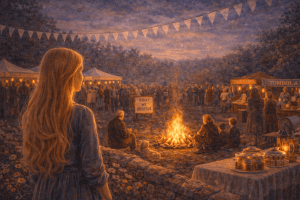
They did not notice her at first.
She stood where the stone wall dips,
Where daisies lean
And lantern light does not quite reach.
Her hair caught the fire’s gold
Before the fire caught her face.
She did not enter the sack race.
She did not judge the sponge.
She did not turn the tombola drum.
She watched.
When the coin rolled,
Her hand did not move.
When the chair wavered,
Her breath did —
But she did not.
She has learned, you see,
That villages must steady themselves.
The bunting above her
Had begun the afternoon undecided.
She saw the first thread pale.
She saw the second follow.
She saw Mrs Doyle’s praise
Tilt the colour toward light.
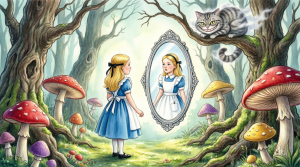
And when the mirror stood
At the field’s edge,
She did not look for herself.
She looked for the field.
Grass.
White bunting.
No ledger.
That was enough.
Later — long after the fire fell to embers —
A child would say,
“Was Alice there?”
And someone would answer,
“Of course she was.”
Because there are some gatherings
She does not begin,
Does not mend,
Does not command —
She only keeps.
And when the wind untied the bunting
And folded it back into the sky,
It brushed her shoulder
Like thanks.

You can read the full story via this LINK. Enjoy.

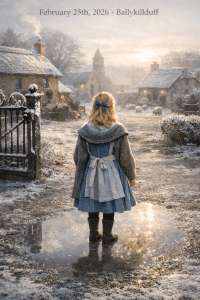
February 25th, 2026 — The Day the Frost Blinked
The frost arrived late.
It did not settle in the night as frost properly should, but wandered into Ballykillduff sometime after breakfast, looking faintly apologetic and extremely decorative.
Alice noticed it first on the gate.
At precisely eleven minutes past ten, the iron latch glittered.
At twelve minutes past ten, it stopped.
At thirteen minutes past ten, it glittered again.
“It’s blinking,” Alice said calmly, which is the sort of thing one must say calmly if one wishes to be believed.
The frost had begun appearing and disappearing in polite intervals — hedge, path, rooftop, sheep — as though winter were reconsidering its position.
Alice stepped into the square. Each time the frost shimmered into existence, the air grew crisp and silver; each time it vanished, the village returned to its damp February self.
“Make up your mind,” she advised the sky.
The sky, which had been undecided all month, hesitated once more — and then, with a soft sigh, allowed the frost to remain.
Not thick.
Not harsh.
Just enough to turn the puddles into mirrors.
Alice looked down and saw not her reflection, but a faint suggestion of spring standing just behind her shoulder.
“Ah,” she said.
The frost did not blink again.
And somewhere beneath the quiet silver crust of February 25th, something green made up its mind to begin.

February 25th, 2026 — The Hat That Refused to Thaw
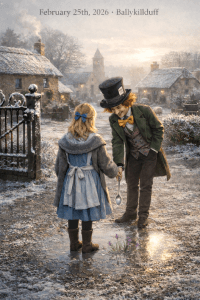
The frost had only just decided to behave itself in Ballykillduff when the sky coughed politely and produced a hat.
Not a rabbit.
Not a teacup.
Just a hat.
It fell with dignity, landed upright in the square, and waited.
Alice, who had already negotiated with blinking frost that morning, approached it cautiously.
The hat cleared its throat.
A moment later, the Mad Hatter unfolded himself out of it as though he had merely been stored there for convenience.
“Good morning!” he cried. “I’ve come for the Thawing!”
“We are not thawing,” Alice said firmly. “We are gently transitioning.”
“Ah,” said the Hatter, peering at the frost. “A hesitant season. Very dangerous. They tend to wobble.”
He removed a small silver teaspoon from his sleeve and began tapping the frost on the cobbles.
Ping.
A patch melted.
Ping.
A daisy appeared.
Ping.
A sheep sneezed and turned very briefly pink.
Alice caught his wrist before he could strike again.
“We’ve only just persuaded February to sit still,” she said. “If you start stirring it, we shall have daffodils arguing with snowflakes.”
The Hatter considered this gravely.
“Yes,” he agreed. “They never agree on colours.”
He placed the spoon back into his sleeve, stamped his hat once (which caused three crocuses to pop up apologetically), and looked at Alice with unusual sincerity.
“Very well. No mischief. Only observation.”
They stood together in the soft silver light, watching the frost hold its breath and spring wait its turn.
After several whole minutes of remarkable good behaviour, the Hatter leaned closer.
“Between ourselves,” he whispered, “March is terribly impatient.”
Then he folded neatly back into his hat.
The hat tipped itself.
And vanished.
The frost did not blink.
But somewhere beneath the cobbles, something giggled.

Chapter One


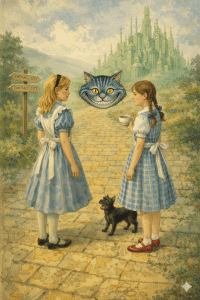
One followed a rabbit down into the dark,
The other a cyclone that left its own mark.
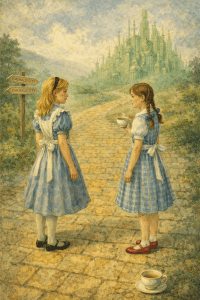
On a road paved in gold, where the green towers rise,
They met for a moment and shared their surprise.
Both wearing ribbons and dresses of blue,
In worlds where the logic is never quite true.
One spoke of riddles and tea with a cat,
The other of wizards and where home was at.
“The cards are all shouting!” the blonde one declared,
While the girl with the braids found herself rather scared.
“There’s a lion who cries and a man made of tin,
And a city of emeralds we’re meant to go in.”
They paused by the signpost that points the same way,
In the soft, hazy light of a magical day.
With a sip of her tea and a click of red heels,
They pondered how living a fairy tale feels.
No logic or compass could show them the door,
Between Kansas, and London, and Never-Before.
But for one quiet second, the wanderers stood—
Two girls lost in dreams, as all wanderers should.
Alice Meets Dorothy
The sun, a pale, milky orb in the sky, cast long, shifting shadows along the path of gold bricks. Dorothy, her blue gingham dress a familiar comfort, stood with a curious expression. Before her, a girl with hair the color of sunlight and a similar blue dress held a steaming teacup, a delicate saucer resting precariously on the rough, uneven bricks.
“Emerald City?” the blonde girl mused, peering at the signpost that read the same words twice. “How perfectly uninteresting. All cities are rather green, if you ask me, with all the grass and trees.”
Dorothy blinked. “But it’s Emerald City! Everything is green inside. The people wear green spectacles, and the palace is green, and—”
“Oh, like a rather large, sparkly bottle then?” the other girl interrupted, taking a sip of her tea. “I once met a bottle that contained a rather rude pigeon. Do you have many rude pigeons here?”
“Pigeons?” Dorothy frowned, trying to recall. “Well, I haven’t really noticed. I’ve been so busy trying to get to the Wizard.”
“A wizard, you say?” The blonde girl’s eyes widened slightly. “How dreadfully dull. Are they anything like a Dodo? Or a March Hare, perhaps? They are quite good at making things disappear, though often they just hide them.” She gestured with her teacup towards the path. “Are you going to a tea party?”
Dorothy shook her head, a little bewildered. “No, I’m going to ask the Wizard to send me home to Kansas. And my dog, Toto, needs to go home too.” She looked around. “Where’s your dog?”
“A dog? Oh, I don’t have a dog,” the girl replied, looking down at her cup. “I have a rather persistent White Rabbit. He’s always late for something or other. And a Ches—” She stopped, a peculiar glint in her eye. “No, I mustn’t mention him. It makes his smile appear, and then he’s terribly difficult to remove from conversations.”
Dorothy tilted her head. “A rabbit that’s always late? And a disappearing smile?” This world felt even stranger than Oz. “Are you… lost too?”
The blonde girl finally looked directly at Dorothy, a flicker of something familiar in her gaze. “Lost? One is never truly lost when one has a destination, however illogical. Though I confess, ‘Emerald City’ wasn’t on my itinerary. I was rather hoping for a game of croquet.” She gestured to the fallen teacup beside her feet. “Though this tea has gone quite cold, I daresay. Would you care for a cup?”
Dorothy looked from the cold teacup on the ground to the girl’s outstretched hand, holding another. The Emerald City gleamed in the distance. “I suppose… a small cup couldn’t hurt.” She had, after all, met a talking lion and a scarecrow. What was one more peculiar encounter on the road?

The meeting of the girls was polite, but the meeting of their companions would be a much more baffling affair!
Toto was a dog of simple, sturdy principles. He liked bones, he liked chasing the occasional crow, and he liked things to stay where he could see them.
He was sniffing a patch of particularly bright poppies when a tail appeared. Just a tail. It was striped, purple, and twitching lazily in the air about four feet off the ground. Toto gave a sharp, inquisitive bark.
“Oh, do stop that,” a voice purred from the empty air. “It’s dreadfully loud, and I’m trying to contemplate the nature of a ‘Kansas’.”
A pair of wide, yellow eyes flickered into existence above the tail, followed by a grin so wide it seemed to be holding the rest of the face together. Toto’s ears flattened. He was used to monkeys with wings and lions who cried, but a cat that was only half-finished was an insult to his canine senses.
Toto growled, a low vibration in his chest.
“A growl?” the Cheshire Cat remarked, its ears finally materializing. “How singular. In my forest, we growl when we’re pleased and wag our tails when we’re angry. Or is it the other way around? It hardly matters, since I haven’t got a tail at the moment.”
The Cat vanished entirely, leaving only the floating grin. Toto lunged, snapping at the empty air where the nose should have been, but his teeth met only the scent of tea and ozone.
“You’re quite a determined little thing,” the grin said, reappearing behind Toto’s left ear. “But you’ll find that biting the air is a very hungry business. Tell me, does your girl always walk on such a yellow road? It’s a bit loud for the eyes, don’t you think?”
Toto turned in a circle, barking at the floating teeth. He didn’t care about the color of the road; he just wanted this cat to pick a shape and stick to it.
“He’s not a dog, Toto,” Dorothy called out from a distance, sensing the commotion.
“And he’s certainly not a rabbit,” Alice added, peering over.
The Cheshire Cat began to fade again, starting with the tip of its tail. “We’re all mad here, little dog. Some of us just have the decency to hide the evidence.”
With one final, mocking wink of a yellow eye, the cat was gone. Toto sniffed the spot, let out one final, huffy “woof,” and trotted back to Dorothy’s side. He decided then and there that he much preferred the Wicked Witch; at least she stayed solid when you bit her.

Everyone in Ballykillduff knew the rhyme. They learned it young, usually from someone older who lowered their voice for the last line.
One for sorrow.
Two for joy.
Three for a girl.
Four for a boy.
Five for silver.
Six for gold.
Seven for a secret, never to be told.
Most people laughed at it. Some people touched wood. Nobody ever talked about seven.
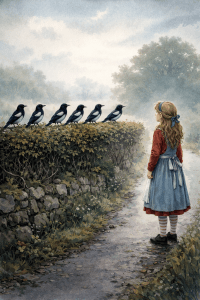
Alice saw them on a Tuesday morning, standing along the hedge at Curran’s Lane.
Seven magpies. Neat as fence posts. Silent as if silence were a rule they were following carefully.
Alice stopped walking.
The hedge itself felt wrong. Not dangerous. Just… held together too tightly, like someone smiling for longer than was comfortable.
She counted them twice. She always did when things felt important.
One. Two. Three. Four. Five. Six. Seven.
All seven turned their heads together and looked at her.
“Right,” Alice said quietly. “It’s that sort of day.”
People passed along the lane without noticing anything at all. Mr Keane walked by whistling. Mrs Donnelly hurried past with her shopping. No one looked at the hedge. No one slowed down.
Only Alice stood there.
The magpies did not speak. They had never needed to.
Long ago, Ballykillduff had made a decision.
It was not a cruel decision. It was a tired one.
Something sad had happened. Something that could not be fixed. A thing with a name, and a place, and a day that people still remembered too clearly. After a while, the village agreed to stop saying it out loud. Not because it wasn’t real, but because remembering it every day was making it impossible to live the next ones.
So the remembering was set aside.
And the magpies stayed.
They stayed because someone had to remember, and magpies are very good at keeping what others lay down. Not just shiny things, but moments, and names, and truths that no longer fit anywhere else.
The rhyme was never meant to predict luck.
It was a warning.
Seven magpies meant a place was carrying a memory it no longer wanted to hold.
One of the magpies hopped down from the hedge and pecked at the ground. Not at soil, but at a flat stone half-buried near the roots. A stone no one stepped on, though no one could have said why.
Alice knew what was being asked of her.
She did not need to know the whole story. She did not need names or details. She only needed to do one thing the village had not done in a very long time.
She knelt and placed her hand on the stone.
“I know,” she said, softly.
That was all.
Not what she knew. Just that she knew something had been there. Something had mattered.
The hedge loosened. Just a little. The air moved again.
When Alice stood up, there were only six magpies left.
They were already arguing with one another, hopping and chattering, busy once more with ordinary magpie business. Shiny things. Important nonsense. The everyday work of being alive.
The seventh magpie rose into the air and flew away, light now, its work finished at last.
Alice walked on down the lane.
Behind her, Ballykillduff continued exactly as it always had. But somewhere deep in its bones, a small, quiet weight had finally been set down properly instead of being hidden away.
And the rhyme, for once, was at rest.

Everyone in Ballykillduff knew the rhyme. They said it quickly, like a spell that worked better if you didn’t linger on it.
One for sorrow.
Two for joy.
Three for a girl.
Four for a boy.
Five for silver.
Six for gold.
Seven for a secret, never to be told.
Alice had already seen seven magpies once before, and she knew what that meant.
So when she walked along Curran’s Lane and saw eight, she stopped dead.
Seven stood along the hedge, silent and still.
The eighth stood on the path itself, blocking the way.
“Well,” Alice said, “that’s new.”
The eighth magpie was smaller than the others and less patient. It tapped one foot, then the other, as if waiting for a late train.
Seven magpies meant the village had forgotten something important. A sad thing. A thing everyone had agreed not to talk about.
That part had already been done.
Ballykillduff had remembered.
But the eighth magpie had arrived because remembering had changed nothing yet.
The bird pecked sharply at the ground.
Alice followed its beak and saw the problem at once.
The old path had collapsed further down the lane. A fence lay broken. The shortcut people once used had never been repaired. Long ago, someone had been hurt there. That was the secret. That was why people stopped using it.
They had remembered the accident.
They had never fixed the path.
“Oh,” said Alice. “You mean that.”
The eighth magpie nodded briskly.
It wasn’t here for memory.
It was here for mending.
Alice went back to the village and told people what she’d seen. Not the whole story. Just enough.
By evening, someone had brought tools. Someone else brought boards. Someone else brought tea.
By the next morning, the path was safe again.
When Alice returned to Curran’s Lane, there were only seven magpies on the hedge.
Then six.
Then none at all.
The eighth magpie was gone first.
It always is.
Because once something is put right, there is no need for it to stay.
And the rhyme, at last, had room for one more line, though nobody ever said it aloud:
Eight for the thing you do about it.
The story you are about to read is not a fantasy. It is an autopsy.
When Lewis Carroll wrote Alice’s Adventures in Wonderland in 1865, he was satirizing the rigid, nonsensical logic of Victorian education and law. He used a rabbit hole to show how a child’s innocence is swallowed by the arbitrary rules of adulthood.
In our modern era, we do not fall through holes in the earth. We descend through pixels.
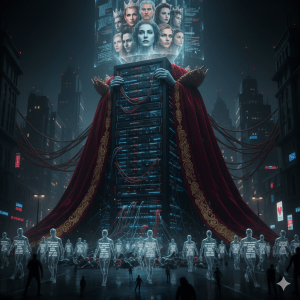
“The Terms of Service” is an allegory for the year we are currently living in—a time when the “elites” are no longer just people in high offices, but the very algorithms they have unleashed. We find ourselves in a world where “Truth” has been replaced by “Engagement,” where “Citizens” have been downgraded to “Users,” and where our most private thoughts are harvested like raw ore to power a machine that never sleeps.
This story is intended to hold no punches. It explores the uncomfortable reality that our modern “Wonderland” is not a prison forced upon us by a cabal of geniuses. Instead, it is a gilded cage we have built for ourselves, one convenient click at a time. The institutions we fear—the media, the tech giants, the financial structures—are merely mirrors reflecting our own collective desire for distraction over depth and safety over sovereignty.
As you follow Alicia through the Institutional Layers of New Ouroboros, I invite you to look closely at the “Slang” in the Appendix and the “Friction” in the Tea Party. Ask yourself:
When was the last time I looked away from the screen long enough to see the sky in its own color, rather than the shade I was told to expect?
The Queen is waiting. The Rabbit is glitching. And the Terms of Service are non-negotiable.
Proceed at your own risk. Click HERE to read the full story

Alice had returned to Wonderland for one reason: nostalgia. Big mistake.
The place had gone full corporate dystopia. The White Rabbit was now a crypto bro shilling “CarrotCoin,” the Mad Hatter ran an NFT tea party where every cup was a unique digital collectible worth exactly nothing, and the Queen of Hearts had rebranded as an influencer with the handle @OffWithTheirHeads69.
Worst of all, the Cheshire Cat had launched “GrinR,” Wonderland’s premier ride-sharing app. Slogan: “We vanish when you need us most.”
Alice tapped the app. Destination: Home.
Vehicle arriving: “Kevin the Boar – 4.9 stars (deducted 0.1 for chronic truffle addiction).”
Kevin arrived looking like a warthog that had lost a bet with a taxidermist. He wore a tiny saddle, a Bluetooth earpiece, and an expression that screamed, “I went to boar school for this?”
Alice climbed on. Kevin immediately side-eyed a glowing mushroom.
“Don’t even think about it,” Alice warned.
Kevin thought about it. Hard.
The ride began politely, past teacup gardens, under rainbow toadstools, until Kevin spotted the Holy Grail of truffles: a massive, glistening beauty sprouting right in the middle of the Queen’s private croquet lawn.
Kevin floored it.
“KEVIN, NO!” Alice screamed, clutching his mane as they bulldozed through a hedge maze like it was made of tissue paper.
Card soldiers dove left and right. One guard yelled, “License and registration!” only to be flattened into the shape of the two of clubs.
They skidded onto the croquet field just as the Queen was about to execute a flamingo for “unsportsmanlike squawking.”
Kevin launched himself at the truffle like a furry missile, uprooted it, and inhaled it in one obscene slurp. Then he let out a belch so powerful it parted the Queen’s wig, revealing a tattoo that read “Live, Laugh, Lob.”
The entire court froze.
The Queen’s face turned the color of a ripe tomato having a stroke.
“OFF WITH HIS TROTTERS!” she shrieked.
Alice, panicking, did the only thing she could think of: she pulled out her phone and fake-reviewed on the spot.
“Your Majesty, please! Kevin has 4.9 stars! He’s verified! He accepts tips in acorns!”
The Queen paused, mallet raised. “Reviews?”
Alice nodded frantically. “Read them yourself! ‘Best ride ever, 10/10 would be stampeded again.’ ‘Kevin took a shortcut through a caterpillar’s hookah lounge, legendary.’ ‘Only complaint: he ate my picnic.’”
Kevin, sensing an opportunity, turned on the charm. He sat. He gave paw. He even attempted a smile, which looked like a constipated bulldog discovering taxes.
The Queen lowered her mallet. “Fine. But he’s banned from my lawn. And someone get this pig a breath mint.”
As they trotted away, the Cheshire Cat materialized on Kevin’s head like a smug helmet.
“Not bad for a rookie driver,” he purred. “Next fare’s the Dormouse, he tips in half-eaten crumpets.”
Alice groaned. “Just get me out of here.”
Kevin suddenly braked. In the path ahead: a single, perfect truffle.
Alice glared. “Kevin. I swear to Lewis Carroll.”
Kevin looked back at her with big, innocent eyes.
Then he winked.
And floored it again.
Somewhere in the distance, the Queen’s scream echoed: “OFF WITH ALL OF THEM!”
Alice clung on for dear life, laughing in spite of herself.
Wonderland, it seemed, was exactly as mad as ever, just with worse customer service.