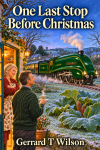
One Last Stop Before Christmas.
**************************************
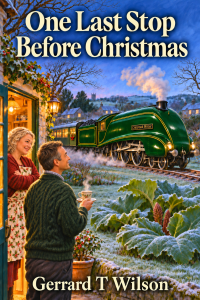
The steam engine arrived in the Crazymad Writer’s garden at twenty past four on Christmas Eve. It came entirely of its own accord, rolled out from behind the giant Gunnera and blew its whistle so loudly that he dropped a mince pie into his tea.
He went to the back door with the saucer still in his hand.
There, on the garden railway, stood a full-sized A4 Pacific with its tender and a single green carriage. Steam drifted across the frosted lawn. A warm light shone in the cab, and someone had hung a small holly wreath on the carriage door.
“Were you expecting that?” asked Breda, the Crazymad Writer’s wife, coming up behind him.
“I generally expect a little warning before a locomotive comes up the garden.”
The engine gave two short blasts.
“There you are,” said Breda. “You’ve had your warning.”
The Crazymad Writer fetched his coat and went out. The moment he put a foot on the cab steps, the engine settled to a quiet hiss. On the driver’s seat lay a single cream ticket.
**BALLYKILLDUFF**
**CHRISTMAS EVE**
**ONE LAST STOP**
He turned it over. On the back, in small print, were the words **Call for Mr Hanrahan.**
“Breda,” he called. “Have you the number for the old station?”
“I have Mr Hanrahan’s number. The station’s been shut since September.”
“Then ring him. Tell him I’ll be at his garden gate in ten minutes.”
“Which gate?”
“The one beside the railway.”
Breda looked at the engine.
“I suppose it would be.”
* * *
For forty Christmas Eves, Mr Hanrahan had kept a tin of shortbread in the signal box. When the last train came through, he’d carry it down to the platform and offer it round. The guard usually took two. The driver used to say he was watching his weight and then put three in his coat pocket for the journey.
The last scheduled train had gone through in September. Mr Hanrahan had retired the following morning.
When the A4 pulled up by his garden gate, he was standing there in his old railway coat, with a square blue tin tucked under his arm.
“I made them out of habit,” he said, climbing into the cab. “I’ve been eating them since Thursday. You’d better get me to Ballykillduff before I finish the lot.”
The Crazymad Writer moved over to make room.
“I take it you know the way?”
“I should hope so. I can tell you where we are by the sound of the wheels.”
Off they went, past the sleeping gardens and the backs of the houses, where Christmas trees shone through the windows. Mr Hanrahan named each bend before they reached it. At the little stone bridge he laid his palm flat on the cab wall.
“Listen,” he said.
The wheels crossed the bridge with three quick knocks and a hollow fourth.
“That last one always sounded like someone coming to the door,” he said. “I used to hear it up in the box and get the kettle on.”
As they rounded the final bend, he looked ahead and straightened.
“Would you look at that.”
The old platform lamps were lit. A dozen people stood beneath them, stamping their feet in the cold. Mr Keane was there in his postman’s scarf, and Mrs O’Meara had brought a basket of mugs. Breda stood beside Mr Byrne, who was doing his best to pour tea from an enormous flask while wearing woollen gloves.
At the very front stood a girl called Niamh, holding a round biscuit tin in both hands.
Mr Hanrahan climbed down with his own tin.
“Who told you there’d be a train?” he asked.
“We were going to bring the biscuits to your house,” said Niamh. “Then Breda rang and said we might catch you here.”
He looked down at the tin under his arm. “And here I am with a tin of my own. It’s a terrible thing, habit.”
“It is,” said Niamh. “You’ve been giving us biscuits for years, so now we’ve had to learn to bake.”
She prised off the lid. Inside, on a sheet of greaseproof paper, lay a dozen crooked shortbread biscuits.
“They’re railway signals,” she said.
Mr Hanrahan picked one up. “I thought this one was a sock.”
“That one is a sock. It was a signal till Mam dropped the baking tray.”
He laughed and took a bite. Then he opened his blue tin, and the two of them went down the platform together, offering everybody a choice of signals or ordinary rounds. The sock, Mr Hanrahan said, was spoken for.
* * *
By six o’clock, the tea was gone and someone had started singing *Good King Wenceslas*, with Mrs O’Meara supplying a surprising number of the words. The Crazymad Writer helped Mr Byrne collect the mugs. When he turned back towards the track, the A4 and its carriage were gone.
Mr Hanrahan stood at the platform edge, listening.
“Did you hear it go?” asked the Writer.
“I heard the bridge,” he said. “Three quick knocks and a hollow fourth.”
Niamh came back for her tin. Mr Hanrahan put the last two pieces of his shortbread inside and handed it to her.
“Will there be a train next Christmas Eve?” she asked.
The Crazymad Writer looked down the line. He’d have liked an answer to that himself.
“Come up to my house at five,” said Mr Hanrahan. “We’ll put the kettle on. If there’s a whistle, we’ll bring the tea down here.”
“Can we come if there isn’t?”
“Of course,” he said. “I’ll show you how to make a signal that keeps its shape.”
They set off home together. Halfway up the lane, Niamh opened her tin and gave him one of his own biscuits. He ate it on the way, crumbs falling into the pocket of his old railway coat.