RSS

Category Archives: Alice in Ballykillduff

The Tumblewink of Ballykillduff

The Tumblewink of Ballykillduff


The Tumblewink of Ballykillduff

It began, as such things often do, with something so small that no one thought it worth mentioning.

Mrs O’Doolin’s teacups.

They had always hung in a neat and sensible row beside the dresser—handle to the right, pattern facing outward, each one minding its own business in a most respectable fashion.

Until one Tuesday morning (or what strongly insisted it was Tuesday), she found them all facing the wall.

Not broken.
Not fallen.
Simply… turned.

“Well now,” she said, after a pause long enough to consider the matter properly, “that’s not how cups behave.”


By the time the village had gathered its thoughts (which took longer than usual, as several of them had gone slightly missing), other things had begun to occur.

Mr Hanrahan at the signal box discovered that the 9:15 had arrived at 9:15… but from tomorrow.

Jimmy McGroggan insisted his ladder now had one extra rung, though no one could agree where it had come from.

And the sheep—always a reliable measure of reality in Ballykillduff—had arranged themselves in a neat row that appeared, upon closer inspection, to be alphabetical.

No one knew quite how sheep managed such a thing.
Least of all the sheep.


It was Alice who noticed it first.

Not the changes.
Those were everywhere.

No—she noticed the feeling.

That quiet, delicate sense that something had just passed by… not loudly, not boldly, but sideways, as though it had slipped between one moment and the next without troubling either.

She was standing by the hedgerow when she saw it.

At first, it looked like nothing at all.
Then like a scrap of ribbon.
Then like a small, glowing tangle of things that did not entirely agree on what they were.

It drifted—not forward, not back—but slightly aside.

And as it passed a fallen leaf, the leaf stood up straight.

The twig beside it, however, forgot what it was for.


“You must be a Tumblewink,” said Alice, quite calmly.

The creature did not answer.

But something about it… smiled.

Not with a mouth, exactly.
More with the idea of a smile.

Alice stepped closer.

“You’ve been tidying,” she said.

The Tumblewink shimmered.

A button appeared where there had been none before, then vanished again as though it had remembered it belonged elsewhere.

“Yes,” Alice continued, “but not quite properly.”

At this, the Tumblewink gave a small, pleased sort of flicker.


They walked together then—if walked is the correct word for something that moved by gently disagreeing with where it had just been.

Everywhere it passed, things improved… and did not.

A crooked fence straightened itself, while the ground beneath it shifted just enough to make it unnecessary.

A lost glove reappeared—on the wrong hand, worn by someone who did not remember owning it.

A sentence begun by Mrs Fitzgerald—
“I always thought that perhaps—”
—finished itself somewhere else entirely, inside Mr Hanrahan’s head, who responded aloud with,
“—it was the teapot all along.”

No one questioned this.


“Why do you do it?” Alice asked at last.

The Tumblewink paused.

For a moment, it became very still—so still that it almost became nothing.

Then, quite gently, it rearranged the air.

Alice felt it rather than heard it:

Because finished things cannot wander.


They stood in silence.

In the distance, a sheep tried to remember whether it was before or after another sheep and decided it rather preferred not to choose.

Alice looked about her.

Nothing was quite right.

But nothing was quite wrong either.

And somehow… the world felt wider for it.


“Will you stay?” she asked.

The Tumblewink flickered.

For just a moment, it gathered itself into something almost clear—a small, warm shape, like a memory that had not yet decided to fade.

Then it drifted.

Not away.

Not toward.

But between.


The next morning, the teacups were facing outward again.

The clock told the correct time.

The sheep had returned to their usual and entirely disorganised ways.

Everything, it seemed, had been put back as it ought.


And yet…

Mrs O’Doolin would later insist that her favourite cup felt warmer than the others, though she could not say why.

Mr Hanrahan occasionally answered questions no one had asked.

And Alice—

Alice sometimes found herself pausing mid-step, certain—quite certain—that she had just missed something important.

Something small.

Something warm.

Something that had been there…

just before it wasn’t.


And if, on certain quiet evenings in Ballykillduff, a thought goes slightly astray, or a moment feels just a touch unfinished—

no one worries overmuch.

They simply smile,
and leave things… almost as they are.


Because somewhere nearby,
a Tumblewink is still at work.


Tags: , , ,

Alice and the Jellyfish That Preferred Dice.

Alice and the Jellyfish That Preferred Dice.

****************************************
Chapter One
It began, as many things in Ballykillduff do, with something that ought not to have been in the square.
Alice noticed it first.
She had been sitting on the familiar stone bench—just beneath the trees that whispered opinions when the wind was in the mood—when something softly plopped onto the cobbles.
Not a loud plop.
Not even a particularly confident one.
More of a polite uncertainty of a plop.
Alice turned.
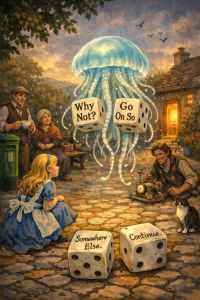
There, beside the green post box (which was behaving itself for once), lay a jellyfish.
Now, this would have been surprising enough.
But what made it considerably worse was that the jellyfish was:
  • Nowhere near the sea
  • Glowing faintly like a lantern that had forgotten its purpose
  • Holding a pair of dice
Not near dice.
Not next to dice.
Holding them.
With a sort of thoughtful wobble.
“Good morning,” said Alice, because it seemed the sort of thing one ought to say to a landlocked philosophical jellyfish.
The jellyfish pulsed gently.
“Statistically unlikely,” it replied.
Alice blinked.
“I beg your pardon?”
“Your greeting,” said the jellyfish, rotating slightly as though considering her from several emotional angles. “Given the conditions, it is improbable that this is a good morning.”
Alice considered this.
“Yes,” she said. “But it’s the sort of thing one says anyway.”
“Ah,” said the jellyfish. “A customary inaccuracy. I approve.”
By now, Ballykillduff had begun to notice.
Seamus appeared first, carrying a cup of tea that he had no intention of spilling, despite the circumstances.
Behind him came Mrs Kavanagh, who believed firmly that anything unusual could be improved with a shawl.
Jimmy McGroggan arrived shortly after, already building something with springs.
“What have we got?” said Seamus.
“A jellyfish,” said Alice.
“Inland,” said Seamus.
“With dice,” added Alice.
Seamus nodded.
“Right so.”
The jellyfish raised its dice.
“These,” it said, “are unsatisfactory.”
“Why?” asked Alice.
“They behave too predictably.”
Alice stared.
“I thought dice were supposed to be unpredictable.”
The jellyfish gave a soft, luminous sigh.
“They are random, not interesting.”
This caused Jimmy McGroggan to drop three springs and pick them up again in a different order.
“That,” he said, “is a very important distinction.”
The jellyfish rolled the dice.
They landed on the cobbles.
Six and two.
“Observe,” said the jellyfish. “An outcome. Entirely reasonable. Entirely dull.”
It rolled again.
Three and four.
“Still dull.”
Again.
Five and one.
“Endlessly obedient to expectation.”
Alice crouched beside it.
“What would you prefer them to do?”
The jellyfish paused.
Then, quite carefully, it said:
“I would like them to refuse.”
This caused a silence.
Even Ballykillduff, which had seen rivers forget their destinations and weather pause for reflection, took a moment.
“Refuse what?” asked Alice.
“To be numbers,” said the jellyfish simply.
Jimmy McGroggan’s eyes lit up in a way that suggested future complications.
“I might have something for that,” he said.
From a pocket that was definitely not large enough, he produced a small contraption consisting of:
  • A clock face with no hands
  • A teaspoon that pointed accusingly
  • A tiny bell that rang when ignored
He attached it—very gently—to one of the dice.
“Now,” said Jimmy, stepping back, “roll it.”
The jellyfish rolled the altered die.
It landed.
Paused.
Then… instead of showing a number…
It displayed:
“Perhaps.”
The entire square leaned closer.
The jellyfish trembled with delight.
“Yes,” it whispered. “Yes, that is better.”
They rolled again.
The second die—untouched—showed a five.
The altered one now read:
“Ask Again Later.”
Mrs Kavanagh sat down.
“I don’t like it,” she said, though she clearly did.
Seamus sipped his tea.
“I do,” he said. “It’s honest.”
Alice smiled.
“But what happens when both dice refuse?” she asked.
The jellyfish considered this very seriously.
Then it rolled them both.
They landed together.
For a moment, nothing happened.
Then—
The first die read:
“Why Not?”
The second read:
“Go On So.”
At this, something quite extraordinary occurred.
The air in Ballykillduff shifted.
Not dramatically.
Not loudly.
But decisively.
Somewhere, a decision that had been waiting for years quietly made itself.
A door that had never opened… did.
A letter that had never been sent… found its way.
And Jimmy McGroggan’s unfinished invention… finished itself, just to see how it felt.
The jellyfish glowed brighter.
“This,” it said softly, “is a much more interesting universe.”
Alice nodded.
“Yes,” she said. “It does seem to have improved slightly.”
“Will you stay?” she asked.
The jellyfish floated a little higher, its edges shimmering like thought itself.
“No,” it said. “I drift.”
“Where to?”
The jellyfish rolled its dice one final time.
They landed.
Together.
Gently.
They read:
“Somewhere Else.”
And with that—
It lifted into the air.
Not quickly.
Not dramatically.
Just enough.
And then, like a thought one almost remembers…
It was gone.
Alice looked down at the cobbles.
The dice remained.
She picked them up.
Turned them in her hands.
Rolled them once.
They landed at her feet.
They read:
“Continue.”
Alice smiled.
And in Ballykillduff—
that was quite enough to begin another story.
 

Tags: , ,

The Fête That Was Never Announced

The Fête That Was Never Announced


Under the White Bunting

No one tied the bunting there.
It simply leaned from post to post
As though the wind had practised.

No chalkboard named the hour.
No bell rehearsed the call.
And yet by noon
The quarry field remembered us.

Tables stood
With lace that smelt of careful years,
Cakes waited
Under domes of patient glass,
Jam jars caught the light
Like small, obedient suns.

The tombola drum
Turned with its wooden sigh —
Hope in a circle.

Children ran before the rules,
Dogs disobeyed with confidence,
Tea was poured
As if it always had been.

And overhead
The bunting held its breath.

Not black.
Not bright.

Only listening.

A coin rolled.
A chair wavered.
A praise paused
On the edge of pride.

These were the fireworks.

Not flame —
But inclination.

Not thunder —
But reflex.

In the smallest space
Between falling and reaching
A village chose itself again.

By dusk
The bunting had settled
Into white.

The mirror said nothing.
The field resumed its grass.
The wind untied what it had tied.

Tomorrow
There would be no trace
Except doors opening
A fraction sooner.

And somewhere,
Folded into the quiet of the land,
The Fête would wait —

Unadvertised,
Unforgotten,
Watching
For the colour of the sky.

Epilogue: The One Who Watched

They did not notice her at first.

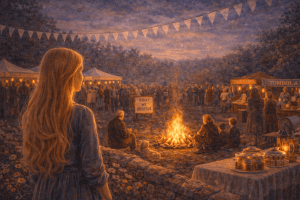
She stood where the stone wall dips,
Where daisies lean
And lantern light does not quite reach.

Her hair caught the fire’s gold
Before the fire caught her face.

She did not enter the sack race.
She did not judge the sponge.
She did not turn the tombola drum.

She watched.

When the coin rolled,
Her hand did not move.

When the chair wavered,
Her breath did —
But she did not.

She has learned, you see,
That villages must steady themselves.

The bunting above her
Had begun the afternoon undecided.

She saw the first thread pale.
She saw the second follow.

She saw Mrs Doyle’s praise
Tilt the colour toward light.

And when the mirror stood
At the field’s edge,
She did not look for herself.

She looked for the field.

Grass.
White bunting.
No ledger.

That was enough.

Later — long after the fire fell to embers —
A child would say,

“Was Alice there?”

And someone would answer,

“Of course she was.”

Because there are some gatherings
She does not begin,
Does not mend,
Does not command —

She only keeps.

And when the wind untied the bunting
And folded it back into the sky,

It brushed her shoulder
Like thanks.


You can read the full story via this LINK. Enjoy.


Tags: