Alice in Mirrorland: The Fractured Reflections
Alice in Mirrorland: The Fractured Reflections
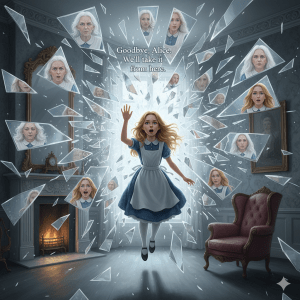
Prologue: The Splintering
Alice Song #1 – The Shard-Storm of Reflection
It was an ordinary afternoon, which was quite suspicious, for Alice had learned long ago that “ordinary” things have a habit of becoming extraordinary the moment one looks away. She was sitting in the drawing-room, watching the fire mutter to itself in the grate and glancing now and then at the great Looking-Glass above the mantelpiece.
The Looking-Glass had never struck her as trustworthy. For one thing, it was altogether too polished, as though it knew secrets it was unwilling to share. For another, it sometimes showed her reflection doing things she was certain she had not done—like tapping its foot when she was standing still, or frowning when she felt rather jolly.
This afternoon, however, the glass seemed well-behaved. Alice tilted her head; so did Alice-Through-the-Glass. Alice stuck out her tongue (not very politely, but no one was looking); her reflection copied her precisely. “At least you’re obedient today,” she said.
But no sooner had she said this than the Looking-Glass Alice gave the tiniest smirk, as though mocking her. Alice’s heart skipped, and she leaned closer. “That wasn’t me,” she whispered.
The smirk grew.
Then came the crack.
It began as a thin silver line across the surface, like a spiderweb spun at impossible speed. Alice drew back with a cry, for the crack was spreading, branching into a hundred more, until the whole mirror was a maze of glittering shards. And in each shard, her reflection was different.
One Alice looked much older, hair white as frost. Another was cross and scowling. A third was laughing so violently her shoulders shook. Some reflections looked away, some refused to meet her gaze at all.
Alice pressed her hands to her cheeks. “Oh, this is most irregular! Which of you is me?”
The reflections did not answer, but one of them—a solemn-faced Alice with eyes like wet glass—stepped forward. She did not step out of her shard so much as the shard slipped away to let her through, like a curtain parting.
“You’ve taken your turn long enough,” said the Reflection. Her voice was cool, not echoing but hollow, as if spoken inside a bottle. “Now it is ours.”
Before Alice could protest, the mirror burst into a thousand pieces that did not fall, but flew, whirling about her like a storm of knives. She tried to run, but the room had gone, the hearth, the carpet, the walls—all vanished. Only the shards remained, spinning faster and faster until they became a blinding whirlpool of silver light.
Alice gave one last shout—“Oh, I do not approve of this!”—before she was swept off her feet and carried into the storm.
The very last thing she saw was her own reflection, hovering calmly in the air, waving her farewell as if to say, Goodbye, Alice. We’ll take it from here.
Chapter One: The Kind Queen
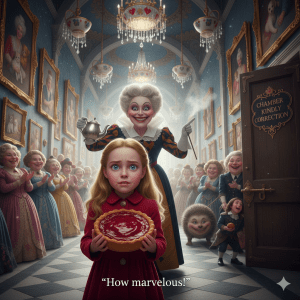
Alice Song #2 – The Compulsory Kindness Carol
Alice landed with a most unladylike thump upon a field of cushions. Or rather, she thought they were cushions until one squeaked “Mind your manners!” and wriggled away. They were plump little creatures, round as pillows, who huffed and puffed indignantly as she scrambled to her feet.
“Forgive me,” said Alice, brushing off her pinafore. “I didn’t know you were—well—alive.”
“That’s no excuse!” cried one.
“Not even a small one?” Alice asked.
“Not even the smallest small one,” it replied, and hopped off in a sulk.
Alice sighed. Wonderland was always like this: one could hardly sit down without bruising someone’s dignity.
She looked about and saw she stood in a meadow as neat as a tablecloth, embroidered with daisies that bent their heads politely. Beyond it rose a grand palace, gleaming white, with banners fluttering from every turret. Upon each banner was painted a great scarlet heart—but not the fierce kind she remembered. These hearts had smiling faces and little arms that waved merrily in the breeze.
At that moment a fanfare of trumpets blared, and a procession appeared: pages carrying baskets of sugared plums, footmen scattering petals, and at the center—Her Majesty the Queen of Hearts herself.
Alice froze. She remembered this Queen all too well, with her booming “Off with her head!” at every inconvenience. Yet this Queen looked… different. Her robes were bright as ever, but instead of scowling she beamed at everyone she passed. Instead of a sceptre, she carried a teapot, pouring steaming cups for the crowd.
“My dear, sweet subjects!” cried the Queen. “Be happy! Be merry! Be kind!”
The people cheered. Even the daisies clapped their leaves. The Queen spotted Alice and hurried forward, arms outstretched.
“A lost little lamb!” she exclaimed, enveloping Alice in a hug so tight she could scarcely breathe. “You must be starving. Guards! Bring cake! Bring pudding! Bring jam by the gallon!”
Alice wriggled free, gasping. “Thank you, Your Majesty, but I’m not terribly hungry.”
The Queen’s smile faltered. “Not… hungry?”
There was a dreadful silence. The crowd leaned in. Even the daisies held their breath.
“Perhaps only a little hungry,” Alice said quickly. “A jam tart would do.”
At once the Queen’s smile blazed back into place. “Splendid! You see, everyone? She is hungry! Isn’t that wonderful?”
“Yes, wonderful!” chorused the crowd, relief plain on every face.
Alice was handed a tart almost as large as her head. She nibbled politely, though it was so sweet it made her eyes water.
The Queen leaned close and whispered, “Remember, child: here we are all kind. No frowns, no refusals. Only smiles and sweetness. Isn’t that lovely?”
Alice forced a grin, crumbs sticking to her lips. “Perfectly lovely.”
Yet in the pit of her stomach she felt something was wrong. For as she looked around at the smiling faces, she saw how stiff those smiles were, how some eyes glistened with tears. And when she dared glance at the Queen again, her grin seemed stretched a little too wide—like a mask that might crack at any moment.
She followed the Queen into the palace, her enormous jam tart balanced awkwardly in both hands. The corridors glittered with chandeliers shaped like upside-down teacups, each dripping with sugar-crystals instead of wax. On the walls hung portraits of the Queen herself—smiling, laughing, cuddling kittens, patting puppies, shaking hands with hedgehogs.
“Do you see, child?” the Queen said, sweeping her arm proudly. “Every day I am kind! And because I am kind, everyone else is kind, too.”
Alice was about to reply when a page scurried past, carrying a stack of muffins. He stumbled, and one muffin rolled across the polished floor. A footman picked it up and said cheerfully, “How marvellous! A runaway muffin!”
But Alice noticed his smile was stiff as a clothesline in winter.
The Queen’s eyes narrowed. “Was that a frown I saw?”
The footman’s grin widened so much it seemed painful. “No, Majesty! I adore runaway muffins!”
The crowd of courtiers laughed at once—too loudly, as though laughter itself were compulsory. Alice tried to join in, but it came out as more of a squeak.
The Queen patted her hand. “Don’t worry, little lamb. You’ll learn. A good subject must be cheerful. If anyone forgets…” She tapped the teapot sceptre ominously. “…well, we have the Chamber of Kindly Correction.”
Alice’s stomach tightened. “What happens there?” she asked.
“Oh, only the gentlest of reminders!” said the Queen sweetly. “A tickling until they smile again, a spoonful of treacle down the throat, or perhaps a mirror held to their face until they remember how lovely a grin can be. Nothing dreadful at all!”
Just then, a servant carrying a tray of jam tarts let out the tiniest sigh of exhaustion. The Queen’s head whipped round.
“A sigh?” she thundered. “In my palace? Guards!”
Two armoured hedgehogs rolled forward, seized the unfortunate servant, and whisked him away down a corridor marked Chamber of Kindly Correction. The door shut with a decisive click.
Everyone applauded the Queen for her swiftness. Alice clapped too, though her hands trembled.
“Isn’t it marvellous?” the Queen said. “No more sulks, no more sulky faces. A kingdom of eternal smiles!”
Alice forced another grin, but behind her teeth her thoughts raced. Kindness isn’t kindness if you have no choice about it. It’s only another sort of cruelty dressed in ribbons and jam.
As the Queen led her deeper into the palace, Alice resolved to keep smiling until her cheeks ached—while secretly plotting how to slip away before her own sigh betrayed her.
The palace rang with brittle laughter, echoing like glass about to shatter. And behind it all, the heavy doors of the Chamber of Kindly Correction closed with a hollow clang.
Chapter Two: The Rabbit of Stone
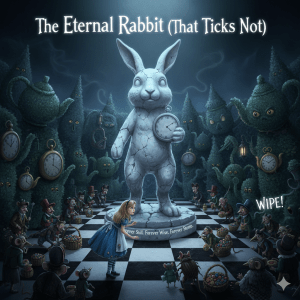
Alice Song #3 – The Plaza of the Forever Stone
Alice tiptoed out of the Queen’s palace at the very first opportunity, still clutching crumbs of the monstrous tart and wearing what she hoped passed for a cheerful smile. Once outside, she let it fall into a bush with a sigh of relief.
“That’s one kindness I could not swallow,” she muttered, brushing jam from her fingers.
The air here was cooler, quieter. She found herself on a winding path lined with topiary shaped like teapots, watches, and playing cards. The bushes bowed politely as she passed, though one muttered something that sounded suspiciously like, “Wipe your shoes, child.”
At the end of the path loomed a plaza paved in black and white tiles. At its center stood a figure she knew at once—the White Rabbit, but not as she remembered him.
He was carved entirely of marble, tall as a lamppost, frozen mid-hop with one paw gripping his pocket watch. His stone ears stretched stiffly upward, and his wide eyes stared forever at the sky.
Alice gasped. “Oh, Rabbit! What’s happened to you?”
The statue, of course, said nothing. But as she stepped closer, she saw that creatures scurried all around it: tiny mice in waistcoats, sparrows in bonnets, beetles carrying baskets of crumbs. They bowed, they knelt, they left offerings of buttons and seeds at the Rabbit’s stone feet.
One of the mice squeaked, “Bow, stranger! Bow to the Eternal Rabbit!”
Alice dipped a curtsy, though she felt ridiculous. “If you please,” she asked, “why is he… like this?”
The mouse puffed out its chest. “Because he is wiser than time. Because he chose to stop running and became forever. Because silence is the holiest answer of all!”
A sparrow added solemnly, “The Watch that ticks not is the truest Watch.”
Alice tilted her head. “But if a watch doesn’t tick, it’s broken.”
At this, the crowd gasped as though she’d cursed. A beetle dropped its crumb basket. “Blasphemy!” squeaked the mouse. “She mocks the Stillness!”
Alice hastily curtsied again. “No, no, I didn’t mean—only, when I knew him, he was always running, and fretting, and very much alive.” She touched the stone paw gently. It was cold, smooth, unyielding.
“Alive?” whispered a sparrow. “How dreadful.”
A hush fell across the plaza. Then a beetle crept forward. “You must leave before you disturb his silence further. He watches us all. He tells us everything without speaking a word.”
Alice stepped back, uneasy. There was something too reverent, too fearful in their eyes. She glanced again at the Rabbit’s frozen face. For just a heartbeat—surely it was a trick of the light—she thought the stony lips twitched.
Her own reflection, fractured memory of the mirror, seemed to whisper in her ear: What if this is all he wanted? To stop moving? To be still forever?
“No,” Alice said aloud, though her voice shook. “He loved his hurry, even if it made him miserable.”
But when she turned to leave, the marble paw shifted, ever so slightly, the stone watch ticking once—just once—before falling silent again.
Alice ran from the plaza, the whispers of the crowd following after her like a prayer:
“Forever still. Forever wise. Forever stone.”
Chapter Three: The Sane Hatter

Alice walked briskly away from the plaza, though she kept glancing over her shoulder in case the Rabbit suddenly decided to hop after her. The path wound on until the tiled stones gave way to a neat gravel lane, and the air began to smell strongly of tea leaves and lemon peel.
Soon she came upon a little house, square and symmetrical, with curtains tied in perfect bows and a brass bell above the door that chimed exactly every ten seconds. It was so tidy that Alice thought it could almost be in her own world—if her world had been drawn with a ruler.
On the gate was a polished plaque that read:
HATTER & HARE
— ESTABLISHED IN LOGIC —
“Oh dear,” said Alice, remembering the mad tea-party. “I do hope they haven’t lost their taste for riddles.”
She rang the bell. It chimed once, twice, and then—precisely on the third second—the door opened.
Out stepped the Hatter. At first Alice almost didn’t recognise him. He wore a neat brown coat, freshly pressed trousers, and a clean hat without so much as a card tucked into the brim. His hair was combed, his boots polished, and his eyes… steady.
“Good afternoon,” he said politely. “You are three minutes early, but I suppose that is tolerable.”
Alice stared. “Why, you’re not mad at all!”
The Hatter frowned slightly. “What a rude thing to say. I should hope not. Madness is terribly inefficient.”
Behind him, the March Hare appeared, carrying a tray of teacups arranged in a perfect row. Each was filled exactly halfway. The Dormouse followed with a measuring stick, ensuring every cup was poured to precisely the same height.
“Welcome,” said the Hare in a solemn voice. “Please sit. Our tea is rational, our biscuits evenly portioned.”
Alice sat at the long table, where plates of identical round biscuits were stacked like soldiers. The Hatter offered her one.
“Do you have riddles?” Alice asked hopefully.
“Riddles?” The Hatter sniffed. “Childish nonsense. We prefer facts. For example: a biscuit has six and one-half bites if consumed properly. That is knowledge. That is sane.”
The Hare nodded gravely. “We once wasted so much time asking silly questions. ‘Why is a raven like a writing-desk?’ Absurd! Now we ask sensible things. For instance: how many crumbs fall per bite? The answer is twelve.”
“Always twelve,” added the Dormouse, holding up his measuring stick.
Alice nibbled her biscuit. It tasted like dust. “But… isn’t it rather dull, being so very sensible all the time?”
“Dull?” The Hatter’s face reddened. “Dullness is stability. Madness is chaos. We cured ourselves. We are respectable now.”
At that moment, a cup tipped slightly, spilling a drop of tea onto the tablecloth. The Hare shrieked. The Dormouse fainted. The Hatter leapt up with a cloth and dabbed furiously until the spot was gone.
Alice hid a smile behind her hand. “I think I preferred you when you were mad.”
The Hatter fixed her with a stern look. “Then you are unwell. Kindly see yourself out.”
Alice rose, dusting crumbs from her lap. As she left, she heard the Hare say, “Order must be restored. Order must be restored!” and the Dormouse muttering in his sleep, “Twelve crumbs… twelve crumbs…”
Outside, Alice took a deep breath of the fresh air. “How dreadful to have all the sense in the world, and none of the nonsense,” she said. And she marched on, wondering what strange shard of Wonderland would greet her next.
Chapter Four: The Inverted Chessboard

Alice wandered on, leaving the overly tidy tea-house behind. The path twisted, straightened, then twisted again, until the ground itself seemed to turn into neat black and white squares. At first she thought it was a tiled floor, but when she tapped one with her shoe it gave a hollow clunk, as though it were part of some gigantic game board.
The landscape stretched in every direction as far as she could see: an endless chessboard plain, flat and gleaming. And scattered across it were chess pieces — pawns, rooks, bishops, knights, even kings and queens — but they weren’t still like ordinary pieces. They marched, they muttered, they grumbled, and they strutted.
“Make way for your betters!” shouted a pawn as it shoved a bishop aside.
“Betters?” The bishop spluttered. “I’ve been diagonal since before you were carved!”
“Well, we’re in charge now,” said the pawn smugly. “Kings polish our boots. Queens wash our socks. The world has turned itself about, and rightly so!”
Alice curtsied politely. “How do you do?”
The pawn puffed out its chest. “Far better than before. We pawns were always first to fall in battle, trampled and forgotten. Now the board belongs to us! The mighty bow to the small, the small stomp on the mighty. Fair’s fair!”
Alice thought this over. It seemed pleasant at first — until she noticed a row of kings, each wearing ragged crowns, bent low on their knees, scrubbing the squares with toothbrushes. Behind them, queens balanced baskets of pawns’ laundry on their regal heads, their faces red with exhaustion.
“Doesn’t seem very fair to them,” Alice murmured.
“Of course it is!” said another pawn, twirling a sceptre made of a snapped-off knight’s leg. “They used to rule us. Now we rule them. Equality means everyone suffers in turn.”
One of the weary queens muttered, “We never scrubbed floors before…”
“Hush!” barked the pawn. “Back to work! And smile about it, if you please.”
The kings obediently bent their heads lower.
Alice folded her arms. “But if pawns treat kings the same way kings treated pawns, haven’t you just become what you hated? Shouldn’t you all try being—oh, what’s the word?—reasonable?”
The pawns scowled in unison. “Reasonable is boring. We prefer revenge.”
A knight trotted up, armour dented, mane frayed. He whispered to Alice, “Don’t argue too loudly. Pawns may be small, but together they’re endless. They’ve learned to march in rows, and when they march, the whole board shakes.”
Indeed, as the pawns stomped their feet, the great chessboard trembled under Alice’s shoes. She wobbled, clutching her pinafore to keep upright.
“I don’t think I belong here at all,” she said.
“None of us do anymore,” the knight sighed. “The board’s turned itself upside down. The game has lost its game.”
Alice curtsied again and tiptoed away, the chanting of pawns echoing behind her:
“Small is mighty! Tall must crawl! Pawns forever, kings must fall!”
The words beat like drums in her ears as she hurried to the edge of the chessboard plain, longing for another shard — even if it was stranger still.
Chapter Four – Extra
Alice tiptoed away, the pawns’ chant still booming in her ears:
“Small is mighty! Tall must crawl! Pawns forever, kings must fall!”
She hurried across the endless squares until her feet ached. Just as she was about to sit down and risk another scolding from the ground, she noticed something strange.
One of the white tiles ahead had a crack running through it — a thin, silver line, glinting as though it were not a crack in stone at all, but in glass. When she crouched to touch it, the surface quivered under her fingers like water.
“Oh dear,” she whispered. “This whole place is only a shard… and it’s beginning to splinter again.”
She drew back quickly, for the crack seemed to hum, and the chessboard around her flickered — pawns doubled and blurred, as though she were seeing them through a broken mirror. One moment they marched, the next they froze in place like ordinary pieces.
Alice stood tall and smoothed her pinafore. “Well, if this board is breaking, I’d best not wait until I tumble through the pieces. I’d much rather choose where to go than fall into it headfirst.”
She stepped carefully around the crack, casting one last look at the pawns shouting their slogans at weary kings. Then she pressed onward, toward the farthest edge of the board, where the horizon rippled like a reflection in troubled water.
Chapter Five: The Silent Garden
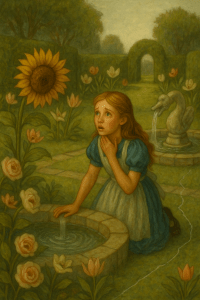
The chessboard plain shimmered like water behind her as Alice stepped forward and found herself in a garden. At first it seemed quite ordinary — a broad lawn, beds of roses and lilies, winding paths bordered by hedges — but within moments she realised what was wrong.
The air was utterly still.
The flowers bent their faces toward her, mouths opening as if to greet her, yet no sound came out. A tulip flapped wordlessly. A rose puckered its lips in a noiseless ooh. Even the grass, swaying faintly in the breeze, rustled not at all.
Alice’s own shoes made no sound against the path. When she gasped at the strangeness of it, even her gasp was silent. She clutched her throat, alarmed.
“Can’t I hear anything?” she mouthed, but not even a whisper escaped.
She hurried to a fountain at the centre of the garden. Water spurted from the mouth of a stone fish, yet it fell without splash or trickle, as though silence itself had swallowed the sound. Alice touched the water — it was wet enough, but it fell on her hand without a drop of noise.
The flowers crowded closer. Their stems creaked and their leaves rustled, but still she heard nothing. One great sunflower mouthed, Help us.
Alice nodded frantically. “How?” she mouthed back.
The sunflower bent down and pressed its wide face against hers. In that moment, Alice understood without hearing: This shard steals voices. Speak too long, and you will have no voice left when you return.
Alice clapped a hand over her mouth. Already her throat felt tight, her voice like a candle flickering low.
She turned to flee, but the garden paths wound back upon themselves. Every turn brought her to another bed of silent roses, another fountain where the water fell in deadly hush. At last she stumbled into a hedge-arch and fell to her knees on the lawn beyond.
There, for the briefest instant, she heard something — the tiniest crackle, like a mirror snapping. A thin silver line split across the grass, glowing faintly. The shard was weakening again.
Alice pressed her lips shut, afraid to speak or breathe too loudly, lest this place swallow her voice altogether. She scrambled toward the silver crack, her heart hammering in her chest, and leapt across it.
The garden dissolved behind her, roses and fountains vanishing into silence so complete it seemed to eat itself away.
Alice landed hard on the next shard, gasping. This time her gasp rang out, loud and bright and alive. The sound of her own voice startled her so much that she laughed in relief, clapping her hands.
But even as she laughed, she noticed the echo of her voice trembled oddly — as though another voice, very faint, had laughed along with her.
Chapter Six: The Labyrinth of Shards
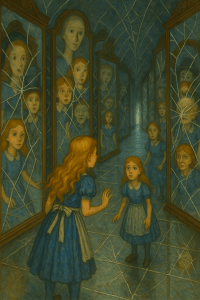
Alice rubbed her throat, relieved that her voice had returned. She tested it with a small hum, and when the sound rang true she laughed again — though the faint echo that laughed alongside her made her shiver.
Before her stretched not a garden, not a chessboard, not even a road, but a corridor made entirely of mirrors. They rose taller than trees on either side, their silver faces gleaming. Each reflected Alice back at herself, though not always correctly.
In one, she was very tall, so tall her head vanished into the clouds.
In another, she was no bigger than a thimble, tiptoeing like a mouse.
Another showed her with eyes as wide as saucers.
Another showed her old and bent, a cane in her hand.
“Goodness,” Alice said softly. “I hardly recognise myself.”
The mirrors multiplied as she walked, splitting and branching, until the corridor became a maze. Whenever she chose a path, she saw dozens of Alices turning in dozens of directions, each one hesitating, each one unsure.
“Which one is really me?” she asked.
One reflection answered — though her lips had not moved. “I am.”
Alice jumped. The reflection smiled slyly. “Or perhaps it’s me,” said another, stepping forward from a neighbouring glass. Soon they were all speaking, voices overlapping:
“I’m the true Alice!”
“No, I am!”
“You’re nothing but glass and shadow!”
“We are what you could have been — what you might yet become!”
They pressed their hands against the inside of the mirrors. The glass quivered, as if they might step through at any moment.
Alice covered her ears, though the voices seemed to come from inside her head. “Stop! Stop all of you! I can’t be everyone at once.”
“Why not?” one reflection said. “Everyone else manages it — a smile here, a frown there, one Alice for mother, another for school, another for herself. Why should you be different?”
The words pierced Alice more sharply than any glass. She stumbled back, her heel striking a crack in the mirrored floor. The sound rang like a bell — at last, a sound! — and at once the maze began to tremble.
Silver lines shot across the walls, splintering into dazzling webs. Each reflection fractured further, breaking into a hundred tiny Alices, all shouting at once.
Alice squeezed her eyes shut. “I am me!” she shouted. “Only me — and that’s enough!”
When she opened her eyes, the echoes had gone. The maze was still. Only a single mirror stood before her, tall and unbroken, showing her reflection exactly as she was: small, nervous, but very much herself.
Alice let out a long breath. “That’s better,” she said. “Though I’d rather not see myself so many times again, thank you very much.”
She touched the mirror. It rippled like water, and beyond it glowed the silver shimmer of the next shard.
Brushing down her pinafore, Alice stepped forward — and vanished through the glass.
For a moment, there was only darkness. Then a faint smell drifted toward her — the sharp tang of smoke, mingled with the sweetness of honey. She caught a glimpse of red, flickering like firelight, and heard the faintest echo of distant bells.
Alice’s heart quickened. “Oh dear,” she whispered. “Whatever could that mean?”
And before she could ask another question, the shard swallowed her whole.
Chapter Seven: The Hall of Echoes

Alice stepped through the glowing mirror, expecting at once to tumble into another odd world. Instead she found herself standing in a vast stone hall. Pillars rose into shadows above her head, and the floor gleamed like polished marble.
It was terribly quiet — until she spoke.
“Hallo?” she called.
Her voice bounced back, but not as she expected.
“Hallo,” answered the echo, though slower, stretched out. Then another joined in: “Hallo… hallo…” — softer, smaller, a child’s voice. Then another — sharper, mocking: “Hallo!”
Alice frowned. “That wasn’t what I said at all!”
“Not what I said at all,” the echoes replied, giggling.
She walked forward, and her footsteps clattered in many directions, some ahead of her, some behind. Shadows rippled along the pillars as if figures darted between them, though she could see no one.
The voices multiplied. Some sounded like her own voice, others deeper, others wheedling, others cruel.
“You’re lost,” one whispered.
“You’ll never leave,” another crooned.
“You don’t belong here,” sneered a third.
Alice pressed her hands to her ears, but the voices seeped straight into her head.
“This is just another trick,” she told herself firmly.
“This is just another trick,” an echo repeated, but its tone was mocking. “She pretends to be brave! She pretends!”
More laughter followed, until Alice’s cheeks burned with shame. She wanted to shout back, but remembered the Silent Garden and clamped her mouth shut.
Instead, she knelt and pressed her palm to the floor. The marble was cold and smooth — and through it ran a familiar silver crack, faintly glowing. She understood at once: this place, too, is only a shard, and it is breaking.
Alice stood tall and shouted into the darkness, “You are only echoes! You can’t hurt me, because you are nothing but reflections of words I might have said.”
Her voice rang bold and true, and though the echoes tried to mimic her, they wavered and faltered. One by one they fell silent, leaving the hall empty again.
The crack widened beneath her feet. Alice took a steadying breath. “Time for me to move on.”
And she stepped into the silver glow.
Chapter Eight: The Final Shard

Alice stepped from the Hall of Echoes into a place colder than all the rest.
There were no hedges, no pawns, no flowers, no tea, not even mirrors this time — only a void stretching endlessly, black as ink and faintly glowing red at the edges, like a coal fire smouldering.
At the centre floated a shard of glass, larger than any Alice had yet seen. Its surface was flawless, sharper than ice, and in it stared back a reflection she wished had never been born.
This Alice had skin pale as frost, eyes dark and hollow, a mouth curved in a smile sharp enough to cut.
“So,” said the reflection, though Alice’s lips did not move, “you’ve wandered through kindness, silence, order, stillness, echoes. You’ve tasted every piece of what you are. And here I am — what remains when the last scrap of softness is stripped away.”
Alice clenched her fists. “You’re not me. You’re only what I might become if I gave up hope.”
The reflection tilted her head. “Hope is fragile. One day it will break. And when it does, I will be all that’s left.”
She stepped forward from the glass — not out of it, but inside it, as though the shard itself was her prison. Silver cracks spread from her hands, each one glowing brighter, threatening to split the shard apart.
“If I break free,” the dark Alice hissed, “then you will vanish, and I will walk in your place. Stronger. Harder. Unfeeling.”
Alice’s heart thudded. She remembered the Queen’s kindness turned cruel, the Rabbit’s endless stillness, the Hatter’s joyless sanity, the pawns’ revenge, the voiceless flowers, the echoes that mocked her. Each shard had shown her something stolen, twisted, wrong. And this one — this final shard — was trying to steal her.
She took a deep breath. “You are nothing but a possibility. And possibilities do not rule me.”
The reflection sneered. “Then destroy me. But if you do, you destroy yourself too.”
Alice placed both palms against the shard. It burned like ice against her skin.
“I am Alice,” she whispered. “With my fears, my faults, my nonsense and my laughter. Imperfect — and real.”
The reflection’s smile faltered. “Real is weak.”
“No,” said Alice, pressing harder. “Real is strong enough.”
The shard screamed — a sound like a hundred mirrors shattering at once. Silver light burst across the void. The reflection clawed at the glass, her hollow eyes wide with fury, before splintering into dust and vanishing.
Alice was hurled backward in a storm of glittering shards. She squeezed her eyes shut against the brightness — and when she opened them, she was back in her own sitting-room.
The Looking-Glass hung above the mantel, smooth and unbroken. Her reflection looked back at her: tired, flustered, smudged with dust — but hers alone.
Alice let out a long breath. She touched the glass, and her reflection touched it too, no faster, no slower.
For just a heartbeat, she thought it hesitated. But then it smiled back — her smile, and no one else’s.
Epilogue: The Whole Mirror

For the rest of that afternoon, Alice sat very still in her chair by the fire. She had no appetite for tarts, nor riddles, nor even chess — not after what she had seen.
The Looking-Glass glimmered quietly on the wall, as though it had never done anything out of the ordinary. It reflected the room faithfully: the mantel clock ticking, the curtains billowing faintly, Alice herself perched with her hands folded primly in her lap.
“Perhaps it was all a dream,” she said aloud.
Her reflection nodded politely, lips moving in perfect time.
Alice narrowed her eyes. “Yes — but dreams don’t leave you quite so tired.” She yawned, proving the point.
At that, the reflection yawned too. Exactly the same. Exactly correct.
And yet… Alice could not shake the feeling that, just before the yawn, it had smiled — a heartbeat too early.
She rose, smoothed her pinafore, and gave the mirror a little curtsey. “Well,” she said, “if you’re up to more tricks, you’ll have to wait until tomorrow. I’ve had quite enough of shards for one day.”
Then she turned away, leaving the fire to flicker and the Looking-Glass to gleam quietly on the wall.
For a moment, when Alice’s back was turned, her reflection stayed where it was — just a fraction too long — before it, too, turned to follow.
 The Crazymad Writer Writes Again