Alice in Dublin, 2025
8Chapter One: Through the Raindrop
It all began with a raindrop—silver, spinning, and most uncooperative.
Alice had been out walking in her garden, which was perfectly strange in its own right. The roses were sneezing, the daisies hummed sea shanties, and a disgruntled caterpillar was muttering about tax forms beneath a toadstool. Everything had returned to the usual level of unusual, and Alice had grown quite comfortable with it.
Until she saw the raindrop fall upward.
Now, you may think that’s quite impossible, and you would be right on most days. But this was not most days, and this was no ordinary raindrop. It shimmered like mercury and spun as if trying to bore a hole through the sky itself. Alice, being exactly who she was, did the only reasonable thing she could think of: she chased it.
She leapt from the garden path, dodged a yawning dandelion, and reached for the raindrop just as it winked at her.
“Oh!” said Alice, and then the world flipped inside out.
She tumbled headfirst into the sky, which felt like soup and smelled faintly of electricity and Marmite. Up became down, time folded like laundry, and somewhere in the mix she heard a voice shout, “Mind the Luas!”
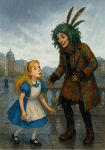
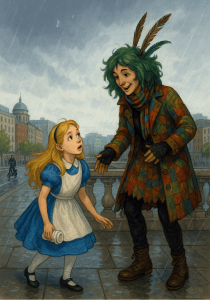
When Alice landed, it was not in her garden, or Wonderland, or anywhere else she recognised. It was smack dab in the middle of O’Connell Bridge, on a grey Dublin morning in the year 2025.
The air buzzed. Horns honked. A small robotic dog zipped past her feet. And then—ZOOOOM!—an electric scooter missed her by mere inches.
“Watch it, love!” shouted the rider, disappearing into the blur of traffic.
Alice sat up, rubbed her eyes, and looked around.
There were tall buildings made of glass and steel, buses painted like rainbows, and people talking to little glowing rectangles in their hands. Even the lampposts seemed to lean in to hear what they were saying.
“This isn’t Wonderland,” she muttered. “This is something far madder.”
Suddenly, a hand appeared before her. It was gloved, painted in a checkerboard of colours, and attached to a figure who looked like they had stepped straight out of a dream and into a thrift shop.
“You alright, petal?” the stranger asked.
She was tall and wore a patchwork coat lined with feathers, buttons, and string. Her hair was bright green, her eyes like copper pennies, and she had a tiny tattoo of a teacup on her neck.
“I’m… I think I’m lost,” said Alice, taking the hand.
“Aren’t we all?” said the woman. “But if you’re properly, delightfully lost, then you’re in the right place. Name’s Lolly.”
“Alice,” Alice replied. “Just Alice.”
“Well, Just Alice, you’ve fallen right into the heart of Dublin—and it’s a Thursday, so the statues’ll be chatty and the air smells of chips. Fancy a wander?”
Alice blinked. “Do the statues talk here?”
“Only on days ending in Y,” Lolly grinned.
And with that, she took Alice by the hand and marched her off the bridge and into the swirl of modern-day Dublin—a world of shouting gulls, flickering traffic lights, and secret magic humming just beneath the cobblestones.
As they walked along the quayside, Lolly pointed out curious things.
“That building’s shaped like a harp if you squint sideways. That bin used to be a knight. That pigeon over there owes me a fiver.”
Alice tried to keep up, but her mind spun faster than the silver raindrop. “Why am I here?” she asked aloud.
Lolly stopped outside a little café called The Bean of Inconvenience and tapped her chin. “Hmm. That’s a question. Might want to ask Himself.”
“Himself?”
“The statue. James Joyce. Just over the way. He usually knows things—when he’s in the mood.”
Alice stared at Lolly, then looked up at the swirling clouds. “Well,” she said, brushing off her pinafore, “I’ve met mad hatters, talking flowers, and argumentative lobsters. Why not a poet made of bronze?”
Lolly grinned. “That’s the spirit. Now drink this.” She handed Alice a small paper cup.
Alice sniffed it. It smelled like burnt toast and moonlight.
“What is it?”
“A flat white. It’ll make everything feel even less normal.”
Alice sipped, and the world sparkled for just a moment.
She could swear the clouds rearranged themselves to spell WELCOME, the river hummed in waltz time, and somewhere behind her, the pigeon let out a tiny burp.
CONTD
Chapter Two: The Talking Statue
Alice had seen a lot of unusual things in her life—march hares at tea, queens who liked to behead, cats with disappearing bits—but she had never, until that particular Thursday in 2025, been invited to have a chat with a statue.
Lolly led her through the drizzle and bustle of North Earl Street, a short walk from the bridge, weaving between umbrella battles and steaming chip bags.
“There he is,” said Lolly, gesturing with a paint-streaked finger.
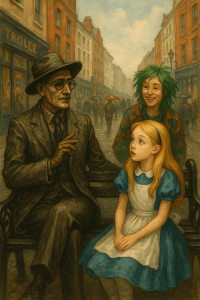
Alice peered through the crowd and spotted a bronze man perched on a bench. His spectacles sat slightly askew, his moustache was mid-thought, and his eyes twinkled with an unreadable joke. Beside him, a little bronze book lay open, pages caught forever in the wind.
“That’s James Joyce?” Alice asked. “He looks… serious.”
“Serious? Pfft! He’s laughing on the inside. Or the outside. Depends on the day. Thursdays are good. Thursdays he wakes up early and pretends to be helpful.”
Alice approached the statue cautiously, feeling a bit foolish. It’s just a statue, she told herself, although things that were “just” something had a nasty habit of becoming anything but.
She sat gingerly on the opposite end of the bench.
Lolly stood behind and whispered, “Ask him something odd. He hates small talk.”
Alice cleared her throat and leaned in. “Mr Joyce? Excuse me, but how does one return to a time that no longer remembers them?”
There was a silence. A long one.
And then, with a metallic creeeeeak, the statue of James Joyce turned its head.
“Finally,” he said, his voice dry as dusty parchment. “Someone with a decent question. You’d be amazed how many ask me where the nearest McDonald’s is.”
Alice blinked. “You can talk.”
“Statues are always talking, young lady. People just don’t usually bother to listen.” He adjusted his spectacles with one bronze finger. “Now then, time travel, was it?”
Alice nodded. “I seem to have slipped out of mine and landed in yours.”
“Happens more often than you’d think. Time’s a trickster in Dublin. Turns sideways when the river sighs.”
Alice wasn’t entirely sure what that meant, but she was used to peculiar explanations. “Is there a way back?”
Joyce didn’t answer immediately. He closed his bronze eyes and muttered a few lines of verse under his breath—something about rivers and refrains and custard.
“To go back,” he said at last, opening one eye, “you must go forward.”
“Pardon?”
“Go forward. Through the city. Through the riddles. Through the rain. The answer is beneath the book.”
Alice looked at Lolly, who gave her a proud nod as though Joyce had just handed her a golden ticket.
“Which book?” Alice asked.
“The Book,” Joyce replied, tapping the side of his nose. “You’ll know it when it glows.”
And with that, the statue creaked back into its original position, once again still, quiet, and smug.
Alice stood up, dazed.
“What did he mean, beneath the book?”
“Ah,” Lolly said, skipping a little on the spot. “That’s where the fun begins.” She twirled a ribbon around her wrist and added, “There’s only one Book worth capitalising in this town.”
“The Book of Kells,” said Alice, the name popping into her head like a bubble.
“Ding ding!” Lolly cheered. “Onward, to Trinity College we go! But first—chips.”
Alice opened her mouth to object, but her stomach got there first.
They stopped at a tiny chip van by the river, where a seagull was loudly arguing with a pigeon over ketchup packets. The chips came in a paper cone and steamed gloriously.
“Is everyone in Dublin so… odd?” Alice asked between bites.
Lolly considered the question, then shrugged. “We’re odd in a structured sort of way. That’s what keeps the time portals from getting too unruly.”
“Time portals?”
“Oh yes. There’s one in every bus shelter and at least three in every pub. But come on, petal. We’ve got a glowing book to find and a future to meddle with.”
Alice looked down the street toward the looming gates of Trinity College, its grand buildings peering out from behind wrought iron and whispering leaves. The clouds above seemed to part just slightly, revealing a shaft of light that fell directly upon the college roof.
She took another bite of chip and smiled.
This wasn’t Wonderland. But it might be something just as strange.
 The Crazymad Writer Writes Again