Strange Things are Happening in Ballykillduff
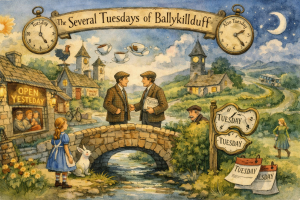
The Several Tuesdays of Ballykillduff
A Most Unreliable Account of How Time Misbehaved, Explained Incorrectly, and Was Nevertheless Understood
I. The Rule About Rules
The first rule in Ballykillduff was that rules only applied once they had finished being useful.
The second rule was that no one remembered agreeing to the first rule, which saved a great deal of argument.
On the morning when Tuesday arrived twice—once politely and once with its coat on backwards—Ballykillduff continued exactly as usual, which is to say, incorrectly.
The postman delivered tomorrow’s letters, apologised for the inconvenience, and promised to return yesterday’s parcels when he found them. The butcher sold three pounds of sausages that had already been eaten, and they were widely agreed to be delicious.
Only the clocks objected.
The clocks of Ballykillduff were old-fashioned, proud, and deeply suspicious of novelty. When Tuesday tried to sit beside Wednesday on the mantelpiece of time, the clocks began disagreeing with one another out of professional embarrassment.
The church clock insisted it was almost later.
The school clock maintained it was nearly before.
The pocket watch owned by Mr Seamus O’Rourke stopped entirely and refused to look at anyone.
This was the first sign that two timelines were now living in the village and pretending not to notice each other, which is considered extremely rude in Ballykillduff.
II. The Rule of Forward Memories
The third rule appeared without explanation:
You may remember tomorrow, but only by accident.
This rule took effect immediately.
Mrs Bridget Keane remembered having already burnt the scones she had not yet baked, and therefore watched them very carefully until they burned anyway. The schoolchildren sat an exam they were certain they had failed last week, only to discover they had already passed it next Thursday.
Alice—who was visiting Ballykillduff at the time and had become used to this sort of thing—noticed that people were apologising before bumping into one another.
“Something is leaning,” she said thoughtfully.
“Leaning where?” asked the shopkeeper.
“Against later,” Alice replied. “It’s pressing its elbow into now.”
No one argued with Alice, because arguing with Alice in Ballykillduff had a habit of becoming permanent.
III. The Two Tuesdays
It was eventually agreed (by everyone separately, which counted) that the village now contained:
- Tuesday A – slightly hopeful, prone to second chances
- Tuesday B – mildly disappointed, but better organised
They did not occur one after the other. That would have been sensible.
Instead, they occurred on top of each other, like two transparencies that refused to line up.
On Tuesday A, the milk turned sour too early.
On Tuesday B, it turned sour too late.
Anyone who drank it tasted regret, which was not unpleasant, merely instructive.
A sign appeared outside the pub:
OPEN YESTERDAY
CLOSED LATER
Business was excellent.
IV. The Bridge That Explained Nothing
Every timeline problem in Ballykillduff eventually arrived at the bridge, because bridges were where things admitted they were halfway something else.
Thomas Reeve crossed it on Tuesday A, rehearsing words he meant to say but had postponed until they felt safer.
On Tuesday B, Thomas Reeve crossed it knowing exactly what postponement cost.
They met precisely in the middle, where the planks creaked in two different tenses.
“You don’t look surprised,” said Tuesday A Thomas.
“I already was,” said Tuesday B Thomas. “Yesterday.”
They examined one another like mismatched shoes.
“Does it help,” asked the later Thomas, “saying it in time?”
The earlier Thomas opened his mouth, then closed it again.
“I think,” he said slowly, “it helps someone. I’m just not sure which of us.”
That answer satisfied the bridge, which promptly forgot them both.
V. The Rule of Consequences
The fourth rule announced itself by knocking three times and entering anyway:
When timelines touch, consequences must be shared fairly.
No one knew what fairly meant, so Ballykillduff interpreted it creatively.
If someone avoided a mistake in Tuesday A, they would experience the embarrassment in Tuesday B. If a kindness was given twice, it would be remembered once. Lost things were found by people who had not misplaced them.
The village adjusted.
People became careful with promises.
They stopped saving words for better days.
They learned that later was not a location but a rumour.
Children used the overlap for games. They raced themselves. They hid things where they would already have looked. They waved at reflections that waved first.
Adults pretended not to notice and noticed very hard.
VI. Alice and the Final Rule
Alice sat on the low wall near the bridge and listened to the timelines whisper.
“They’re tired,” she said.
“Tired of what?” asked Thomas, now carefully standing only in one day at a time.
“Tired of being useful,” Alice replied. “They want to be ordinary again.”
“Can they?”
Alice considered this.
“Only if everyone stops trying to fix them.”
This became the final rule, though it was never written down:
Things mend themselves once you stop rearranging them.
So Ballykillduff stopped asking which day it was.
They lived it instead.
VII. Thursday Arrives (Eventually)
When Thursday finally came—having waited patiently until it was no longer required—it arrived alone.
The extra Tuesday folded itself neatly into memory. The borrowed Wednesday returned with thanks. The clocks resumed their sulking but agreed on the hour.
The village felt quieter.
Not emptier.
Just… steadier.
People spoke sooner.
Listened longer.
Forgave earlier.
And sometimes, when the light slanted oddly or a kettle boiled too fast, someone would smile and say,
“Ah. Another Tuesday passing through.”
Which, in Ballykillduff, was as close to an explanation as anyone needed.
I
 The Crazymad Writer Writes Again