The Day the Forms Stopped Working

The Day the Forms Stopped Working
A Ballykillduff Story
No one in Ballykillduff could later agree on which form misbehaved first.
Some said it was the blue one, thin as regret and twice as long. Others insisted it was the yellow one, which had arrived already tired and smelling faintly of envelopes. Mrs Flanagan maintained it was neither, but a modest green form that merely sighed once and refused to open properly.
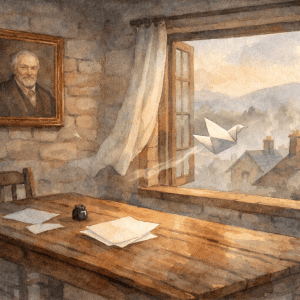
What was agreed upon was that the forms arrived as usual, in a neat stack on the long table in the village hall, under the portrait of a man nobody recognised but trusted anyway. They came stamped, numbered, referenced, cross-referenced, and accompanied by a leaflet explaining how to read the leaflet explaining the forms.
At first, Ballykillduff did its best.
Mr Kelleher ticked boxes carefully, but they unticked themselves the moment he looked away. Mrs Doyle signed her name three times only to find it had wandered off the page and was sitting politely in the margin, as if waiting to be invited back. Young Seamus McGroggan tried to staple two pages together, but the staple bent into a question mark and dropped to the floor.
“It’s probably the damp,” someone said.
The forms rustled at this, offended.
By midmorning, things had worsened. Boxes began asking questions.
Are you sure?
Is this really necessary?
Would you not rather have a cup of tea first?
Several villagers attempted to answer honestly, which only made the forms longer.
One particularly stubborn document expanded from twelve pages to forty-seven when Mrs O’Rourke admitted she wasn’t entirely certain what it was for. It then folded itself very neatly into the shape of a bird and flew out the open window, pursued briefly by a man with a clipboard who tripped over a chair and gave up.
By noon, a small delegation arrived to help.
They wore tidy jackets and expressions of concern. They spoke gently but continuously, explaining that the forms were very important and had travelled a long way. Ballykillduff listened with admirable patience.
Unfortunately, the forms would no longer accept being filled in.
Pens refused to write in the boxes provided. Ink slid sideways. A date entered as Tuesday quietly altered itself to whenever. One page tore itself free and placed a note at the bottom:
“Applicant appears to be answering questions out of order.”
“That’s how we do things,” said Mrs Doyle, mildly.
The delegation conferred.
By mid-afternoon, the forms had become selective. They would only open for people who genuinely needed them, and even then only briefly. Mr Kelleher’s form snapped shut when he tried to declare a hedge. Mrs Flanagan’s accepted a declaration of hens but rejected the part about counting them.
At four o’clock, a final form arrived by special courier. It was heavy, cream-coloured, and sealed with confidence. It opened itself in the centre of the table.
Inside, there was nothing written at all.
Just a small, polite note in the corner:
“We regret to inform you that you appear to be governing yourselves.”
No one spoke for a moment.
Then Mrs Doyle poured tea.
The delegation packed up quietly, taking nothing with them except a faint sense that they had forgotten something important. The forms, now calm, stacked themselves neatly and turned blank, as if they had never been anything else.
Life continued.
Bins were collected when needed. Decisions were made by whoever was closest at the time. Nobody filled in a form to explain why. Weeks later, someone noticed the village hall table was clearer than usual.
“Didn’t there used to be more paperwork?” asked Seamus.
“There was,” said Mrs Flanagan. “But it finished.”
And that was the end of the matter, more or less.
No announcement was made. No argument followed. Ballykillduff did not notice it had changed, because it felt exactly the same as before.
Which, in Ballykillduff, was the whole point.
Epilogue: A Small Matter of Imitation
It began, as these things often do, with someone elsewhere noticing nothing in particular.
In a town several counties away, a woman filled in a form and found it had already been filled, quite sensibly, with what she had meant to say. She thanked it, out of habit. The form blushed and became shorter.
In another place, a regulation arrived late, looked around, and decided it had missed the point. It folded itself into thirds and became a notice about the weather instead.
A clock in a city office refused to match any other clock, insisting on keeping local time, which turned out to be far more useful. People began arriving exactly when they needed to.
None of this was connected. At least, no one said it was.
Officials held meetings to discuss an increasing difficulty in locating certain villages on official maps. The villages, for their part, were still there, making tea, arguing gently, and getting on with things in the old way, which turned out to be the new way as well.
Someone mentioned Ballykillduff.
Not loudly. Just as a reference.
“Oh,” said another. “They stopped filling in forms, didn’t they?”
“They did,” said someone else. “And nothing went wrong.”
This was written down and then quietly lost.
Across the country, boxes became suggestions. Guidelines softened. Instructions learned to ask instead of tell. People discovered they could make decisions without asking permission from anywhere that required a stamp.
Nobody announced a return of anything.
Ireland simply remembered how it worked.
Ballykillduff noticed none of this, except that visitors arrived more often, stood quietly for a while, and then went home looking thoughtful. The village hall remained tidy. The table stayed clear.
Once, a blank form arrived in the post.
Mrs Doyle opened it, nodded, and put it on the fire.
It burned warmly, like paper always does when it has finished its job.
And somewhere, far away, a very large filing cabinet closed itself for the last time, content to be left alone.
 The Crazymad Writer Writes Again