CIRCUS OF THE GROTESQUES: BOOK TWO
CIRCUS OF THE GROTESQUES: BOOK TWO
THE BROKEN TENT
PRELUDE
The Circus Returns Wrong

The villagers of Ballykillduff woke in the middle of the night to a sound that should not have existed.
The circus music.
Not as they remembered it.
Not the haunting, lilting waltz that once drew them toward revelation.
This version crawled through the dark like something wounded.
Slow.
Uneven.
Each note slightly off, as if the melody were being dragged backwards through water.
Patrick Byrne sat bolt upright in bed.
At first he thought it was a dream. Then the next warped note slid through the walls of the house, and he knew.
“Mam,” he whispered.
Bridget was already awake. She sat at the edge of her bed, her breath held tight in her chest, staring at the dark window.
“You hear it,” Patrick said.
“Yes.”
They shared a long, fearful silence.
Another backward sweep of the melody sighed through the night. The air felt colder with each note.
Patrick climbed out of bed and crept to the window. The glass looked black at first, reflecting only the room behind him. Then a faint glow flickered far across the road.
“Mam,” he whispered, “come look.”
Bridget approached the window slowly, as if afraid the glass itself might reach out to her. She peered across the lane.
The meadow was no longer empty.
Something stood there.
A tent, but not the one they had come to know.
Not pearl and black.
Not shimmering with invitation.
This one leaned slightly to the left, as if sagging under its own weight. Its stripes were darker, muddied, like shadows stained with soot. Where the old tent had pulsed gently with life, this one flickered unnaturally, the edges of its canvas fraying in and out of existence like a bad reflection in a broken mirror.
Bridget pressed a hand to her mouth.
“That is not the same circus,” she whispered.
A cluster of lanterns formed around the tent, but they were dim, their light trembling and stuttering. A cold wind blew toward the Byrne cottage, carrying a whisper that twined itself through the warped music.
Patrick pressed his ear to the glass.
A voice.
A breath.
A message.
This time, you are the performers.
Patrick stepped back, heart hammering.
“Mam,” he said shakily, “it spoke.”
Bridget swallowed. “I heard it too.”
The black-and-soot tent flickered again, a slow, pulsing distortion that made the meadow look wrong, as if the grass were bending toward it.
A shadow moved behind the canvas.
Another.
Long.
Twisted.
Not shaped like the acts they had once known.
Patrick looked up at his mother, face pale.
“Do we go back?”
Bridget held her breath. She remembered the Mirror-Man, the Beast, the Echo. All the ways the circus had reached into them, changed them, pulled truth from their bones.
She looked at the broken, flickering tent across the road.
“I think,” she said quietly, “the real question is not whether we go back.”
She kept her eyes on that impossible, trembling structure.
“But whether it wants something from us it should not want.”
The music slowed.
The lanterns dimmed.
The whisper returned.
Come.
And far behind the tent, for just an instant, a shape unfolded tall and crooked, its silhouette bending in ways no body should bend.
Patrick’s breath caught.
The Circus of the Grotesques had returned.
But it had not come for revelations this time.
It had come for something else.
Something broken.
Something hungry.
Something that needed performers.
Chapter One
The Wrong Tent

The music did not stop.
It crawled along the walls of the Byrne cottage, slipped under doors, and curled into the corners of the rooms. It was softer now, but that made it worse. The notes dragged, bent, and slurred together, like someone playing the original circus waltz on a broken instrument.
Patrick lay awake under his blanket, eyes wide open. The storm clouds outside were thinning, but the sky was still heavy and black. He could not tell what time it was. It felt like the middle of the night and the end of the world at the same time.
He heard the tread of his mother’s bare feet on the landing, then the gentle creak of his bedroom door.
“Patrick,” Bridget whispered. “Are you awake?”
“Yes.”
She stepped inside and sat on the edge of his bed. Her face looked pale in the darkness, her eyes full of the same tired fear he remembered from before the circus had ever come. Only now there was something else behind it. A spark. A stubbornness.
“Do you hear it?” he asked.
“Of course I do,” she said quietly. “I am not made of stone.”
They sat in silence for a moment, listening to the music twisting in the air.
“It is wrong,” Patrick said at last.
“Yes.”
“It is the same, but it is wrong.”
Bridget nodded. “Like a face you know, but twisted in a bad dream.”
Patrick swallowed. “The tent is still there, Mam. I looked again after you went back to your room. It flickers whenever the music bends.”
Bridget did not tell him off for looking. That troubled him even more.
“Did you wake anyone else?” she asked.
He shook his head.
“Good,” she said. “Let us not drag the whole village out of bed for a nightmare that may yet vanish by morning.”
“You think it will vanish?”
“I have no idea.”
The music dipped, then rose again, warped like a voice being played backwards. Patrick shivered.
“Mam,” he whispered, “what if someone else goes out there?”
Bridget frowned. “Who would be foolish enough to do that?”
They both knew the answer at the exact same moment.
“Jimmy,” they said together.
Bridget stood up. “Stay in your bed. Do you hear me?”
“Yes,” Patrick lied.
She gave him a long look, knew he was lying, and closed the door anyway.
Bridget wrapped a shawl around her shoulders and went downstairs. The cottage felt brittle, as if a shout or a laugh might cause it to crack. She lit a candle and cupped her hand around the flame as she opened the front door.
Cold air rushed in, sharp and damp. The music grew clearer outside. It seeped from the direction of the meadow, dragging itself over the hedges.
Bridget stepped onto the lane.
The village was not sleeping.
In the dim light she could see other doors half open, curtains twitched aside, figures standing in their gardens and at their gates, all peering toward the meadow.
A small hunched shape emerged from the gloom, coat flapping, hair like an offended dandelion.
“Jimmy,” Bridget called softly.
He jumped. “Ah. Bridget. You heard it too. Good. I thought perhaps I had gone entirely mad.”
“Only partly,” she replied. “Are you going down there?”
“Of course,” Jimmy said. “It is an anomaly. One does not ignore an anomaly.”
“One does if one wants to stay alive,” Seamus muttered from his doorway further down, clutching a blanket around himself. “That is not the same tent that changed us. That is something else. Something that failed to change properly.”
Mrs Prendergast appeared in her own doorway, wrapped in an old dressing gown, hair in a tight scarf. Her eyes were narrowed and glittering.
“I told you,” she said. “I said nothing good ever glows in the dark unless it is holy or haunted. That one is not holy.”
The three of them stared toward the meadow.
The wrong tent stood in the distance, a sagging bruise against the sky. Its stripes were not clean bands of colour but streaks, like someone had painted shadows and then scratched at them with fingernails. Its top slumped. Its edges shook in a slow, unnatural quiver that had nothing to do with the wind.
Every now and then, part of it seemed to vanish entirely, only to stutter back into existence a second later, as if someone were flicking it on and off like a lantern.
Bridget felt a cold heaviness in her chest. “I do not like it.”
“Neither do I,” Jimmy said. “Which is exactly why we must understand it.”
Seamus made a small strangled sound. “Why can we not simply pretend we do not see it and hope it gets bored?”
“Because ignoring things rarely works,” Bridget said. “We tried that with our troubles for years. Then the circus came and dragged them into the open anyway.”
Mrs Prendergast sniffed. “Wisdom in the middle of the night. That is new.”
The music lurched, a long, low scrape of sound that made the hair on Bridget’s arms rise.
“It is calling,” Jimmy said.
“Calling who?” Seamus asked.
As if in answer, the music shifted again. Notes twisted, squeezed into a new shape. A rhythm emerged, uneven but insistent. The warped melody almost sounded like words.
A hush fell over the lane.
The words became clear.
Not spoken, but unmistakable all the same.
Come inside.
Bridget’s heart jumped. For a moment she thought the words were meant for her.
Then she realised they were not.
They were meant for the ones who had gone before.
The ones who had stepped through the first tent and come out changed.
Patrick.
Seamus.
Jimmy.
Bridget.
Mrs Prendergast pressed her hand to her chest. “It remembers us.”
Jimmy exhaled slowly. “Of course it does. The circus works with what it is given. We gave it our fears, our grief, our hopes. That wrong tent out there looks like something that tried to build itself from leftovers and did not quite manage.”
“Like a bad copy?” Seamus asked.
“Yes.” Jimmy’s eyes gleamed. “A flawed reflection. Something interrupted. Something broken.”
The thought did not comfort anyone.
Behind them, a small sound came from the Byrne gate. Bridget turned just in time to see Patrick stepping out onto the path, his boots already on, his face set with determination.
“Patrick,” she said sharply.
He froze. “I knew you would come out,” he said. “I could not stay inside. Not with that thing calling.”
“You do not go near it,” Bridget said. “Do you hear me? Not one step into that meadow.”
Patrick swallowed and nodded, though his eyes did not leave the distant tent.
Mrs Prendergast watched him narrowly. “The circus spoke to him before. It showed him futures. That might matter.”
“It matters too much,” Bridget said.
Jimmy looked from the wrong tent to Patrick. His mind was working quickly, and that was always a dangerous sign.
“If that crooked thing out there is feeding on what the first circus left behind,” he said slowly, “then it might be drawn to the ones who changed most.”
Patrick thought of the glowing actions he had seen in the final swirl of light. Standing tall. Helping others. Being brave when it counted.
“I do not feel changed enough,” he muttered.
“Neither do I,” Bridget said.
The music grew louder. The notes stumbled and hissed, then settled into something smoother. Almost tempting.
This time, the whisper was clearer.
Come perform.
Patrick shivered. “Perform what?”
Seamus’s voice shook. “I do not want to know.”
Lanterns flickered to life around the base of the wrong tent. Their light was sickly, a yellow-green sheen that did not quite touch the canvas. It reminded Patrick of swamp water, or bruises.
Bridget made a decision.
“We do nothing,” she said firmly. “We do not answer. We do not step closer. We wait for morning. If it is still there when the sun is up, then we will deal with it. Together. In daylight.”
Seamus nodded eagerly. “Daylight sounds good. I have always been a great supporter of daylight.”
Jimmy hesitated, then sighed. “Very well. Daylight first. Investigation later.”
Patrick opened his mouth to argue, but Bridget’s hand tightened on his shoulder.
“Inside,” she said. “Now.”
The villagers drifted back to their houses, doors closing slowly, curtains drawn, though many pairs of eyes continued to peek out through cracks and corners.
Patrick returned to his room and lay on his bed with his boots still on. He stared at the ceiling while the music writhed around the house like smoke.
Eventually, he fell into a thin, troubled sleep.
He woke to silence.
The twisted music had stopped.
Bright light spilled across his floor. He sat up, heart thudding, and raced to the window.
The sky was clear. The world looked startlingly normal.
And the wrong tent was still in the meadow.
It no longer flickered. In the bright light of morning it looked more solid, more real, its bruised stripes dull and heavy. The lanterns at its base had gone out, but the shadows around the canvas seemed too dark for such a sunny day.
Patrick felt an odd mix of dread and relief. It had not vanished like a dream. That meant it could be faced.
Bridget’s voice came from the landing.
“Patrick. Get dressed and come down.”
He hurried to obey.
In the kitchen, Bridget had already put the kettle on. Her jaw was set, eyes sharper than he had seen them in months. On the table lay a folded square of pearl-striped fabric, the last scrap from the first circus.
She touched it with the back of her fingers.
“The first circus changed us,” she said. “Now something else has come, pretending to be it. I will not let that thing undo what we have gained.”
Patrick nodded slowly. “So what do we do?”
She looked up at him.
“We do not go there alone,” she said. “We bring Jimmy. We bring Seamus. We bring Mrs Prendergast, if she insists. We look at it together.”
She took a deep breath.
“And if it truly wants performers,” she said quietly, “then we had better decide what sort of performance we are willing to give.”
Patrick felt a strange, fierce thrill in his chest. Fear and excitement mixed together.
Because the Circus of the Grotesques had returned.
Only this time, the villagers of Ballykillduff were not the same frightened people who had walked into the first tent.
This time, they knew something the wrong circus did not.
They knew themselves.
And the wrong tent in the meadow was about to find out how dangerous that could be.
Chapter Two
The Meadow at Daybreak
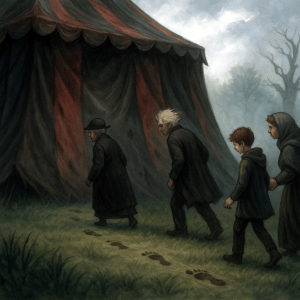
The morning light fell cold across Ballykillduff. It was the kind of pale, washed out sunlight that should have made everything feel safe again, but somehow did not. The wrong tent still stood in the meadow, solid now, sharply outlined against the bright sky. Its bruised colours and slumping shape looked even more out of place in daylight.
Patrick Byrne hurried down the stairs, nearly forgetting to tie his boots. Bridget followed more slowly, folding the same shawl around her shoulders she had worn during the storm. The square of pearl striped fabric lay in her pocket, thin and cool against her palm.
The lane outside was already stirring.
Jimmy McGroggan waited at the gate to the meadow, arms folded, hair sticking up as if he had fought it in his sleep and lost. Seamus stood beside him, pale as chalk, holding a thermos of tea with both hands as if it were a lifeline. Mrs Prendergast approached from the opposite direction at a surprisingly brisk pace, dressed in a heavy coat and shoes that looked more suited to funeral weather.
They gathered without speaking.
The tent loomed in front of them.
Now that the villagers could see it clearly, the wrongness was even worse. Its stripes were no longer simple streaks but jagged, uneven smears of black and sickly purple. The top sagged as if weighed down by invisible hands. The canvas shivered ever so slightly, though the morning air was still.
Patrick stepped beside Bridget and squinted up at it.
“It looks like it was painted by someone who only sort of remembered how the circus used to look.”
Jimmy nodded grimly. “A broken copy. Something tried to rebuild the tent from memory, but the memory was damaged.”
“Who would try to rebuild it?” Seamus squeaked.
“No idea,” Jimmy said. “That is what worries me.”
Mrs Prendergast sniffed loudly. “It is pretending to be the circus and failing. Like a bad impersonator. A hopeless one.”
They all watched the tent for a long moment, waiting to see if it would move or flicker again.
Nothing.
The morning breeze touched the grass but skirted around the canvas, as though the air itself refused to go near it.
Patrick felt a prickling on the back of his neck. “Do you feel that?”
Bridget nodded. “Yes. It is as if something is watching from inside.”
Jimmy opened his notebook and began sketching the outline of the tent. “It is entirely possible that it wants to be seen. Or that it wants to lure us closer. Or that it is disguising something else. Or perhaps it is hollow and waiting for something to fill it.”
“Jimmy,” Seamus said, “each thing you said there was worse than the last one.”
“Thank you,” Jimmy replied absently.
Mrs Prendergast took three decisive steps forward. “Well, someone must look at it properly. We cannot simply stand here until it gets bored and leaves.”
Patrick took a step with her, but Bridget pulled him back. “Stay behind me.”
Patrick frowned. “Mam, I am not a baby.”
Bridget stared at the tent. “I know. That is the problem.”
Jimmy and Seamus followed Mrs Prendergast toward the canvas, moving with the exact caution of people who are unsure whether the ground will collapse beneath them.
As they approached, the air grew colder.
Patrick could see their breath in small puffs. Bridget could too. She gripped the scrap of the original circus fabric tightly in her pocket.
Mrs Prendergast reached the tent first. She extended one gloved hand and pressed her palm against the canvas.
The fabric twitched.
Just once.
She snatched her hand back with a sharp gasp.
“It is warm,” she whispered. “Warm as a living thing.”
Jimmy stepped closer and placed the back of his fingers against the canvas. His eyebrows rose.
“Warmer than body heat. Almost like a hearth. But no flame. And no smell of smoke.”
Seamus peered over Jimmy’s shoulder, careful not to touch anything. “Is it breathing?”
They all stopped.
Listened.
Waited.
At first there was nothing. Then, very softly, a slow rise and fall passed through the fabric, like a long, quiet sigh.
Bridget stepped backward. “We should not be near this thing.”
“It knows us,” Patrick whispered. “It remembers us from last time.”
Jimmy nodded. “Yes. But this is not the same circus. It does not feel like revelation. It feels like hunger.”
Mrs Prendergast glared at the tent. “You will not eat anyone today. Not if I have anything to say about it.”
Seamus lifted his thermos in a tiny salute. “I would like to vote for that idea.”
A sudden ripple passed across the tent.
A deep sound rose from within. Not music. Not a voice. Something closer to an echo of a heartbeat, but slower and heavier.
Patrick shivered so hard his teeth clicked.
Jimmy snapped his notebook shut. “We need more than observation. We need answers. And I think we must search around the back of the tent.”
Seamus blanched. “Why the back? Why do bad things always hide at the back?”
“Because that is where answers usually hide,” Jimmy said.
Mrs Prendergast straightened her coat. “Very well. We will walk around it. All of us. No splitting up. This is not a fairy tale and I am not losing anyone.”
Bridget nodded. “Agreed.”
Patrick bounced on his feet. “Do we go now?”
Bridget hesitated, fear and determination warring across her face.
Then she took his hand.
“Yes,” she said. “Now.”
They moved as a group, circling the tent.
The ground grew colder. The shadows lengthened unnaturally, stretching across the grass in shapes that did not match the angle of the rising sun.
Patrick spotted a faint mark in the dirt.
“Mam. Look.”
Footprints.
Not from boots.
Not from shoes.
From bare feet.
Small ones.
Jimmy knelt beside them. “Child sized. Recent. Very recent.”
Bridget felt her breath catch. “Who would walk barefoot out here?”
Patrick looked up slowly at the sagging canvas of the wrong tent.
“No one,” he said. “No one would.”
Another footprint appeared around the curve of the tent.
Then another.
Leading toward the far side.
Seamus whispered, “Whoever it is… they went inside.”
Mrs Prendergast raised her chin. “Then we must follow them.”
Bridget closed her eyes briefly, a prayer forming without words.
Patrick squeezed her hand.
Together, in the cold light of morning, the villagers of Ballykillduff followed the barefoot tracks around the corner of the wrong tent.
What waited behind it would change everything.
Chapter Three
The Back of the Tent
The barefoot tracks led them around the sagging canvas wall, curving toward the far side of the wrong tent. The grass grew thicker here, tall and damp, brushing against their legs as they moved. The footprints pressed deeply into the earth, as if whoever left them had been walking slowly, perhaps stumbling, perhaps afraid.
Patrick stayed close to Bridget, though his eyes darted everywhere at once. He watched the shadows beneath the canvas, the trembling of the stripes, the faint ripples that sometimes moved across the fabric the way a shiver runs over skin.
Jimmy McGroggan raised his notebook and scribbled furiously while walking.
“This number of prints means a single individual,” he muttered. “Light weight, short stride. Definitely a child. Possibly ten or eleven years old.”
Seamus made a tight sound in his throat. “This is all wrong. No child should be anywhere near this.”
Mrs Prendergast marched ahead, holding her coat tight against her chest. “When I find the one responsible for this foolishness, I will lecture them so harshly that the tent itself will tremble.”
The footprints curved again.
Then they stopped.
Patrick froze. “Mam. Look.”
The final footprint pointed directly toward the canvas.
Not beside it.
Not around it.
Into it.
Bridget knelt and touched the impression in the grass. It was soft, still warm, as if the child had stood there only minutes before.
“Whoever it was,” she whispered, “they went in.”
Seamus backed away. “No. No, that is impossible. There is no door here. No opening. No way in.”
He was right.
The back of the tent had no entrance. No flap. No seam. Nothing that looked like a place for anyone to go.
Yet the footprints ended here.
Jimmy ran his fingers lightly across the canvas. “Perhaps it absorbed them.”
Mrs Prendergast clicked her tongue. “Do not use that word. That word is unpleasant.”
Patrick leaned in closer, squinting. “It looks different here.”
The canvas at this spot was thinner than the rest, stretched tight like an overfilled balloon. Strange shapes flickered beneath the fabric. Not clear shapes, not anything he could name, only movements, shadows that wriggled like something trapped behind frosted glass.
Bridget felt the scrap of original tent fabric press against her side. It gave her enough courage to touch the wrong tent herself.
The moment her fingertips brushed it, the canvas rippled.
She snatched her hand back.
Seamus whimpered. “It is alive. I knew it. I could feel it.”
Jimmy ignored him. “It is not alive. Not exactly. It is reacting to stimuli. Much like the original tent. But this one seems unstable. Almost confused.”
Mrs Prendergast folded her arms. “A tent should not be confused. A tent should be a tent.”
Before anyone could respond, the canvas at the spot where the footprints ended began to bulge outward.
Slowly.
Silently.
As if something behind it were trying to push through.
Bridget grabbed Patrick’s wrist and pulled him back.
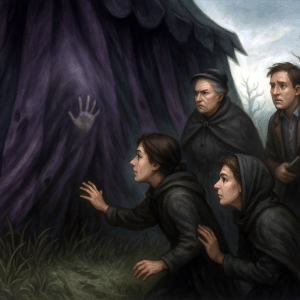
A shape pressed against the fabric. A small shape. A hand.
A child’s hand.
The fingers splayed against the canvas, pushing, flattening, trying to break through. The fabric stretched until it whitened at the strain.
Patrick gasped. “Someone is in there.”
“Not just someone,” Jimmy whispered. “A child. The same one that left those prints.”
Mrs Prendergast stepped forward despite the fear on her face. “We must help them. Quickly.”
She reached out to grasp the bulging section of canvas.
Before she could touch it, the hand vanished.
The canvas snapped back into place like water smoothing after a stone falls in.
The villagers stood frozen.
Then the tent gave a low, soft sound, like a muffled cry swallowed by cloth.
Patrick felt his heart twist. “They are trapped.”
Bridget nodded, face pale. “Yes. And they want out.”
Jimmy pressed both palms to the canvas, searching for a weakness. “There must be an entrance somewhere. A place this distorted structure allows passage. The original tent had rules. This one must as well.”
Seamus wiped his forehead. “I do not like the word distorted. It makes me nervous.”
“It should,” Jimmy said. “This tent is mimicking the first one, but badly. Someone or something tried to rebuild its magic without understanding how it worked. It feels incomplete. Broken.”
Patrick turned to Bridget. “Mam, we must find the real entrance.”
Her jaw tightened. “Yes. But we will not rush inside. We will call for help, and we will stay together.”
Mrs Prendergast peered at the canvas. “If a child went in there, we cannot abandon them. We would never forgive ourselves.”
Patrick nodded fiercely. “We will find them. Whoever they are.”
The tent shivered, as though reacting to those words.
Jimmy stepped back. “It heard you. The tent heard you.”
A cold breeze swept across the meadow, bending the grass around their legs.
Bridget took Patrick’s hand and met the eyes of the others.
“Whatever happens next,” she said, “we stay together.”
The tent bulged again, this time lower, near the ground.
A whisper drifted from within.
A small voice.
Help…
Patrick’s breath caught.
“Did you hear that?”
Seamus closed his eyes tightly. “I did not. I refuse.”
But everyone had heard it.
The child was alive.
And the tent, broken or not, was beginning to stir.
Bridget straightened her shoulders.
“We must find the entrance,” she said.
They turned away from the trembling canvas and began to circle the tent again, moving faster now.
Because somewhere on its other side, the wrong circus had hidden a door.
And whatever was inside had no intention of waiting quietly.
Chapter Four
The Door That Did Not Belong
The villagers circled the tent again, following the curve of the sagging canvas as the morning light grew brighter and colder. Patrick kept close to Bridget, though his heartbeat refused to settle. Each step felt too loud, too fragile, as if the grass itself might betray them.
The tent loomed above them, heavy and silent, except for the faint, awful shiver of its fabric. Jimmy walked with his fingers pressed to his notebook as if this might steady him. Seamus clutched his empty thermos like a weapon. Mrs Prendergast moved with determined fury, her jaw set in a line of iron.
The footprint trail had vanished completely.
Whoever the child was, they were no longer outside.
Patrick glanced at the tent again. “Mam, how do we find the entrance if the tent does not want us to?”
Bridget answered without looking away from the canvas. “Everything has a way in. Even things that pretend it does not.”
Jimmy nodded. “Quite right. Even anomalies follow rules, even if they are rules we do not understand yet.”
They walked on.
The air felt thicker here, as if they were pushing through something invisible. The grass bent away from the tent, leaning outward instead of upward. Patrick bent to touch one blade. It felt cold and brittle, like winter grass touched by frost.
Suddenly Mrs Prendergast stopped so sharply that Seamus walked into her back.
“Look,” she whispered.
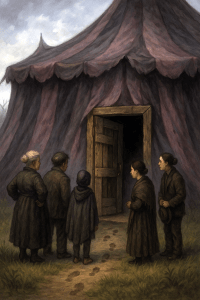
At first Patrick saw nothing but the warped stripes of purple and black. Then the sunlight shifted. A thin vertical shape flickered into view. A seam. A line. A door.
Except it was wrong.
The frame did not match the canvas or the structure. It was a patchwork of mismatched wooden slats, hammered together as if someone had built it in a hurry using whatever scraps they found nearby. Six or seven different types of wood clashed in a single frame. Some were clean. Some were splintered. One piece was painted red, flaking and old.
And the door itself was not a curtain flap at all.
It was a wooden door, the kind that did not belong anywhere near a circus tent.
Jimmy blinked twice. “That should not exist.”
Mrs Prendergast sniffed. “Nothing about this dreadful thing should exist.”
Bridget stepped forward cautiously and ran her fingers along one of the wooden slats. “It is real. Solid.”
Patrick touched the grass at the base of the frame. It had twisted into a ring around the bottom of the door, as if the earth itself had drawn back in fear.
Seamus inched closer. “Do we knock?”
“No,” Bridget said sharply.
“Yes,” Jimmy said at the same time.
Mrs Prendergast ignored them both. She reached out one firm hand and rapped her knuckles on the wooden door.
The knock echoed strangely, as though the door were hollow for miles.
There was no reply.
Patrick suddenly felt that same prickling on the back of his neck.
Someone was watching them.
He turned his head slowly.
Nothing moved behind them. Nothing stirred in the meadow. The hedges were still. The ditch was quiet. Yet he felt eyes.
Close ones.
Watching through the canvas.
Jimmy stepped forward and tried the handle. It was an old brass knob, tarnished and dull. He tested it very gently. It did not turn.
Mrs Prendergast frowned. “Locked?”
Jimmy tried again. “At first glance, yes. But this might not be a normal lock. It might be listening.”
Listening.
The word made Patrick shiver.
Then the door moved.
Only a fraction. Only enough for the air around them to shift. The sound was small, a soft wooden creak.
Mrs Prendergast jumped back. “It opened. I did not open it.”
Jimmy studied the door intently. “It responded to something. To whom, though?”
Bridget stepped between Patrick and the opening. “I do not want him going in.”
Patrick leaned to the side. “I was not going in yet. I only want to see.”
The space beyond the door was too dark. Much too dark. It was not the darkness of a tent interior. It was deeper, thicker, like the beginning of a tunnel carved from shadow.
Seamus peered in and then stepped away quickly. “No. Absolutely not. That is not normal darkness. That is the kind of darkness that might bite you.”
A soft sound slipped from the blackness. A whisper. A breath. A small voice.
Help…
Patrick froze.
“It is the child,” he whispered. “They are in there. They need us.”
Bridget closed her eyes briefly. “I know.”
Mrs Prendergast placed both hands on her hips. “We are not leaving a child in that thing. We are going in.”
Seamus’s voice cracked. “We are? Are we actually doing this?”
Jimmy shut his notebook and tucked it under his arm. “Yes. The tent is broken. Something is interfering with its structure and its purpose. If there is a child trapped inside, that means the tent is incomplete and unstable. If we leave it alone, it may collapse on them. We have no choice.”
Bridget opened her eyes again and looked at Patrick.
He lifted his chin. “I know I must stay close.”
She nodded. “Then you stay behind me at every moment. Understand?”
“Yes.”
Jimmy reached for the door.
It did not need his help.
The wooden frame shuddered. The door swung inward with a slow, groaning sound. Warm, stale air drifted out, smelling of old dust and something else. Something sharp. Something like metal.
The child’s voice whispered again.
Please…
Mrs Prendergast stepped through first.
She did not hesitate.
She did not look back.
Bridget went next, with Patrick clinging close.
Jimmy ducked inside with wide eyes, studying everything as though the strange shadows might rearrange themselves at any moment.
Seamus stood trembling at the entrance.
“Do not make me go last,” he begged the empty meadow.
Then he winced, shut his eyes tight, and stepped inside.
The door closed behind them on its own.
The sound echoed down the long, unnatural stretch of darkness that lay ahead.
The wrong circus had allowed them in.
Now it waited.
Chapter Five
Inside the Broken Tent

The door shut behind them with a sound that echoed far longer than it should have. It rolled through the darkness like a slow wave, then faded into silence so complete that Patrick could hear his own heartbeat.
The air was warm and stale, thick with dust that tasted faintly metallic. Bridget held his hand so tightly that her knuckles whitened, yet she did not loosen her grip.
A thin ribbon of light seeped from nowhere, enough to show the first few steps of the ground beneath them. It was not the polished floor of the original circus. This floor was uneven, made of packed dirt and thin boards laid haphazardly, as if someone had tried to copy the original layout from a vague and broken memory.
Jimmy stepped ahead slowly, holding his notebook against his chest.
“This is not a tent interior,” he whispered. “The geometry is wrong. There should be supports or at least some sense of canvas weight overhead.”
Seamus peered upward. “Do not say overhead. I do not want anything overhead.”
Mrs Prendergast sniffed. “You are safer under a roof than without one.”
Patrick looked up reluctantly.
The ceiling was there, but barely. The canvas sagged and bulged, forming unnatural dips that moved as though something heavy pressed against it from above. Pale streaks of light wriggled through the fabric like worms trapped beneath skin.
Bridget swallowed. “We move forward. Slowly.”
They walked.
The narrow corridor widened suddenly into a large open space. Patrick knew instantly that this was meant to be the main ring, the heart of the circus. But everything felt distorted.
The circle was misshapen, more oval than round. The lanterns that should have hung along the edges were scattered randomly across the walls, crooked and dark. In the center of the ring lay a heap of wooden planks, ropes, and strips of canvas tangled together.
Mrs Prendergast frowned. “What is this rubbish?”
Jimmy crouched beside the heap. “This looks like an attempt to form a structure. Something more specific than a tent ring. Something that failed.”
Patrick stepped closer.
The pile twitched.
He jumped back, grabbing Bridget’s coat. The others froze.
The heap shifted again.
Then a small hand appeared from beneath the planks.
Bridget gasped. “The child.”
They rushed to the pile. Jimmy lifted the boards carefully, and Mrs Prendergast pulled aside a rope. Seamus held a lantern that sputtered weakly into life.
A small figure curled underneath the debris. A girl, no older than ten, with tangled dark hair and bare feet covered in dust. Her eyes were closed, her face thin and pale.
Patrick felt his chest tighten. “She is alive. She must be alive.”
Bridget knelt and touched the girl’s cheek. Warm. Too warm, like the canvas outside.
At her touch, the girl’s eyes snapped open.
They were completely white.
No pupils. No colour. Just pale, milky white, glowing faintly in the dimness.
The girl sat up in a single, smooth motion that did not look natural.
Mrs Prendergast stumbled back. “In the name of the saints.”
The child looked at each of them in turn, her blank eyes unblinking. When she spoke, her voice came out as a whisper layered with something else. A deeper, broken echo beneath it.
“You should not have come.”
Patrick trembled. “We came to help you.”
The girl tilted her head. “Help me?”
Her voice shifted, splitting into two tones at once. “I was made. I was shaped. I was not finished.”
Jimmy stared, horrified. “She is part of it. She is part of the tent.”
The girl blinked slowly. “I was meant to be a performer. The tent tried to rebuild itself. It tried to remember. But it did not understand the memories. It built me wrong.”
Bridget wrapped an arm protectively around Patrick. “What do you mean wrong?”
The girl raised one bare foot and pressed it to the ground. The earth beneath her rippled like disturbed water.
“I am its copy,” she whispered. “Its memory of a child. But the memory was broken. So it trapped me to keep me from fading.”
Seamus backed away, shaking his head. “We must leave. We must leave now.”
The girl looked at him. “The tent will not let you.”
The entire structure gave a long, low groan, as though shifting in its sleep.
The girl touched Patrick’s hand.
Her skin felt warm and strange, like touching fabric that breathed.
“You can help me,” she said softly. “If you help me, the tent will stop. It will stop trying to remake itself. It will stop calling. It will stop watching.”
“How?” Bridget asked, her voice steady but her hands trembling.
The girl pointed toward the deeper shadows behind the main ring.
“There is a heart,” she whispered. “A heart the tent built to replace the one it lost.”
Jimmy paled. “A living core.”
The girl nodded. “It is broken. And it is angry. If the heart stops, I stop too. But I want to stop. I do not want to be this.”
Patrick swallowed hard. “If we find the heart, what do we do?”
Her pale eyes widened with fear. “Take it away from here. Take it out of the tent. Away from the canvas. Away from me.”
Bridget stared into the darkness where the girl had pointed.
“You are asking us to destroy the tent.”
“Yes,” the girl said. “Before it finishes rebuilding itself.”
A deep rumble rolled through the floor. The lanterns flickered.
The tent was waking up.
The girl grabbed Patrick’s sleeve.
“Please,” she whispered. “Run before it sees you.”
The ground vibrated beneath their feet.
A distant sound echoed from the far end of the tent. A slow, heavy thump.
A heartbeat.
The same kind they had heard in the first circus.
Only now it was wrong.
Uneven.
Angry.
Jimmy stood up quickly. “We need to move. Now.”
Bridget lifted the girl into her arms, though the child weighed far less than she should have. Almost nothing.
Mrs Prendergast pulled Seamus toward the far corridor. Patrick stood frozen for a moment, staring at the place where the shadowy tunnel stretched deeper into the tent.
The heartbeat pulsed again.
The wrong circus was fully awake.
Bridget’s voice snapped him back. “Patrick. Move.”
He ran.
Together, villagers and the unfinished child fled toward the heart of the broken tent.
Whatever waited for them in the deeper dark was stirring.
And it had noticed them.
Chapter Six
The Corridor of Echoes
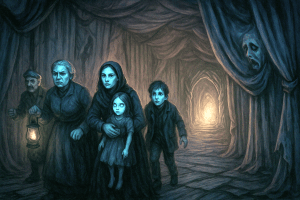
The narrow passageway swallowed them as they ran. The air felt thicker with every step, warm and stale like the inside of something that breathed. Bridget carried the unfinished child in her arms, the girl’s white eyes glowing faintly as though they held their own light.
Behind them, the heartbeat thumped again. Slower this time, but heavier. Each pulse slid up the canvas walls and shivered along the ceiling.
Patrick clung to Bridget’s coat. “Mam, is it following us?”
The girl pressed her small fingers against Bridget’s shoulder. “It does not need to follow. It feels every movement. Every breath.”
Seamus stumbled over a warped plank on the floor. “Then we go slowly. Quietly. We tiptoe. Very softly.”
Mrs Prendergast glared at him. “It already knows we are here. There is no tiptoeing away from a monstrous canvas with a temper.”
Jimmy pushed his glasses up and examined the darkness ahead. “The tent is expanding. I can feel it. These corridors were not this long when we first entered.”
Patrick frowned. “Can a tent grow?”
Jimmy swallowed. “This one can.”
The passage narrowed suddenly, squeezing them into a single file. The light behind them dimmed. The next heartbeat rattled through the floorboards.
Then the whispers began.
Not words at first. Just breathy sounds, like dozens of soft voices behind a curtain. They rose and fell, threading through the corridor walls.
Patrick held his breath.
The girl spoke in her double voice. “Do not answer them.”
Bridget tightened her grip. “What will happen if we do?”
“They are not real,” the girl said calmly. “They are pieces of people. Leftover thoughts. Fragments the tent copied. If you speak to them, they might try to become more whole.”
Mrs Prendergast stiffened. “We are walking through a corridor full of thinking scraps? How dreadful.”
The whispers grew louder, forming faint words.
“Stay…”
“Come back…”
“Do not leave us…”
Seamus covered his ears. “I do not want to hear that. I do not like that at all.”
Patrick looked at Jimmy. “Are these from the first circus?”
Jimmy shook his head. “No. The first circus mirrored memories. This one collects them, but without understanding. These are unfinished reflections. Like the girl.”
The girl watched him with expressionless eyes. “I was made from scraps too.”
Bridget kissed the top of her head. “You are still a child. We will not let the tent keep you.”
The girl blinked slowly. “It will fight you.”
They reached a fork in the corridor. Both paths stretched into darkness.
Mrs Prendergast placed her hands on her hips. “Well. This is inconvenient.”
“What do we do?” Patrick asked.
The girl lifted a thin arm and pointed to the left. “The heart is that way.”
Seamus gulped loudly. “Of course it is. The darker path. Why not.”
They moved left.
The floor changed beneath their feet, dirt giving way to old boards that creaked loudly with each step. The boards glowed faintly along the edges, as if something pulsed beneath them.
Patrick frowned. “It feels like walking on someone’s ribs.”
The girl nodded. “You are.”
Bridget nearly dropped her. “What did you say?”
“The tent rebuilt a skeleton.” The girl’s voice was steady, almost peaceful. “A frame for its new form. It is not done yet. It is still learning how to hold itself together.”
Jimmy looked slightly ill. “This is a living structure. A failed one.”
The next thump of the heartbeat made the boards shake. Dust drifted from the ceiling.
Patrick squeezed Bridget’s arm. “Mam, we must hurry.”
“I know.”
They turned a corner.
And found themselves inside a long hall lined with curtains.
The curtains were wrong. They sagged like melting wax, folding inward as if pulled by invisible hands. Shapes moved behind some of them. Slow shapes. Human shapes.
Seamus whispered, “Do not look behind them. I am begging you.”
Mrs Prendergast marched on. “I refuse to be intimidated by curtains.”
One of the curtains rippled.
A pale face pressed against the fabric. Not a real face. An almost-face. A smear of features that might once have been someone’s memory.
It whispered, “Stay with us…”
Bridget stepped faster. “Keep moving.”
Patrick followed, heart pounding.
Another curtain swayed. A hand slid through its folds, but the fingers were too long, bending in too many joints.
Jimmy shook his head. “The tent cannot shape full people. Only pieces. It is trying to lure us with unfinished memories.”
The girl rested her head on Bridget’s shoulder. “It wants to keep anyone who enters. It wants to be a real circus. It wants the performers it never had.”
Seamus muttered, “And we are the performers. Wonderful.”
At the end of the hall, the corridor opened into a wide chamber.
The heartbeat pounded louder now.
The room was empty except for one thing.
A doorway.
Not a wooden one.
Not a flap of canvas.
A tall, arched frame made of bone white ribs intertwined with old ropes and canvas strips. It pulsed faintly with each beat.
The girl pointed at it.
“The heart is through there.”
Jimmy’s breath caught. “This is the central chamber. But the frame is unfinished. The tent is not supposed to have a doorway like this.”
Mrs Prendergast frowned. “It is horrible, whatever it is.”
Patrick stepped closer. He could hear something on the other side.
A slow dragging sound.
A crackling breath.
A whisper that might have been words.
He felt cold down to his bones.
“Mam,” he said quietly, “I do not think the heart wants us to come closer.”
Bridget wrapped her free arm around him.
“That is why we must.”
The heartbeat thudded again.
The doorway pulsed.
The room darkened.
And behind the bone framed archway, something began to move.
To be continued.
 The Crazymad Writer Writes Again