The Old Man Who Borrowed Tomorrows
Chapter One
The Hour in the Pocket Watch
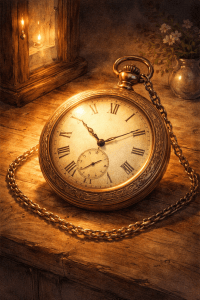
Mr Alderwick lived in a house that looked as if it had been built out of patience.
It was not a grand house. It did not boast towers, or turrets, or anything that might be described as “imposing.” It simply stood at the edge of the village with the steady confidence of a thing that had been there long before anyone thought to ask questions, and would probably remain long after those questions had grown tired and wandered away.
The roof was slate. The windows were small. The garden gate leaned at a thoughtful angle, as if it was considering whether gates truly mattered.
Inside, everything had a proper place, except for the things that did not.
There were books that had moved slightly left during the night. A teacup that sometimes ended up on the wrong shelf. A pair of spectacles that could not be found until Mr Alderwick stopped looking for them, sat down, and began to read without them.
Mr Alderwick would never have described any of this as magic. He would have sniffed at the very idea.
“It is not magic,” he would say to the kettle, which had developed a habit of boiling at the exact moment he turned his back. “It is simply time behaving in an untidy manner.”
The kettle would respond by boiling cheerfully anyway.
On the morning that Chapter One begins, Mr Alderwick woke at precisely six o’clock, as he had done for years, and lay still for a moment, listening.
The village was quiet. Not asleep, exactly. Villages rarely slept properly. They dozed. They listened. They held their breath while the sun considered whether it was worth rising.
Mr Alderwick sat up, swung his legs over the side of the bed, and reached for his pocket watch.
It sat on the small table beside the lamp, as it always did, with its chain coiled neatly like a silver question mark. The watch had belonged to Mr Alderwick’s father, and before that his father’s father, and so on until you reached a person who was mostly legend and possibly never existed at all.
The watch was warm.
That was the first odd thing.
A pocket watch should not be warm. It should be cool and sensible and mildly judgemental. It should tick in a steady manner and remind you that you are late.
Mr Alderwick picked it up.
The brass case felt as though it had been resting in sunlight, though no sunlight had yet reached the window. The face of the watch was plain, but the hands seemed to tremble slightly, as if they were impatient.
Mr Alderwick frowned.
He opened the watch.
The second hand moved, then paused, then moved again, as if it could not quite decide how the seconds ought to behave.
Mr Alderwick held it closer to his ear. He did not simply listen to it. He listened as if he might catch it out.
Tick. Tick. Tick.
Then, very softly, as if trying not to be noticed, another sound slipped between the ticks.
A sigh.
It was not a human sigh. It was not even a proper sigh. It was more like the sound a door makes when it has been opened too many times and begins to take the matter personally.
Mr Alderwick shut the watch with a snap.
“Well,” he said to the room, which was full of polite shadows. “We are not doing that.”
The room, being sensible, did not argue.
He dressed slowly, as he always did, because he did not see the point of hurrying when you were going to arrive as yourself either way. He washed, combed his hair, and tied his shoes with great care, as if his laces were capable of feeling insulted by sloppy knots.
Downstairs, he made tea. The kettle boiled the moment he turned his back, as expected. He poured the water, watched the leaves swirl, and considered the pocket watch sitting on the table like a small, silent creature.
He had tried not to notice it being warm.
It had been warm the day before too.
And the day before that.
At first he had assumed it was only the weather, though the weather had been cold enough to persuade the village pond to wear a thin film of ice.
Then he had assumed it might be his own hands. He was getting older, after all. Perhaps he was simply radiating more warmth. Old people did all sorts of mysterious things.
But the watch was warm before he touched it.
Mr Alderwick sat down with his tea, held the watch in both hands, and spoke to it quietly, because it was always best to speak quietly to strange things.
“Why,” he said, “are you warm?”
The watch did not answer in words, which was a relief. Mr Alderwick had no wish to begin his day arguing with an heirloom.
But the warmth pulsed, once, like a heartbeat.
Mr Alderwick’s eyes narrowed.
He had noticed the other thing too. The most troubling thing.
The watch was not simply ticking.
It was ticking ahead.
Not by much. Only a little. A minute at most. Sometimes less. But a watch that ticks ahead is not merely incorrect. It is ambitious.
He opened it again.
The face was clear. The numbers were crisp. The hands moved smoothly now, as if they had remembered what they were supposed to do.
Mr Alderwick compared it to the clock on the wall.
The clock on the wall had never been wrong in its entire existence. It was the sort of clock that considered accuracy a moral duty.
The pocket watch was fast.
Mr Alderwick took a careful sip of tea. He did not like to rush a thought.
Then he did something he had not done in a very long time.
He waited.
He watched the second hand travel round, and he watched the minute hand creep, and he sat so still that even the dust seemed to hesitate.
When the wall clock finally clicked over to six fifteen, Mr Alderwick’s pocket watch had already been there for nearly a minute.
And during that minute, while the village still insisted it was six fourteen, Mr Alderwick felt the strangest sensation.
It was the sensation of having time placed gently in his hands, like a small animal that did not entirely trust him.
The room seemed sharper. The air seemed brighter. The silence had an extra layer, as if the world had taken a breath and was holding it for his convenience.
Mr Alderwick looked down at his hands.
They were the same hands he had always had. A little knobbier, perhaps. A little more veined. The hands of a man who had opened jars, carried wood, repaired chairs, written notes, turned pages.
But for that minute, those hands felt young.
Not young in the foolish way, not young in the running and shouting way. Young in the way a well used tool feels when it has been sharpened.
Mr Alderwick’s tea tasted different.
It tasted like the first sip of tea you ever have, when you are a child and you have finally been allowed it, and it feels like a secret.
He swallowed, and the world returned to normal.
The wall clock ticked.
The kettle clicked faintly.
A bird outside decided to begin its day.
Mr Alderwick closed the pocket watch again, but his fingers lingered on the warm brass.
He did not smile. Mr Alderwick did not approve of smiling at things that might turn out to be dangerous.
Still, he could not deny the truth.
Something had happened.
And the pocket watch had done it.
Mr Alderwick stood, carried his cup to the sink, and washed it. He did not need to wash it immediately. He could have left it. But when you suspect something strange is taking place, it is comforting to perform ordinary actions, as if the world can be coaxed back into behaving properly by the simple act of rinsing a cup.
He dried it and put it away.
Then he took his coat from the peg by the door.
On the peg beside it hung a scarf. On the floor beneath it sat a pair of muddy boots. A sensible man might have cleaned them the night before.
Mr Alderwick was a sensible man.
But he was also a man who had once been young, and therefore occasionally forgot to be perfect.
He slipped the watch into his waistcoat pocket, felt its warmth settle against him, and paused with his hand still on the pocket.
“Just so you understand,” he murmured, “I have no time for nonsense.”
The watch warmed, very slightly, as if amused.
Mr Alderwick opened the door and stepped outside.
The village lay ahead, soft with early morning, the roofs pale, the lanes empty, the hedgerows glittering with cold. A thin mist wandered lazily between the cottages, not in any hurry to choose a direction.
Mr Alderwick began to walk.
He always walked at the same time each morning, down the lane and past the green, because routine was the frame that kept the picture from falling apart.
But today, as he approached the village green, he saw something that did not belong in his routine.
A child stood by the stone wall near the old clock.
She was small, with dark hair tied back in a ribbon, and she had the attentive posture of someone who was not merely waiting, but observing. She was not running. She was not shouting. She was simply standing, looking up at the clock with the seriousness of a person reading a riddle.
Mr Alderwick slowed.
Children were not usually out this early unless something had gone wrong, or something had gone wonderfully right.
The child turned as he approached, and her eyes were sharp, as if they had been polished.
“Morning,” she said.
Her voice was polite, but there was a question hidden inside it.
“Morning,” Mr Alderwick replied.
He would have walked on. He preferred to walk on. The village had plenty of people who would happily speak for hours, and Mr Alderwick did not wish to be one of them.
But the child did not move out of his way.
Instead, she pointed at the clock on the green.
“Is it ever wrong?” she asked.
Mr Alderwick glanced up at it. The clock face looked down at the village like a stern guardian.
“No,” he said. “It is never wrong.”
The child nodded as if she expected that answer.
Then she pointed, not at the clock, but at Mr Alderwick’s pocket.
The pocket watch was not visible, but perhaps its warmth was.
Perhaps it made the air different.
Perhaps it made the world slightly brighter, the way it had in the kitchen.
“Then why,” the child asked, very quietly, “are you always early?”
Mr Alderwick went still.
He could hear the village now. A distant door opening. A kettle beginning to boil. A dog stirring. The beginning of the day, lining itself up neatly.
And in the middle of it, a small girl, watching him as if she had been watching him for days.
He cleared his throat.
“I am not always early,” he said, because it is astonishing how often adults say things that are untrue simply because they want them to be true.
The child did not argue. She simply waited, which is far more unsettling.
Mr Alderwick felt the watch warm against his chest.
He looked down at the child again. She did not look mischievous. She did not look naughty. She looked curious in the way a cat looks curious, as if curiosity is not a hobby but a necessary part of breathing.
“What is your name?” Mr Alderwick asked.
“Nessa,” she said. “Nessa Grey.”
Mr Alderwick nodded.
“Nessa Grey,” he repeated, as if testing how it sounded in the morning air. “And why are you watching the clock?”
Nessa lifted her shoulders in a small shrug that suggested she had been dealing with baffled adults all her life.
“Because yesterday,” she said, “I lost an hour.”
Mr Alderwick’s hand went to his pocket without his permission.
The watch pulsed once, warm and steady.
Nessa’s eyes flicked to the movement.
“I did not mean it like a story,” she added quickly, as if that might make it less alarming. “I mean I was doing my sums, and then I looked up, and suddenly it was dinner time. But I had not finished. And my pencil was still sharp. And the page was clean, like the hour had not happened.”
Mr Alderwick’s mouth went dry.
He looked at the clock again. It stared back, perfectly innocent.
He looked at Nessa.
She was watching him with the calm certainty of someone who has spotted a loose thread and intends to pull it until the whole jumper reveals what it is really made of.
Mr Alderwick swallowed.
“That,” he said carefully, “is very strange.”
“Yes,” Nessa agreed. “So I thought I would find who took it.”
Mr Alderwick felt, for the first time in years, something close to panic.
Not the loud panic of shouting and running, but the quiet panic of a man who has kept a secret so carefully that he has almost convinced himself it is not there.
He had not told anyone about the watch.
Not anyone.
He had not even told himself properly.
And yet this child was standing here, as if she had arranged the morning.
Mr Alderwick stared at her.
Nessa stared back.
The village clock ticked.
The pocket watch warmed.
And somewhere, not in the sky and not in the ground and not in any place that could be pointed to, Tomorrow seemed to lean closer, listening.
Mr Alderwick took a slow breath.
“Come with me,” he said at last.
Nessa’s face brightened, not with triumph, but with the simple delight of being taken seriously.
“Where?” she asked.
Mr Alderwick turned toward his house.
“To my kitchen,” he said. “If you have lost an hour, you should at least be offered tea.”
Nessa nodded as if this was the most sensible thing she had heard all week.
They began to walk together, the old man and the child, down the misty lane.
Behind them, the village clock remained perfectly correct.
In Mr Alderwick’s pocket, the warm watch ticked on, quietly, politely, as if it had all the time in the world.
And perhaps it did.
For now.
Chapter Two
The Rules That Were Never Written

Mr Alderwick did not usually invite children into his kitchen.
It was not that he disliked children. He simply felt that kitchens were places of quiet agreements between kettles, cups, and people who knew how to wait. Children, in his experience, were often too honest for such arrangements.
And yet here was Nessa Grey, seated at his small wooden table, her feet not quite touching the floor, her hands folded neatly as if she were attending a meeting rather than investigating a missing hour.
Mr Alderwick placed a cup of tea in front of her.
She looked at it.
“Milk first?” she asked.
“No,” Mr Alderwick replied, automatically. Then he paused. “Unless you prefer it.”
Nessa considered this carefully, as if milk were not a matter of taste but of principle.
“After,” she said. “So I can see it change.”
Mr Alderwick nodded. This seemed reasonable.
He poured the tea, then sat opposite her with his own cup. The pocket watch rested between them on the table, its chain curled loosely, its brass case catching the morning light.
Nessa did not reach for it.
This pleased Mr Alderwick more than he expected.
They sat in silence for a moment, listening to the kettle cool and the house settle. Outside, the village had fully woken. Doors opened. Voices called. A bicycle rattled past.
Time, apparently, was behaving itself.
“You are not afraid of it,” Mr Alderwick said at last, nodding toward the watch.
Nessa shook her head.
“I am afraid of things that hide,” she said. “That is just sitting there.”
Mr Alderwick smiled, briefly, before remembering himself.
“That,” he said, “is how it begins.”
He took the watch and turned it over in his hands. In the kitchen light, it looked perfectly ordinary. Respectable. The sort of object that would never cause trouble unless invited to do so politely.
“I have had this watch a very long time,” he said. “Longer than I should have, perhaps.”
Nessa leaned forward.
“Does it steal time?” she asked.
Mr Alderwick stiffened.
“No,” he said firmly. “It does not steal.”
“What does it do, then?”
He hesitated.
There were words he had practiced over the years, though he had never spoken them aloud. Words that had grown careful and precise from disuse.
“It borrows,” he said.
Nessa nodded, as if this confirmed something she had already suspected.
“That is different,” she said.
“Yes,” Mr Alderwick agreed. “Very.”
He opened the watch.
The second hand ticked smoothly. The face showed no sign of mischief. Only the faintest warmth seeped into the wood beneath it.
“When I was younger,” Mr Alderwick said, “I discovered that the watch could give me an hour that did not belong to today.”
Nessa’s eyes widened, but she did not interrupt.
“Not often,” he continued quickly. “And never without reason. It was always only one hour. Always an hour that had not happened yet.”
“Tomorrow,” Nessa said.
“Yes,” Mr Alderwick said. “Though I did not think of it that way at first.”
He closed the watch again.
“It happens quietly,” he went on. “The world sharpens. The minute grows generous. And for that hour, you have more time than everyone else.”
“What do you do with it?” Nessa asked.
Mr Alderwick looked at his hands.
“Small things,” he said. “Important things that do not look important at the time.”
He thought of a fence mended before a storm. A letter written and delivered before regret could settle. A neighbour sat with long enough to finish a story that had waited years to be told.
“I have learned,” he said, “that borrowed time is no good for grand plans. It resists them.”
Nessa tilted her head.
“What about the hour I lost?”
Mr Alderwick felt the question settle heavily between them.
“I believe,” he said slowly, “that when I borrow an hour, it must come from somewhere.”
Nessa did not look angry.
She looked thoughtful.
“So tomorrow lends it to you,” she said, “and today takes it from someone else.”
Mr Alderwick winced.
“That,” he said, “is the part I did not understand for a long while.”
He stood and crossed to the window. Outside, Mrs Quince from the library was hanging washing with great concentration, as if each peg required careful consideration.
“I told myself,” Mr Alderwick said, “that the hour would be taken from a place where it would not be noticed. From waiting. From idleness. From moments people would not miss.”
“And was it?” Nessa asked.
Mr Alderwick did not answer at once.
“No,” he said finally. “It was not.”
He returned to the table and sat again.
“There are rules,” he said. “They are not written anywhere. The watch does not explain them. But they exist all the same.”
Nessa folded her hands more tightly.
“Tell me,” she said.
Mr Alderwick took a breath.
“First,” he said, “the hour must be used kindly.”
Nessa nodded.
“That makes sense.”
“Second,” he continued, “it cannot be used only for yourself.”
Nessa frowned.
“That is trickier.”
“Yes,” Mr Alderwick said. “It is.”
“And third,” he said quietly, “every borrowed hour must be returned.”
Nessa’s gaze dropped to the watch.
“How?”
Mr Alderwick’s fingers tightened around his cup.
“That,” he said, “is decided later.”
Nessa was silent for a long time.
Then she looked up.
“Have you been returning them?” she asked.
Mr Alderwick did not answer immediately.
He watched the steam rise from his tea and vanish.
“Yes,” he said. “I have.”
Nessa studied his face.
“Have you returned all of them?”
The watch warmed slightly, as if listening.
Mr Alderwick met her eyes.
“No,” he said.
Nessa did not gasp or accuse or leap from her chair.
She simply nodded again.
“That explains it,” she said.
“Explains what?”
“Why the hour came from me,” Nessa replied. “I was not doing anything important enough to stop it, but I noticed.”
Mr Alderwick felt something tighten in his chest.
“You should not have lost it,” he said.
Nessa shrugged.
“I found you instead,” she said. “That seems fair.”
The watch ticked.
Mr Alderwick closed his eyes briefly.
“When I borrow an hour,” he said, “the watch grows warm. When it is time to repay one, it grows heavy.”
Nessa glanced at his waistcoat.
“Is it heavy now?”
Mr Alderwick hesitated, then nodded.
“Yes.”
“How heavy?”
“Like a book you have promised to return,” he said. “And kept too long.”
Nessa smiled faintly.
“I know that feeling.”
They sat together in the small kitchen, the old man and the child, with time resting between them like a quiet agreement.
“At some point,” Mr Alderwick said, “Tomorrow will ask for what it is owed.”
Nessa leaned forward.
“What happens then?”
Mr Alderwick looked at the watch.
“I do not know,” he said. “No one ever does. Not until it happens.”
Nessa considered this.
“Then,” she said, “we should be careful.”
Mr Alderwick smiled, properly this time.
“Yes,” he said. “We should.”
Outside, the village clock struck the hour.
Both of them listened.
It rang true.
But the pocket watch on the table ticked just ahead of it, patient and warm, keeping its own careful count.
And somewhere beyond the reach of clocks and kitchens and borrowed tea, Tomorrow continued to wait, perfectly willing to be kind, and perfectly unable to forget.
Chapter Three
Kind Uses for Borrowed Time

Mr Alderwick did not borrow an hour every day.
That was the first thing he explained to Nessa as they walked together through the village later that morning. Borrowing time, he said, was rather like borrowing sugar from a neighbour. If you did it too often, people began to notice, and then to talk.
“And talking,” he added, “is when trouble begins.”
Nessa accepted this without question.
The village was fully awake now. Shop doors stood open. A cart creaked past the green. Mrs Quince was already inside the library, arranging returned books into piles that made sense only to her.
Mr Alderwick walked at his usual pace, which was neither slow nor fast. It was the pace of someone who intended to arrive eventually and saw no need to rush the world along ahead of him.
Nessa matched him easily.
“You are going to borrow an hour today,” she said.
Mr Alderwick glanced down at her.
“That is not a question,” he observed.
“No,” Nessa said. “It is an observation.”
He sighed.
“Yes,” he admitted. “I am.”
They stopped near the low stone wall at the edge of the green. Beyond it stood the cottage of Mr Hobb, whose fence had leaned at an increasingly dramatic angle for several weeks.
Mr Alderwick rested his hand over his waistcoat pocket.
The watch was warm.
He did not take it out. He had learned long ago that borrowing time did not require ceremony. It required intention.
He closed his eyes.
The sensation came gently. There was no jolt, no rush, no sound. The world simply leaned closer, as if it had decided to pay attention.
When he opened his eyes, the village looked the same. But the air felt newly swept, as if dust had been cleared from corners no one usually noticed.
“That is it?” Nessa asked.
“That is it,” Mr Alderwick replied.
They crossed the green together. Mr Hobb stood in his garden, staring at the fence with the expression of a man who had been meaning to fix something for so long that it had begun to feel impolite to finally do it.
“Morning,” Mr Alderwick said.
Mr Hobb jumped.
“Oh. Morning,” he replied. “I was just thinking.”
“That can be dangerous,” Mr Alderwick said mildly.
Mr Hobb smiled, relieved to have his thoughts interrupted.
They worked together in easy silence. Mr Alderwick held the posts steady while Mr Hobb hammered. The fence straightened. The gate swung properly. A job that might have taken an afternoon took less than an hour, and yet felt unhurried.
Nessa watched closely.
“No rushing,” she said.
“No,” Mr Alderwick agreed. “Borrowed time dislikes being chased.”
When the fence was done, Mr Hobb stood back and nodded.
“Looks better,” he said.
“It does,” Mr Alderwick replied.
They did not explain why.
As they walked on, Nessa noticed small things.
A dropped handkerchief returned before it was missed. A disagreement outside the baker’s resolved with laughter rather than raised voices. Mrs Quince finding a book she had been searching for weeks without quite knowing she was searching for it.
Nothing miraculous.
Nothing showy.
“It is like nudging the world,” Nessa said.
Mr Alderwick smiled.
“Yes,” he said. “In the right direction.”
The hour did not announce itself ending. It simply thinned, like mist in sunlight. The sharpness softened. The air returned to its usual texture.
Mr Alderwick felt the watch cool slightly.
“That was it,” Nessa said.
“Yes,” he replied.
She looked thoughtful.
“Does Tomorrow mind?” she asked.
Mr Alderwick stopped walking.
“Tomorrow,” he said carefully, “does not mind kindness.”
They reached the edge of the green again. The village clock struck the half hour, solid and certain.
Mr Alderwick checked his pocket.
The watch was no longer warm.
It was heavier.
Not painfully so. Not yet. But enough to remind him.
Nessa noticed at once.
“It wants something back,” she said.
“Yes,” Mr Alderwick replied.
“When?”
He hesitated.
“That,” he said, “is not up to me.”
They stood quietly for a moment, watching the village move on, unaware that an hour had been rearranged.
Nessa broke the silence.
“Can I help?” she asked.
Mr Alderwick looked at her.
“I do not know,” he said honestly. “No one ever has before.”
Nessa nodded.
“Then,” she said, “we will find out.”
Mr Alderwick felt the weight in his pocket shift slightly, as if the watch had heard her and was considering the idea.
He turned toward home.
“Come along,” he said. “Borrowed hours are generous. Repayments require thought.”
They walked back together, the old man and the child, while behind them the village carried on, neatly unaware that it had been treated with a little extra care.
And somewhere, not impatient and not indulgent, Tomorrow made a small mark in its ledger.
To be continued.
 The Crazymad Writer Writes Again