Fle and the Philosopher’s Pebble
Fle and the Philosopher’s Pebble
The Philosopher’s Pebble song – enjoy
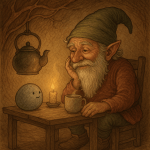
A very old elf sat in a very old chair beside a very lively compost heap. The elf was called Fle. His beard was the colour of mushroom caps after a rain. His boots were the colour of boots that had never met soap. In front of him, a kettle hung over a candle. The candle was in the habit of thinking it was a bonfire and tried to crackle, which is how the kettle took so long to boil.
Fle lived far below the bright and noisy world. He preferred the hush of soil, that polite sort of quiet that is full of useful gossip. Roots whispered about the weather. Worms hummed through the dark like small violins. Stones said nothing at all, which Fle usually counted as a blessing.
On this particular afternoon, while the kettle was deciding whether to be tea or drama, Fle poked through a tray of ordinary-looking pebbles he had collected from the tunnels that morning. He liked to keep a bowl of them near the fire as a reminder that the world still had weight, even on days when he felt rather floaty in the head.
He chose one round, unremarkable pebble and was about to begin a very serious contemplation on the virtues of roundness when the pebble spoke.
“Good afternoon,” the pebble said, with a voice like two teaspoons tapping at the bottom of a cup. “Do you think light has elbows?”
Fle looked at the pebble. Then at the kettle. Then back at the pebble, in case it had been the kettle who spoke and the pebble who boiled. He scratched his ear. His ear declined to answer.
“Pardon?” Fle said.
“Elbows,” said the pebble. “You know. Hinges for bending corners. Light keeps turning around things it cannot pass through. That is suggestive. Do you suppose it bends at elbows, or is it more of a polite wiggle?”
“Pebbles do not speak,” said Fle, mostly to see whether speaking about speaking would cancel the problem.
“Agreed in principle,” said the pebble. “Yet here we are. Now, if light bends, it must be thinking. Things that think need rest. Where does light sit down when it gets tired?”
Fle decided he should not drink tea that had not yet been made. He put the pebble down and folded his hands.
“What are you?” he asked.
“A philosopher,” said the pebble. “But do not let that worry you. I am only a pebble on my mother’s side.”
“Ah,” said Fle. He had met mushrooms who wrote poetry and an eel with a law degree. He supposed a philosophical pebble was no worse.
The pebble rolled a little to get more comfortable. “Would you say soil dreams, Fle? And if it does, does it dream of sky, since that is what it does not have?”
“Soil dreams of seed,” said Fle at once. “Always seed. Because seed is a promise it can keep.”
The pebble was quiet. Then it gave a small approving tick, like a tiny clock deciding to be pleased.
“You will do,” it said. “I am looking for silence.”
“Then you are in luck,” said Fle, and he gestured at the grand hush of his subterranean home.
The pebble sounded doubtful. “This is not silence. This is a crowd of shy noises. I want the real thing. The kind of silence that teaches you how to listen.”
Fle considered this. “And what will you do with it?”
“Stop asking questions,” said the pebble. “There must be a way to stop. I have tried not being curious. It hurt my corners.”
“Pebbles do not have corners,” said Fle.
“Exactly,” said the pebble. “You see the problem.”
Fle poured the first proper cup of tea and set the second cup in front of the pebble. The pebble vibrated in gratitude and warmed a fraction.
“All right,” said Fle. “We will find this silence together. I will be your legs. You will be my questions.”
“Excellent,” said the pebble. “But first, what is tea?”
They set out through the tunnels, Fle with the pebble in his pocket, the pocket with a little hole that let in a thread of light, and the pebble with an increasingly steady thrum that was either excitement or a small geological tremor of happiness.
The first place they visited was the Hall of Thinking Moles, because moles understand darkness better than anyone who is not a potato. The hall was not much of a hall. It was a soft boulevard of tunnels arranged in tasteful loops, with mud signage at snout height. Fle tapped politely on a wall. The wall blinked. Moles are easily startled when the day arrives through the masonry.
A mole with a velvet waistcoat wriggled out. He had a pencil behind one ear and a pebble of chalk behind the other. He nodded at Fle with the solemnity of a librarian who has successfully shushed a thunderstorm.
“We seek silence,” said Fle.
The mole pressed two paws together. “Naturally. Please fill out these twelve forms.”
He handed Fle a leaf, a second leaf, and then ten more leaves that were not entirely certain they wanted to be forms. Fle tried. His handwriting looked like a family of ants who had got lost and were doing their best. The pebble tried too. It produced an elegant series of dots.
“Your companion writes beautifully,” said the mole, and tucked the leaves under his vest.
“We want the kind of silence that teaches listening,” said the pebble.
“Ah,” said the mole. “You want the Silence Below the Silence. For that we recommend the Three Day Truffle Retreat, which includes guided not-speaking, mindful snuffling, and a certificate with gold ink.”
“How much?” asked Fle.
“A handful of patience,” said the mole.
Fle emptied both hands. “I have only ordinary patience.”
“That will do,” said the mole. “Close your eyes.”
They closed their eyes. They breathed. They listened. The soil shifted softly like a sleeper turning over. Far away, water threaded stones in a friendly way. Fle felt his own heart go plink plink plink as if it had something to add.
After three breaths, the pebble said, “Is it working yet?”
“Three days,” whispered the mole.
The pebble tried to be a statue. It managed three heartbeats. Then it skittered in Fle’s pocket.
“I am sorry,” it said fiercely. “I am made of questions. I would explode into dust if I tried to be otherwise.”
The mole opened one eye. “Perhaps your silence is not the silence of moles. Try the Worms’ Conservatory. They have music that sounds like listening.”
They thanked the mole and proceeded to the Conservatory of Worms, which was long and slim and damp. Worms in bow ties and worms in shawls were practicing scales by sliding through different soils. Their conductor, a glossy red luminary called Maestro Vermis, bowed at Fle and at the bulge in Fle’s pocket.
“Welcome,” he said. “We play soil in keys of rain, root, and distant thunder. Please take a seat on the moss. Our next piece is a meditation in C major, which is to say compost.”
The orchestra assembled. There were altos with a hint of clay, tenors with sand in their vowels, and a bass worm who could make the floor purr. The conductor lifted a blade of grass, which here served as a baton. The music began.
Fle heard the slow turn of leaf to loam, the soft crumble of yesterday into today. A rhythm like footsteps that belonged to roots. A choir of threads. The pebble hummed in agreement until it forgot to hum and only felt.
When the piece ended, the room remained quiet. A good music always leaves a shape behind. Fle sat inside that shape with his eyes closed and thought of sowing.
The pebble gave a small sigh. It had discovered that sighing was an art form.
“I like it,” the pebble whispered. “But the listening is still full of sounds.”
“Listening is a basket,” said Maestro Vermis, who had slithered nearer. “You cannot carry it empty. Try the Sidebar of Stones.”
The Sidebar of Stones was exactly what it sounded like. A long bench in a cave where stones went to be stones together. There were cobbles with a pleasant roundness. Slabs with a seriousness that made Fle sit up straight. Shales in layers that looked like they had been carefully folded to fit in a drawer.
They all said nothing in a very professional way.
Fle placed the pebble beside them. For a while nothing happened, which was the whole point. The pebble tried to join the silence with enthusiasm, which is not advisable. Silence is allergic to enthusiasm. It itched. The pebble scratched. The itch moved.
At last, one slab shifted a hair and spoke with a voice as old as a map.
“Do you want our silence,” it said, “or do you want your own?”
The pebble thought. For a pebble, thinking is a kind of music. The stone bench received the music with grave attention.
“I want to stop asking questions,” the pebble said.
“Then ask the right one,” said the slab.
“What is the right one?” asked the pebble at once, which made Fle smile in spite of himself.
The slab did not answer. Slabs are very strict about pedagogy.
Fle picked up the pebble again and walked on. They passed a pool where blind fish drew silver shapes in the dark. They crossed a field of glow moss that spelled out polite greetings to passing beetles. The tunnels narrowed and then opened into a chamber hung with crystals that looked like winter caught in the act.
A single quartz stood separate from the rest, pale and still. It was tall enough to be a door and sad enough to be a poem.
“Good day,” said Fle.
“I hope not,” said the quartz without moving its mouth, since it did not have one. “Days are for glitter. I am off glitter at present.”
The pebble trembled. “Are you a philosopher?”
“I tried to be,” said the quartz. “I began as a shard of light trapped in stone. I finished as a stone trapped in itself. I grew a thought. The thought grew points. The points grew heavy. Now I am tired of growing.”
“We are looking for silence that teaches you how to listen,” said Fle.
The quartz made a sound like a bell being careful. “You already have it. You only need to know where it sits.”
“On chairs?” said the pebble, which was very fond of surfaces.
“In patience,” said the quartz. “And sometimes in the space after laughter. There is a hush that follows a good joke which holds more truth than a library.”
The pebble was baffled and delighted. “Then tell us a joke.”
“I only know one,” said the quartz. “It is not very funny unless you are a crystal.”
“We will risk it,” said Fle.
“All right,” said the quartz. “What did the stalactite say to the stalagmite?”
“I cannot guess,” said the pebble.
“I am only hanging on,” said the quartz. “The rest is a drip.”
Something about the way the quartz delivered this line, so pure and free of self-importance, made Fle snort. The snort startled a bat into a quiet squeak that sounded like a hiccup for shadows. The bat’s squeak made the pebble giggle. Fle laughed properly then, a sound that knocked the dust off old corners. The quartz did not laugh, but its pale body brightened a shade.
After the laughter, there was a pause. The pause was not embarrassed. It did not shuffle its feet. It set its hands in its lap and looked kindly at everything.
The pebble noticed it at once. “There,” it whispered. “Listen.”
They did. The pause had a shape like a bowl. Inside it, thoughts could sit down. Questions did not need to be answered. They could tilt their faces up and drink.
“Take this with you,” said the quartz. “You cannot pack it. You must make it where you stand.”
“Thank you,” said Fle.
“And if you ever see glitter,” added the quartz, “tell it I am only resting.”
They went on, turned left around a memory, and found themselves at the Root Gate. Fle had only been here once, long ago, when the oak above had been a little taller than a dream and the badgers had not yet struck their bargain with the hedgehogs. The Root Gate was a lattice of immense roots woven together by time and agreement. The air smelt of old bread and promises.
A figure waited at the gate. It was neither mole nor worm nor stone nor crystal. It looked like a person who had borrowed their shape from the idea of a tree. Its hair was leaves. Its skin was bark. Its eyes were whistle holes in a flute.
“Keeper,” said Fle, with respect that had not once been taught and therefore could not be unlearned.
“Fle,” said the Keeper. “You have come again.”
“I have brought a question,” said Fle.
“Naturally,” said the Keeper. “We keep those as well.”
The pebble rolled into Fle’s palm. “I want to stop asking questions,” it said in a small voice. “But I do not know how to stop being myself.”
The Keeper smiled. The leaves made the sound leaves make when they are pleased with the weather.
“Do not stop being yourself,” said the Keeper. “Be yourself completely. A question is a door. Some doors lead to more doors. That is delightful if you are a hallway. It is not restful if you are a room. You must learn when to be hallway and when to be room.”
Fle felt the truth of it settle in his bones. He had been a hallway many times, mapping the veins of the earth, tracing the path of water from shale to root. He had also been a room, putting the kettle on and permitting nothing more difficult than steam to enter.
“But how do I know,” asked the pebble, “which to be and when?”
The Keeper reached out and touched the Root Gate. The roots answered with a slow music that was not sound so much as shape. It flowed through Fle and filled the pebble with a warmth that was almost roundness itself.
“Try this,” said the Keeper. “Before you ask a question, make a small room inside your listening. Leave the door open. If the question hurries in by itself and sits down comfortably, it is the right time. If it knocks too loudly, ask it to come back later. It will. Good questions have good manners.”
The pebble thought, which for it was prayer. “I will try.”
The Keeper turned to Fle. “And you, old friend. What do you seek beneath the seeking?”
Fle looked at his hands. Soil lay in the lines of his palms like a quiet script. “A way to be useful,” he said softly. “Without breaking what I love by improving it.”
The Keeper nodded. “Be compost. Take what the day gives you. Turn it slowly. Return it richer. That will be enough.”
They thanked the Keeper and left the Root Gate to its business of holding the world together with a relaxed grip. On the walk back, Fle felt lighter in the heavy way he liked best. The pebble did not speak for a long time, which in pebble terms is a sign of deep contentment or the early stages of a nap.
They reached Fle’s home in the dark that comes after the dark has finished its chores. The kettle, which had been very brave, had boiled and then forgave itself.
Fle poured tea. He set the pebble on the table. The silence between them was new. It had a pleasant weight. It let the candle flicker without turning it into a performance.
“All right,” said the pebble at last. “I will try being a room.”
It closed its questions like eyelids. The room welcomed them. The candle bowed. The kettle made a small approving glug.
After a time, the pebble spoke again, very gently, as if careful not to poke holes in the quiet.
“Fle,” it said. “If silence is a room, what is laughter?”
“A window,” said Fle. “With the breeze coming in.”
The pebble vibrated with happiness. “And what are friends?”
“Chairs,” said Fle. “Sturdy ones, with cushions that know your shape.”
The pebble tried not to ask another question. It tried so hard that it shivered. Fle reached out and set one finger on it, like a paperweight on a lively thought.
“You may ask,” he said. “Rooms do not forbid the door.”
The pebble drew a breath it did not need. “Will you keep me?” it asked.
“Always,” said Fle. “Unless you roll away to find your own room. Then I will keep the space where you sat and let sunshine in on purpose.”
The pebble glowed with the dull and private glow of complete satisfaction. It had found something that was not silence and yet was the reason for silence.
The days that followed were small and excellent. Fle listened to roots with the confidence of a man who has found a hat that suits him. He brewed tea and invented a way to hang carrots to dry that did not insult the carrots. He attended a lecture by Maestro Vermis titled A Brief History of Mud and managed to remain awake through almost all of it. He purchased a certificate from the moles not because he needed one, but because the gold ink was charming.
The pebble asked questions as before, but now they came in clusters like grapes rather than like hailstones. Between clusters there were soft places where the pebble sat in its room and watched the world pass through the window of laughter. Sometimes the only question it asked all morning was whether the kettle preferred to boil on a Tuesday. The kettle had no opinion but appreciated being consulted.
One evening a knock came at the door. It was the quartz, who had decided it was ready to be seen in public again. It stood in the doorway like a polite winter and said that glitter had been in touch. Glitter was doing well. It had joined a circus.
Fle set out three cups, because hospitality is a way of opening a room so wide it becomes a field. They drank in a companionable line. The quartz told a new joke about a geode who retired to focus on being hollow. Fle laughed. The pebble giggled and then left the giggle ajar so the silence could look in and borrow a chair.
When at last the candle burned down to its sensible end and the kettle sighed like a satisfied hill, the pebble spoke one more time for the night.
“Fle,” it said. “I think I have found my question.”
“Tell me,” said Fle.
“If I am a door,” said the pebble, “where do I open onto?”
Fle smiled into the comfortable dark. “On to us,” he said. “On to now. On to whatever sits down in the chair and likes the cushion.”
The pebble rested. The quartz gleamed like a promise that had kept itself. The soil around the house turned over a little in its sleep. The worms sang a bar or two very quietly, the way musicians hum after closing the case. The moles far away filed a report titled Silence Achieved, Provisional, With Laughter.
And somewhere high above, light tried its elbow at the edge of a cloud, then rushed along happily, not because it needed a place to rest, but because it had remembered that windows are just doors that forgot to keep secrets.
In the morning, Fle woke with a new idea for compost that would make spinach sing alto. He told the pebble. The pebble asked if spinach preferred alto to mezzo. They debated. They laughed. After the laughter, they sat and listened, and the room filled itself with the quiet you carry when you know where to put your questions.
Which is to say, everywhere.

Epilogue — The Question That Rolled Away
The Question that rolled away song – enjoy
The morning after the quartz’s visit, Fle awoke to find a small hollow on the table where the pebble had slept. It was still warm, as though a thought had recently vacated it. He searched under the chair, behind the kettle, and even in his boot, which had been known to host unexpected guests before. But the pebble was gone.
At first Fle was cross in the mild, dignified way that only very old elves can manage. He muttered about ungrateful minerals and unannounced departures. Then he saw what the pebble had left behind: a single line drawn in fine white dust across the floor, looping gently toward the tunnel that led to the world beyond.
Fle sighed. “Off to ask the world its opinion,” he said, and smiled despite himself.
He took his walking stick, his travelling lantern, and a small paper bag of tea leaves “for emergencies of thought.” Outside, the tunnels were unusually bright. It wasn’t sunlight — more like a mood the earth had decided to wear for the occasion.
He followed the trail as it curled past the Hall of Thinking Moles, who waved their chalk in polite farewell, and through the Worms’ Conservatory, where Maestro Vermis conducted a new piece entitled Symphony in Humidity. Finally, Fle reached the Root Gate.
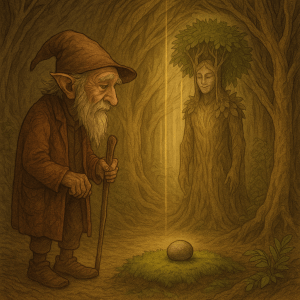
There, in a patch of soft moss, sat the pebble — perfectly still, perfectly content. The Keeper of Roots was with it, humming something ancient and leaf-shaped.
“Ah,” said Fle, leaning on his stick. “You found your room.”
The pebble glowed faintly. “Yes,” it said. “I opened onto here. I am listening to the world listening to itself. It’s rather lovely.”
Fle nodded. “That’s the best kind of silence. The sort you can hear.”
The pebble was quiet for a moment, then said, “Do you think… I might visit sometimes?”
“Of course,” said Fle. “Rooms should have doors that open both ways.”
They said no more after that. The Keeper smiled and went back to tending the Gate. The pebble sank a little into the moss, humming softly to the rhythm of the roots. Fle turned for home, whistling an old composting tune.
When he reached his door, the kettle began to boil all by itself, which he took as a sign of excellent timing. He poured two cups, set one at the edge of the table for tradition’s sake, and lifted his own in a toast.
“To good questions,” he said aloud. “And better listening.”
Down in the earth, a faint echo answered — not words, but a feeling, like laughter resting between heartbeats. And Fle, who had always preferred the company of quiet things, smiled and let the silence sit with him.
 The Crazymad Writer Writes Again