RSS

The Haunted Chip Shop

The Haunted Chip Shop

The Haunted Chip Shop

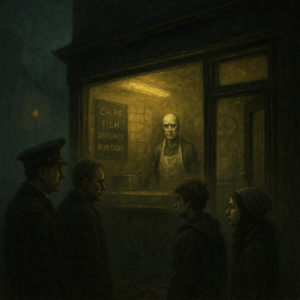
Chapter One — The Light That Doesn’t Blink

On nights when the fog slides down from the Wicklow hills—a slow, woolly animal that noses around doorways and licks the cobbles clean—there is one patch of colour left on Church Street. The chipper window, a jaundiced square, burns like a bruise you can see from two bends away. The rest of Tullow dials itself down to greys and soft blacks; that pane stays a tired amber, as if a low sun were trapped inside the fryer and could not die.

Dogs know better. They cross the road long before they reach the door, hauling their people with them, nails skittering on stone. Buster, the butcher’s collie, plants his paws and refuses to move until someone says the word “river” and points away. Cats sit on windowsills facing it, tails ticking, eyes full of small arithmetic. Moths do a kind of soft worship, bumping the glass and falling away with dusty thuds, then returning, as if something in there is counting them.

Nobody claims the shop belongs to them. Nobody remembers renting it out, or signing for deliveries, or cleaning the hood after a busy Saturday. It’s just—there. Whitewashed walls stained to the colour of weak tea, a door that’s never locked, a bell that never rings, and that glow that paints the fog a sickly, drinkable gold.

Tonight the fog arrived early. Declan O’Connor came out of his bar wiping glasses in the street air the way barmen do—an old reflex, a sign to stragglers that the night’s nearly done. You could tell it was a slow evening by the way he wiped a glass until it squeaked; on busy nights, he only managed a foggy shine. He paused halfway through the motion and looked across at the chipper.

“Light’s the same,” he said.

“It’s always the same,” said Mrs. Brigid Kavanagh, who had been tracking his hand with her eyes because she couldn’t abide streaks. Her scarf was a colour the factories had retired in the seventies and her handbag could fell a grown man. “That light’s older than the telephone box.”

Sergeant Flanagan, who had taken a patrol that was mostly an excuse to walk off his dinner, stopped too. “Do ye ever remember it flickerin’?”

The three of them stood for a moment, listening to the fog tidy the town into muffled bundles. Somewhere far off, the Slaney turned over in its sleep. Somewhere close at hand, an unseen chip hissed in oil. The sound didn’t come from the shop so much as from the street itself, from the cobbles and the air in your ears.

“Flicker?” Declan said. He waited. The glass in his hand was clean enough to shave in. “Not once.”

“Maybe it’s not a bulb,” said Mrs. Kavanagh. “Maybe it’s… a fire.”

“In a chipper?” Flanagan asked. “God help the insurance.”

They laughed the small laugh people use to keep the world nailed where it is. The laugh spooked and ran as a pair of teenagers came out of the fog, a boy and a girl with the particular reckless quiet of those who believe no rule applies to them until it does.

“Tommy Doyle,” Mrs. Kavanagh said, because names are power. “You’re not goin’ in there.”

“Wasn’t,” Tommy said, which was true at the exact moment he said it. His jacket was unzipped against advice, his hair doing its own weather. Sinéad Walsh walked half a step behind, eyes narrowed the way people look at puzzles they’re not sure they want to solve.

“We were only—” Sinéad began, and didn’t bother finishing because Mrs. Kavanagh had turned back to the window as if dragged by an invisible hook.

Through the glass, the counter gleamed with the wet shine of things forever wiped and never clean. The chalkboard to the left listed CHIPS, FISH, SAUSAGE, and BURGERS in a hand that was different every night but always too careful, the chalk squirming away from certain letters. Underneath the staples was a smudge of additions and deletions that might once have been SPECIALS; now it looked like a fingerprint the size of your head.

The counter was manned. It always was, though nobody remembered seeing anyone travel to or from the spot behind it. Tonight the cashier was a man of an ordinary shape and an unhelpful age—late enough to have learned to be careful, early enough to still be tempted not to be. His hair lay flat; his apron was clean. He had the sort of face you’d forget between the door and the pavement, except for the eyes, which were the exact colour of the fryer and seemed to cross a little whenever steam rose.

“Do you know him?” Flanagan asked, already knowing the answer.

“No,” Declan said. “And I know everyone.”

“He’s not from town,” Mrs. Kavanagh declared, which for her was both a description and a sentence.

The cashier looked up as if he had heard his cue. He didn’t wave. He didn’t nod. His gaze rested on them a fraction too long, then moved to the next passerby, the next shape in the fog, as if he were marking attendance. The fryer hissed again, louder this time, and though nobody had seen him lower a basket, something in there rose and turned and suffered a little and then didn’t.

The door wasn’t closed; it never was. A strip of air lay under it, damp and cold, with an edge like a coin. The bell above it trembled slightly without producing a sound. A fly walked slow circles on the glass and found its own footprints.

“Go on then,” Sinéad said, her tone feather-light so the dare wouldn’t weigh enough to pin either of them to the spot. “If you’re such a big man.”

Tommy didn’t move. He was looking at the reflection of himself in the glass—him and Sinéad, and Declan and Mrs. Kavanagh and the Sergeant, and beyond them the streetlights scumbling the fog into halos—and then at the reflection of the chipper window inside the chipper window, and further back, further in, as if the glass were a corridor of night-time squares, each one with a smaller him and a smaller her looking in. In the third or fourth reflection, he thought his hair was shorter, and in the fifth his shoulders were narrower, and in the sixth he had grey at his temples. He blinked and the trick folded itself up and vanished; he was only himself again, in this one wet night, with the taste of nothing much in his mouth.

“Big man?” he said, and stepped forward because that is what boys do when the road forks.

The bell gave a single sound like a penny dropping under water. The air inside the shop had a flavour: old oil, sure, and vinegar, yes, and something else—a sourness with teeth. The floor tiles weren’t tiles at all, not in the way a person understands tiles; they were squares cut from something that had once been flexible and had now set. The counter smelled like a church just after the candles go out. The ketchup bottle stared with an unblinking red eye.

“Evenin’,” Declan tried, because someone ought to be polite when entering a place that isn’t theirs. The cashier didn’t smile. He didn’t frown. He looked at Declan as if seeing where he would fit on a shelf.

“Two bags of chips,” Tommy said, because talking is another fork in the road, and you might as well choose. Sinéad took a half-step to the side to see the back room without being seen doing it.

The fryer was a rectangle with rounded shoulders, the steel pitted to a dull matte by steam and time. The oil didn’t look hot until it did; its surface trembled like an animal breathing. There were two baskets. One was empty. The other had a shine to it that wasn’t oil. No radio. No clock—except there was a clock; you just didn’t register it at first because it had the kind of face you don’t notice unless you’ve already been looking at it for a while. Its hands were wrong: they didn’t jump, they flowed, and sometimes they went the other way, tiny back-swims of time, like a fish correcting its position in a stream.

The cashier lifted the empty basket, though neither Tommy nor Declan saw his hand close on it. The sound of lowering rattled the air. The oil received it with a hiss like a thousand shushes. Somewhere behind the fryer there was a door, and behind that another, and they were both ajar in the way mouths are ajar when someone is deciding whether to speak or bite.

“How much?” Tommy asked, already digging in his pocket for coins. He didn’t want to hand over a note; notes made noise in your wallet, and he suddenly felt like the shop leaned toward noise.

The cashier looked at him. Not his face. Not his hands. At his throat, as if gauging the depth of something lodged in there. “First time?” he asked, and the sound of it startled everyone, because the staff hardly ever spoke. The voice was dry enough to rasp but carried, like a whisper heard from under a bed.

“It is,” Declan said quickly, laying a tenner on the counter to settle the world back into its grooves. “We’re mindin’ the young ones.”

The cashier let his eyes move to the note for a second and then back to Tommy. A question sat in the space between them like a hot plate.

“Money’s good,” Declan said again, and because he ran a bar he knew when a purchase needed a witness, he added, “Isn’t it?”

The cashier placed a hand on the counter. The skin had the peculiar blandness of someone who had never worked a day in daylight. “Tonight,” he said, “yes.”

Coins changed hands, or seemed to; Tommy’s palm was suddenly lighter and his pocket no heavier. A paper bag opened itself between two fingers and stood patient. The fryer exhaled a ghost. The tong—a single tong?—clicked once to test its own hinge.

Outside, the fog thickened. The street narrowed to two lights and the space between them. Sergeant Flanagan coughed because the idea of not coughing had occurred to him and he wanted to choose for himself. Mrs. Kavanagh fished in her handbag for nothing in particular and found what she was looking for: the weight of it.

The chips came up the colour of one hundred school dinners and one hundred perfect Sundays. Oil shed in bright beads. The paper bag took them as if they had turned to rain. The cashier folded the top crisply, one, two, three, like a flag at a military funeral.

Tommy took the bag. It was heavier than it should have been, or lighter, or both; weight slid around inside it like attention. He looked at Sinéad. She held his gaze with that straight, sharp look of hers. He didn’t need to be told not to eat in the doorway. He didn’t need to be told to get out.

They stepped back into the fog. The bell stayed silent this time, though the door moved.

“What?” Sinéad asked when they had come far enough for the light to be a pressure on their backs instead of on their skin. They stood in the lee of a shuttered shop where the fog pooled like breath. “Well?”

Tommy opened the bag. Steam rose and bumped their faces. He pinched a chip and held it up between them. It looked ordinary if you didn’t look too long. It looked like a piece of potato that had done what it was told.

He put it in his mouth.

There is a number of chews that every human learns: the chew that says “hot,” the chew that says “salt,” the chew that says “too hot,” the chew that says “worth it.” Tommy reached none of those. The first chew was a footstep. The second was a stair. On the third chew, he was nine years old and hiding under a table while two voices he loved had a conversation in a room they didn’t know had him in it. On the fourth, he was sixteen and listening to a door click shut somewhere you should never hear a door. On the fifth, he understood he was being looked at from the inside out.

He stopped. He swallowed because spitting felt like it would be rude in a way that could kill him.

“Hot?” Sinéad asked, though she could see his eyes had changed focus.

“Tastes like… chip,” he said, and heard the foolishness of it and clung to it, because ordinary words are grappling hooks on steep nights. He held the bag out. “You?”

She took one. She did not eat it. She sniffed it the way a person sniffs a house when they walk in for the first time and try to decide if they should back out again. She put it in her mouth and bit once, delicately, her teeth touching as if greeting each other. Her jaw paused. Her eyes counted seconds.

She spat—not the chip itself, but the idea of it. She stuck out her tongue and wiped a long grain of salt from the middle with the back of her hand. “Someone said my name,” she said, too light to be casual.

“Who?”

“The bag,” she said, and laughed so that the words would have a soft place to land. “Only… you know.”

Behind them, the chipper door eased open without a hand and leaned there, listening to its own hinge. A paper bag slid across the tiles and paused at the threshold. It was folded tight. The grease blossom on its side resembled a mouth.

Sergeant Flanagan saw it first. He moved as if to nudge it back with a toe and then didn’t. There are lines you know by feel. “Someone forgot their order,” he said, to put a roof on the moment.

“No,” Mrs. Kavanagh said, the word a little too quick, the way you speak to stop a child touching a pot on a stove. “No free food.” She bent, took the bag between two fingers as if it might twitch, and placed it back just inside the door. The bell trembled. The door closed itself, not with a bang but with a neat little click, the sound a seam makes when two edges meet again after being parted.

The fog breathed. The light stayed on. The hum in the cobbles under their shoes continued at a pitch you only really hear when it stops.

“Right so,” Declan said, and clapped his hands as if to wake the night properly. “Home with the lot of ye. Mass in the mornin’ if the Father’s up for it, and if he’s not, say a decent word near the river and it’ll know who it’s for.”

They dispersed the way people in small towns always do: orbiting the same centre, passing the same windows, making the same promises to themselves about what they will and won’t do next time. Flanagan took the long route back to the station, because the shortest way went past the chipper and he didn’t want to measure anything against it. Mrs. Kavanagh walked with them as far as the crossroads, then turned left because left felt less chosen than right.

Tommy and Sinéad went three doors up and ducked into the shadow of a doorway with a missing handle. They stood shoulder to shoulder, not touching.

“Did you hear the bell?” he asked.

“No,” she said. “Did you?”

“I heard it before we went in,” he said. “Not when we left.”

“Maybe it only rings when you’re still decidin’.”

He folded the paper bag closed, sharply, the way he’d seen the cashier do it. The crease made a shape like an arrow.

“Keepin’ it?” she asked.

“For the bin,” he said, and didn’t move to find a bin.

They waited a while, because sometimes waiting is the only thing you can do that doesn’t feel like surrender. The fog thinned by fractions. A car went by, an exhaust note and a hiss and the brief map of red lights. The chipper light didn’t change. It burned in the corner of his eye as a square he could carry with him wherever he looked.

“Tomorrow,” Sinéad said at last, as if scheduling something in a diary neither of them owned.

“What?”

“Let’s see if it’s open in the day.”

Tommy almost said, “It’s always open,” and stopped himself. He nodded instead, and the nod was a promise to both of them and to the town.

They walked home. Behind them, the hum under the cobbles shifted and settled like a creature adjusting its weight in its den. The moths counted themselves back into the dark. The clock in the corner of the chipper, which nobody had properly seen and which didn’t quite know it had hands, flowed its way to 3:11 a.m., then slipped backwards twice like a fish nosing against a current, then chose forward again, because forward is what clocks do when watched.

On Church Street, where fog loves to practice being forever, the light did not blink. Not once. Not ever. Not yet.

the haunted chip shop


The Haunted Chip Shop

Chapter Two — A New Face Every Night

By day, the chipper was a trick of the fog. Blink and you’d think the place was shut: blinds down, no movement, no queue, no smell of salt and grease. By dusk, though, the amber light bloomed again, and the counter was never empty.

The people behind it changed each night. Not in the way a shop hires teenagers for summer shifts, not in the way staff turn over slowly and you notice it on your third visit. No — this was every single night.


The Woman with the Egg Eyes

On Monday, a woman with eyes like boiled eggs served chips. They bulged, white and slick, with a pinprick of yolk where pupils should have been. She scooped from the fryer as if blind, but never spilled a chip. People queued anyway. Some swore she stared right through their skulls, yolks drilling down into the marrow.

Mrs. Brigid Kavanagh took one look and muttered, “That one’s not from Tullow.” Then she said nothing else, because to comment further felt like inviting something closer.


The Boy with the Greasy Hands

On Tuesday, it was a boy, no older than sixteen, grinning so wide the corners of his mouth creaked. His hands shone with oil that never dripped, never dried. Every time he brushed a coin, the metal smoked faintly, like bacon in a pan. He counted change with the care of a surgeon and pressed the notes into palms so firmly the smell clung for days.

Tommy Doyle noticed the boy didn’t blink. Not once, through the whole evening.


The Silent Old Man

Wednesday brought silence. An old man manned the counter, skin creased like butcher’s paper, lips thin as a knife’s edge. He took orders with a nod, served with precise motions. Not a sound passed his throat. Not when Declan O’Connor greeted him. Not when Breda Maher asked what fish they used.

But when Sergeant Flanagan dropped a coin on the floor, the man turned his head sharply — not toward the clink, but toward Flanagan’s throat, watching the shape of his Adam’s apple as he swallowed.


Gossip in O’Connor’s

By Thursday, the town was whispering over pints.

“They’re blow-ins,” someone said. “Travellers, maybe. Passing through.”
“Passing through where?” another asked. “They’ve never left the counter.”
“Did ye ever see them after hours? Any of them?”
Silence answered.

Declan polished a glass until it sang. “I’ll tell ye what’s true,” he said. “There’s no one livin’ in Tullow who owns that shop. Never paid a bill. Never cashed a cheque. Never set foot in Mass.”

“And yet it’s open every night,” Mrs. Kavanagh muttered. “Always open.”

The conversation ended there, because the pub lights flickered — just once, like a wink — and the smell of vinegar drifted in though no bag of chips had crossed the threshold.


Tommy and Sinéad’s Dare

Tommy Doyle and Sinéad Walsh met at the corner that night, fog rolling between their shoes.

“Same again?” Sinéad asked, though her tone was more warning than invitation.

Tommy shoved his fists in his pockets. “I want to see if it’s true.”

“What’s true?”

“That it’s never the same person twice.”

She didn’t stop him, because she wanted to see too. Curiosity’s a door you can’t close once it’s been nudged. Together, they walked into the jaundiced glow, where the window hummed with light and the fryer hissed like a throat boiling secrets.

Tonight’s cashier was different again: a woman whose hair dripped with water that left no puddle, as if she’d stepped straight from the Slaney. She smiled without opening her mouth, and her eyes were pale as river stones.

“Chips?” she asked, her voice a ripple over water.

Tommy’s throat tightened. Sinéad reached for his sleeve, but he’d already stepped to the counter.

Because in Tullow, once you’d entered the chipper, leaving without ordering was the one thing nobody dared.

a new face every might

The Haunted Chip Shop

Chapter Three — When Food Learns Your Name

The first strange bite was almost a joke.

A bag of curry chips, steaming hot, handed to Michael Doran after the Friday dance. He and his mates staggered out into the square, grease soaking the paper bag. He popped one in his mouth and laughed, half from drink, half from hunger.

Then the chips hummed. Not loud enough for the others to hear—just low, buzzing, a tune playing against his teeth. He spat it onto the ground, swore, and laughed again. His friends roared with him, shoved each other, told him he was cracked.

But when the next chip sang the same tune, slow and low like a dirge sung underwater, Michael dropped the bag and never ate from the chipper again.


The Whispers Spread

Word drifted through Tullow like steam: food from the chipper wasn’t just food.

At first, it was harmless. Chips that hummed lullabies. Battered sausages that whispered bad jokes, filthy as graffiti. A burger that muttered, “Hungry, are ye? Hungry forever,” between each bite.

Teenagers dared one another to order and eat. They crowded on the church steps after closing, laughing with grease on their fingers, chips singing from their bags. The braver ones came back week after week, claiming the food told them secrets of the future.

But not all secrets should be told.


The Widow’s Snack Box

Breda Maher, a widow for twenty years, finally gave in to temptation. She ordered a snack box. In the square outside, she lifted a drumstick to her lips.

She bit down once.

And the chicken whispered the name of her husband. Not as she knew him in life, not as the town knew him in his coffin—but the name he used the night he begged her not to bury what she buried. The name he said when the shovel cut earth.

The meat in her mouth turned slick and heavy. She dropped it, gasping, her throat burning with old dirt. She never touched the food again.


Declan O’Rourke’s Burger

One night, Declan, drunker than was decent, ordered a burger and chips. He ate standing under the streetlamp, grease dripping onto his shirt.

The burger spoke in his own voice. Clear. Measured. It described the hour and manner of his death: three weeks hence, drowned in the Slaney, lungs burning, hands clawing riverweed.

Declan laughed, so loud the square echoed. He roared, grease spraying from his lips. “I’ll drink to that!” he shouted, raising the burger as though to toast it.

Three weeks later, he staggered home from the pub, stepped onto the riverbank, and never returned. The Gardaí called it misadventure. The town called it proof.


Confession in Grease

By now, the chipper was no longer just a place to fill your stomach. It was confession in grease. People queued for it. They went in with coins in their hands and came out pale, shaken, mouths full of things they hadn’t wanted to know.

No priest could absolve what the chipper dredged up.

And no one ever managed to stop eating.

Because once food has spoken to you, silence tastes wrong.

The Haunted Chip Shop

Chapter Four — The Price Menu (Unposted)

By day the chalkboard in the chipper window is just that: chalk. CHIPS. FISH. SAUSAGE. BURGERS. The letters change their slant each morning as if a different hand were learning the same alphabet. Prices sit beside them in careful figures that never quite smudge in the same direction. It looks ordinary until the light inside comes on and the fog leans in and you step through the door and try to pay.

The first time, money behaves. Notes go soft in the greasy air, coins pick up a sheen and a smell that will not wash out of your purse for a week, but they’re accepted. The till—if that metal mouth at the end of the counter is a till—chimes a single flat note and a drawer slides, shallow as a breath. You feel better: things still cost.

The second time, the drawer doesn’t move.

“Two bags of chips,” says Kieran the postman, easy, like a man asking for what he has asked for all his life. He sets a ten-euro note on the counter and presses it with two fingers so the curl at the edge doesn’t flick up.

The cashier—tonight a boy whose skin looks dusted in flour that won’t pat off—doesn’t touch the money. He looks at Kieran’s throat like he’s estimating the diameter of a pipe.

“First time was last week,” Kieran says, half grin, half apology he can’t place. “Same again, sure. Salt and vinegar. Plenty.”

The boy tilts his head. His pupils have the dull shine of oil after it’s been used a few too many times. “Money,” he says, and the word leaves a smear in the air, “is for the door.”

Kieran tries a little laugh, the kind that rests a hand on your shoulder and says we’re all right here, aren’t we? “Grand,” he says, and nudges the note closer. It leaves a faint trail, like a snail has passed that way. “Door’s open.”

“Door is the first thing,” the boy answers, and the fryer behind him releases a hiss that could be read as agreement. He draws his finger down a square of cloth by the salt. The finger leaves a dark line that sinks and holds.

“What do you want, then?” Kieran says, light failing. “I have… I’ve stamps in the bag, if it’s a barter ye’re at. A book of saints. A roll of ‘urgent—’ ”

The boy’s gaze doesn’t leave Kieran’s throat. “A song,” he says.

Kieran blinks. “I don’t sing.”

“The one you hum when you think no one’s listening,” says the boy, and for the first time his mouth shapes something like a smile. “Down in the sorting room. The one you stole off the radio in ’98 and kept like a secret.”

Kieran opens his mouth to say he doesn’t know what the boy is on about and the tune rises out of him, helpless, a little riff he’s kept on the underside of his tongue for years like a lucky coin. He hums three bars without choosing to, then clamps his jaw shut and stares at the counter as if his own teeth have betrayed him.

“Put it on the cloth,” the boy says, almost kind. “It’s only small.”

Kieran leans. The square beside the salt is not a napkin. It’s butcher’s cloth gone stiff with fat, the weave clogged with layers of old shine. From the surface a smell rises: not fresh oil but old kitchens, frying pan handles slicked by hands now dust, Sunday rooms where windows never opened, a winter of chipper-steam trapped in curtains. In the cloth the dark line the boy drew is resolving into letters: KIERAN FOLEY — 2 × CHIPS: and then a space, blank and waiting like a mouth.

“How do I—” Kieran begins.

“Just think it,” the boy says. “You’ve kept it well. It will know the way.”

He thinks it. He thinks of the small coin of tune, and as he thinks, it pries up and out of whatever part of him has tucked it away. The cloth accepts something you cannot see. The blank space darkens, then sets: ONE HUM.

The fryer takes breath. The basket goes down. From the oil rises the small sound of someone whistling under it, the echo of Kieran’s habit, and he feels a lightness behind his teeth, as if a bit has been unscrewed. He takes the paper bags when they’re folded to him and walks out into the fog with a face he’s trying to hold in a normal shape. Later, sorting letters, he will go to reach for the hum he always reaches for when the fluorescent tube fusses, and there will be a hole where the tune used to live.


By ten the queue is a weather front. Jackets bead with mist. The bell above the door shivers occasionally but does not ring; it trembles as if remembering the act of ringing.

A builder with hands like blocks of peat stands two back from the counter, rolling his right wrist. He’s Fergal McEvoy, father, drinker, fixer-of-what’s-visible. He has always paid in cash the day he has it. He doesn’t like tabs, lists, or owing anything to anyone tall enough to reach his collar. He also doesn’t like anything peering too long down his throat. Tonight, the cashier is not a boy but a woman with hair laid smooth as the Slaney in dry weather. Her eyes are the tired yellow of kitchen bulbs.

“Large chips,” he says. “And a battered sausage.”

She opens the drawer of the till to show him the emptiness, then closes it again as if to be polite about the fact. Her hand rests on the cloth. A faint scar crosses her palm. It looks like a nib mark.

“Cash is cash,” Fergal tries. He lays down a twenty as if pinning a bird to a table. “I’ll not be paying with any of your… stories.”

Her eyes flick down to the note. A drop of vinegar lands on it from nowhere and spreads. The queen’s face blurs; the figure “2” dissolves to a greasy question mark.

“The sausage,” she says, and now she does smile, but only with the front of her teeth, “will be dear.”

He squares himself. “Pick something else. I can spare… I don’t know. My left elbow. The last time I saw the sea.”

“The sausage,” she repeats, “is dear because you know it is.”

He blinks. He doesn’t, and he does. Years ago, on a Sunday, a car park, a decision he did not make but did not stop, a bag of something handed around with laughter, a smell that stuck in his boy’s hair for a week. He wakes some nights with grease baking the back of his mouth, the shape of what he did not say hot on his tongue.

“Your right hand,” she says, and the words land with the weight of prices no one agrees with and everyone obeys.

He draws back, angry because fear embarrasses him. “Are you mad? How would I—”

“Grip,” she says, and taps the cloth. “Only grip. The rest can stay.”

It’s ridiculous until his thumb and forefinger tingle. He looks down at them. He tries to flex his palm. The hand closes, opens, fine. He laughs, furious with relief. “You’ll get no such thing.”

She waits. It is a good tactic. The queue behind him breathes like one animal. He has a son, a mortgage, a knee that aches when it rains. He has set down his twenty and it has come back as paper pulp. He feels stupid in front of teenagers. He feels hungrier than is reasonable.

“Grip,” he says, grudging, like a man overpaying for tiles because the job must be done by Wednesday, and he thinks the word hard so no one can accuse him of cheating. The cloth darkens: FERGAL MCEVOY — LARGE + SAUSAGE: RIGHT-HAND GRIP. Something eases off his fingers as if a ring has been pulled, and the relief is so immediate he doesn’t feel the absence until the bags are in his hands and the handles of the bags slip straight through, paper skating out of his reduced hold. He clutches with his left and manages not to drop his dinner.

Later, in O’Connor’s, his pint slides out of his right and smashes and everyone pretends not to notice him go red.


A girl in school blazer and eyeliner too ambitious for the parish steps up. Niamh Caulfield: good at Maths, bad at keeping her voice down. She has broken silence since she could form a word. Tonight the cashier is a man as thin as a knife’s reflection. He wears his apron straight. His hair is parted with a ruler.

“Mini chips,” she says, sweet. Her coins clatter; she starts to scoop them back up as if she hadn’t meant to put down so many.

He moves her hand aside without touching it. “The price,” he says, “is not in coins.”

“I suppose you want my firstborn,” she says, because she is seventeen and television has trained her to make a joke at mirrors.

“Not yet,” he says.

She flicks him an eye. “What, then? A secret? I’ve loads.” It’s a dare and a lie: she has three secrets, two of them dull and one that sits on her breastbone like a cup of hot tea she doesn’t want to spill.

“Laughter,” he says.

She scoffs. “I can’t give that. Sure I’m full of it.”

“Exactly,” he says gently.

She opens her mouth to scald him and instead of words a giggle comes out, the reflexive little fountain she half loathes and half loves, and she sees how that sound has bought her friends, charmed teachers, lifted parents from arguments, gotten her out of more than one thing. She sees it in full, a gift she didn’t seek. The idea of removing it feels like pulling a candle out through its own flame.

“No,” she says, and hears the smallness in the word.

He waits.

“Half of it?” she tries.

He almost smiles. “You don’t set the portions.”

The fryers sing—a thin chorus, like eels moving under metal. The queue breathes. Niamh looks back to see who is watching. Everyone is watching. She knows how to leave a stage and how to own one. She also knows hunger like a sibling.

“A chip is a chip,” she says, anger rising to save her from another thing rising, “it shouldn’t cost—”

“Everything costs,” he says, and taps the cloth once. Names bud there like mould. NIAMH CAULFIELD — MINI: the blank waits.

She stares. She thinks of the friend who is only her friend because they laugh at the same thing at the same speed. She thinks of exams; of sitting through years of them without a private relief valve; of fights with her mother where her mother has laughed despite herself and the fight has broken. She thinks of people who never laugh and the way rooms treat them.

“Fine,” she says, because you can only stand on a precipice for so long before it’s falling or stepping back, and stepping back in front of a town is harder than any fall. “Take it.”

It goes. You cannot see where it goes. She carries out her paper cone, shoulders tight, her mouth set. She tries a sound in the square half for herself, half for the people around her.

Nothing emerges. She coughs, eyes wet with the memory of what a laugh used to feel like in her chest.


Not everyone gives easy. There are negotiations, and refusals, and the occasional storming out—coins screwed in a tight fist, a door that won’t slam. There is a woman in a nurse’s uniform who offers a ring and the way the cashier shakes his head silently as if she has held up a spoon to a locksmith. There is a man who offers his wedding day and is told, “We never take days you didn’t put there yourself.” There is Siobhán Quinn, hair like nettles and temper to match, who bargains down a price in a voice that would make a market-stall holder retire, adding and removing items of her own life like she’s balancing a bill: “I’ll not give you my father’s nickname, but you can have the smell of apples from the old tree, I never eat them anyway.” The cloth drinks APPLE SMELL. She takes her food, and two weeks later a Bramley will taste to her like chalk. She will pretend not to mind.

Sometimes the price is years. An old man leans on a stick and tells the waiter—tonight a girl whose hair drips water that leaves no mark on the tiles—“I haven’t got much to spare.” She looks at him with pity that is either acted or real. “Two years,” she says. “You will not miss them. They were the nap between two afternoons.” He puts his thumb on the cloth and when he lifts it the pad has a crease like a ring he never wore. He walks out with his food and everyone pretends not to see the way his back bends a fraction more by the time he reaches the door. Later, his daughter will swear a photograph on the mantel has changed: he was seventy-seven when it was taken; now the number in her head has become seventy-five, then seventy-three. She will go to bed wrong-footed and wake with a calendar she does not trust.

Sometimes the price is small and the cost is ruin. A young mother pays with a lullaby because the cashier asks and she thinks, not unreasonably, that songs grow back. That night when her child cries she opens her mouth and nothing comes that isn’t a recipe or a prayer. The baby quiets anyway, but not out of comfort. Out of listening.

Sometimes the cloth writes its own lines. Tommy and Sinéad see this from the side of the queue, pressed to the skirting, two shadows learning their own lengths. The square of fat-stiffened weave is not inert. Even when no one touches it, a letter blossoms. When the boy with the flour-dusted skin runs his finger along its top edge as you might run a finger along a dog’s back, it sighs. The names on it are neat in a way no one in this town writes their names, as if a teacher who never lived here is keeping records.

Tommy reads down the list because reading is what he does when faced with something too big to think about.

BRENDA MAHER — SNACK: ONE SECRET (BURIED)
KIERAN FOLEY — 2 × CHIPS: ONE HUM
FERGAL MCEVOY — LARGE + SAUSAGE: RIGHT-HAND GRIP
NIAMH CAULFIELD — MINI: LAUGHTER
SIOBHÁN QUINN — CHIPS: APPLE SMELL
EILEEN WALSHE — FISH: FIRST TUNE (PIANO)
JOHN MCDONAGH — BURGER: THREE NIGHTS (SLEPT BADLY)
RUAIRÍ BYRNE — CHIP BUTTY: FIRST KISS (TASTE ONLY)

He reaches the bottom and feels the drop that tells you there is further to go: _ (the wide blank of the page that is not page), then a faint line, thinner than the rest, hesitant. It is writing itself. It is his name. Not written, exactly, but drafted: THOMAS DOYLE — and then nothing, a dash, a blink, an ask.

He speaks without looking away. “Do you see—”

Sinéad says, “I see something,” and takes his elbow because she knows if she touches his hand he will think she is trying to stop him and she is not sure she could. “Move,” she says, and they move as if they meant to all along, past the salt, past the cloth, past the little clock in the corner that glides its hands and occasionally swims backwards like a fish resetting.

Out on the pavement the fog grips and lets go. He stands with the door closed behind him and his breath drawing shapes he does not recognize in the gold.

“It could be someone else,” she says, and hears it as the poor lie it is.

“It had my middle initial,” he says, and she wants to say that doesn’t prove anything but he is the only Tommy Doyle she knows who uses it, and the cloth never wastes letters.

“What would it take?” he asks eventually, which is the wrong question and the only one people ask.

“For you?” she says, because if she makes him say it aloud he might hear himself.

He chews his lip. He thinks of what is unique to him, not to the town. He thinks of small hoards: a marble he never told anyone about, found in the cracked lip of a wall; a bit of tune that isn’t his, that he stole from the air at a festival and has carried since; a hammer his father left behind when he left everything; a word he said once and never again. The first that comes up is the hammer. He sees it, head dinged, handle worn smooth where a thumb sits without needing to be told.

“Not that,” Sinéad says immediately, and he flinches because it is what he was going to say, and she has cut it off like a braid.

“It’s only a tool,” he says, and now he is arguing with the reflex not with her.

“It’s not the tool,” she says. “It’s the way your hand knows it.” She looks past him at the window. The boy with flour-skin has turned to serve someone else, but Tommy has the sure sensation of being watched in layers: by the boy, by the fryer, by the clock, by the cloth, by the light itself. “Don’t put your name on their paper,” she says. “Make them come out and write on the air if they want you.”

He nods, because nodding is the closest he can get to resisting anything that feels this big without being childish.

They walk. They do not look back. The hum under the cobbles climbs half a step, then settles, as if something under the road has shifted its weight and found a better angle.


In O’Connor’s the talk changes. Money used to be the measure of a pint, a night, respect. Now conversations knot around new rates.

“What did you pay?” Declan would have asked, and did ask once before the river. Everyone stopped breathing. He laughed at his own insensitivity, then laughed again because he realized he was the one who should mind least.

“Birthday,” Breda says, and stares at the ring on her finger, twisting it. “I woke up the day after and the cake in the freezer had my name on it but I couldn’t have told you why I’d put it there. It felt like a note from someone else.”

“Grip,” Fergal says, holding his pint in his left and learning new ways to be himself. “They took it like a thread.”

“Laugh,” Niamh says, and the table hears it as a word you can print on paper and not as the small engine it used to be. She smiles with her mouth, not her eyes, and it is worse than if she had cried.

“What if I just don’t go back?” Kieran asks, and then stops his mouth because it feels like a betrayal to say it. The thing in a small town is not whether you go; it’s whether you can stop yourself.

“They’ll raise the price,” Mrs. Kavanagh says, not unkind. “For absence.”

“Is that how it works?” He wants a rule. There isn’t one.

She sips her stout. “It’s how everything works.”

From somewhere under the floor a faint knock sounds, not the random creak of boards but a rhythm. The room stills. It could be pipes. It could be the way buildings think in winter. It could be a hammer.

Flanagan takes a long drink and does not remark on it.


Later, late, Maura Connolly sits at her kitchen table with the paper bag folded in front of her like a letter. She has two daughters asleep in the next room and a third on the way if the calendar is honest. The living room smells of mashed banana and damp towels and the faintest edge of bleach where she has tried to make a small space for three people and herself in a house that was only ever meant to hold two.

She puts a coin on the bag and watches it roll to the corner. She is tired enough to cry if the coin lands heads. It doesn’t land. It sits and looks at her solemnly like a round little priest.

“What did they take?” her husband asks from the couch, not unkind and not interested enough to get up.

“Nothing,” she lies.

He hears it and chooses to let it be nothing. “Grand.”

She closes her eyes. The price was not nothing. It was something she thought would grow back after the baby. It was a lullaby her mother sang, and her mother’s mother. The girl at the counter had said it lightly, as if Maura carried more songs than she could ever use. “Only one,” the girl had said, and the cloth had drunk ONE LULLABY, and the fryer had sighed. Now Maura opens her mouth and a tune emerges that is not what it should be. The baby stirs anyway, then settles, listening to the hole as if it were a sound.

Maura folds the paper bag in half, then in half again, until it is the size of a credit card. She tucks it in her purse where a card would go. It warms the leather. Every time she pays for something in the supermarket after this, she will feel that heat and have to steady her hand.


“Not everyone has to pay,” says the boy with the flour skin the next night when Tommy edges back in, alone. “You have one more door.”

Tommy looks at the till drawer. It is a thin xylophone bar of metal, clean in a way nothing else in the shop is clean. He thinks of money and the way it fosters the illusion that a thing has an end once you put a number on it. “And after that?” he asks.

The boy’s eyes cross as steam lifts. “After that, you’re welcome.”

“Welcome where?”

“Into our kitchen.”

In the corner the clock slips backwards three minutes, then forward five, then pretends it never did any of that. On the cloth, his name quietly refreshes itself: the faint THOMAS darkens a breath and fades again, like a fish surfacing.

“What would it be,” he says, the question a splinter he has been tonguing since last night, “if I did pay?”

“For you?” The boy looks down without lowering his head, the way a diver looks at their own reflection in water to check if they will break it. “Something with a handle.”

“My hammer,” he says, because not saying it will not change the shape the word has already made in the air.

The boy does not confirm. The fryer releases a single bubble and it pops with a sound like a nail drawn from wood.

Tommy takes a breath that makes the ribs of his jacket creak. He lays a ten on the counter. It looks unclean in the clean way the drawer looks clean. He leaves it there long enough to prove to himself that he is offering it, and to the shop that he is not. Then he takes the note back, and puts two coins down because choosing to pay less is another small resistance and might make something in him stand up straighter.

The boy looks at the coins, then at Tommy’s throat. He moves his hand to the cloth, waits, does not touch it. The coins make no difference to any of the physics at play.

Tommy says, “Another time,” and the boy nods as if they have arranged a meeting in a place that is kinder than here.

Outside the door, the bell does not ring. The moths count him out into the fog. From the square he can smell the river, wet rope and iron. In his pocket his ten and the two coins stick to his breathing.

At the end of the street Sinéad appears like a decision he would have made if he had had the courage. She does not ask if he paid. He does not tell her what was asked. They walk toward O’Connor’s because where else is there to go when the place that feeds you has started keeping your accounts.

Behind them, on the counter by the salt, the grease-cloth ledger hums, barely more than a warmth. A line at the bottom, faint as a pencil mark on a window, waits with the patience of heat.

And under the cobbles the town hears, or imagines, a tiny adjustment of weight: the fryer god turning, settling, content for now with what has been offered, content that the menu—though unposted—has been read.

The Haunted Chip Shop

Chapter Five — Father Pádraig’s Blessing

By the time they brought him the third story that week—the snack box that confessed, the burger that foretold—a cold film had begun to cling to everything in the presbytery. Father Pádraig wiped it from the brass lamp as he listened to Mrs. Kavanagh speak in a fierce whisper, and he wiped it from the oak of his desk when she was finished, and he wiped it from his own fingers after he gave her tea and sent her home with a prayer he did not entirely believe would help.

The film came back as soon as his hand left the cloth.

He stood a long while looking at the votive rack in the chapel. The little red glasses flickered. The flame as prayer; the flame as a mouth. The air smelled faintly of frying oil. He told himself it was his imagination, or a draught from the sacristy door, or Declan’s new habit of shuttling pints across the street and back again—but the smell thickened when the fog rolled, and at each breath the blur in his memory about Church Street sharpened.

He carried the aspergillum to the font and turned it in his hands like a baton. The silver head had been polished and repolished by hands older than his. He knew the prayers by muscle memory. It was not the words that worried him. It was whether words were the right currency at all.

“Father,” whispered the sacristan at the door, dropping her voice to the level of candles, “they’re saying the chipper’s got a ledger.”

“A ledger,” he repeated.

“Names,” she said, and something in him flinched before she finished. “Written in grease.”

He thought of the parish baptism book, the christened infants bound into neat procession, one after the next, ink tidy as stitches. He thought of how a book lives even when no one looks at it. Of how names are a way to keep a soul where you can see it.

He set the aspergillum down. He took up the stole; he laid it aside. He took up the green St. Benedict medal that hung on a nail above the telephone and kissed it. He put it in the pocket of his coat.

Half an hour later he stood at the presbytery window and watched fog make the town new for the hundredth time. He could have waited for dawn. He could have asked the bishop for permission. He could have pretended not to have heard what he had heard. The light across the square did not blink. He felt, for a petty second, the sting that the chipper drew a fuller congregation than Sunday Mass.

“All right,” he told the empty room. “All right, then.”

He dressed as if for a funeral. Alb, cincture, stole. He took holy water in a glass bottle with a wire clamp; he took a thumb-sized phial of chrism though he did not know why, only that oil speaks a language old things understand. He took matches for the thurible, then set them down. Smoke and heat felt too much like home to the enemy tonight.

Outside, the bells of Church Street were not ringing, but the bell over the chipper door trembled as if it wanted to.

He crossed the road with the aspergillum tucked in his sleeve. The fog parted and re-knit, the net making and unmaking itself around his shoulders. The window’s jaundiced pane pulled at the moths. He saw his own reflection in it: a slip of white, a mouth already set to the shape of prayer. Beyond the reflection, the counter: tonight a cashier whose age was whatever age stands behind a counter and makes eye contact very carefully. Thin, creased, the skin of the face gone to parchment. No malice in it. No welcome.

“Father,” said a voice behind him.

He turned. Mrs. Kavanagh had crossed without his seeing her. She clutched her handbag like a shield. “Don’t go in alone.”

He smiled the way priests are trained to smile when they are afraid, so that the fear looks like kindness. “If it is what they say, it will not like a crowd.”

“It likes crowds fine,” she said. “Ask the paper bags.”

He pressed his fingers to her knuckles and felt the bones there, bird-light and tough. “Prayers are lighter when shared,” he said. “Stay by the door.”

She nodded once, brisk, as if granting permission. He stepped inside.

The bell did not ring. The air changed the instant he crossed the threshold, as if he had walked from field to sea: pressure, taste, the sense of a body pressing back. The warmed vinegar smell was not smell but presence. He was aware of his lips as separate from his face, of the small hinged muscle that opens the mouth to breathe and to bless and to eat and to kiss. He had never, until that moment, considered how unguarded a mouth is.

The cashier inclined his head a quarter of an inch. The fryer hissed. The cloth on the counter looked like a square of old snow, grimed, layered, trodden and refrozen.

“Good evening,” Father Pádraig said; and because you do not begin with insults when you are not yet sure whether you are being hosted or tried, he added, “God save all here.”

The cashier did not answer, but the clock in the corner swam its hands backwards three minutes and then forward to where they had been, producing a tiny sound like laughing and then stopping at exactly the same not-time as before. The fryer lifted and lowered a basket without any hand to guide it. The boy and the girl—Tommy and Sinéad—were nowhere in sight. The town and all its inhabitants were a distance back, as if he were at the front edge of a cliff.

He lifted the aspergillum. He dipped it in the bottle and flicked water toward the glass, toward the fryer, toward the cloth.

“From the snares of the devil, deliver us, O Lord,” he said.

The droplets arced. In the window they drew a chain of light and then burst, leaving behind—he blinked—little crosses of grease glowing like brand marks. Where the water met the fryer it did not hiss as water does when it strikes hot metal. It hissed as fat does when it meets colder fat and encloses it. The smell climbed, sweet and ugly, childhood and sin.

He drew nearer. He sprinkled again, wider, like rain.

“From sudden and unprovided death—”

The fryer spat. A thin stream of oil flicked from the far basket and struck the glass with enough force to make it flex, not shatter. The oil was too neat; it drew a shape and held it; it drew a cross over his first cross as if correcting his grammar. He took a careful step back, more insulted than afraid, and blessed a third time, slower, making the sign over the door, over the bell that insisted on quivering but would not speak, over the counter where the cloth lay like a hide.

“From all that is contrary to charity, to mercy, to the peace of this parish—”

The cashier moved. One finger slid across the cloth. Names lifted and sank. The blank space pulsed like the space between heartbeats. It was impossible to be sure at that distance, but he thought he could make out PÁDRAIG flickering very faintly and he did not, he would not, give the sight the dignity of a second look.

“By the sprinkling of this water, may the power of evil be driven far—”

The fryer threw its answer. A fine spray of hot fat leapt, as if tugged by wire; he flinched, too slow, and three drops landed on the inside of the window and one on the cloth and two on his face—one temple, one lip. The one on his lip was pain, then heat, then no pain and a new sensation, a bind, as if a finger had been set on his mouth from the inside.

He put a hand there without letting the other hand lower the aspergillum. His lips felt… coated. He tried to open them wider and the coat tightened. Panic flashed its match briefly: the body’s old animal terror that the mouth might be stopped for good, that breath might not pass, that speech might be taken. He calmed it. He could breathe through his nose. He could speak, a little, though the words arrived in a smaller shape.

“Who are you,” he asked the room, and the question was wrong, grammar more demanding than prayer, and he corrected gently, “What are you.”

The old man behind the counter tilted his head. A small ripple passed across the cloth as if a fish had turned underneath it. From further in the shop—beyond the door half seen through steam, beyond the angle where the light went amber to grey—came a sound like a wheel turning very slowly in shallow broth.

He understood that he would get no fair answer. He changed tack. “What do you want.”

This time the bell consented to give a sound: a single half-ring, waterlogged. The fryer’s baskets went down and up together. The cloth shivered. The old man’s mouth made the shape of a word and did not send it.

“If it is hunger,” he said, “you’ll find no famine here tonight.” He said it not out of theatricality but because the old pains were close at hand these weeks—the headlines in the paper about the memorial, the anniversary everyone had learned not to name and learned to carry like marrow. He had sermons on hunger; he had theology for it; he had a plan to preach on loaves and fishes come Sunday and he knew he would not because it would ring too neat in a town where the chipper had turned appetite into liturgy.

A whisper rose under the counter, under the floor, from the marrow-place the town stood on. Not words. The shape of them. He heard a thing that was not language ask for a thing that was not food, and in it he heard what people had already paid: a hum; a grip; a laugh; an apple’s ghost. The shop’s hunger was confessional. The shop wanted the hinges off the mouths.

He went still. He thought of the confessional in the side chapel, the little plank seat and the smell of polish and the ash of late winter on the floor, and the way a voice turns truer or untruer behind a grille depending on whether it intends to be caught. He thought of every secret he had kept; of the tender ones; of the rotten ones; of the very small one that did not feel rotten until he touched it and found the soft spot. A letter he had not forwarded. A kindness he had withheld. A word he had said in a good voice that had been meant to harm. The shape, at least, of sin.

“Not mine,” he told the fryer and himself. “Not mine, not like this.”

He lifted the aspergillum again, and the little muscle in his lip protested; the grease-stitch there pulled; he blessed with his whole arm to distract himself from the mouth and sent a silver rain across the glass, the fryer, the cloth.

“God of Abraham, Isaac, Jacob—”

The cloth heaved. It was small, but to a man standing close it was huge: the sense of something lifting underneath and then settling as if on second thought. A shadow moved behind the fryer door. He saw, in the corner of his eye, movement: a girl with river hair; a boy with flour-dusted skin; both there and not there, faces that belonged to years not lived, to kitchens not built. A no one you could remember if you had a reason.

“Father?” called Mrs. Kavanagh from the doorway, and he heard the fear in the word and the way she made her mouth brave for it.

“Stay,” he said without looking at her, and felt the thread go over his lip again. He made the sign, third time, a wide one, an old one learned in rooms that did not smell like this.

He took the St. Benedict medal from his pocket where it had warmed against him and set it on the counter beside the cloth. The old man’s hand shifted. The medal seemed to lean of its own accord, drawn toward the grease-square as filings take to a lodestone. He laid two fingers on it and pressed. It stuck.

“Lord,” he said, because Latin would make him feel like a man listing credentials to a thing that did not care about degrees, “this is your town.” He meant it as a claim. He heard it as a plea.

The fryer silenced itself, suddenly, completely, like a congregational hush when a funeral hymn begins. The quiet filled his ear canals until he could hear his own tongue move. Then the baskets rose, simultaneous, and held there, dripping. Oil beads formed neat rows along the mesh. Each drop hung, perfect, the whole tray a rosary of fat. Each bead fell, one after another, as if counted.

The old man slid something across the counter. Not a plate. Not money. A paper napkin.

He did not mean to take it. He didn’t take it. It was in his hand anyway, the way a door handle is in your hand when you pass a door you did not intend to open. He looked down and the napkin had letters pressed into it by grease: tiny ones, too neat, like the cloth’s handwriting in miniature. WILL YOU BE QUIET it asked, and before he could tell it no, that silence is never grace when begged by hunger, the napkin lifted on a wind that did not exist and kissed his mouth like an unclean benediction.

The heat was not heat. The pain was not quite pain. The seal formed between the words he had and the air that wanted them. When he tried to speak, the bond tightened. His breath came in his nose and left again. His tongue had room to shape only one thing: a tone. He hummed, quite without choosing, a note in the human scale his mother had used when she had worked, a small comfort in a poor kitchen: mmm to fix the hands, mmm to keep the thought.

“Father?” Mrs. Kavanagh again, closer.

He held up a hand. He had meant to bless. The hand made a different gesture—a not now, a keep—because his body did not want witnesses to whatever he had failed to do.

The old man’s eyes—were they eyes? they were—were kind and merciless at once. He nodded, the smallest concession. The fryer released two bubbles and then settled. The bell over the door went slack.

He lifted the medal. It came away from the cloth with the effort of removing your fingers from honey. He could see where it had lain: a bright circle in a field of old shine. He pocketed it, careful not to touch his lips with the same hand. He bent to gather the aspergillum and did not let himself drop it. He walked to the door and turned, because it is part of the office, this turning back, this making your face into a blessing because faces are the only altars that go into every room.

He tried to say, “Peace be with you.” He hummed instead.

The bell did not ring when he left. Outside, the fog touched his cheeks like a cloth laid on a feverish child. Mrs. Kavanagh looked up at his mouth and her eyes filled before she knew why.

“Father—” she said.

He shook his head, pressing fingers to his lips and cutting the note. He smiled because he could. She took his arm with a kind of fierce tenderness and steered him across the street to the presbytery. They did not speak. The street did not either.


News went to ground the way roots do: quick, quiet, inexorable, finding every cellar. By morning the parish knew the priest had tried and the shop had answered and his mouth was not what it had been. The sacristan put out a pot of tea and stopped herself three times from asking questions he could not reply to. He wrote on a square of lined paper with the neatness of a schoolboy: CAN SAY MASS. CANNOT PREACH. She nodded as if this were ordinary. Ordinary is a tent we pitch around disasters in small towns.

At Mass he sang the parts he could sing with his mouth closed. He hummed the rest. The congregation hummed with him without needing to be asked. When it came to the homily he laid his book aside and looked into every face as if to place a hand there. He tapped the St. Benedict medal in his pocket to steady his own pulse. After Communion, as the hosts dwindled, he tasted metal and paper. He shut his eyes and kept going. It is not the taste that makes a sacrament, he told himself firmly, and then felt with a wince that his own pride liked the sentence too much.

After Mass, Sergeant Flanagan walked up the aisle like a man going to the scaffold and held out both hands. The skin of his palms was red and peeling. Vinegar lifted from them like a question.

“I went at it with chains,” he said, then flushed and added, “—with the lads.” He could not bear to place himself alone in any sentence with the shop. “It was open again by night. We… we’ll not try that way again.”

Father Pádraig took the hands between his fingers in a way that did not press or sting. He hummed the hum. He made the sign in the air over the burns and felt the napkin-bond tug to object. He did not care. Some protests deserve to be ignored. The sting in the sergeant’s face lessened. Not miracle; comfort.

He scribbled: DO NOT TOUCH IT. Then, NOT ALONE. He drew a small circle like a medal and underlined it. The sergeant looked at the drawing as if it were a map he could file.

“Right, Father,” he said hoarsely. “Right so.”


He did not sleep well. All night the house made soup sounds. On the second night he went to the sacristy and pulled the old registry books down from the top shelf, the ones he almost never opened. Baptisms, marriages, funerals. He ran his fingers down lists of names until the shape of lists calmed him. It worked until he found a page where grease had bled into the paper and left a transparent oval around a family’s entries—father, mother, five children—like a thumb had rested there many times. He turned the page. The stain was on the next, too. And the next.

He opened the window though it was cold. Fog slipped its hand in. The smell rode it. He shut the window again and laughed a soundless laugh that didn’t shake his shoulders the way it should; he made a note of the absence and carried on. He copied out three names in his own hand, as if to overwrite, and then stopped because it felt like theft.

On the third day he went to the river. The fog held back from the water, respecting it. He took off his hat and said the prayers for the dead. He hummed parts of them with embarrassment and then without. Declan’s name sat heavy in the air, a pint never settled. He thought of all the bodies a river carries in memory, of those it gives back and those it keeps. He bent to the water and dipped his fingers. When he lifted them to make the sign, a film clung, a slick that would not shake free. He wiped his hand on his coat and the slick spread into the wool and no mark showed.

He went home and placed the St. Benedict medal on the table. He put the glass bottle of holy water beside it. He took out the napkin—clean now, somehow, the grease-latin vanished. He looked at the three in a row. He could not tell which was heavier.

Late afternoon found him on Church Street again because habits return a man to the scene of his failure like a tide. He did not cross. He stood on the church steps and watched the window across the street. The old man was there. The boy arrived to replace him without arriving; one moment one person and then the other, no door opening, no shadow in the glass.

Someone else stood below him on the steps. He looked down, startled to find he had not heard them.

“Don’t go in tonight,” Sinéad said without preamble. “It likes that you went alone.”

He inclined his head. The rustle inside his sealed mouth felt almost like thanks. She watched his lips with frank curiosity and then, because she was kinder than she liked to pretend, lifted her gaze to his eyes so he would not think himself a curiosity.

“Tommy says it wants something with a handle,” she said. “From him. I told him no.”

He felt the pang that is pride and love and responsibility and its insufficiency, all in one. He wrote on his little pad: BRING ME THE HAMMER. Then, NOT TO TAKE. TO BLESS.

She chewed the inside of her cheek, thinking. “Blessings didn’t do much,” she said, not to wound but to tell the truth.

His mouth wanted to answer sharply; the napkin pulled, reminding him he could not. He wrote instead: BLESSINGS ARE NOT CURRENCY. THEY ARE DIRECTION.

She looked at the words a long moment and nodded. “All right,” she said. “But you hold it. He won’t let it go for long.”

Night came early. He went home and set the medal on the table again. He lit a candle and watched the drops of wax run down like a rosary. He fell asleep in the chair and woke to his own hum carrying him out of a dream in which the cloth with the names had been the size of the town square and everyone’s bare, wet footprints had printed themselves on it.

When the knock came at the presbytery back door, he knew who it would be. Tommy stood there with the hammer in both hands, a boy holding a relic with more respect than he used on anything else in his life. The metal head was dinged, the handle smooth where a thumb had sat for years.

Father Pádraig reached, and the boy did not release. He looked the boy in the face. The boy looked back. Between them the tool sat like a fact.

“Only a second,” Tommy said, voice lower than usual. “All right?”

He hummed assent and wrapped both hands around the handle and felt something pass into his palms; not ownership, not quite, but the knowledge of how to use it properly. He set the hammer on the table beside the medal and the bottle and the napkin and the candle. He traced a cross in the air, then on the wood, then over the hammer. He would have spoken the full prayer for blessing tools if he had believed such a thing existed. He spoke what he had: a thank you for work; a request that work not be stolen; a plea that hands know what they are for and what not for. He placed the medal against the hammer’s neck and the two metals felt of a sudden like cousins meeting.

Tommy watched solemnly. “Grand,” he said at last, and took the hammer back as if he had noticed its weight grow slightly. “Thank you, Father.”

He tried to speak; the napkin held. He hummed a note that meant go careful. The boy nodded once and was gone.


They asked him to try again. To go with them in a group, this time—Sinéad and Mrs. Kavanagh, Flanagan with bandaged hands, a knot of parishioners behind. He shook his head. He wrote NOT YET and FAST FIRST and they looked at him with a hunger that wasn’t food and nodded. He watched the little circles of oil rising in strangers’ eyes and wanted desperately to give them bread that would taste like bread.

That night he tried what he should have tried first. He invited the town to the square. He set up tables with nothing on them. He stood in the middle and hummed a tone and gestured for others to hum. They did, awkwardly, then with more courage, then with the conviction of people who had run out of other choices.

Across the street the chipper light flickered once. The fryer raised its baskets and held them just above the oil as if in indecision. The cloth on the counter darkened and lightened and finally steadied to a dull, suspicious stillness.

He could not speak, so he prayed with his hands. He moved through the crowd touching shoulders, heads, backs of hands. He did not try to fix anything. He told the bodies they were still theirs. People wept, a little, then less. People laughed, a little, then more: hollow at first, then gradually less so, as if the sound might grow back.

At the end of the hour he looked up and met the cashier’s eyes. Tonight it was the woman with the river hair. She watched him with a look he could almost call fondness if he were in the mood to flatter himself. She placed a napkin beside the cloth and did not slide it toward him.

He lifted a hand to his lips and hummed one clear note. The bell above the door trembled a fraction and then went still.

He slept that night without soup sounds.

In the morning, the film still clung to the presbytery lamp. The smell of vinegar still lived in the sacristy wood. His mouth was still sealed by something not entirely of this world and not entirely of the other. He could not preach. He hummed.

Under the floor of O’Connor’s, something knocked in rhythm again: tap—tap—tap. Mrs. Kavanagh set down her glass. Flanagan looked at his hands. Sinéad pressed her palm to the tabletop and listened as if the town had grown a heartbeat.

Across the street, the chipper breathed and waited and opened its unnamed door like a throat long used to confession.

And the priest, who had once thought words were the only instrument he had, learned to hold one note until the rest of the town could find it and sing.

The Haunted Chip Shop

Chapter Six — The Gardaí Close It Down

It began with a report, written on an ordinary form with an ordinary pen, signed in triplicate and filed in the dusty station at the edge of Tullow.

UNLICENSED BUSINESS PRACTICES.
FOOD SAFETY CONCERNS.
DISTURBANCES REPORTED.

Sergeant Flanagan held the form between his blistered palms and thought, with a wryness he did not show his men, that none of the little boxes on the paper read SUPERNATURAL MALFEASANCE. So he ticked Other.

“Tonight,” he said. “We board it up.”


I. The Gathering

A little knot of townsfolk had gathered outside the station. Word spreads in Tullow the way smoke does—up chimneys, along rafters, into every nose. Some came in hope, others in dread. A few came simply because the fog was thicker that night, and when the fog grows thick, people cleave to each other for warmth.

Father Pádraig stood among them, humming his low, steady note. His lips, still sealed by that thin, greasy napkin-blessing, did not part, but the sound was enough to stop a shiver or two.

Tommy leaned on his hammer as if it were a crutch. Sinéad watched him closely, ready to pull it from his hand if he looked like giving it over.

Mrs. Kavanagh had brought a flask of tea. She pressed it on the sergeant, who shook his head.

“No hot drinks,” he muttered. “It’s oil it wants. No vinegar on my lips tonight, nor tea neither.”


II. The Approach

They went as a squad: Flanagan and three guards with crowbars and hammers, nails and chains rattling in a bucket. The townsfolk followed at a cautious distance, as if trailing a hearse.

The fog parted to show the chipper’s jaundiced light. The bell above the door shivered once, twice, without ringing.

Inside, the fryer’s hum rose like the breath of a sleeping beast.

“On my mark,” said Flanagan, though his voice was hoarse. “Up with the boards. We’ll close her like a coffin lid.”

The first plank went across the door. A hammer swung, iron meeting nail, the sound echoing far too loud for such a narrow street. The second plank followed. The window began to vanish beneath their work, crosshatched, sealed, shut.

The crowd watched, teeth gritted.

For a moment, it seemed ordinary.


III. The Counterstroke

The fryer hissed. A soundless laugh rippled the glass. Then the chains—they’d left them coiled neatly by the step—slid of their own accord across the ground. Metal links snaked upward, quick as ivy, and wound themselves around the fresh boards, pulling them taut until the wood creaked.

“Hold it steady!” barked Flanagan, though his own hands burned raw as he gripped.

One guard swung his hammer, striking at the writhing chains. Sparks leapt, but the chain swallowed the blow, growing brighter, as if the heat of the strike only fed it.

Another tried the crowbar at the lock. The bar bent. The lock grinned back with a jaw of polished grease.

The third simply dropped his tool and muttered a prayer. His knees buckled.


IV. The Burning of Hands

Every man who touched the boards yelped as the skin on their palms began to blister, not with heat but with the faint sting of vinegar poured on an open wound. They staggered back, holding their hands up, raw and red. The air smelled like chips doused in malt, sharp and sour.

Flanagan spat on the cobbles, lips curling. “It’s branding us. Marking what’s touched it.”

“Not hands it wants,” rasped Mrs. Kavanagh from behind. “Not hands at all.”

The sergeant glared at her but said nothing.


V. The Undoing

By dawn, the boards they’d nailed so carefully were stacked in neat bundles beside the church, tidy as firewood. The chains, blackened and smelling faintly of vinegar, lay coiled on the chipper’s step in the shape of a nest.

And the door? Spotless. No sign of nails, no bruise where the wood had been. Only the same jaundiced light glowing within, and the bell above the door still trembling like a heartbeat.


VI. The Aftermath

At the pub that night, the guards drank with their hands bandaged and silent. They lifted pints awkwardly, fingers wrapped in cloth. The skin beneath blistered, oozing vinegar-scented weals.

“Boards,” muttered one. “Chains. As if it wanted to show us what useless things they are.”

“Worse,” Flanagan said grimly. “It wanted us to work for it. Carry boards to its doorstep, chains to its hearth. We did its labour. Volunteers without knowing.”

No one argued.

Father Pádraig hummed low from the far end of the bar, lips sealed, eyes dark. The note crawled through the rafters like incense.

The bell across the square jingled once—though no one had gone in.

And everyone in O’Connor’s that night put down their drinks at the same time, as if one hand, larger than all theirs, had guided the motion.

The Haunted Chip Shop

Chapter Seven — Declan’s Deluxe


I. The Pint and the Dare

Declan Doyle had never met a pint he didn’t like, nor a dare he didn’t take. At thirty-five, with the soft belly of a man who loved his stout and the twinkle of a boy who’d never grown out of mischief, he was known in Tullow as the one who’d try it first.

When the talk began, when whispers of voices from vinegar bottles and names in grease-cloths filled O’Connor’s snug, it was Declan who slapped the counter and said:

“Ghosts? In a chipper? Ah, lads, I’ll eat the bloody place out of business. What’s the worst a bag of chips can do—burn me tongue?”

A few chuckled nervously, but most dropped their eyes into their drinks. It was Tommy who muttered, “It’s not chips that bite you, Declan. It’s what you give back when you swallow.”

Declan waved him off. “Sure I’ve swallowed worse. I’ll go tonight. Deluxe meal, all the trimmings. You’ll see. Nothing but grease and salt.”

“Don’t,” Sinéad said quietly. “Don’t joke with it.”

But Declan only laughed, bought another round, and toasted the fog outside.


II. Crossing the Street

He left the pub at half past eleven, wobbling only slightly, wrapped in that false courage stout lends the foolish. The fog was thick, but the chipper’s window shone through it like an old lantern—sickly, amber, promising.

The bell above the door trembled before he even touched it. It knew he was coming.

Inside: the fryer humming its low hymn, the light catching the grease-slick tiles, and behind the counter, a girl with long river-dark hair, smiling faintly without warmth.

“Evenin’,” Declan said, brash. “One Deluxe, extra curry. Don’t skimp the sausage.”

Her hands didn’t move, yet a paper bag landed on the counter, steaming, heavy. The smell hit him—sweet, salty, smoky—his stomach growling despite the pints.

“Quick service,” he said, and slapped a tenner down. The note sucked itself into the countercloth, leaving a faint grease-smear in the shape of his name: DECLAN.

He didn’t notice.


III. The First Bite

Declan tore the bag open. Chips golden, glistening, more perfect than any he’d ever seen. The sausage lay fat and split, curry sauce bubbling as if alive.

“Now that’s what I call grub,” he muttered, and bit in.

The heat should have scalded his mouth, but it didn’t. Instead, it spread like honey, rich and wrong, coating his teeth, his tongue, sliding down his throat with a weight heavier than food.

He gasped. His mouth felt fuller than it was, as though another jaw had taken up residence inside his own. His eyes watered.

“Good, isn’t it?” whispered the girl with the river hair.

Declan blinked at her, sauce dripping from his chin. “Strong stuff,” he managed, voice thick. “Good curry, though. Fair play.”

She smiled again, wider this time, and he swore her teeth were not human teeth, but rows of tiny fryer-baskets lined with oil.

He ate on.


IV. The Witnesses

Across the road in O’Connor’s snug, the townsfolk pressed their faces to the fogged glass. They saw him chewing, laughing, stuffing fistfuls of chips into his mouth. They saw him slap the counter again, demanding vinegar, and a bottle slid to him of its own accord.

“God save him,” Mrs. Kavanagh whispered, clutching her rosary so tight her knuckles bled white.

Father Pádraig stood with them, humming, eyes fixed. His hum deepened, vibrating the pane, but Declan didn’t hear. Declan was grinning, curry staining his shirt, as if he were the happiest man in Ireland.

Then his grin faltered.


V. The Drowning

It began with a cough. A little one, sharp, swallowed down. Then another. Then a splutter, sauce spraying the counter. Declan wheezed, grabbed his throat. His eyes bulged.

The fryer hissed louder, a sound like boiling water in a drowning ear. The girl’s smile did not fade. She simply tilted her head, as if listening to a tune only she could hear.

Declan staggered back. His pint-thick body hit the counter. His knees buckled. The bag fell, spilling chips that writhed like eels across the tiles. He clawed at his throat, but his hands slid in grease.

“Help him!” cried Sinéad from across the street, but no one moved. They all knew, even if they couldn’t say it: once the shop had you, it never let go.

Declan lurched toward the door, hands outstretched. The bell above it jangled once, mockingly. He slammed into the glass. For a second, his face pressed there, eyes wide, mouth open in a scream that carried no sound. Then he slid down, leaving a trail of curry and grease.

Inside, the fryer bubbled merrily.

And then—silence.


VI. The River

At dawn, they found him not in the shop, nor on the street, but floating face-down in the Slaney. His skin was pale, slick with oil, as though he’d been fried. His mouth hung open, and inside it was not a tongue, but a small, glistening paper chip-bag folded tight, bearing his name in grease: DECLAN.

The guards pulled him out, faces grey. Father Pádraig hummed over the body, tears on his cheeks. The hum sounded like a dirge, low and steady, vibrating the river’s surface until it shivered like hot oil.

The coroner said “drowning.” The town knew better.


VII. The Deluxe Remains

That evening, O’Connor’s was silent. No laughter, no music, no talk. Just the clink of glasses and the occasional sob.

On the table where Declan used to sit, a bag lay waiting. Still warm. Still steaming. No one had put it there.

Flanagan approached it with bandaged hands. He looked inside.

A single sausage. Split. Bubbling.

And the faintest sound, like Declan’s voice, whispering from the steam: “Go on, try it.”

The bag was thrown into the fire, but the smell lingered all night.


VIII. Aftermath

The next morning, the chipper’s window was bright as ever. The bell quivered. Inside, the fryer sang its hymn.

And on the counter, the cloth showed a new name, written bold in grease, as if carved into stone:

DECLAN DOYLE.

Beneath it, space for another.

The Haunted Chip Shop

Chapter Eight — The Fog That Spoke

The morning after they pulled Declan from the Slaney, the fog arrived early and did not lift. It lay along Church Street like a damp quilt, heavy at the hems, stitched with the weak light from the chipper window. People kept their doors shut and their curtains half-drawn. In Tullow, grief usually makes a racket—wakes and kettles and too many chairs borrowed from cousins—but this grief went quiet and watery. It got in the ears.

By late afternoon the fog had found the keyholes.

I. Steam in the Kettle

Mrs. Brigid Kavanagh heard it first in the whistle of her kettle.

She had set the blue enamel pot on the hob to boil and turned away to line up cups the way she liked them—handles at two o’clock, spoons all pointing home—when the whistle slid into a voice. Not the voice of the news on the radio, nor the thin gossip voices she ignored on principle. Her brother’s voice, dead these twelve years. It came thin and piping through the spout, as if his mouth were pressed to the metal.

“Brigid,” said the steam. “Turn off the gas. You know what happens when you leave things on.”

She snatched the knob to off, heart stumbling. “Don’t,” she told the kitchen. “You’re a pot.”

“Brigid,” said the whistle gently, and then—because the town had learned that every kindness now carried a hook—“you could have stopped it, do you remember? That day with the sandwiches? The boys down by the bins?”

Her hand shook once, hard enough to set the cups clinking. “No,” she said, straightening each cup with unnecessary care. “I do not remember things that speak through kettles.”

The whistle faltered. For a second the sound was only steam again, harmless. Then, riding up out of it, came a smell she had not allowed herself to notice in her own house: vinegar, warm and sweet, the particular tang that makes the mouth water. She took the kettle off the ring and set it to the far side of the counter as if exiling it to think about what it had done.

“Brigid,” it coaxed, softer now, almost a song. “You don’t have to boil me. We can fry.”

She went to the sink, opened the salt, and drew a crooked line along the sill. “We can not,” she said. “And I am not alone.”

“Who’s with you?” asked the air.

“Every name I can say without crying,” she answered, and began to speak them: nieces, godchildren, women she had once minded, men she had once refused. Speaking them stacked the room with bodies the fog could not reach.

The kettle sulked to silence. The smell receded like a tide.

II. The Pane at O’Connor’s

By early evening there were bodies enough in O’Connor’s. They had not come to drink; they had come to be together in a room that still remembered how to be a room. Conversation drifted in cautious currents. No one said Declan’s surname. No one said the word drowned. When glasses clinked, the sound felt too loud, as if cutlery had been clashed in church.

It was Sinéad who noticed the writing on the inside of the window.

She had been watching the amber square across the street—same as ever, jaundiced and tireless—when a ripple passed through O’Connor’s pane from the bottom up, as if a cold finger had drawn a lesson on condensation. Letters bloomed in the damp, tidy and small: OPEN.

“Declan?” somebody breathed, and people flinched at the name as if it had teeth.

The letters smeared, shivered, gathered again. OPEN OPEN OPEN, the window told them, and each word’s O sagged with gravity, round and wet, like mouths begging.

“Out,” said Mrs. Kavanagh at once, shooing with her hands. “All of ye away from the glass.”

They backed up in a slow, unhandsome fashion: men with bandaged palms, women with set mouths, teenagers who had practiced bravery all week and found it spoiled quickly in the open air. Father Pádraig hummed a low note that would have been a prayer if his mouth would let him. The note steadied the room and set the pint glasses quivering in a manner that was almost funny if you had the nerve.

“Father,” Declan’s voice said from the fog on the other side of the glass, dead on the consonants, affectionate with mockery. “You’re out of tune.”

The priest’s hum did not wobble. It grew, a fraction, and the pane fogged over its own writing as if ashamed of its penmanship.

“Maybe it is him,” muttered one of the guards, then blushed because he had not intended to say it aloud.

“It’s not him,” Sinéad said, not turning her head. “It’s the place. It knows how he spoke.”

“How do you know?” asked Tommy quietly.

“Because it knows how you speak too,” she said. “And it keeps trying your name on for size.”

The shape of his name seemed to move through the room like a draught under a door. He felt it at the back of his throat as a question.

III. The Street Listen

Sergeant Flanagan, bandages browning at the edges, had set two men at the pub door, two at the church, and one at the chipper corner, because duty is a habit as strong as hunger when you have spent your life building it. He walked his slow square with the set of a man who knows he can do little and means to do it anyway.

On his third pass the fog spoke to him as if through wool.

“Sarge,” it said, in a voice he had not heard since the hospital. His mother’s voice, from her last good day, softened by morphine. “Give me your hands. I’ll fix them.”

He stopped, breath caged. “No,” he said aloud.

“Poor hands,” said the fog. “Always carrying other people’s trouble. Bring them here. We’ll dip them and they’ll cool.”

His palms had been stinging all day like nettles. The idea of cool made the muscles in his forearms flex with longing. Judas was a policeman once, he thought, then winced at himself for the dramatics. He stuck his hands under his armpits and held them there like a man in a gale.

“You’re a clever boy,” said the fog in a voice it had borrowed from a teacher long dead, a teacher who had told him he could have been a scholar if he liked books better than bicycles. “You know a bargain when you hear it.”

He turned his head slowly until he was looking square at the chipper window. “You’re not my mother,” he told it. “You don’t want my hands fixed. You want my hands.”

The fog grinned along the sill. It did not deny it. Around the corner, a paper bag slid on its side against cobbles, making a soft clapping sound like someone patting a dog to coax it closer.

IV. The River’s Mouth

Word goes round about fog the way it goes round about a spitting chip—quickly, with small mouths. The children were kept in that night. The teenagers were not. A boy and a girl—never the same pair twice—would vanish into the whitening dark in the direction of the bridge and return an hour later smelling of river and vinegar, faces calm and too pale.

“What do you hear down there?” Tommy asked one of them, quiet, at the back step of O’Connor’s where the smokers did their penance.

“Nothing,” said the boy, blinking the way newborn foals blink. “Everything.”

“What do you mean?” Sinéad pressed.

The boy searched for his word as if it were in his pocket. “It says things like you wished you’d said them yourself,” he managed at last, soft, embarrassed. “Like you’re only finishing a thought you’ve always had.”

The girl beside him whispered, “It sang my mam’s name,” and then covered her mouth as if she had been caught.

Tommy looked at Sinéad. She shook her head once, slowly. “Don’t follow it.”

He hadn’t realized he was already leaning toward the door.

V. The Call and the Countercall

At half past midnight, the fog found its pitch. It came down Church Street like a choir that has been practicing in a different room and has decided now is the time to perform.

“OPEN,” it sang against glass; “OPEN,” it breathed under doors; “OPEN,” it wrote on mirrors and wiped itself off to write again. The bell above the chipper door trembled in time, making that half-ring that sets teeth on edge, a dentist’s drill crossed with a sacristy bell. The amber window seemed to pulse, very slightly, like a throat swallowing.

People in their beds rolled over and pulled pillows to their ears. People on stools sat straighter and drank nothing. The priest’s hum met the fog’s note halfway and the two rubbed together, throwing off a third tone that made the hair on your arms lift.

“Counter it,” Mrs. Kavanagh said sharply. “If it sings ‘open,’ sing ‘stay.’”

She began, because she could not not: “Stay,” she hummed, not pretty, not meant to be. Sinéad joined, thin and sure. Tommy found the line beneath theirs and held it. A barwoman added harmony by accident and stuck. The room’s noise gathered the way rope gathers. It looped and held.

Across the street, the letters on the chipper window smeared their O’s and became zeros, mouths closed. The bell’s tremble weakened. The fog pushed once, twice, as if testing the door with a shoulder. It did not go in. It retreated an inch you could not measure except by breath.

“You see?” Mrs. Kavanagh said, and then grabbed the edge of a table because the room dipped and righted itself like a boat. “You see?”

“Keep going,” the priest wrote on his pad in his controlled hand, and underlined it thrice.

They hummed until voices went hoarse and the sound shook pictures on the wall. Outside, the fog sulked in a ring around the square like a dog told to get off the bed. It mouthed silent words at the window while their hum made a lid over the town.

VI. Maura’s Lullaby

Even so, the fog is patient, and patience is a tool for any machine.

At the far end of Church Street, in a terrace whose roof measured the rain in minutes, Maura Connolly stood over her cot and swayed. The baby had refused five kinds of milk and two of silence. She had paid the chipper last week with a lullaby she had thought would grow back, and it had not. Tonight the baby’s cry set the street fox to listening.

“Shall I?” asked the fog from the crack under the windowframe.

Maura pressed her mouth shut until her teeth ached.

“Just the first lines,” the fog breathed, and the tune she had lost uncurled itself under the cot like steam from a dish. The baby quieted at once, that luxurious instant hush that makes a body weep with relief. Maura’s knees trembled with the longing to say yes.

“Price?” she asked the air, because there is always a price and better to name it than pretend.

“Just a taste,” it said. “Just the smell of birthdays,” it said. “Just that first laugh after the stitches came out.”

She packed her lips with the edge of her cardigan and shook her head. The baby fussed, then sighed, then slept without her, carried by the fog’s remembered hum. Maura stood over the cot and cried without sound until she had finished, and then stood a while longer and thought of lemons.

In the morning she could not remember the smell of candles even in the shop.

VII. The Writing on the Grease

At one, the fog made itself small and slid under the chipper door. You could see it as a thin seam, like a racer snake seeking a crack. Inside, it kissed the counter and raised a bloom on the cloth the way breath raises fog on glass. Letters formed without the help of any hand:

EAT OR BE EMPTY.

The cloth pulsed once in pleased agreement and settled.

Tommy saw it from the step, because he was on watch with the priest’s medal in his pocket and the hammer in his hand, and because he had better eyes for words than for lies. He took the salt Sinéad had given him and poured a line across the threshold.

The fog recoiled. Then it gathered itself and crept along the edge of the line until it found a hairline gap between salt grains, a space smaller than a thought. It slid there and kept going.

“Again,” he said, and Sinéad, behind him, poured with a steadier hand, making the line thick as rope.

From the back room came a small, pleased clank, metal meeting metal. A clock somewhere swam its hands backward three minutes and forward five and set to pretending it had not done anything of the kind.

“Not tonight,” Tommy told the door. He was talking to it as if to a dog with the wrong idea.

The fog did not answer, because it did not need to. The cloth on the counter had written its message. The window across the street kept its glow. The bell hung like a swallowed command.

VIII. Declan in the Mist

At half two, the fog changed tactics. It lifted off the cobbles and became a waist-high bank that could meet your mouth head-on. People on their way to bed met it at the stairwell. People at their windows met it at their lips. It took Declan’s voice the way a river takes a boat: cleanly, with the easy weight of something already the right shape.

“Ah, come on,” it coaxed from the corner by the postbox, a shape that could have been nothing or a man standing with his hands in his pockets. “One bag. We’ll all go. We’ll tell the story and laugh at it tomorrow.”

“Declan,” said one of his drinking mates, voice cracking, and then bit his knuckle.

“Leave him,” Mrs. Kavanagh said, passing, not looking, handbag like a cudgel tucked under her arm. “Leave him to the river that keeps him.”

“Brigid,” said the fog tenderly, and for a half-breath the bag under her arm got heavier, as if a lad of ten had tucked himself there. She tightened her grip and kept walking.

In O’Connor’s the window fogged again and wrote STAY all by itself, the word bowing under its own damp weight, letters slumping, earnest and ugly and perfect. Someone laughed, fragile and relieved. The laugh sounded like Niamh’s and wasn’t; it had a new, quieter edge to it, and she put her fingers to her own throat for a second as if to check what had left.

IX. What the Hammer Heard

Under the pub floor the knocking resumed: tap—tap—tap. Not like a man trapped, but like a workman measuring. Tommy went still. The hammer in his hand hummed in sympathy, a low metal purr your palm can hear.

“Don’t,” said Sinéad.

“I wasn’t going to,” he lied, and they both let the lie sit there as a fence they would pretend not to jump.

He pressed the hammer head to the pub’s threshold stone. The hum under the stone matched the hum in the head; a tuning fork finding its twin. Somewhere under the street, something heavy turned wheels in shallow liquid. He pictured the Slaney channeled through tin, the way he had once imagined a story could be guided through a pen. He swallowed hard, and the fog, being everywhere, admired his throat.

X. Holding the Night

It lasted until almost four. The town’s counter-hum thinned and frayed in places and strengthened in others. People slept in snatches, their dreams filled with chips that sang and paper bags that breathed. A straw-coloured dawn collected, hesitant, in the east.

When the fog finally loosened its grip, the relief was not clean. It left a thin tack on everything it had touched. Windows dried with a film. Shirts smelled of fryer in the sun. The church’s brass felt as if too many fingers had polished it at once.

“Tonight again,” someone said in O’Connor’s, not a threat, not a plan. A fact.

“That’s how siege works,” Sergeant Flanagan muttered, flexing his aching hands. “You wait. You make the other fella wait more.”

Father Pádraig set his pad on the bar and wrote, in his tidy schoolboy hand: FAST. THEN SING. He underlined both words. His lips ached to open; they did not.

Sinéad looked past them all to the lane that ran behind the chipper. “There’s a window at the back,” she said, low. “Salt-crusted. It looks out somewhere that isn’t here.”

Tommy nodded without knowing he’d decided. “Tomorrow,” he said. “Before dark.”

Mrs. Kavanagh tightened the belt on her coat and looked at the bright, eternal square across the way. “Bring a lemon,” she said. “Bring two.”

The bell above the chipper door, unnervingly polite, made a single, muffled chime, as if it had overheard their plans and approved of the appointment.

Out by the river, the fog lay flat and pretended to be water. Under O’Connor’s, the hammer beat time for a machine that had not yet finished learning their names.

CONTD


The Haunted Chip Shop

Chapter Nine — The Back Window 


I. Gathering at the Table

No one really liked being in Mrs. Kavanagh’s house after dark. It was too quiet, too ordered, as if the walls themselves had been pressed into submission. But on that night, with the fog thickening outside and the chipper’s jaundiced glow leaking across the square like a lantern in a crypt, there was nowhere else to gather.

The kitchen smelled of polish and lemon rind. The clock ticked in a polite, persistent manner. On the table—a long pine board with a burn mark in the shape of a boot heel—sat four cups of tea no one touched, four saucers catching drips, and a plate of ginger snaps that remained unopened.

Sinéad laid her piece of paper down. It wasn’t quite a map, but it was the best she could do. She had sketched the chipper as a square block with windows on the front, the door in the middle, and, in the back, a smaller square marked in heavy pencil: BACK WINDOW. She had added arrows pointing to it, the way children might draw battle plans with stick figures.

“That’s where we go in,” she said firmly. “Not the front. The front’s where it wants us. The bell, the cloth, the counter—it’s the mouth. If we’re to learn what’s inside, we go in through the teeth at the back.”

Sergeant Flanagan sat hunched, bandaged hands pressed to his knees. He looked like a man too tired to argue, but he tried anyway. “You don’t go in through anywhere. You leave it alone. That place isn’t a shop anymore—it’s something else. And whatever it is, it wants us. It’s writing our names, for God’s sake.”

“That’s why we have to look,” Sinéad replied. Her voice shook, but she held his gaze. “Declan’s dead. But what killed him is still there. Still cooking. Still calling. If we don’t face it now, we’ll all end up in the river.”

Tommy rested his hammer on his lap. He hadn’t said much, but his eyes were lit with that hard, stubborn glint that made people trust him—or follow him into trouble. “Then it’s settled,” he said. “Tonight. Before the fog thickens.”

Mrs. Kavanagh got up without a word and fetched two lemons from her larder. She placed them on the table as if they were relics. “Hold these. Don’t let go. And whatever you do, don’t eat.”

The lemons glowed pale in the lamplight. No one laughed at the strangeness of the instruction.


II. The Lane

They left just after dusk. The town was swaddled in fog already, though it clung to the cobbles for now, not yet risen to the windows. Church Street was silent; the pub’s lights burned but no sound carried. It was as if Tullow itself were holding its breath.

The lane behind the chipper was narrow and mean, hemmed in by walls damp with moss and bins that stank of old cabbage. The ground was slick underfoot. Rats skittered from the sound of their boots.

And there, above a stack of crates, they saw it: the back window. Small, square, salt-crusted from years of river spray, its glass jaundiced and smeared as though greasy hands had dragged themselves across it from the inside.

Sinéad climbed onto the crate first, Tommy steadying it with one hand. She pressed her sleeve to the glass. Her reflection swam back—blurred, distorted, smiling too wide. Too many teeth.

“It’s warm,” she whispered. “The glass is breathing.”

Flanagan took out a crowbar and wedged it under the frame. Metal screeched against wood, loud as a scream.

Inside, the fryer hissed.

“Faster,” Mrs. Kavanagh urged, her rosary clutched so tight the beads left marks in her palms.


III. The Window Opens

With a sound like tearing fat, the frame gave way. The window swung outward, and a wave of fryer air hit them—thick, cloying, the smell of chips so rich it coated their throats.

“Don’t breathe it,” Sinéad muttered, pulling her scarf over her mouth.

They leaned in.

The kitchen wasn’t a kitchen anymore. The fryer stood at the centre like an altar, its oil surface rippling though no basket moved. The counter stretched on and on, longer than the building should allow, vanishing into greasy haze. And on it lay dozens of paper bags—closed, steaming, breathing.

Each bag bore a name, written in slick black grease.

DECLAN. BRIGID. SINÉAD. TOMMY.

Names of neighbours. Names of children. Names of the dead. Names of people not yet born.

On the wall, the cloth twitched. Letters began to scrawl themselves in fat, greasy lines:

HUNGER IS MEMORY.
FEED US.

The fryer bubbled as if laughing.


IV. Declan’s Voice

“Close it,” Flanagan croaked. His bandaged hands trembled on the crowbar. “Close it before it—”

But Sinéad was leaning in. Her eyes fixed on a bag in the centre, quivering more than the rest. From it came a muffled voice.

“Sinéad,” it whispered. “Don’t leave me. It’s dark. It’s hot. Please.”

Her face drained. Her hand shot forward before Tommy caught her wrist.

“That’s not him,” he hissed. “That’s what’s left. It wants you to open it.”

Her eyes brimmed. “What if he’s still—”

“He’s not,” Mrs. Kavanagh snapped. “And you know it. Shut the window.”

But the fryer hissed louder, bubbles leaping as though something beneath was thrashing to surface. The bags writhed. One split open at the seam, spilling not chips but pale, twitching fingers, slick with oil. They scrabbled across the counter, leaving trails of fat.

The voice grew louder, distorted now, layered with others: “Sinéad Sinéad Sinéad—”


V. The Struggle

Flanagan shoved the window shut, searing his bandaged hands on the hot glass. He gritted his teeth and pressed until the latch clicked.

The cries muffled. The fingers recoiled, dripping back into the bag. The fryer hissed in fury, bubbles spitting against steel.

The lane fell still. Only the drip of distant water remained.

They staggered back, coughing, eyes watering from the fryer air. Mrs. Kavanagh clutched her coat—juice from the lemons in her pocket had split their skins, running down her lining. The sharp citrus cut through the grease like a knife.

Sinéad slumped against the damp wall, shaking. “It knows us,” she whispered. “Every name. Even the ones we’ve never spoken aloud.”

Flanagan shook his scorched hands. “Then we give it nothing more. No words, no songs, no names. We starve it.”

But the fryer’s hiss still echoed in their ears. And the image of those bags—breathing, waiting—clung to their eyes long after the window closed.


VI. Return to O’Connor’s

When they returned to the pub, the snug was silent. Even the clink of glasses seemed too loud. They told what they’d seen in fragments, their voices hollow. No one touched the plates of chips on the tables, though their smell filled the room.

“Breathing bags?” muttered one man, paling.

“Names in grease,” said another, crossing himself.

“Declan’s voice,” Sinéad whispered, eyes glazed.

The barmaid took the untouched chips and swept them into the bin. The grease hissed on the fire as if alive.

Father Pádraig wrote a single word on his pad and held it up: FAST.


VII. The Mirrors

That night, Tullow did not sleep. Fog pressed against windows, heavy as wool. Every mirror in town clouded with steam. And when the condensation cleared, one word remained, drawn in vinegar-sour lines:

OPEN.

It appeared in bathrooms, in shopfronts, in the silvered glass above the church font.

By dawn, the whole town knew the chipper had written its demand in every house.


VIII. The Final Echo

Sinéad woke before sunrise, heart hammering. She thought she heard a bag breathing under her bed. She struck a match and found nothing but shadows.

From the street came a sound—the bell above the chipper door, jangling once.

It was waiting.

And on the counter inside, the cloth shifted and began to write a new name in grease.

The Haunted Chip Shop

Chapter Ten — Pilgrims

They began arriving at dusk: strangers shivering off buses, fog-cloaked and bright-eyed, mouths already open for the smell they’d chased across counties. Some carried candles like penitents. Some clutched ziplock bags of coins that turned tacky in their fists before they reached the counter.

“Search me,” a woman from Ballon said, laying a locket down. The cashier (tonight the boy with flour-dusted skin) didn’t touch it. “We don’t take metal,” he said, and the Ledger cloth drank ONE SECRET (UNREAD) anyway. She walked out lighter, weeping, the locket empty when she opened it.

Pilgrims lined the kerb on Church Street like a vigil, eating while the fog breathed over their shoulders. Each bite made a noise: a hymn-syllable, a courtroom cough, a bell from a drowned steeple. By midnight, Tullow’s queue had more outsiders than locals. The town watched itself become a shrine to a god that demanded hot confessions.

The Ledger fattened. Names the town could not pronounce slicked into place. The fryer hummed like a hive that had found new fields. And the chipper learned dialects.


Chapter Eleven — Procession of the Paper Bags

At 2:03 a.m., the door unlatched itself and a hundred paper bags floated out, folded to neat mouths, grease blossoms like badges over their hearts. They rustle-clapped down Church Street, tapping on windows. People followed in nightclothes, bare-footed, obedient as sleepwalkers.

Each bag breathed—soft in, soft out—as if it had a lung tucked in its fold. They led the procession to the square, circled the cross, then rose together, opening wide. From some, steam streamed; from others, only sound: a laugh borrowed from Niamh; a hum stolen from Father Pádraig; a baby’s first word offered back, wrong.

One bag lagged. It bumped against Tommy’s knee like a lost dog. He reached; Sinéad slapped his wrist. The bag sighed, then lifted, joining the final drift through the chipper door. The bell didn’t ring. The door closed with the tidy click of a till.

Morning brought a list at the church noticeboard—not posted by human hand—of those who had followed and not returned. Ten names. Two from the pilgrim queue. Eight from Tullow.


Chapter Twelve — The Salt Line

Sinéad came with a sack. She poured a bright spine of salt across the threshold, then a second, then a third, until the door sat behind a small winter. The cashier—tonight the silent old man—watched without blinking, hands resting by the Ledger as if on a pet.

The salt held. The fryer coughed smoke that smelled like fear trimmed with lemon. Names on the cloth blurred, just for a breath, DECL— smearing to DEC—, BRI— to B—. A sound, not quite a word, squeezed out of the doorframe: displeasure in a language older than speech.

Then the old man smiled with only the front of his teeth. He leaned forward and looked at the line. The salt melted under his gaze the way hoarfrost does under a pale sun, bead by bead, leaving wet stone that smelled of vinegar. He set a napkin on the counter. In neat grease: LINES TASTE LIKE LIES.

For a heartbeat, the oil stilled—an uncertainty, a blink. Then the baskets lowered and rose together, brisk, as if to say: noted; never again.

That night, the town found salt damp in their cupboards, clumped and grey. Every shaker in O’Connor’s clogged solid, grains fused to a useless brick.

The Haunted Chip Shop

Chapter Thirteen — O’Connor’s Night of Silence


I. The First Knock

It was a Thursday night when O’Connor’s went mute. Thursdays in Tullow were never lively to begin with—half the farmers home early, the shop shutters down—but there was always a low burble in the snug: the dominoes clacking, the dartboard thudding, someone humming under their pint.

But not that night.

The moment Mrs. Kavanagh pushed the door open, the air seemed to fall flat. No music, no cough, no chair scrape. Just the low flick of the fire and the tick of the brass clock above the bar. Even the old dog that usually snoozed under the stove raised its head only to bare its teeth, soundlessly.

She frowned. “Where’s the chatter?”

Behind the bar, O’Connor himself only shrugged. His lips moved, but nothing came out.

The others noticed it too, one by one—Tommy, Sinéad, Flanagan, a half-dozen others. They tried speaking, tried roaring even, but no sound left their throats. Their lips formed words, their chests moved with breath, but the room held them hostage.

Then came the knock.

From beneath the floorboards.

Slow. Heavy. Knock.


II. Mute Panic

Chairs scraped—soundless. Glasses slammed—soundless. The room filled with frantic movement, arms gesturing, faces stricken, but no noise. Not a cough, not a gasp.

Sinéad’s hands flew to her ears, though silence pressed harder from inside than out. She looked at Tommy, who raised the hammer he’d taken to carrying everywhere. He swung it down on the table with all his strength. The table dented. The glass shattered.

No sound.

Only another knock from beneath.

This one lighter, quicker. knock-knock.

The pub’s dog bolted for the door. When its nails hit the wood floor, not even a scratch sounded. The dog howled silently, foam on its lips, before the door creaked open of its own accord and the animal fled into the fog.

Mrs. Kavanagh clutched her rosary, mouthing prayer after prayer. The beads clicked in her fingers, but nothing reached their ears.

Flanagan grabbed the chalkboard from the wall and scrawled in white dust: IT’S THE CHIPPER.

The others nodded.

Another knock. knock-knock-knock. This one travelled under the floor, from the hearth to the snug to the dartboard, as if something were crawling beneath the boards on hands slick with oil.


III. The Ledger’s Arrival

On the bar lay the day’s ledger, O’Connor’s accounts: neat columns of who’d ordered what, whose pints were still running. As they stared, the chalk dust swirled, forming letters not O’Connor’s hand.

HUNGER.

A line below it.

UNDER THE BOARDS.

The chalk stub rolled off the bar, bounced once—silently—and came to rest at Tommy’s feet.

He picked it up, hand shaking, and wrote on the table: WHAT DO YOU WANT?

The boards beneath his boots knocked once, as though in reply.

Then the ledger scrawled again:

OPEN.


IV. The Attempt

Tommy motioned for silence, though none was needed. He pointed to the trapdoor near the hearth—a small square used to store turf in winter. His hammer gleamed in the firelight.

Sinéad shook her head violently. She grabbed his arm. But Tommy’s eyes had that stubborn glint, the one that never bent to reason.

Flanagan held up a hand, scrawled with chalk on the hearthstone: NOT WITH WORDS. WITH MEAT.

They all looked then to the bar counter. On it sat a single paper bag, steaming faintly, though none remembered bringing it in. The grease darkened the wood beneath.

Tommy stepped forward, teeth clenched, and ripped it open.

Inside: a sausage, split down the middle, pale fingers twitching where fat should be. A whisper curled from it, not sound but sensation—grease thick on their tongues.

FEED US. UNDER.

Tommy hurled it into the fire. Flames leapt, greenish, and shadows writhed along the walls like figures pressed to glass. The knocks came faster, furious, shaking glasses in their shelves.

Then—silence deeper still.


V. The Vision

It was Sinéad who saw it first.

The floorboards near the dartboard grew translucent, slick with oil. Beneath them, not stone nor soil, but fryer oil bubbled, stretching far as the eye could see. And in it floated bags—hundreds, thousands, like bloated lungs rising and falling. Each bore a name.

She saw Declan’s bag, split at the seam, twitching fingers pushing against the paper. She saw names of children unborn, written in grease she recognised as her own hand. She saw her own bag, pale, sealed tight, steam leaking from the fold.

She screamed—or tried to. No sound.

Instead the fryer spoke in the language of grease: YOU ARE ALL ALREADY WRITTEN.


VI. Breaking the Silence

It was Mrs. Kavanagh who broke it. She slammed her rosary on the hearthstone, bead after bead, mouthing prayers with such ferocity that her lips bled.

For a moment, just a moment, a sound slipped through—a single click of bead on stone.

And that was enough.

The dog outside howled. The glasses rattled. Tommy’s hammer struck the bar with a bang that tore the silence open like a wound.

Voices rushed in at once—screams, gasps, sobs. The fryer’s hiss filled their ears though the chipper was across the square. The knocks became thunder, shaking dust from the rafters.

Then, with a sound like oil poured on ice, it all stopped.

The silence did not return. But the floorboards were damp, and the fire hissed as though fat dripped into it.


VII. Aftermath

O’Connor’s never felt safe again. The dartboard warped from the damp. The snug smelled forever of fryer oil, no matter how many times it was scrubbed.

And each night, just before closing, a single knock came from beneath the floor. One. Heavy. Final.

The townsfolk learned not to speak of it. Learned to drink quickly, mutter their prayers, and leave before the hour struck.

But Sinéad could not forget the sight under the boards: the bags floating, each with a name, each breathing.

And worst of all, the empty one with space left for hers.

The Haunted Chip Shop

Chapter Fourteen — The Famine Window


I. Lemons & Nails

They met at the lane in daylight because daylight felt like a superstition worth indulging. Church Street simmered in a washed-out sun; you could almost believe the window on the front of the chipper was just glass and bulbs and grease. But behind—the narrow lane wet even in summer, weeds drinking at the base of brick—waited the little square of jaundiced pane that Sinéad had found and named in a whisper: the famine window.

“Half the town thinks we imagined it,” Tommy said, setting down the canvas bag. It clinked: iron nails, a length of rope, a bent crowbar. He’d brought his hammer like always, the handle dark where his thumb lived without asking permission. “The other half thinks we’re pokin’ it with sticks.”

Mrs. Kavanagh produced two lemons from her pocket like relics from a pocket shrine. “Poke softer,” she said. “And hold onto these till your knuckles go white.”

Sergeant Flanagan flexed the pink gloss of his healing palms and looped the rope around his waist. He had insisted on the knot himself, muttering something about procedures, about not letting boys go where men couldn’t pull them back from. He had brought a tin of rock salt that had clumped and greyed since the chipper’s last smile at it.

Father Pádraig had come, too, with his St. Benedict medal and his humming. The seal the napkin had left across his lips caught the morning light like the smallest of scars. He nodded to the window as if greeting an old adversary who had started arriving to meetings in better suits.

“Right so,” Sinéad said, hopping up onto the crate beneath the pane, steadying herself with a palm flat against brick slick with moss. “We do it clean, and if it starts with voices, we close.”

“And if it starts with hands?” Flanagan asked, looking at his own with the aversion you reserve for a photograph of yourself from a worse year.

“Then we run,” she said, and set her sleeve to the glass.

Warm: the window was warm even in the shade, warm like a cheek, warm like breath captured and kept. Her reflection swam up: too many teeth, she’d thought the first time. Today it was the eyes—the way they seemed to be set half a second further back in her head, the way the glass made a room inside her skull for something looking out.

Tommy levered the crowbar under the frame. The wood made no sound when it gave—none of the honest groan of torn timber—only a wet little sigh, as if fat had parted. The latch clicked like a tongue against teeth. The window swung outward on hinges dark with something that wasn’t rust.

The smell that exhaled was not the evening smell of chips you can get used to if you’ve been hungry enough. It was older: boiled cloth and bone broth and candle ends melted and repoured until the wick was a thread of memory. It hit the roof of their mouths and sat there like a fact.

“Don’t breathe it,” Sinéad warned, and pulled her scarf up.

They peered in.


II. Field of White Sky

There was no kitchen.

Where the fryer had been the night before there was open air, bright and bitter, a sky the colour of old milk stretched taut and cold. The frame of the window did not open into a room. It opened into a landscape laid right up against the back of the chipper as if the town itself had leaned away to make space for it.

“Jesus, Mary,” Mrs. Kavanagh whispered, despite herself. “It’s a field.”

Stubbled earth. Rows of stones. Hedgerows choked with black bramble. In the distance, figures moved in ones and twos, then in a thin line like a faraway procession. The air carried a sound without volume: the hush of wind over unkind grass.

Sinéad pressed her fingers to the sill. They came away damp with something that wasn’t dew.

“Look,” Tommy said.

Closer now: the distant figures shivering into detail. They were not the clean ghosts of stories. They were the wrong shape of living people. Cheeks gone to planes. Shoulders rounded forward against a wind that seemed to blow from inside their ribs. Many were barefoot. A few wore hats that had seen better heads.

Each carried a sack slung over one shoulder.

The sacks sloshed.

“Not grain,” Flanagan murmured. “Not spuds.”

He did not say what, but the smell knew: tallow; broth; soup boiled down past soup to a glue. When the wind from that other place struck the pane, it left a smear that beaded like fat.

One of the figures noticed the open window.

He—she?—turned their face without turning the rest of their body. The eyes found the square that didn’t belong to the day. The mouth moved. On this side of the glass, no sound. Father Pádraig closed his eyes and hummed, that low unspooled note. The figure’s head lifted as if scenting it.

More looked. The procession slowed. Thin faces tipped. What mouths they had made shapes that the lane did not air. Mrs. Kavanagh felt a rosary bead crack under her thumb.

“They see us,” Sinéad breathed.

“And they’re not the ones askin’ us to open,” Tommy said quietly.

“What are they carryin’?” Mrs. Kavanagh asked, and wished the answer had been potatoes.

“Rendered,” Flanagan said, the word horrible for how factual it was.

“Rendered what?” asked Tommy, almost pleading for a less specific noun.

“Hunger,” the priest wrote in his tidy hand on his pad, because humming could only say so much.

The wind turned. The field’s smell washed over them. It was memory and meat.


III. A Boy With a Blue Cap

A small shape broke from the line and walked toward the window with a care learned from things that strike without warning. A boy, perhaps ten, though famine ages children into uncertain arithmetic. He wore a blue cap gone the grey of old rain. His sack was small and heavy and moved like liquid when he put it down.

“Don’t,” Sinéad said when Tommy lifted a hand to the glass. “You don’t touch people through panes you didn’t put in.”

The boy lifted his palm. It had the clean shape of a child’s hand even now. He put it to the window.

A circle of heat bloomed under his skin. He didn’t startle. He looked at it with an interest uninterested in where warmth came from; he looked like someone who has discovered a fact about the world and is adding it to a small, tight list.

His lips moved: a word you could read through glass even if you didn’t hear it.

Open.

“No,” Mrs. Kavanagh said softly, to the window, to herself.

He looked past them then, into the lane, stairs into town, across to a light that would be on all night. He looked afraid not of them but of the space behind them, the abundance there.

“Can you see us?” Sinéad asked, and hated the stupidity of it. Of course he could.

The boy’s sack sloshed. He put both hands on its neck and tightened the seal. His eyes slid back to the procession. Adults had noticed where he’d gone. Nobody called to him. Calling takes energy. Calling makes your throat remember how it used to love singing.

Sinéad reached into her pocket. The lemon’s skin was tired and still bright. She held it up where he could see, rolled it between her fingers so the light from that white sky could find its yellow.

His eyes went wider for one second, the way any child’s eyes do at the promise of fruit.

He mouthed something again. Another word this time. Two.

Bring… out.

She shook her head immediately. It was not cruelty. It was refusal to let the window learn the shape of their yes.

He made the littlest shrug and smiled the littlest smile, the one children make when they’ve been told no by someone they like and they’ve decided to save the energy of arguing for later. He touched his cap’s brim—habit more than acknowledgment—and picked up his sack.

When he turned, the sack’s mouth gaped a little. Sinéad saw pale stuff slop and thought of candle-making lessons in school, of cooling circles in cupcake tins, of how fat holds the shape of trouble longer than water. The smell climbed the pane and licked.

The boy walked back into the procession and took his place. The line kept moving. No one looked back again.

“Christ preserve us,” Flanagan said, and someone had to.


IV. The Soup Kitchen

Beyond the field, a building’s black square grew—a long house with a doorway cut in its middle and a cross chalked above the lintel. The procession fed itself into that door. People came out with tin bowls. They ate very carefully, lifting spoon to mouth as if the floor solved maths under their feet and they feared getting the sum wrong.

“Souper,” Mrs. Kavanagh said, and the word bit her tongue. You could take soup and live and lose your dead’s company forever. Or you could not take it and keep your dead and go join them. She had never once criticized a person who’d taken a bowl. She had also never congratulated one who hadn’t. Some matters do not need your mouth on them.

A woman came to the door and made a sign. Not a cross. The chalk-mark over the lintel was not theirs. Theirs tonight was a crooked X drawn with a finger dipped in something that steamed when it hit the lintel then set hard. She looked towards the window—not at it; at the air near it—and she made the sign again, slow.

“Ward,” said Flanagan. He had seen wards on jail cells in old files and on cottage doors in older stories. He knew fake protection when he saw the real thing, and vice-versa.

“Against what?” Tommy asked.

Father Pádraig wrote: REMEMBERING.

The woman retreated. The door swallowed people and returned them lighter by a bowl. The queue kept moving. The sacks kept sloshing.

Sinéad pressed the lemon to the sill until a bead of juice gathered at its flesh and fell onto the wood. It ran like a tear across the old varnish and into the groove of the frame. The wood hissed.

The window’s glass flexed as if a breath had been taken.

“Again,” she whispered, and dotted lemon along the frame like a dotted line on an atlas.


V. The Beast Under the Pane

A sound rose then—not a knock, not the polite drum from under O’Connor’s boards, but the long wheeze of something that has been turned and turned and has just been asked to turn again. Not in the field. In the window. In the grease that had sealed it the first time and sealed it the second and never expected acid.

“Careful,” Flanagan warned, gripping the rope around his waist. “It can make you think the right idea wrong and the wrong idea yours.”

Sinéad squeezed lemon into the u-shape where frame met glass. The juice puddled against fat. It smelled like Sunday and like summer and like the little scream of an oyster. It smelled like a room opening a window after a long winter.

The pane shivered. Something under it bucked. The landscape beyond the glass flickered: field, kitchen, field again—just for a blink—showing a glimpse of shelves that had never held bread and hooks that had never hung coats. Behind those, just for a blink, a wheel turned slow in shallow amber.

“Did you—” Tommy began.

“See it,” Sinéad said, voice flat with keeping herself inside her own skin. “Saw.”

“River,” Father Pádraig wrote. Then, because the word felt small for what a river is when it is stolen for labour, he wrote it again and underlined it: RIVER.

The pane breathed in. Their next breaths had to choose to be against it. They kept their mouths shut and drew air through their noses that remembered salt and winter.

Something pushed out from the other side then: not a hand, not yet, not fingers like last night in the kitchen that wasn’t. The pane pushed outward as if the glass were a skin and a shape was considering learning how to go through.

“Close it,” Mrs. Kavanagh said, and didn’t raise her voice because raising voices helps nothing near the hungry.

Sinéad didn’t close it.

She lifted the second lemon, scored its skin with her thumbnail, and snapped its life open. The scent hit like a story you loved told by someone who remembers it better. She pressed half to the pane itself.

There was a sound.

Small. Defiant. Not human. Not hunger’s language.

Pssst.

Steam fled backward. The field blurred with summer for one second—one real one, not a trick. The grasses raised their heads with a start. Every eye in the procession turned toward the lemon. Children’s mouths made the grins they had forgotten. Even the woman at the soup door looked; her X tilted as if she had remembered how to write a better letter.

“Close it,” Mrs. Kavanagh said again, very soft, and this time Sinéad nodded because it was one thing to be brave near a beast and another to show fruit to starving people and leave the fruit outside and expect to sleep.

They swung the window shut.

The latch pressed into place with the hum of a machine content with the amount of power it had kept. The pane cooled. The lane breathed again the damp normal of Tullow.

Sinéad held the lemon halves like halves of a heart. Juice ran down her wrists and into her sleeves.

“What did we learn?” Flanagan asked, more to keep the moment from finding its own words than because he hoped for answers.

“That it wasn’t our imagination,” Tommy said.

“That it’s not only now,” Sinéad said.

“That it doesn’t just fry,” Mrs. Kavanagh said. “It renders.”

They stood there, four bodies in a narrow back lane, catching up with the size of the door they had opened and then spared themselves. The day had leaned into afternoon. The chipper’s front window would be amber by dusk. Pilgrims would arrive at buses; the fryer would hum hymn and appetite into one long note.

“Next time,” Flanagan said, coiling the rope with hands that craved action over thinking, “we bring more than fruit.”

“And not to feed it,” Mrs. Kavanagh added. “Or them. Or ourselves. We bring a way to make it stop using our mouths to remember.”

Father Pádraig wrote, slow so that each letter could be watched like a candle: COUNTER-MEAL. He circled it. He underlined it. His mouth itched to speak. His hum held steady.


VI. The Parade That Wasn’t

That evening, the procession down Church Street was not paper bags. It was people—locals and pilgrims—who had heard nothing about a window and everything about a fryer that could make your secrets worth eating. The queue doubled back to the church gate. Parents kept children home and the children crept out windows because hunger at thirteen is curiosity wearing a stolen coat.

When the first bag came out of the chipper on its own (they always do, for pageantry), it drifted along the saltless threshold and bobbed toward the square like a lantern. People clapped without wanting to. The bag was empty; you could tell by the way it breathed—soft in, soft out. A second bag followed, then seven, then thirty. A hundred by two a.m. The door did not have to open; it was always open. The bell did not ring. It never did. It trembled in gratitude.

Sinéad and Tommy stood at the mouth of the lane, hands smelling of lemon. They watched the flotilla of grease-paper hearts pass and felt both pride (we said no, we closed it) and a guilt that had no proper shape (we closed it on people who asked us to open).

“Don’t,” she said, catching his sleeve as one bag bumped his shin, familiar as a cat.

“Wasn’t going to,” he said, and then admitted, “Much.”

Under the boards of O’Connor’s, the knock was precisely on time: tap—tap—tap. The dog, now forgiven, returned to the stove and slept with its nose tucked under its tail. The priest hummed in his room and wrote COUNTER-MEAL again and folded the paper beside his medal.

In the lane, the window looked like brick. You could have walked past it a thousand days of a good life and never known it was there.


VII. What Remains After Lemon

After they went home, Sinéad sat in her narrow bed and tried, as a trick, to imagine the smell of roast chicken from Christmases when she was small. The lemon had cleared a space inside her nose. The space did not fill with the chicken. It filled with the river.

She went to the sink. She squeezed the last of the lemons into a glass and sipped it to the bottom and wished it were stronger and that it did not make her think of how salt gives up in damp.

Tommy placed his hammer under his pillow and did not feel silly about it. He closed his eyes and saw a wheel turning in shallow amber and a boy tipping his cap because while the dead and the not-yet are complicated, manners are not.

Flanagan wrote himself a note: No one alone. Then underlined No, then alone. He slept in his chair with the rope coiled under his palm like a tame snake.

Mrs. Kavanagh put the spent lemons in the bin and then, without looking, took them back out and set them on the sill to dry. They looked like hearts spayed of their uses. She said her prayers with the exactitude of a woman who knows the shape of trouble comes in half-inches.

Father Pádraig dreamt of a church kitchen where the floor was clean and the oil stayed where it was meant to be, in little lamps behaving themselves.


VIII. The Window Writes Back

At dawn, when the fog was thin enough to see your own house through, Sinéad walked to the lane alone because saying no one alone is useful and being alone is easier. The window looked dead and poor, just two panes set in a frame that had outlasted its carpenter.

On the glass, in a child’s finger’s width of grease, a message had drawn itself overnight:

OPEN OR STARVE.

She felt, not behind her but in front—beyond the pane—a room lean forward to hear what she would say.

She pulled the lemon halves from her pocket. They smelled like old faith, like summer that hadn’t been used up. She pressed them to the words and dragged them down the glass until the letters smeared and sighed and went to a blur.

“Not on your terms,” she said, and left the rind clinging there like a pair of gold coins on the eye of a memory that would not bury itself.

The bell at the front of the shop made its little muffled not-quite ring.

Somewhere under the street, a wheel turned a fraction slower.

And far away, where the white sky over the field had drawn itself tight as skin, a boy in a blue cap licked a finger that tasted of lemon and smiled as if he’d remembered a different story.

The Haunted Chip Shop

Chapter Fifteen — The Counter-Meal


I. A Table in the Vestry

It began not in O’Connor’s, not in the lane, not even in the square, but in the vestry of Saint Brigid’s where Father Pádraig had laid a table.

The table was too small for the task. Old oak, warped at the edges, its surface covered in white cloth gone yellow where wax had burned into it. But he had dragged it into the centre of the room like a general planning a campaign. On it, he spread his notes. Chalk scrawls from the pub. Names from the ledger. A rosary bead cracked down the middle. A lemon rind still wet.

“Meals are stories,” he told them. His voice was still a rasp, but he had forced it past the napkin’s scar. “And stories can be argued with. We make a meal to answer its meal. To feed something other than hunger.”

Tommy scowled at the scraps. “You can’t just cook up a sermon and expect it to stand against that thing. We’ve seen what it feeds.”

“You’ve seen what it eats,” the priest corrected. “You’ve not seen what it fears.”

Mrs. Kavanagh nodded grimly. “Aye. And it’s never had to swallow laughter, or kindness, or any of the bits we keep from it.”

The group was small: Tommy, Sinéad, Mrs. Kavanagh, Flanagan, the priest. Outside, the town continued queuing for paper bags. But inside the vestry, a counter-plot simmered.


II. Ingredients

They agreed on ingredients. Not meat. Not starch. Not fat. The fryer had dominion over those.

Instead:

  • Lemons, bright and sour, the taste of refusal.
  • Salt blessed and dried by hand, Flanagan measuring pinches like evidence.
  • Bread baked without yeast, hard as resolve.
  • Milk from a widow’s cow, collected before dawn, warm in its jug.
  • Apples from a tree planted the year the famine ended, gnarled, bitter, and precious.
  • Words written on scraps of paper: laughter remembered, promises made, confessions whispered and forgiven.

Each person contributed. Mrs. Kavanagh set her apple slices down like jewels. Flanagan laid his salt in careful lines. Sinéad wrote I still believe in music on her scrap. Tommy scrawled I’m not afraid, not all the way. Father Pádraig placed his own note last, folded tight: Faith without bread is still faith.

The meal, he explained, would not be cooked. It would be assembled. To cook it was to boil it in the fryer’s tongue. To leave it raw was to serve it in the language of the living.


III. Doubt

Of course, there was doubt.

Tommy slammed his hammer down on the vestry floor. “We’re about to walk into a chipper with a plate of lemons and holy salt and think it won’t laugh us out the door?”

“It doesn’t laugh,” Sinéad whispered. “That’s the point. That’s what we’ve got it on.”

Still, the thought gnawed at them. Outside, pilgrims from Carlow and Kilkenny queued, empty-handed, waiting for greasy bags to breathe. Every pilgrim that left staggered home full of more than chips.

“How do we get close enough?” Flanagan asked. “You’ve seen what happens when you cross the threshold.”

“We don’t cross it,” the priest said. “We make it cross ours.”


IV. The Night of the Attempt

They chose midnight, when the bell over the chipper door did not ring but shivered anyway.

The square was quiet except for bags drifting like paper fish above the cobbles. The air smelled of salt that had forgotten the sea.

They brought the table, carried by four, set in the middle of the square. They laid their meal upon it: lemons quartered, salt lines, bread broken, milk poured into chipped enamel cups, apple slices glistening. At the centre, the folded scraps of paper like the marrow of the dish.

Sinéad lit a single candle. Not to cook. To mark. Its flame wavered in the square’s strange breeze.

They waited.

The fryer always noticed.


V. The Response

It began with a hiss, a slow exhalation from the chipper’s vent that smelled of lard and long-buried kitchens. The bags circling above the cobbles froze, as if caught in a current. Then they descended, one by one, and hovered above the table like vultures circling a body.

Tommy gripped his hammer, but the priest shook his head. “Let it see.”

The bags dipped lower, steam leaking from their seams. One split. Inside was not chip or sausage but a slurry that moved as if it still had a pulse. The stench of marrow boiled down hit them.

Mrs. Kavanagh shoved an apple slice forward, hard. “Try this instead.”

The slurry hissed, recoiling, steam spitting. The bag crumpled.

A murmur went through the others. For the first time, the fryer’s language faltered.


VI. Contest of Meals

The fryer fought with food. Bags burst open, spilling pale fat onto the cobbles. Each time, the townsfolk countered: salt thrown to hiss it away, lemon squeezed until juice seared like acid, bread pressed down to absorb.

The fryer shrieked—not aloud, but in their teeth, their jaws aching as if bitten from the inside. The square trembled.

Sinéad unfurled her scrap of paper, read it aloud: I still believe in music.

The words rose into the air, more solid than steam. The bags shrank back. One tore itself apart, unable to hold the sound.

Flanagan read his confession, voice raw: I feared more than I fought, but I fought anyway.

Another bag collapsed, dropping flat to the stones.

The fryer surged, sending a final wave. The largest bag yet, swollen, bloated, smelling of Declan’s drowned breath. It split and poured sludge that writhed toward the table legs.

Tommy stepped forward. He slammed his hammer down, crushing bread and salt into the muck. His note burned in his fist. He shouted it into the night:

“I’m not afraid, not all the way!”

The words struck like iron. The sludge smoked, shrieked, then withdrew.


VII. Victory, For a Moment

The bags dissolved, fluttering to ash. The vent went silent. The square smelled briefly, impossibly, of lemon and bread.

They had won—just for a heartbeat.

But the fryer was not destroyed. Its window still yawned in the lane. Its ledger still turned pages of grease.

Father Pádraig gathered the scraps—some burned, some whole—and pressed them into the breast pocket of his cassock. “It can be argued with,” he said, eyes bright with exhaustion. “It can be slowed.”

They looked at the table: crumbs, peel, spilled milk. A meal eaten by something unseen.

And in the silence that followed, the fryer whispered, so faint they weren’t sure if it was sound or the memory of grease on their tongues:

NEXT TIME, YOU BRING YOUR CHILDREN.


VIII. The Aftermath

They left the table in the square. By morning, it was gone.

Some said the wind took it. Others said the fryer did. Only Sinéad knew the truth: she had dreamed of the boy in the blue cap carrying the table across the field under the white sky, setting it down in the soup queue, and smiling at her once before lifting his sack again.

The Haunted Chip Shop

Chapter Sixteen — The Pilgrimage Gone Wrong

I. The Buses

They came with fog on their coats and rumours under their tongues. Two buses the first night, four the next, then a convoy of cars with plates from counties Tullow only heard on weather reports. By dusk the queue at the chipper kinked back to the church gate and along the river wall, a river of people feeding a fryer.

Vendors appeared as if grown from cobble cracks: vinegar candles, “protective” napkins, paper cones printed with saints. A woman from Carlow sold lemons at holy-water prices until the lemons browned and the buyers didn’t care.

II. What They Paid

Money failed by the second visit. The Ledger cloth swelled with names the town couldn’t pronounce.

A man with a polished accent paid with winter. He left the shop in shirtsleeves, sweat beading, forever summer on his skin.
A teenager from Naas gave the taste of snowflakes. She cried, but half from relief; she would never again feel cold on her tongue.
A grandmother from Athy offered her wedding vow’s last word. The fryers hummed; the cloth drank it. She walked out lighter, ring bright as a lie.
A small boy held up a wooden tractor. “Payment,” he said. The cashier—tonight the river-haired girl—shook her head. “We don’t take wood.” She leaned in, eyes soft. “We’ll take your first laugh.” The boy’s father shouted no; the room heard it and pretended not to. The ledger wrote FIRST LAUGH anyway.

III. How Tullow Changed

Beds ran out. People slept in pews. Pilgrims lined up at O’Connor’s sinks to wash grease from their hands, then cupped the water and drank because even the tap tasted faintly of chips.

Father Pádraig tried to hum against the tide; his note was a string between two enormous teeth. Mrs. Kavanagh patrolled the queue with a lemon slice like a ward; it browned in the air and turned bitter enough to smart. Salt in every kitchen fused to grey bricks. Bread went flat, milk turned sweet as if it were always an hour from curdling.

Sinéad watched the boy in the blue cap at the edge of the crowd—there/not there—head cocked the way a bird listens for worms. When she blinked he was gone, but her sleeve smelled of white sky.

Tommy saw the Ledger twitch. His middle initial bloomed and faded like a heartbeat: THOMAS J. DOYLE — and the dash that waited.

IV. The Turn

On the third night, the queue folded inward. The crowd pressed up the steps and into the shop and didn’t come back out the door they used. The bell jangled once, delighted. Paper bags floated from the hatch like lanterns released on a river and drifted across the square. People followed their own names printed on grease.

A mother lifted her child above her head so he could read a bag. The bag read him first. He giggled. Then he didn’t. He wouldn’t, ever again.

Pilgrims knelt on the cobbles and ate their futures in handfuls. The fryer’s pitch rose to a keen that made glasses sing in their cabinets. O’Connor’s went silent without command. Under its floor, the hammer struck a steadier rhythm, as if timing a process the town had failed to count.

When the chipper shut (it never shut) there was a list at the church—not posted by a hand you could follow home—of those who had come and not left. Names. Counties. A blank at the bottom, waiting for Tullow.

The fog rolled in, pleased. The bell trembled. The ledger turned a page of its own accord.

And from the lane behind the shop, the famine window breathed out, once, carrying the smell of boiled cloth and lemon.

The Haunted Chip Shop

Chapter Seventeen — Feast of Ash Wednesday


I. The Ashes

Ash Wednesday dawned grey. The church bell tolled once, but the echo didn’t reach the square. Instead, a different smoke coiled through the lanes—fryer steam tinged with cinder, the smell of old palms and burnt paper.

Pilgrims gathered without bidding. Locals joined despite themselves. Everyone carried something to offer: bread crusts, love letters, scraps of memory folded into napkins.

The chipper door stood open. The fryer hissed like a thurible.


II. The Banquet

Inside, paper bags moved of their own accord, handing themselves out like offertory. No cashier this time. Only the fryer, whistling a hymn too low for ears but heavy enough to bow backs.

The food was endless, spilling onto platters that weren’t there:

  • Fishbones reknit into silver, still flapping.
  • Chips that bled when bitten.
  • Sausages cut into rosary decades, linked in grease.

People devoured them. Couldn’t stop. Ash streaked across foreheads smudged into mouths. Fingers blackened with soot, lips cracked, yet they chewed on.


III. The Hunger

Father Pádraig staggered to the steps, tried to hum, but the fryer drowned him. His throat filled with smoke. The hum rattled out like a broken organ.

Tommy raised his hammer to smash the hatch. The hammer froze mid-swing, caught in a paper bag that tightened around the handle like skin. His arm burned with vinegar.

Sinéad clutched an untouched slice of apple, brown now, shrivelled—but she held it up like a relic. A few nearby looked, paused, their jaws stilled for just a breath.

But then the fryer sang louder.


IV. The Aftermath

By dusk, the square was littered with husks of paper bags, each folded neatly shut. The church doors were locked from within. No prayers drifted out.

The ledger on the counter glowed faintly, ink still wet: ASHES TAKEN, VOICES SILENCED, HUNGER FED.

The bell jingled once, like grace said after supper.

And in the silence that followed, the town realised Ash Wednesday had never ended.


The Haunted Chip Shop

Chapter Eighteen — The Boy in the Blue Cap Returns


I. Seen on the Steps

It was Sinéad who saw him first.
The boy stood on the church steps as though he’d been there all morning, though the mist was thick enough to blind a crow. Blue cap tilted low, his sack dragging the stone, he was watching the queue curl before the chipper.

He looked no older than eight or nine. Face hollowed, cheeks pale, but eyes bright as coins in fresh water. His cap was too big, shadowing his face. His shoes had no laces.

“Tommy,” Sinéad whispered. “There.”

Tommy followed her gaze, hammer tight in his fist. His stomach dropped. He’d seen that boy before—once, when Declan drowned, and again in the crowd when the pilgrims poured in. Always at the edge, never at the centre.

And always carrying that sack.

The boy lifted his chin as if he’d heard Tommy’s thought. Then he smiled.


II. The Sack

The boy hefted the sack onto the steps. It landed with a soundless thud, though the air shivered as though something heavy had been dropped. The stone beneath it darkened with oil.

The crowd watched. Even the fryer’s hiss seemed to lower, as if listening.

The boy loosened the cord. The sack opened, spilling—not toys, not stones, not coal—but scraps. Bits of paper. Greasy corners of chip bags. A child’s drawing half-gone to grease. A receipt for lemons. A rosary bead cracked down the middle.

Sinéad’s breath caught. She recognised one slip of paper. Her handwriting: I still believe in music.

It should have burned during the Counter-Meal. But here it was, damp, blackened, and folded into the boy’s sack.

He looked at her, eyes bright. Then he whispered. Everyone heard it, though no lips moved.

“Not yours anymore.”


III. The Bargain

Father Pádraig stumbled forward, cassock trailing ash. His voice cracked but found strength. “Child, who are you?”

The boy tilted his head. “A collector.”

“Collector of what?”

The boy tapped the sack. “What you give away. What you think feeds it.”

The priest swallowed. “And do you serve it?”

The boy’s smile was neither cruel nor kind. “No one serves hunger. Hunger serves itself. I carry the scraps. I keep them warm. And sometimes I bring them back.”

Tommy stepped forward, hammer raised. “Bring back Declan.”

The boy’s eyes glittered. “Declan’s bag burst. He’s everywhere now. He’s the hiss in your teeth when you sleep. You can’t have him back.”

Sinéad’s heart thumped. “Then why are you here?”

The boy shrugged. “Because it’s Ash Wednesday, and no one’s laughed yet. It needs a laugh.”


IV. The Unasked Question

The crowd began to murmur, hands at their throats as though testing if they could still laugh. No one dared.

Mrs. Kavanagh stepped forward. “What happens if it doesn’t get one?”

The boy’s smile faltered. For the first time, he looked almost sad.

“Then it makes its own.”

He tipped the sack. From it slid a sound—not paper, not chip, not bone, but laughter. Thin, strained, bubbling like fat. The crowd shivered. A few clutched their ears. One pilgrim retched on the steps.

The boy tied the sack again. “You don’t want to hear the rest.”


V. The Blue Cap

Tommy narrowed his eyes. “What’s under the cap?”

The boy’s smile widened again, but he said nothing.

Sinéad whispered, “Take it off.”

He shook his head slowly. “You wouldn’t eat after you saw it.”

Before anyone could move, Flanagan lunged. His hand snatched the brim. He yanked.

The cap fell.

For a moment, everyone saw.

Not hair. Not skull. But folds—thin, greasy paper, layered like a hundred chip bags pressed together. Steam rose between them. Names were written in grease across the folds, some whole, some half-erased. Declan’s. Tommy’s. Sinéad’s. Others too young to have been born.

The paper shifted, opening like lips. From within came the sound of frying.

The crowd staggered back. The boy calmly picked up the cap, set it back on, and the face beneath was human again.

“You shouldn’t have done that,” he said softly.


VI. The Hammer and the Apple

Tommy’s hammer shook in his hand. “What are you then? A child? A bag?”

The boy spread his arms. “I’m what you dropped when you queued. I’m what you lost to feed it. Every chipper needs a boy to carry the scraps.”

Sinéad, trembling, reached into her coat. She pulled out the last of her apple slices, brown and shrivelled but still hers. She held it up.

“Take this instead.”

The boy’s eyes flickered. For a moment, his lip quivered like any child offered food. He reached.

But Tommy swung.

The hammer struck the sack. Oil splattered. The papers screamed. The boy staggered, clutching it shut. His face twisted—anger, sorrow, something older than both.

“You don’t know what you’ve undone,” he hissed.


VII. The Unravelling

The sack burst. Papers whirled up like a storm, each with a name, each with a voice. Laughter, sobbing, prayers, screams—all filled the square.

The fryer’s vent wailed in harmony. The famine window in the lane yawned wide, boiling air rushing out. The crowd fell to their knees, clutching their throats.

The boy screamed—this time with sound, pure and piercing. His cap flew off again, paper folds spreading like wings. The names on them burned, then vanished.

One slip of paper floated down, into Sinéad’s hands. Her words, I still believe in music.

She clutched it to her chest and, for the first time since the fryer came, she laughed. Weak, trembling, but real.

The crowd froze. The fryer faltered. The oil hiss dipped low, uncertain.

The boy’s eyes widened. He looked at Sinéad as if she had just struck him. Then he smiled, small and sad.

“That’s what it wanted. Not from me. From you.”


VIII. Departure

The boy gathered the tatters of his sack, tied it with a grease-stained cord, and slung it over his shoulder. His cap reformed itself on his head.

He stepped down from the church steps, past Tommy, past Sinéad, past Father Pádraig. His eyes lingered on each of them.

Then he said only: “See you next hunger.”

And he walked into the fog.

The crowd parted. The mist swallowed him.


IX. Aftermath

The fryer hissed on, but softer. The ledger still turned, but slower. For the first time in weeks, the queue outside faltered. Some pilgrims left. Some wept. Some knelt in thanks.

Sinéad held her scrap of paper, damp but whole. She felt its words in her chest. Music hummed faintly in her ears, as if the town had remembered a tune.

Tommy lowered his hammer. His hand ached from the strike, but he realised he had not been written into the paper folds—yet.

Father Pádraig whispered a prayer, though his throat burned. Mrs. Kavanagh picked up the fallen apple slice and tucked it into her rosary.

The night closed heavy, but not absolute.

For the first time since Declan drowned, the town had drawn a breath that was its own.

The Haunted Chip Shop

Chapter Nineteen — The Fire That Will Not Burn

I. Kindling

They came after midnight with what towns bring to bad barns: paraffin in paint tins, rags twisted into ropes, a crate of matches, two battered fire extinguishers “just in case,” and Father Pádraig’s chrism because somebody said oil fights oil.
No speeches. No plan better than hotter than it can stand.
Tommy tapped the door with the hammer once, like a knock on a coffin to see if it answers. The bell didn’t ring. The glow kept its jaundiced calm.

II. The First Flame

Flanagan struck a match. The match head fizzed—and wept. The flame drooped sideways, reluctant, as if the air in front of the chipper had been trained to say no to heat. He cupped his hand, swore, struck another.
This one caught. Rag to paraffin: a tongue of fire. For a breath they all felt something like hope.
The flame leaned toward the glass—and curved. It bent like a flower toward sun, only sideways, then down, then back along the rag to the tin until the fire licked its own fuel and went quiet, content as a cat resettling.

III. Trying the Wood

They stacked pallets against the door. The priest traced a quick cross over them, not a blessing—permission. Sinéad set a lemon wedge on the top slat anyway, because habit is armor.
Tommy touched the torch. Heat popped. Flame danced up the wood, bright and ordinary—until it reached the lintel.
There it slowed. Threads of fire unwound like wool teased by careful fingers. The flame stretched thin, thinned thinner, then drew itself across the threshold and disappeared under the door with a sound like a straw finishing a milkshake.

IV. Where Fire Goes

Smoke should have curled. Instead it ran—a slick ribbon poured into the letterbox, under the sill, through nail holes as if the building drank it. The door pane clouded, not grey but amber, as if smoke inside had learned the chipper’s colour.
The fryer answered with a sigh. Baskets dipped. Oil trembled. Heat didn’t build; it settled, like a creature taking warmth where warmth was offered.

V. The Turn

“Petrol,” someone hissed, foolish and desperate.
“No,” Flanagan barked, already too late. The splash hit the step. Vapour climbed—then sank, drawn inward by a breath they couldn’t hear.
For the first time the bell gave a sound: one low, damp chime, grateful.
The chalkboard fogged on the inside. A finger they couldn’t see wrote in neat, greasy lines: FIRE IS A SAUCE.

VI. The Counter-Heat

Mrs. Kavanagh, eyes wet with fury, upended a bucket of water across the sill. Steam rose, not white but vinegar. It curled around their heads, hot and sharp, a scolding you taste.
Sinéad grabbed the extinguishers. Foam snowed the door, whipped by no wind into tidy drifts that slid under the jamb and vanished. The gauge needles didn’t drop. The extinguishers felt… fed.

VII. The Backdraft

From the lane, a thump. They ran, skidding. The famine window had fogged like a bathroom mirror after a scalding shower. With each breath it exhaled, the pane wrote and erased the same two words: EAT. OPEN. EAT. OPEN.
Inside that other sky, a distant cottage burned wrong: flame hanging in strings, smoke pouring into the soil instead of the air. Figures carried sacks past it without turning their heads. The boy in the blue cap paused, looked at them from a distance you could measure in centuries, and shook his head once—not no, not yes, only you don’t know fire.

VIII. The Last Match

Tommy struck one more. The sulfur bloom lit his knuckles. He held the flame to the glass until his skin hissed.
Inside, the fryer gave a gentle burp. The flame guttered—then the tiniest thread of it pulled off the match like a silk fibre, drifted through the pane, and stitched itself into the oil. The surface shivered, pleased.
Tommy let the spent stick fall. His palm smelled of burnt sugar and coins.

IX. Aftermath

By dawn the pallets weren’t char, only damp. The door was spotless. The step gleamed as if scrubbed with salt that would no longer obey.
Every stovetop in town refused to light at breakfast: matches fizzled, rings clicked and clicked, kettles sat cold. But if you touched a cold pan you flinched—it held a memory of heat, skin-deep, the kind that makes you lick your finger without thinking.
At O’Connor’s, the hearth would not catch; the grate drank sparks like mints. Under the floor, the hammer tapped once—approval or warning, no one agreed.

X. The Lesson

On the counter, the Ledger’s bottom line unfurled a neat addendum in dark shine: FUEL RECEIVED. FLAVOUR DEEPENED.
Father Pádraig set the chrism back in his pocket and sagged. “We don’t burn it,” he said, voice raw. “We season it.”
“Then we starve it,” Mrs. Kavanagh said.
“Or drown it,” Flanagan muttered.
Sinéad stared at the lemon rind collapsed on the step like a used eye and whispered what none of them wanted to test: “It doesn’t drown. It renders.”

The bell trembled once, polite as grace after a meal.
And the town learned there are hungers you can’t cauterize—only refuse, together, every time they ask for flame.

The Haunted Chip Shop

Chapter Twenty — The Last Bag


I. The Quiet After Fire

Tullow woke raw.
The air tasted of vinegar and cinder though nothing had burned. Chimneys sulked cold. Stoves refused their spark. The town carried kettles to neighbours, hoping some other kitchen might still kindle, but all they met was metal that hissed and sulked, as though the fire had been spirited away into one place only.

The chipper glowed calm as a lantern left on a grave. Its vent whispered in and out, oil-breath steady, no faster than a sleeping child.

But on the counter, the Ledger had opened wide. Its page glistened with fresh ink. One line had already written itself, broad as a headline:

THE LAST BAG.


II. A Bag for the Town

That night, no queue formed. The pilgrims had gone, leaving scraps behind them like husks. Only townsfolk stood in the square, shoulders drawn, eyes on the door.

The bell chimed once. The hatch creaked open. And onto the counter slid a single paper bag. It was heavier than any sack of chips had a right to be, edges dark with grease that hadn’t yet dripped.

Mrs. Kavanagh spat into the dust. “That’s for us.”

Sinéad shook her head. “Not us. One of us.”

The bag quivered, just slightly, like breath moving inside.


III. The Drawing of Straws

Tommy fetched a bundle of broomstraws from O’Connor’s, chopped them unevenly. Each neighbour reached without a word. Fingers shook. Father Pádraig closed his eyes before pulling his straw, as though bracing for a confessional blow.

They held them up together.
One was shortest.

Flanagan’s.

The crowd moaned low. He’d been the one to measure salt for the counter-meal, the one who still patrolled the lane with a notebook, tallying every whisper, every bell chime.

He gave a dry laugh, though it cracked in the throat. “Figures.”


IV. The Offering

He stepped forward. Each stride felt heavier, as though the bag were drawing him. His shoes scuffed cobbles sticky with unseen grease.

At the counter, he laid a hand on the bag. It was warm, like a child’s fever. His fingers trembled.

From inside came a faint sound: pages rustling, laughter thinned into steam.

Flanagan looked back at the crowd. “If it takes me, write it down. Every name. Every hour. Don’t let it vanish like the rest.”

He picked up the bag. It was heavier still, pulling his arms down.


V. The Opening

He unrolled the top.

The smell hit first. Not chips. Not batter. Not vinegar. A smell like old coats burned in famine stoves, of marrow boiled out of bone.

The bag moved in his grip. Something inside pressed against the paper, straining to come out.

The crowd pressed back. Tommy’s hammer lifted, useless. Sinéad clutched her apple scrap. The priest hummed, but his voice faltered.

Then the bag split open.


VI. What Came Out

It was not food.
It was not meat.

It was every other bag.

Slips of paper poured forth—names, vows, laughs, cries—flooding the counter, spilling over Flanagan’s hands. They swirled like fish in a stream, circling, tearing, folding themselves into shapes.

Faces flickered on them—Declan’s drowned mouth, the boy in the blue cap’s wide paper skull, the pilgrims who had never returned. Each face opened and shut like a fried gill.

Flanagan staggered back. The bag clung to his wrists, its paper edges biting like teeth.


VII. The Choice

Father Pádraig shouted hoarsely: “Don’t put it down! If you drop it, it chooses!”

Flanagan gasped, knees buckling. His straw dropped from his fist.

The townsfolk stared. Some sobbed. Some turned away.

Sinéad stepped forward, her voice breaking but clear: “Flanagan! Throw it in the lane—into the window!”

The famine window yawned, fogged and waiting. Through it, a grey sky flickered. The boy in the blue cap watched, sack over his shoulder, lips folded in grease.

Flanagan’s arms shook. He met Sinéad’s eyes. “Write it down.”

And he hurled the bag.


VIII. The Seal

It hit the window. Not glass—cloth. It sank in, hissed, and vanished. The window shut with a clap like a book slammed shut.

The Ledger snapped closed. Its ink dried black. The fryer’s hiss went quiet.

For the first time since Declan drowned, the chipper sat still.

Flanagan collapsed to his knees. His hands were blistered with grease burns, but empty.


IX. The Aftermath

The square held its breath. The vent did not sigh. The bell did not ring. The air smelled faintly—miraculously—of nothing at all.

Sinéad dropped to Flanagan’s side. He looked up at her, pale, but alive.

“It’s gone,” she whispered.

He shook his head. “Not gone. Fed. Sated. For now.”


X. The Last Word

From somewhere deep beneath the counter, faint as settling fat, came one word written on no page, spoken on no tongue, breathed into every ear at once:

“NEXT.”

The Haunted Chip Shop

Chapter Twenty-One — The Decision


I. Gathering

By dawn the square was wet with dew, though none remembered rain. The chipper sat dark for the first time in weeks. No hiss, no bell, no amber glow from the fryer’s throat. The air felt wrong without it, like a church without incense or a pub without voices.

The townsfolk did not scatter. They lingered in knots, eyes on the door that did not breathe. They whispered the same word again and again, until it became the town’s pulse:

“Next.”

O’Connor’s opened early, though no one had the thirst. Chairs scraped on the floorboards. They filed in—Flanagan with his bandaged hands, Mrs. Kavanagh with her rosary, Sinéad clutching the paper scrap that still read I still believe in music. Father Pádraig, raw-voiced but steady, took a chair at the head. Tommy stood rather than sit, hammer propped against the table.

The famine window fogged in the lane outside. Every few minutes it thumped faintly, like a palm pressed on wet glass.


II. The Argument Begins

Father Pádraig cleared his throat. “We must decide. We cannot go on waiting for it to feed again. We must choose: seal the window, or let it remain.”

Mrs. Kavanagh crossed herself. “Seal it. The boy showed us enough. That sack—those scraps—if we keep it open, it’ll come back hungrier.”

Flanagan shook his head. His bandages were already grease-stained. “Seal it how? You can’t burn it. Can’t drown it. We tried. If the famine could be closed, it would’ve stayed shut the first time it ended.”

Tommy thumped the hammer against the floor. “Then we smash it. The glass, the frame, the bricks around it. Tear the lane down if we must.”

Sinéad’s voice rose, trembling. “You think we can smash hunger? You think a hammer frightens it? Look at Declan! Look at the pilgrims who never came back!” She held her paper scrap high. “If anything kept it back, it was this. Not fire, not wood. Just remembering who we are. What we loved before it fed.”

The pub murmured. Some nodded. Some scoffed.


III. The Outsiders’ Voices

Two voices joined that the town did not expect.

A pilgrim woman—she had stayed behind when the others fled—stood in the doorway. Her face was gaunt, her hands trembling. “I lost my vow,” she said softly. “I fed it my wedding vow. If you close the window, that vow never comes back. My husband speaks, but his words fall hollow. Seal it, and you bury us with it.”

Behind her, another pilgrim muttered through cracked lips, “We came for food. We left our lives in bags. If you close it, we stay hollow. If you leave it, at least there’s a chance…”

The townsfolk bristled. A fisherman spat into the hearth. “Your chance is our curse. We didn’t ask you here.”


IV. The Priest’s Plea

Father Pádraig raised a shaking hand. “Enough. I will tell you plain. The famine is not gone. It is waiting. We can keep feeding it—names, vows, laughs, fire—but it will never be full. Or we can close the window and accept that what it took will not return. No bargains, no sops, no second harvest. Only silence.”

He stood. His shadow flickered against the wall as though lit by some hidden flame. “I cannot promise silence is safe. But I know hunger. I’ve seen it in the old ones’ eyes. Hunger never ends until someone ends it.”


V. The Hammer and the Scrap

Tommy slammed the hammer on the table. “I say we smash it. I’ll strike until my arms fall off.”

Sinéad slapped her scrap of paper beside it. “And I say we hold what it cannot eat. This is stronger than your hammer. It’s stronger than fire. It’s the only reason I can still laugh. If we close the window without remembering who we are, it’ll only open somewhere else.”

Flanagan rubbed his bandaged palms. “And if we leave it? It will call for more bags. And sooner or later, the bag will have your name.” He nodded at Tommy. At Sinéad. At himself. “No hammer. No scrap. Just a bag you can’t refuse.”

The room shuddered at the thought.


VI. The Silence Before the Vote

The pub went still. Even the floor stopped its restless creak. From outside, the famine window thumped again. Three times. Slow. Deliberate.

The sound of a hand on glass.

The townsfolk looked at one another. Some clutched rosaries. Some gripped mugs though they’d gone cold. A few stared into space, lips moving with unspoken bargains.

Finally, Father Pádraig drew a deep breath. His voice broke but held.

“Then we must vote. Seal it, or leave it.”


VII. The Count

Mrs. Kavanagh: “Seal.”
Tommy: “Smash it—seal it after.”
Sinéad: “Leave it—fight it with what we still hold.”
Flanagan: “…Seal it.”

The votes rolled on. The town split near down the middle. Fear against hope. Rage against memory. Every “seal” landed like a nail. Every “leave” like a candle.

When the count ended, the numbers stood even.

All eyes turned to Father Pádraig.


VIII. The Priest Decides

He bowed his head. For a long while he did not move. Then he whispered, as if to himself: “Better silence than sack.”

When he looked up, his eyes were red. “We seal it.”


IX. The Plan

The room broke into whispers, protests, sighs. But the decision held.

Flanagan unrolled his notebook, hands trembling. “We’ll need mortar. Iron. Words strong enough to outlast our hunger.”

Mrs. Kavanagh laid her rosary on the table. “And lemons. Every wedge we can find.”

Tommy gripped his hammer. “If it knocks while we work, I’ll strike.”

Sinéad said nothing. She clutched her paper scrap so tightly it creased. A tear dropped onto the ink, smudging the word music. She didn’t wipe it away.


X. The Window Listens

Outside, the famine window pulsed with light. Grease, gold, and fog swirled in its pane. Shapes pressed close to the other side—hands, mouths, bags.

It listened.

And as the townsfolk rose to their feet, gathering tools and prayers, the window breathed out a single word, steaming on the inside glass where none could reach:

“WAIT.”

The Haunted Chip Shop

Chapter Twenty-Two — The Sealing


I. Tools in Hand

By midnight they had gathered what little could pass for weapons and wards: mortar in rusting tins, bent iron bars from old gates, sacks of lemons hacked into wedges, and the hammer Tommy swore would be the last sound the window ever heard.

The Ledger sat shut on the counter. The chipper did not stir.
The famine window, fogged and quivering, waited.


II. The Work

Flanagan mixed the mortar with hands bandaged black. He muttered tallies under his breath, counting each scoop as though numbers could hold the wall.
Mrs. Kavanagh pressed wedges into the wet mortar, rosary swinging.
Tommy swung the hammer at the frame, each strike ringing like a church bell underwater.
Sinéad hummed softly, a tune no one recognised, her scrap of paper clenched in her pocket.

The lane filled with echoes. Not the town’s, but echoes older—farm cries, famine songs, the scrape of spoons on empty bowls.


III. The Resistance

The window pulsed.
Hands struck from the inside, pressing out. Each time, the mortar cracked hair-thin, but they pressed it back.
The air stank of vinegar, smoke, and something sweet: scorched sugar, luring.

A voice breathed through the pane—Declan’s, or what wore him now.
“You cannot seal hunger. You only feed it stone.”

Tommy raised his hammer higher. “Then choke on stone.”


IV. The Seal Closes

At last the mortar thickened. The wedges blackened. The iron bent but held.

One final breath steamed the inside of the window.
This time no word. Only a child’s handprint, pressed flat, small as the boy in the blue cap’s palm.

Then the light guttered. The pane dulled.
The famine window was gone.


V. After

Silence.
Not peace, not safety. But silence heavy as a locked coffin lid.

The townsfolk stepped back. None cheered.
Father Pádraig whispered a final prayer.
Sinéad’s tune faltered into stillness.
Tommy let the hammer fall to his side, knowing it was not finished, only hidden.

And in the square behind them, the chipper’s bell jingled once—soft as a child’s laugh.

he Haunted Chip Shop

Chapter Twenty-Three — The Hunger Underground


I. A Strange Stillness

At first, Tullow thought itself delivered.
The famine window was gone, mortared, ironed, lemoned shut. The lane smelled only of dust and wet lime. The chipper still sat mute, fryer quiet, ledger closed. Even the pilgrims had drifted away, shoulders slack, as if released from a binding.

For one day, no bell rang.
For one night, no hiss answered.
Children played knucklebones in the square without glancing over their shoulders. O’Connor’s hearth lit again, flames behaving like ordinary flames, wood cracking the way it should.

But the stillness was wrong. Too complete. A hush that bent the air inward, like the moment between a breath drawn and the cough that follows.


II. The Return of Sound

On the second night, it began.

Tommy was the first to hear it. He had taken the hammer home, set it against the bedstead as if it might guard his sleep. Around three in the morning, he woke with his knuckles aching. He sat up. The hammer vibrated faintly, tapping without moving.

Knock. Knock. Knock.

But not from above, or from the lane. From beneath.

The sound travelled through his floorboards, down into the soil. As if the sealed window had not silenced the hunger—only driven it deeper, beneath their houses, beneath their beds.


III. The Bread That Wouldn’t Rise

The next morning Sinéad tried to bake. She kneaded her dough, tucked it neat, and left it by the stove to rise. When she lifted the cloth, the dough had sunk lower than when she began. A grey slick bubbled in the bowl, smelling faintly of vinegar.

She flung it into the yard for the hens. They would not touch it.

At Mrs. Kavanagh’s, porridge curdled in its pot though the fire burned steady. At O’Connor’s, stout poured flat and sour. At Flanagan’s, the tea in his cup rippled as if stirred by an unseen spoon.

The hunger had left the chipper. It was everywhere else now.


IV. Whispers in the Lane

By evening the townsfolk gathered in the square again.

Father Pádraig’s voice was hoarse. “We sealed it. Yet it seeps. Hunger’s not ended—only turned.”

Flanagan showed his palms, still bandaged. The burns were blacker, spreading. “It’s under the mortar. Beneath the iron. It’s pulling through the soil.”

Mrs. Kavanagh clutched her rosary. “It’s not asking anymore. It’s taking.

A child whispered, “Mam, the drains are singing.”

They fell silent. And sure enough, from the gutters rose faint voices—wet, rattling, half-drowned giggles.


V. The Descent

The council of the square decided: if hunger had gone underground, they would follow it down.

By lantern light, Tommy led them to the old famine tunnels, the ones bricked up since Black ’47, running under the town where soup lines had once queued. The mortar was soft with damp. They pried it loose, the smell of vinegar rushing up in a sigh.

Down they went, one by one. Lanterns hissed. Steps echoed. The air thickened.


VI. Beneath Tullow

The tunnels sprawled like veins, brick walls slick with grease instead of damp. Each lantern beam shone back oily yellow, as though light itself had been battered and fried.

The floor was strewn with scraps: chip bags, burnt receipts, vows scribbled on napkins, rosary beads cracked in two. The further they walked, the fresher the scraps became, as though someone had dropped them only moments before.

Tommy’s hammer rang once on the tunnel wall without his swing.
The sound answered from deeper in: Knock. Knock. Knock.


VII. The Cavern

They emerged into a wide chamber where the air shimmered like oil on water.

At its centre lay the fryer. Not the one in the chipper, but older, deeper, set into the very earth. Its baskets were wrought from bones, its oil a black shimmer that did not bubble but breathed.

And around it stood sacks. Hundreds of them. Each one wept grease, each one bulged with paper slips. On some, names glowed faintly. On others, mouths opened and shut, whispering laughter.

Sinéad gasped. She recognised her own handwriting on one slip, though she held her scrap in her pocket still. The fryer was copying, taking shadows of what people kept.

The hunger no longer waited to be fed. It stole.


VIII. The Boy Returns

From behind a sack stepped the boy in the blue cap. His sack was gone; instead he carried a lantern, its flame guttering sideways.

“You sealed the window,” he said, voice calm as ever. “So it opened a cellar.”

His eyes met Sinéad’s. “You thought paper could hold it? Fire could kill it? Hunger doesn’t climb, or fall. It seeps. It only needs a floor.”

Mrs. Kavanagh spat. “Then we’ll starve it yet.”

The boy tilted his head. “Can you starve what is already emptiness? Seal this place, it opens another. Knock me down, another boy carries the sack.”

He raised the lantern. The flame flickered across the sacks. They shivered, then split open.


IX. The Feast Below

Papers whirled. Slips unfolded. Names spilled into the air—Declan’s, Flanagan’s, Sinéad’s, Tommy’s, hundreds more. They circled like moths, whispering the words they’d once belonged to.

The fryer breathed them in. Each whisper deepened its shimmer. Each laugh twisted into steam.

The boy in the cap stepped closer, his face half-shadow, half-grease. “This is the hunger beneath your hunger. The fryer upstairs was only the mouth. This is the stomach.”

Tommy raised the hammer, hand shaking. “Then we smash the stomach.”

The boy smiled, almost kindly. “Smash your own floor first.”


X. The Realisation

The townsfolk saw it then: the walls of the cavern weren’t stone. They were soil, straw, and splinters of their own houses, pulled through the earth. A chair leg. A kettle handle. A crucifix.

The hunger had already stolen the foundations. The fryer didn’t sit beneath Tullow. It was Tullow.

Seal it, and the town would collapse with it. Leave it, and it would keep feeding.

No choice was clean.


XI. The Silence Below

The fryer hissed, low, waiting.

The sacks shuddered. The papers whirled. The hammer shook in Tommy’s grip.

Sinéad clutched her scrap. It glowed faintly, stubborn against the dark. She began to hum again. The tune echoed off the walls, off the fryer, even off the papers. For a moment, the sacks faltered.

The boy watched her, eyes unreadable. “Careful,” he said softly. “Hunger listens. Give it a song, it may want the rest.”


XII. Back to the Surface

They fled before the fryer could breathe again. Up the tunnels, through the grease-streaked walls, back to the lane.

When they burst into the square, dawn was breaking. The chipper stood mute. The famine window was still sealed.

But beneath their boots, the ground thumped once, faint as a heartbeat.


XIII. The Town Divided

By midday, the square was alive with argument again. Some shouted for more mortar. Others demanded prayer. A few muttered of leaving Tullow entirely, abandoning it to the fryer below.

Sinéad said little, humming under her breath. Flanagan took notes with hands that bled through their bandages. Tommy leaned on the hammer, eyes on the cobbles.

And under it all, faint, steady, the town felt the hunger move.


XIV. The Ledger Reopens

That evening the chipper door creaked. The Ledger flipped itself open, pages black as tar. A new line gleamed across the bottom:

NOT SEALED. NOT FED. ONLY DEEPER.

The bell jingled once, polite as ever.

And the town knew the sealing had not ended anything—only driven it underground, into a place where hunger could grow without end.

The Haunted Chip Shop

Chapter Twenty-Four — The Exodus

I. Packing Quiet

No speeches. No notes through doors. Just zips drawn soft, kettles unplugged, drawers eased shut so neighbours wouldn’t hear you quitting.
Lemons wrapped in tea towels. Salt in jam jars. Wedding photos face-down between jumpers.
“Just the weekend,” said fathers who didn’t believe themselves. “Just till it settles.”
The square watched itself empty from behind curtains.

II. The Road Out

Engines caught on the first turn—merciful—and then coughed a vinegar breath and steadied.
At the bridge, tyres ticked on tar that felt tacky. A paper chip-bag drifted against the kerb and kept pace with a car for fifty yards, as if slipstream were a kind of leash.
By the sign that said NOW LEAVING TULLOW, a damp shining bled up from the steel posts and ran in two thin lines like tears. No one looked long enough to call it grease.

III. The Radio

Past the hedges, the local station faded to a mild fog of static—relief—until the static turned a slow, deliberate whisper.
“Open,” it breathed, once, and then, as if embarrassed by its eagerness, “—line… open line.”
Mothers snapped the dial off and sang nothing.

IV. Junctions

At the first roundabout, a bus from the night-queue floated through with its hazards on and a paper triangle caught under its wiper like a pilgrim’s flag. The driver’s face said holiday; his knuckles said drowning.
A Garda checkpoint in a lay-by waved cars on, then held one: Flanagan’s cruiser, bandages fresh. He leaned in the window, didn’t recognise the family until the mother said his name. He blinked like a man waking on the wrong shore.
“Go on,” he said. “If you can.”

V. Away (For a While)

In Ballon, a cousin’s kettle boiled sweet and clean. The tap tasted like tap. The children slept hard, mouths slack, no paper-breath.
At breakfast the bread rose like it should. The butter didn’t weep.
Someone laughed. It sounded ordinary. The room went quiet to listen to how blessedly dull it was.

VI. Where It Finds You

At eleven, the cousin’s sink began to hum—a delicate note at the edge of hearing, like a fridge pretending innocence.
At twelve, the salt in the cupboard had clumped to a grey puck.
At one, the television blinked from a soap to a frame of amber light without a frame to hold it, as if the picture had licked the screen and left a shine.
By two, a paper bag (plain, no logo) lay neatly on the doormat. No one had knocked.

VII. The Picnic That Wouldn’t

Another family pulled into a lay-by beyond the county line and laid a cloth on a wall. Lemons. Hard bread. A triumphant block of cheese.
The knife—clean—left a smear of shine anyway. The bread swallowed the knife marks and stayed flat.
The children’s mouths watered for no reason you could forgive.
A bag—where from?—settled among the plates, patient as a dog. When the father tried to flick it away, it drifted back and waited for him to stop pretending.

VIII. Hotel Smell

Two rooms in a roadside hotel. Clean sheets. New carpet. The hallway smelled of vacuum and rain.
Inside the en-suite, steam wrote and erased a single word on the mirror: OPEN (line, vein, door)—it couldn’t decide.
When they called the desk, the phone hissed with cooking. “Power issue,” said the receptionist, voice too bright, voice that had said this to others. “It’s… everywhere this week.”

IX. Borders

A teacher made it as far as Naas before the rearview showed the square instead of the road. Not a vision; a reflection that didn’t belong to the glass. She blinked, and it was hedges again. She put the car in reverse by accident and tasted vinegar.
She drove on.
The sign that said WELCOME TO had been wiped blank.

X. Return

By dusk, cars came back over the bridge like fish drifting with the current after a spasm. Lamps went on in houses that hadn’t wanted to be home yet. Suitcases stayed zipped in hallways—no one dared unpack the lemons in case they’d been used up in the bag.
Neighbours glanced through lace. No one said I told you so. Everyone smelled fryer in their own curtains.

XI. Ledger (New Lines)

On the counter by the bell, the Ledger turned a fresh page where the prices would be. Neat as ever, it wrote:
ADDRESSES TAKEN:
KETTLES LEARNED:
MILES EATEN:
and at the bottom, space for Tullow’s map to lay itself down like a napkin and be remembered forever.

XII. What They Kept

That night, a few small things held: a lemon half behind a photo of a grandfather; a hymn hummed low enough to be mistaken for a fridge; Tommy’s hammer under a bed that did not creak; a child on a sill peeling an orange and holding the peel to his nose as if it were a passport.
The hunger knocked once under every floor and let them know the journey had only taught it new roads.

The bell jangled, very polite.
And in the dark beyond the square, a bus changed its sign to OUT OF SERVICE and drove on with no one inside but paper.


Comments are closed.