A Christmas Carol Betwixt
A Christmas Carol Betwixt
Chapter One
Scrooge could never be anything but cold of heart, burning his coal one piece at a time.
Exiting the counting-house, two gentlemen made their way dejectedly down the steps and into the chill of the street.
“Mr Fosdyke,” said the first—a plump, grey-haired man with kindly eyes—“I am deeply saddened that anyone could be so cold of heart, especially at this time of year.”
The second gentleman, ruddy-faced with thinning red hair, nodded. “Indeed, Mr Hartwell. To think a man would cast the poor and destitute into prisons as punishment for misfortune… Mr Scrooge must surely be the coldest soul in England this Christmas.”
“His poor clerk was near frozen,” Mr Hartwell replied. “Did you see the miserable fire in his grate?”
“I did,” said Mr Fosdyke. “Mr Scrooge could never be anything but cold of heart—burning his coal one lump at a time.”
“Come,” said Mr Hartwell, gesturing along the cobbled street. “We have other households to call upon before this day is done.”
“Indeed,” said Mr Fosdyke. “I daresay every one of them will offer us warmer cheer than Mr Scrooge.”
Their footsteps echoed through the narrow street, bouncing off doorways and darkened arches. Gaslight flickered in the fog. Rounding a bend, Mr Hartwell stopped short, eyes widening.
“Look!” he cried, pointing. “Someone’s lying in the road!”
The gentlemen hurried over. The figure—clad in threadbare clothing—was facedown in the cold, unmoving.
“Who is it?” asked Mr Fosdyke.
“I cannot tell,” said Mr Hartwell, kneeling beside the figure. “He’s frightfully thin.”
“And so small,” added Fosdyke.
“Help me roll him over,” said Hartwell. Together, they turned the boy onto his back.
“My word,” Mr Hartwell breathed. “He’s no more than a child!”
“Aye,” said Fosdyke, aghast. “Ten, perhaps eleven years old.”
“He’s soaked to the bone,” Mr Hartwell murmured.
“And as cold as the grave,” added Mr Fosdyke. “Come—we must get him indoors before he perishes.”
Later, at their offices in Threadneedle Street, the child sat wrapped in blankets in a deep leather chair before a blazing fire. He held his hands to the warmth, trembling faintly.
“Begging your pardon, sirs,” he said shyly, “but how did I come to be here… wherever here is?”
Offering him a steaming mug of cocoa, Mr Fosdyke smiled. “You’re safe now, lad. We found you lying unconscious in the street.”
“And on such a bitter night,” added Mr Hartwell. “We feared for your life.”
The boy accepted the mug with a nod. “Thank you, sirs… for helping me.”
Mr Fosdyke pulled up a chair beside him. “Tell us your name, boy.”
“And what brought you to be lying in the road at such an hour?” Mr Hartwell asked gently. “Your parents must be beside themselves with worry.”
But the child stared silently into his mug.
“Has the cat got your tongue?” Mr Fosdyke asked with a light chuckle, hoping to lift his spirits.
Still staring downward, the boy whispered, “My name is Timmy. Timmy Tilbert, sirs.”
“And…?” said Mr Hartwell, encouraging him gently.
“I was… playing,” the boy muttered, as if ashamed.
“Playing?” echoed Hartwell, incredulous. “Outdoors? In December? At nearly five o’clock?”
“Yes, sir,” Timmy replied. “It’s true.”
“It’s all right,” said Fosdyke, exchanging a glance with his colleague. “We believe you, don’t we, Mr Hartwell?”
“Humph. Yes… of course,” Hartwell agreed, though puzzled. “You must have had a reason.”
“I did, sir! I did!” Timmy insisted. Then, more quietly: “I’m homeless. And I was… set upon.”
“Set upon?” Mr Hartwell exclaimed, horrified. “By whom?”
“Street urchins, sir.”
“But… why?” asked Mr Fosdyke. “They are homeless too, surely?”
“They are,” Timmy replied. “But they have a gang. I’m not part of it. I haven’t always been homeless, sirs.”
“What happened?” asked Mr Hartwell gently. “Did you get lost? We’ll help you find your parents.”
Timmy’s face crumpled. Tears welled in his eyes and spilled down his cheeks.
“Mum and Dad—are dead!”
The room fell silent. The fire crackled softly as the men absorbed the weight of his words.
“They died last year,” Timmy sobbed. “Just before Christmas. Consumption. Both of them… the same day.”
“I am so very sorry,” said Mr Hartwell, his voice heavy with compassion.
“You have our deepest sympathies,” added Mr Fosdyke.
“Thank you, sirs,” said Timmy, wiping his eyes. “The landlord came the day after the funeral. Said the house needed fumigating. Told me to leave. Said I could come back in a week. But when I returned… there was another family there. They threatened to call the police if I came near.”
“Do you have any brothers or sisters?” asked Mr Hartwell.
“No, sir,” Timmy said, despondently.
“Any family at all?” said Mr Fosdyke.
“I’ve an uncle and aunt somewhere in Pimlico… but I couldn’t find them.”
“That’s why you were in the street,” said Mr Hartwell.
“Yes,” Timmy murmured. He tugged off one worn shoe and reached inside, as though for a stone. Instead, he withdrew a shiny sixpence.
“But they didn’t get this!” he said with pride.
The gentlemen laughed, startled and delighted.
“Why are you laughing at me?” Timmy asked, alarmed. “That’s my life savings!”
“We’re laughing with you,” said Mr Fosdyke kindly.
“Mind your money well,” Mr Hartwell advised, smiling. Seeing their good humour, Timmy grinned shyly.
Later, after Mrs Mablethorpe the housekeeper had tucked Timmy into a warm bed upstairs, the gentlemen returned to their fireside, port in hand.
“The child was asleep the moment his head touched the pillow,” said Mr Hartwell.
“Indeed,” said Mr Fosdyke. “The poor lad has roamed the streets for near a year. No wonder he’s exhausted.”
“We must find his uncle and aunt,” said Hartwell firmly.
“Indubitably,” replied Fosdyke. “Mrs Mablethorpe will care for him while we search.”
Mr Hartwell lit a taper from the hearth and set it to his pipe. He drew in the sweet smoke, eyes on the dancing flames.
“You know, Mr Fosdyke,” he said at last. “I’ve been thinking.”
“Thinking?”
“Yes. About Christmas.”
“Christmas?” Fosdyke echoed, wary.
“Indeed. This boy has stirred something in me. Let me explain…”
By the time Hartwell had finished, Mr Fosdyke looked baffled.
“Let me see if I understand,” he said. “You want to make Christmas better by making it easier?”
“In a nutshell, yes.”
“But how? There are so many poor and desperate souls in England alone—it would take a miracle.”
Placing his glass upon the mantel, Mr Hartwell looked his colleague squarely in the eye.
“A miracle,” he said softly, “is precisely what I’m hoping for.”
Thinking his companion had enjoyed one port too many, Mr Fosdyke gently nudged the glass farther from his reach.
Hartwell laughed. “That was my first, and you know it well.” Reclaiming the glass, he took a sip. “You seem confused, old chap. Let me put it another way.”
He turned back to the fire.
“Do you remember what Mr Scrooge said about Christmas?”
“He said many things,” said Fosdyke. “All of them dreadful.”
“Quite so,” said Hartwell. “He also told us that his partner—Mr Marley—died seven years ago, this very night.”
“He did,” said Fosdyke, frowning. “A terrible thing, and yet it softened him not one whit.”
Tapping his pipe against the hearth, Hartwell emptied it of ash. As he refilled the bowl, he said quietly, “If I were Mr Marley—alive, well, and not dead as a doornail—I’d use my wealth to make every Christmas better than the last.”
“I fail to see,” said Fosdyke, “how speaking of Mr Marley helps us in this.”
Hartwell leaned close. “After we’ve paid a visit to his grave,” he whispered, “you’ll understand.”

Chapter Two
Here lies the body of Jacob Marley
Later that same evening, as the gentlemen made their way toward Pimlico in search of Timmy’s uncle and aunt, they took a curious detour. Guided by instinct—or something deeper—Mr Hartwell led them through the narrow, lamplit streets until they came upon the old graveyard where Jacob Marley had been laid to rest.
“I say,” Mr Fosdyke muttered, pulling his coat tighter about him, “is this really necessary? Visiting such a dismal place, and on a night so bitter?”
Mr Hartwell did not answer at once, but instead pointed toward the far corner of the graveyard, where the mist lay thickest and the stones leaned crookedly against one another like old drunks at closing time.
“I’ll wager you a shilling,” he said, “that Mr Marley lies buried there, in the paupers’ lot. Come. Let us inspect it.”
With some reluctance, Mr Fosdyke followed him. They stepped carefully through the frost-bitten grass, passing the yawning mouth of a newly dug grave by the entrance. The scent of freshly turned earth mingled unpleasantly with a more ancient, sour odour. Wrinkling his nose, Mr Fosdyke pulled his collar up over his face.
“This is an abominable place,” he grumbled. “So rank with the stench of death, I daresay some of the occupants lie uncovered. Ugh!”
“There,” said Mr Hartwell, stopping before a modest, moss-covered headstone. “That’s the one.”
“That?” Mr Fosdyke exclaimed. “The smallest stone in the whole yard? Surely Scrooge would not bury his old partner so miserly—even for him!”
They stepped closer, brushing aside the frost to read the inscription:
Here lies the body of Jacob Marley
Born 1785 — Died 1836
Mr Hartwell rested a gloved hand upon the stone, as if in silent communion.
“Oh, that he were alive again,” he said. “I daresay he would see things—especially money—in a new light.”
Fosdyke folded his arms, still frowning.
“You told me, back at the fire, that once we reached this wretched man’s grave, I would come to understand how to make Christmas both better and easier,” he said. “Well, I must confess, I am none the wiser. I am as perplexed as I was before we left Threadneedle Street.”
With a sheepish cough, Mr Hartwell turned to him. “Yes… I must admit, that was something of a smokescreen. A ruse, if you will, to lure you here. You see, the moment Mr Scrooge mentioned his partner’s death, I felt a… tug. A sense that we ought to come.”
“A tug?” Mr Fosdyke repeated. He removed his hat and scratched thoughtfully at his thinning, red hair. “If I didn’t know you as well as I do, Hartwell, I’d say you were halfway to Bedlam. But knowing you—and knowing that you’re no fool—I’ll give you the benefit of the doubt. Do go on.”
“That’s just it,” Hartwell admitted. “There’s nothing more I can explain. Whether it’s instinct, second sight, or some inkling of another realm, I felt drawn here. I believed the meaning would reveal itself upon arrival.”
Fosdyke glanced uneasily about the overgrown corner of the graveyard. The moon was veiled by clouds, and the crooked shadows of leaning headstones seemed to shift in the periphery of their vision.
“All I know,” he muttered, “is that we’re sitting ducks, lurking in this godforsaken corner like a pair of fools. If there are vagabonds about—and you know they don’t take holidays for Christmas—we may find ourselves robbed, or worse.”
Suddenly, a sharp crack—the unmistakable crunch of dry leaves—snapped the silence.
“Hush!” whispered Mr Hartwell, pointing toward a skeletal tree.
Both men turned.
And what they saw next was more terrifying by far than any cutpurse or rogue…
Chapter Three
I was not always like this, a Ghost
“What is it?” Mr Fosdyke whispered, pointing fearfully at the tree.
“Someone is lurking there,” Mr Hartwell whispered in reply. “Whoever you are,” Mr Fosdyke warned, speaking louder, “know you this, there are two of us!”
“And we are armed!” Mr Fosdyke cautioned.
Glancing peculiarly at his colleague, Mr Hartwell said, “Armed?”
“Yes, with our canes,” Mr Fosdyke explained. “Whoever it is, lurking under that tree, doesn’t know that is all that we have,” he whispered. “He might reconsider his options, thinking we are armed with something more threatening than mere walking canes.”
In spite of Mr Fosdyke’s wishful thinking, the clandestine individual, weaving between the low slung branches of the huge tree, continued to act in the same menacing manner. In and out, under and around he went, close enough for the gentlemen to get a glimpse of him but far enough away to conceal his true identity.
Whispering to his colleague, lest the furtive individual might hear him, Mr Hartwell said, “The best form of defence is offence.”
“It is?” Mr Fosdyke anxiously replied.
“Yes!” he insisted. “We shall play him – whoever it is – at his own game.” Pointing to where they had stepped into the low corner of the graveyard, Mr Hartwell said, “Circle across to the right, heading for that open grave. I’ll go about in the opposite direction. We shall meet up at the grave, and push, shove, scare; do whatever we must to send our worrier falling, crashing hard into it.”
In a pincer like movement, the gentlemen, armed with nothing more threatening than walking canes, circled the low corner of the graveyard, herding the clandestine individual slowly but surely towards the grave alongside its entrance.
The closer they got to the grave, herding the mysterious individual through the low hanging branches, the more excited (and apprehensive) the gentlemen became. Approaching each other and the open grave adjacent the entrance, they each breathed a sigh of relief, believing the job almost done. However, the mysterious individual, howling, groaning, grating its disquiet at being treated in so callous a manner, suddenly abandoned the cover offered by the low hanging branches. Rushing out from under a tree, it hurtled towards the gentlemen, and then flew over their heads, rising fast into the night sky, trailing chains, padlocks and boxes far behind it.
“Good lord!” Mr Fosdyke gasped. “What on earth was that?”
Removing his hat, Mr Hartwell scratched his head contemplatively, and then said, “Whatever it was it was certainly no vagabond.”
Pointing skyward, Mr Fosdyke, gasped, “Look, its returning!”
The creature, returning to earth at great speed, was heading directly towards the gentlemen.
“Run; run for your life!” Mr Fosdyke howled.
“I’m running, I’m running!” Mr Hartwell yelped.
As the gentlemen dived for cover, trying to evade the fast moving object, they lost their top hats. The descending object, however, stopped before it smashed into them. Retrieving his hat, Mr Fosdyke asked, “Where did it go?”
Pointing upwards, Mr Hartwell replied. “There it is, directly above you.”
Gazing up at it, Mr Fosdyke almost feinted with shock, because, hovering no more than twenty feet above him was a ghost of disingenuous appearance and proportions. This ghost, all callus and grizzly, had a cloth bandage swathing its head, supporting its thin, bony jaw. Furthermore, yards and yards of the cruellest, coldest, rustiest chains Mr Fosdyke had ever laid eyes, with portfolio boxes – and so many of them – locked and secured to these chains, enveloped its body. Skirting under the ghost, Mr Fosdyke stuttered, “M, M, Mr Hartwell, is that t, t, thing hovering so despicably above us r, really a g, ghost?”
However, before Mr Hartwell had a chance to reply, the ghost, loosening the cloth supporting its jaw, bellowed, “I am indeed a ghost!”
Edging further away from it,” Mr Fosdyke said, “I must be losing my m, mind. Yes, that must be it, because no one c, can converse with the d, dead.”
Speaking again, the creature said, “I was not always like this, a ghost.”
“Y, you weren’t?” Mr Fosdyke timidly replied.
Descending to ground level, the ghost, its chains and portfolio boxes clanging and banging noisily into each other as they settled upon the cold, hard earth, said, “I was once like you, a man, albeit a misery, penny-pinching aberration of one.”
“You were?” Mr Fosdyke asked almost as timidly as before.
Motioning for them to come closer, the ghost said, “What business do you have here, in this, a place for the dead?”
“We came here to pay our respects to Mr Marley,” Mr Hartwell explained.
Rising fast from the ground, its chains, padlocks and portfolio boxes smashing hard into each other, the ghost bellowed, “Marley? You wanted to pay your respects – to Marley? That miserable, penny-pinching accountant who thought so little of people that he threw them into the workhouses and debtors prisons if they reneged on their responsibility of debt by as little as a penny?” Its chains and portfolio boxes rattling and shaking in time to its rage, the ghost smouldered above him.
Studying the portfolio boxes attached to the ghostly chains, Mr Hartwell smiled a little, and then he said, “I truly believe that everyone has some good in them…including you, Mr Marley.”
Mr Fosdyke gasped in abject surprise, on hearing him say this.
Bellowing angrily, the ghost took hold of its chains and rattled them so angrily Mr Fosdyke feared the attached boxes might break free and crash down upon them. However, the ghost’s rage subsided as quickly as it had developed. Its manner changing, softening, the ghost returned to ground level, and then it said, “Why do you, a complete stranger, who never met the man that I was, say such a thing?”
Chapter Four
Abandoning Her Tree, the Witch Swooped Down on Her Broomstick
Its disposition softening still further, the ghost settled wearily upon a broken headstone.
“Who are you?” it asked, its voice tinged with exhaustion.
“I am Mr Hartwell, and this is my colleague, Mr Fosdyke,” replied Mr Hartwell. “We run a small charity that helps the poor and destitute during Christmastime—offering them some small respite from the rigours of winter.”
“Yes,” added Mr Fosdyke, “our only regret is that it cannot be more.”
“More!” the ghost roared, suddenly rattling its chains, padlocks, and rusted portfolio boxes with violent intensity. “That is why I am here like this! Because I wanted more!”
“More?” the gentlemen asked, taken aback.
“Yes,” the ghost lamented. “More money, to stash away for a day that never came—a day when I might finally spend it! Come closer.”
Reluctantly, they obeyed.
“Look at these chains,” the ghost said, lifting one with effort. “I forged them in life—inch by inch, yard by yard. They are a terrible weight, tethering me to this world. And see these boxes?” The gentlemen nodded solemnly. “They are stuffed with money I hoarded whilst in business with Scrooge. I gave no care to the harm I caused, the hearts I hardened, the families I ignored. And now? What good is it? None, I tell you! Are there pockets in a shroud? No, sirs, there are not.”
Its voice lowered to a miserable whisper. “These boxes are my burden, and I must drag them through eternity. That is why I am here—on the anniversary of my death.”
“It is?” Mr Fosdyke asked softly.
“Indeed. I am cursed to return to this place each year, a prisoner of my own making. If only I could undo what I have done…”
The ghost lowered its head, cloaked in shame.
Raising a hand tentatively, Mr Hartwell spoke: “Perhaps… there is a way.”
“A way?” the ghost echoed, lifting its head.
“A way?” Mr Fosdyke repeated incredulously.
“Yes,” Mr Hartwell continued. “From the moment Mr Scrooge told us you were dead, I’ve had the glimmerings of a notion. I began to wonder what you might do—if you had the chance—to undo the harm. And in a way… you do.”
The ghost leaned forward.
“And?” it asked, a flicker of hope in its sunken eyes.
“You must visit your former partner—Scrooge. Tell him what has become of you. Warn him that he faces the same fate, or worse. Show him that redemption is still possible—for both of you.”
The ghost considered this.
“What you say has a ring of truth to it,” it murmured. “I have dreamt of doing just that, many a time. Very well. I will visit Scrooge tonight. But as for my own redemption…” It rattled its chains angrily. “I think not.”
“You don’t?” Mr Hartwell asked, dismayed.
“No,” the ghost said sadly. “My chance for redemption died with me. But I’ll be damned if Scrooge suffers the same fate. Rest assured, I shall do all I can to change his despicable ways. That is… if she allows it.”
“She?” Mr Hartwell asked.
“She?” echoed Mr Fosdyke, trembling.
The ghost pointed to the tall, leafless tree from which it had first descended.
“Yes. The witch. She who haunts my steps, wherever I roam.”
“She worries you?” Mr Fosdyke asked nervously.
“As in controls me,” the ghost explained. “For every day of the year—except this one—I am bound to her will. It is part of my punishment.”
Suddenly, the ghost froze.
“She has heard us.”
The gentlemen followed its gaze up into the tree.
There, perched high among the branches, was a figure—gaunt and pale, with hair the colour of moss, eyes red as embers, and robes as black as a raven’s wing.
The witch.
And then, without a sound, she swooped down on her broomstick like a vulture in descent.
Landing beside them, she dismounted. Her long coat and pointed hat settled into place as she adjusted her tangled hair. With narrowed eyes, she surveyed the gentlemen.
“What have we here, then?” she croaked.
“I am Mr Hartwell, and this is my colleague, Mr Fosdyke,” Mr Hartwell said calmly.
“We run a small charity,” Mr Fosdyke added nervously, “helping souls at Christmastime.”
At the word souls, the witch raised her broomstick threateningly.
“Souls, is it?” she hissed. “And what business do you, men of comfort and coin, have with souls?”
“We provide them with food,” Mr Hartwell explained gently. “Something warm for the belly during the cold.”
“And if funds allow,” Fosdyke said, “a dram of port for warmth.”
The witch lowered her broomstick slightly, her suspicion abating.
Mr Hartwell seized the moment. “Will you release the ghost of Mr Marley—for this one night—so he may warn Scrooge?”
“Warn him not to end up the same way?” the witch rasped, her eyes narrowing.
“Yes,” Hartwell replied.
“And you would deny me a soul? One I’ve already claimed?”
“Well, yes,” Mr Hartwell admitted.
The witch snarled. “And what’s in it for me?”
“The satisfaction of doing something… good,” Mr Fosdyke offered.
“Foolish man!” the witch snapped, and in a blink, a searing beam of light burst from her broomstick. It struck Mr Fosdyke squarely in the chest, knocking him to the ground.
Mr Hartwell rushed to his side.
“Are you all right?”
“I think so,” Fosdyke coughed, smoke curling from his mouth. “Though I’ve a dreadful pain in my chest.”
“Let me speak now,” Mr Hartwell said. Fosdyke eagerly agreed.
Turning back to the witch, Mr Hartwell said carefully, “Perhaps you might have… a suggestion, as to how we might proceed?”
The witch cackled. “You should have gone into politics, sir—not charity.”
“Then… it’s agreed?” he asked hopefully.
“I will tell you when that is so,” she growled. Then, after a long silence: “I will release the ghost. And I shall dispatch to aid him three Spirits—Christmas Past, Present, and Future.”
“You will?” Mr Hartwell exclaimed.
“Yes—but on one condition.”
“Condition?” asked Mr Fosdyke.
“You must find—and return to this graveyard with—the people you seek.”
Mr Hartwell narrowed his eyes. “How do you know who we’re seeking?”
“I have my ways,” she said darkly. “But know this: if you fail to return with them before the first rays of dawn… your souls are mine.”
“Our souls?” gasped Fosdyke. “I say, madam, our souls are not to be gambled!”
“We accept your terms,” said Mr Hartwell.
“We do?” whispered Fosdyke.
The witch laughed maliciously. “Go now, Marley—go and redeem what you can. If you can.”
The ghost, after binding its jaw once more, floated upward and vanished into the night sky.
“There. It is done,” the witch said. Then, pointing her long, gnarled finger at each man: “Remember—before dawn, or your souls are mine.”
With that, she mounted her broomstick and ascended to the tree’s crown, where she perched once more in silence.
Later, with the graveyard far behind them, the gentlemen scoured the streets for a Hansom cab.
“I say,” muttered Fosdyke, “do you think that witch was… entirely sane?”
“I fear she was more there than we dare imagine,” replied Hartwell grimly.
Just then, he pointed. “Look—there’s a cab!”
Stepping into the street, Mr Fosdyke waved his arm.
“My good man!” he cried. “We are in urgent need of your services!”
The Hansom cab slowed, steered by a ghastly driver—an incredibly ugly fellow with a crooked mouth and mismatched eyes.
“Yessirs,” he drawled, “what can I be doin’ for yous fine gentlemen on this ‘ere Christmas Eve?”
“To Pimlico!” said Mr Fosdyke. “We have business most urgent.”
Chapter Five
Timmy’s Uncle and Aunt Could Never Live in So Moribund a Place
After more than an hour winding through the cold, fog-shrouded streets of London, the cab driver pulled sharply on the reins, bringing his horse to a halt halfway along a desolate, cobbled street. He tapped on the roof of the cab to alert his passengers.
“Sirs, if it please you, we’ve arrived—Pimlico.”
Mr Fosdyke stepped down first, eyeing the street with no small degree of suspicion. A long, soot-darkened yellow brick wall stretched along one side, grim and unwelcoming. Opposite it stood a row of squalid dwelling houses, each as shabby and forsaken as the next.
“I say,” he muttered, turning to the cabbie, “are you certain this is the place?”
“Yessir,” came the reply. “You asked for Pimlico, and Pimlico this is.” He swept a hand across the bleak vista as though it were the finest boulevard in the city.
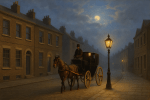
Mr Hartwell descended next and cast his eyes down the street. Spotting a flickering gas lamp a few yards ahead, he stepped toward it, hoping to get a better view by its feeble light.
“The fare is half a crown,” the driver called after them, concern creeping into his voice.
Unperturbed, Mr Hartwell pulled out his pipe and tapped it gently against the lamppost, emptying its spent contents with deliberation.
“Begging your pardon, sir,” the cabbie said to Mr Fosdyke, “but your friend seems to have left you with the bill.”
“He certainly has,” Fosdyke huffed, rifling through his pockets. Producing a two-shilling piece and a single shilling, he handed them over. “Three shillings, my good man. Please wait here—I’ll consult with my colleague.”
The cab driver doffed his cap. “As you wish, sir. But I warn you—this part of town isn’t safe, not at this hour, and not in weather such as this. It’s no place to be loitering.”
Fosdyke crossed the street to where Mr Hartwell was now packing fresh tobacco into his pipe. “I think the driver’s brought us to the wrong end of Pimlico,” he said in a low voice. “He may even have done it on purpose. This street—this dreadful, godforsaken street—can’t possibly be where Timmy’s relatives reside. I wouldn’t house a rat here.”
Lighting his pipe with deliberate calm, Mr Hartwell drew in the aromatic smoke and let it linger on his tongue. “I quite agree. Timmy’s uncle and aunt could never live in so moribund a place.”
“Then why are we here?” Fosdyke snapped. “This is barely a fragment of Pimlico! Let’s return to the cab and drive on through in comfort.”
But Mr Hartwell, contentedly leaning against the lamppost, made no move to follow.
“Beggin’ your pardon, sirs,” the cabbie called again, uneasily. “I must be off!”
“It’s alright,” Mr Hartwell replied, waving him off. “You may go.”
The driver hesitated, pulling his horse alongside them. His face was drawn, his tone wary. “With respect, sirs, are you sure Pimlico’s where you meant to go? This place isn’t safe for the likes of yourselves.”
“We’ll be fine,” Mr Hartwell replied calmly.
The driver nodded uncertainly, then cracked his whip and jiggled the reins. The Hansom cab, guided by its less-than-handsome driver, rattled off down the foggy street, disappearing into the gloom of Christmas Eve.
Mr Fosdyke watched it go, his breath clouding the air. “I sincerely hope you know what you’re doing,” he said grimly. “This is an unforgiving place. A man—two men—could be murdered here, and no one would be the wiser.”
Hartwell puffed silently on his pipe. After a pause, he pointed across the street with its stem. “Do you see that house?”
“The small one? Two up, two down?”
“That’s the one.”
Fosdyke regarded the structure with open suspicion. “What about it?”
“That,” said Mr Hartwell, a plume of sweet smoke curling from his lips, “is our next port of call.”
 The Crazymad Writer Writes Again