Clonmore Castle
The Thirteenth Echo of Clonmore Castle
They say Clonmore Castle has no ghosts.
That’s what draws them in, the thrill-seekers, the paranormal investigators, the late-night YouTubers with thermal cameras and plastic EMF meters. “Nothing ever happens here,” they say, laughing over cheap cans of lager as the wind rattles the ivy-choked stones. “It’s the perfect place for nothing to go wrong.”
But they’re always gone by morning.
Every single one.
In the autumn of 1997, two university students from Carlow Institute—Keiran Daly and Deirdre Coyne—disappeared while camping within the castle ruins. Their tent was found flattened, torn at one corner as if something had tried to claw its way in—or out. The only other evidence was a charred old wristwatch, still ticking, in the centre of a scorched circle.
Police found no trace of them. Locals muttered of wild dogs, of freak lightning storms, of drug-fuelled hysteria. And then they said no more.
It was Halloween night.
Twenty-five years later, a podcast team called Grave Matters returned to Clonmore. They weren’t local. They didn’t know the stories. Or if they did, they laughed at them like everyone else did.
The team:
- Tommy Breen, the presenter, with a voice like hot buttered whiskey.
- Nina Kells, the tech expert, who didn’t believe in ghosts, only glitches.
- Robbie Hennessy, the sound guy, whose nerves were paper-thin even before they arrived.
They were there to record a live Halloween special. They had all the gear: high-sensitivity microphones, EMF detectors, infrared drones. They had charm. Banter. Confidence. The usual.
They didn’t have permission.
The first anomaly came at 10:13 PM.
Tommy was speaking into his mic—”Here we are in Clonmore Castle, built in the thirteenth century by Norman hands, and as far as history tells us, never haunted by a single—”
CLONG.
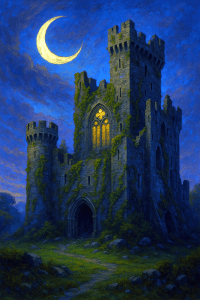
The castle bell tower rang.
Except Clonmore never had a bell.
The sound was deep, metallic, and wrong. Nina looked up from her laptop. Robbie froze mid-recording. For three full seconds, the air shimmered with the after-ring.
And then the recording corrupted.
All of it.
Nina checked the files. They had gone blank. Not missing—blank. Every device was still recording, but the timecode stuttered like a nervous heartbeat. Battery levels dropped 40% in a minute. Her phone said 12:13, though it had just been ten.
“You didn’t bring a clock, did you?” she asked Tommy.
“No. Why?”
She showed him her screen. All her tech was frozen at 13:13.
“There is no 13:13,” said Robbie, wide-eyed. “That’s not a real time.”
“Exactly,” Nina whispered.
That’s when the whispering started.
It came from the southeast tower.
A low, desperate murmur like wind curling through a broken bottle. Not voices. Not really. But syllables, half-caught in stone. Robbie’s boom mic picked it up first—a looped echo of something unintelligible. He turned the volume up in his headphones. And screamed.
“I heard… I heard myself!”
“What?”
“It was my voice! But twisted—like it had been dead a long time!”
He dropped the gear and fled down the castle steps, swearing he’d heard himself begging to be let out.
They found him two hours later in a nearby field, muttering, face scratched, one hand clutching a strange, rusted watch.
The watch read 13:13.
Nina wanted to leave. Tommy didn’t.
“We’re onto something,” he said. “If this place has a… frequency, maybe we’ve triggered it.”
“Or it’s triggered us.”
They returned to the scorched courtyard, where the tent of the students had once been found.
Nina scanned with her lidar.
A glowing spiral appeared in the scanner—carved into the ground but invisible to the naked eye. In the middle of the spiral, a stone slab. She brushed moss away and found an engraving:
IN TEMPORE PERDITO — IN TIME, LOST.
Below that, the image of a clock. But with thirteen hours.
“What if it’s a trap?” Nina asked.
“What if it’s a portal?” Tommy replied.
And because horror stories don’t end with wise decisions, Tommy stepped onto the stone.
The clock ticked.
Reality shifted.
Time bent inwards like a funhouse mirror. Nina watched in stunned silence as Tommy’s outline grew hazy, his skin flickering like old film. The castle around him brightened, sharpened. The ivy receded. The moss peeled away.
Clonmore Castle was whole again.
And full of people.
But not alive.
Not really.
Transparent shapes walked the battlements. A man in chainmail looked down, eyes empty sockets. A noblewoman in bloodstained robes wailed silently from a window. A child crawled along the flagstones, clutching a headless doll.
Tommy was in their world now.
Or they were in his.
He turned to Nina. Smiled. Reached out.
“Come see,” he said.
She ran.
Two days later, the Garda found Nina wandering along the road to Tullow. She had no memory of the event, only fragments:
- The clock with too many hours.
- Tommy’s voice saying see you soon.
- A castle bell ringing thirteen times.
She never touched tech again.
As for Clonmore, the spiral is gone.
But every Halloween, at precisely 13:13—the time that doesn’t exist—the winds shift.
A bell tolls.
And for a moment, Clonmore is whole again.
You might even hear the thirteenth echo.
Just don’t listen too closely.
Because it might be your own voice, calling from the wrong side of time.
And you don’t want to answer it.
End.
 The Crazymad Writer Writes Again