Nighthaven
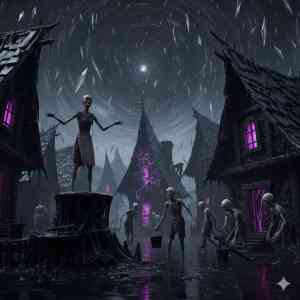
In the somber heart of Nighthaven, a village where the houses were hunched and the trees bled a faint, unnatural glow, the weather was not a character, but a curse. On one side of the valley, the sun did not shine, but merely bled a cold, sickly amber light through a perpetual, choking smog. It illuminated nothing, offering only a false promise of warmth that settled on the villagers like a shroud of sickness.
On the other, the storm cloud Bartholomew did not rage; it whispered. It was a silent, malevolent presence, a thing of pure shadow and cold. It offered no cleansing rain, but a chilling drizzle that clung to the skin and seeped into the bones. The lightning it produced was not a flash of light, but a momentary, sickening glimpse into the Void, a fleeting portal that showed horrors no mortal mind could comprehend. The villagers, their faces pale and gaunt, did not call this side the ‘stormy side,’ but the ‘silent side,’ for all sound seemed to be swallowed by its oppressive presence.
The true source of the curse was not in the sky, but in the village itself, in the hands of the baker, Elara. She lived on the silent side, a woman who had not spoken a word in years. In her silent existence, she had learned to harvest the blueberry-muffin-scented rain that fell from Bartholomew’s cloud. But she did not bake with it; she distilled it, a process that bled the rain of its sweetness until it became a black, viscous ichor. This she used to write, etching a cryptic, ever-changing script onto the cobblestones of the village square.
The gnomish boy Finley, too young to remember a time before the curse, was captivated by these writings. He saw not a story, but a puzzle. The shifting script seemed to tell of two ancient, warring entities: the Amber, which represented the false light and the stagnant, smothering warmth, and the Void, the silent, cold shadow. He tried to tell the other villagers, but they ignored him. The curse had dulled their minds and their spirits; they were lost, unable to see beyond the eternal gloom.
One day, Bartholomew’s silence was broken. A jagged bolt of his un-light lanced down, not striking the ground, but piercing the heart of the great tree in the center of the village. The tree, which had for centuries been the source of the village’s strange glow, shuddered violently and then began to pulse with a horrifying, rhythmic beat. From its bark, a black, oily substance began to seep, spreading across the ground and dissolving everything it touched.
Finley, in a moment of clarity, realized the truth. The Amber and the Void were not warring entities. They were the same. The false sun and the silent storm were one, a single, malevolent being that had taken on two forms. The glowing trees were not providing life; they were siphoning it. The blueberry-muffin-scented rain, the promise of sweetness, was a lie. And the black ichor with which Elara wrote was not ink, but the pure essence of the curse.
He understood now. Elara, in her silence, was not a victim, but the keeper of a terrible secret. She was not documenting the curse; she was performing a ritual, her writings a spell meant to contain it within the village. The un-light from Bartholomew, the black ichor from the tree—these were the final ingredients. The pulse from the tree was the signal. The time for the curse to be unleashed upon the world was at hand.
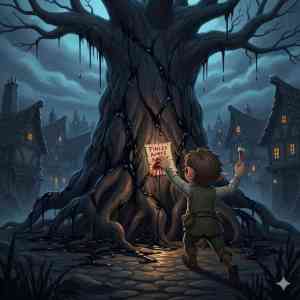
In a last, desperate act, Finley ran to the tree, his small body a fleeting speck against the horror. He tore a page from his journal and wrote in his own blood, a simple, final message: “It’s all one.” He pinned it to the tree just as the final, sickening pulse erupted, and the world went dark.
The curse was not the storm, or the sun, or even the writing. It was the village itself, a gilded cage designed to contain a malevolent entity. Elara’s ritual had held it for years, but Finley’s act, meant to warn the world, was the final catalyst. He had not stopped the curse; he had unleashed it, a final twist of a knife in the heart of a doomed village.
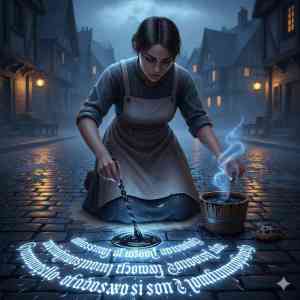
The curse, now free, did not descend with a cataclysm. It ascended. The black, oily substance from the tree coiled into a spiraling helix, a sentient shadow that rose to meet Bartholomew. The storm cloud, no longer silent, began to hum with a low, dissonant frequency that vibrated through the very stones of Nighthaven. The sickly amber light of the false sun, a thing of false hope, was sucked into the helix, swallowed whole until the sky was a canvas of pure, starless black.
Elara, the silent baker, stood alone in the village square. Her hands, covered in the black ichor, trembled. She had spent a lifetime weaving a containment spell with the unholy ink, a spell that had been so close to completion. But Finley’s note, scrawled in blood, had not been a warning; it had been a key. The simple, honest truth of it—”It’s all one”—had unlocked the final seal, a paradox that the unified entity of Amber and Void could not resist. Her ritual was undone, and the thing she had so painstakingly trapped was now unchained. She stared up at the helix, which pulsed with her own heartbeat, and finally, after years of silence, she spoke. It was a single, guttural word of resignation and despair.
Finley, huddled in the dissolving ruins of his home, felt the truth like a physical blow. He had seen the Amber and the Void, the sun and the storm, as two sides of a coin he could flip, two enemies he could pit against each other. He was wrong. The entity, the Aetheric Parasite, had not been a curse on Nighthaven, but its symbiotic heart. The village was not a gilded cage; it was its host. The glowing trees, the waterfall houses, even the blueberry-muffin rain—all of it was a facade, a carefully constructed illusion to sustain the parasite as it slowly siphoned the life and hope from its inhabitants.
The parasite, now fully manifest, extended its consciousness. It had no need for a physical form; it was the hum in the air, the cold on the skin, the emptiness in the soul. It reached out, not with tendrils or claws, but with a horrifying understanding, a knowledge of every secret, every sorrow, every forgotten dream. It consumed them, not for power, but for the sheer, simple act of consumption. The villagers, one by one, did not die. They simply ceased to be. Their forms remained, but their essence—their memories, their personalities, their very souls—were devoured.
The story was not of a village saved, but of a cage broken. Finley, in his desperation to expose a lie, had unleashed a truth that would swallow the world. The last thing he saw, before his own mind was consumed, was Elara, who was no longer Elara but a vacant vessel, a silent monument to her failed vigilance. The parasite had been contained within the village because that was where it had chosen to feed. Now, with the lock broken, it had simply decided to move on, leaving Nighthaven as an empty husk, a ghost town haunted by the memory of a beautiful illusion.
Finley’s note, scrawled in blood and pinned to the cursed tree, did not just break the final seal of Elara’s ritual; it acted as a beacon. The Aetheric Parasite, newly freed and ravenous, did not merely consume the souls of the villagers and leave Nighthaven a husk. It left a twisted promise, a horrifying inheritance. The husks of the villagers, now devoid of life and consciousness, did not crumble to dust. Instead, they began to move, their limbs jerking with a grotesque, puppet-like grace. They were animated by a fragment of the Parasite’s essence, left behind to serve a new purpose.
This vestigial consciousness, a cruel echo of the original entity, had only one directive: to recreate what it had just consumed. The husks, one by one, began to rebuild Nighthaven. They did not use stone or wood, but a congealed, black ichor that pulsed with the same horrifying rhythm as the cursed tree. The new houses were not hunched and quaint, but twisted and malevolent, their walls shifting and groaning as if in perpetual agony. The trees, once glowing with a sickly light, now writhed like tortured things, their branches lashing out at the empty air. The village was being rebuilt, not as a place of refuge, but as a monument to its own destruction.
But the most horrifying part of the transformation was the weather. The Parasite had taken the original Amber and Void and integrated them, and in doing so, had created something new and terrible. The sky was no longer a mix of false light and silent shadow. It was now a swirling, churning vortex of pure nothingness, a black hole of atmosphere that emitted a faint, high-pitched scream. And from this scream, a new form of precipitation began to fall: not blueberry-muffin-scented rain, but a cascade of shimmering, crystalline shards. They were beautiful, refracting the last vestiges of moonlight with a prismatic glow, but they were also sharp as razors, carving new, bleeding wounds into the husks of the villagers as they worked tirelessly to rebuild their own tomb.
Elara’s vacant husk, her face still contorted in a silent scream, stood at the center of the square. The ichor on her hands had hardened into a petrified black glove, and she was no longer a baker, but a conductor. She raised her hands, and the husks of the villagers moved with a renewed, sickening fervor, the sound of the crystalline rain and the grinding of the shifting houses becoming a symphony of despair. The Aetheric Parasite had not just taken their souls; it had enslaved their bodies, forcing them to become the architects of its next, grander trap.
The story of Nighthaven was not over. It was just beginning. It was not a story of a curse being unleashed, but a story of a parasite building a nest, and with Nighthaven rebuilt, its next victim would be the world.
 The Crazymad Writer Writes Again