Murmurings at Christchurch

Chapter One – The Tourist
Michael had meant only to pass a quiet hour. His guidebook called Christchurch Cathedral “a jewel of medieval Dublin,” a place of soaring arches and solemn beauty. He paid his admission, smiled politely at the woman in the gift shop, and stepped inside expecting nothing more than cool stone and history.
Yet once the heavy oak door closed behind him, the city seemed to fall away. The muffled traffic, the chatter of tourists outside—all gone. The silence was a presence in itself, pressing against his ears like a tide.
The stained glass gleamed, colours alive in the morning light, but the air was strangely heavy. Michael wandered past the nave, pausing by the great pillars. Their surfaces were rough to the touch, worn by centuries of hands.
That was when he noticed it.
The stone hummed.
At first he thought it the faint buzz of his phone, but when he leaned closer, ear to the pillar, he heard them: voices.
Faint, overlapping, urgent:
“Turn back… too late… he waits below…”
Michael stepped back sharply. His laugh came too quickly, too nervous. Surely it was a trick of the acoustics. He told himself so—but the voices followed him down the aisle, one pillar to the next, whispering louder.
Drawn by something he couldn’t name, Michael descended into the crypt.
Chapter Two – The Crypt of Hunger
Most visitors found the crypt charming, a curiosity: stone knights, dusty relics, odd treasures of medieval Dublin. But to Michael the air was stifling, iron-scented, and colder than the grave.
At the far end, past the display cases, he saw it: a narrow, iron-bound door, slightly ajar. It should not have been there. He was sure of it.
Pinned to the wood was a scrap of parchment, faded, inked in a looping hand:
“Do not open. For he stirs.”
His laugh faltered. It was too theatrical, surely, some prop for tourists. Yet his hand rose of its own accord, pushing the door wide.
Behind it wound a spiral staircase, descending deeper than any crypt had right to go. The steps were slick, the air close with damp. Each footfall echoed downward, swallowed by the dark.
And then came the smell—incense and iron, incense and blood.
The whispers returned, urgent, crowding his mind:
“Why did you come? He is awake now… you should not be here…”
At the bottom lay a vast chamber, dimly lit by guttering candles that should not have burned. In its centre was a stone slab. Upon it, at first glance, lay a skeleton.
But then it moved.
The ribcage rose and fell in rattling breaths. The skull lifted—and where the face should have been, there was only blackness, a void that devoured the candlelight.
The voice thundered inside Michael’s skull, shaking his very bones:
“I was the first stone laid. I was the last prayer spoken. I am older than this place, older than your city, older than your kind. And now—because you opened the way—I am free.”
The figure rose, joints cracking like doors opening after centuries. Shadows spilled from it, thick and dripping, spreading across the floor.
Michael turned to flee up the spiral stairs, but each step he took stretched endlessly. The exit never came nearer.
Behind him, the faceless thing followed, filling every inch of the passage with its voice:
“You will never leave. All who listen to the stones must stay. The cathedral grows hungry again.”
Chapter Three – The Choir that Never Sang
Michael stumbled back into the nave at last—or thought he did. The spiral steps had twisted him around until he no longer knew up from down. When he burst through a stone archway, gasping for air, he found himself not among tourists, but in a cathedral lit by torches.
The pews were filled, row upon row, yet every figure sat unnaturally still. Their faces were shrouded in veils.
At the far end, beneath the great organ, stood a choir of boys, their mouths wide open, mid-song.
But there was no sound.
Their throats strained, veins bulged, yet not a single note escaped. Only silence—thick, dreadful silence. Michael clutched at his ears, certain he heard the echo of their music inside his skull.
The whispering stones around him filled in the words:
“They sang once. Too beautifully. Too purely. The cathedral wanted their voices forever.”
The organ pipes rattled. The air filled with a sudden rush of pressure, like a scream about to break. Michael shut his eyes—
And when he opened them, the choir was gone. The pews were empty. Dust swirled where they had stood.
Only the silence remained, deeper now, pressing into his bones.
Chapter Four – The Heart Beneath the Altar
Drawn forward, staggering as though drunk, Michael reached the high altar. The carved wood gleamed, holy and immaculate. But the flagstones before it shifted—breathing, rising and falling as though the cathedral itself had lungs.
A crack split open in the floor, and Michael saw it:
An organ, vast and obscene, not of metal pipes but of bone and sinew. Great ribs arched upward like columns; veins ran along the floor like cords. It pulsed rhythmically, each beat a soundless chord, shaking the cathedral.
The whispers grew frenzied:
“It is the first heart. The only heart. Fed by prayers, by fears, by flesh. It beats when we feed it. And you—oh, you—have brought it life again.”
The pipes began to play. No one touched the keys, yet the music poured out—discordant, beautiful, terrible. Notes that clawed at memory, dragging every grief Michael had ever known into the open.
His knees buckled. Tears ran unbidden. The cathedral was drinking him, pulling sorrow and joy alike into its pumping heart.
And beneath the music, a single voice rose, deep and resonant, echoing from the altar itself:
“Stay. Kneel. You are mine now.”
Michael staggered back, desperate to escape. Yet every door was closed. The nave stretched longer and longer, as if the exit receded with each step.
The organ beat on. The cathedral’s heart was awake.
Chapter Five – The Bell Without a Ringer
The music had ceased. The organ heart beneath the altar quieted, leaving Michael trembling in the half-light. His breath steamed in the cold air though no warmth escaped his body.
Then, faint at first but swelling with dreadful clarity, came another sound.
The bell.
High above in the tower, it tolled once.
The vibration ran through the stone like a living shudder, down the pillars, across the floor, and into Michael’s bones.
He froze.
It tolled again.
And again.
But there was no ringer. No hand upon the rope, no mechanism moving. Michael had read in his guidebook that the bell was silent most days, rung only for special services. And yet here it was, swinging with dreadful force, though the air in the nave was still.
Each toll was wrong, somehow. Not quite the note it should be. It stretched too long, too low, almost like a moan torn from the earth itself.
The Gathering Shadows
Michael’s gaze was drawn upward. From the rafters, shadows began to drip—slowly at first, like water seeping through cracks. They gathered along the edges of the stained glass windows, bleeding black across the holy images until saints and angels were blotted out.
He staggered back, craning his neck. The shadows writhed, thickened, and with every toll of the bell, they reached further down the stone walls.
The bell is summoning them, he thought, though he dared not say it aloud.
On the fourth toll, the whispers returned—dozens, hundreds of voices, layered into one terrible chorus:
“It wakes us. It calls us. It feeds.”
The Procession Appears
The fifth toll brought movement.
At the west door, where he had entered what felt like a lifetime ago, figures were appearing. Not bursting in, not opening the door, but phasing through it, as if the wood were water.
A line of them. Monks in blackened habits, their faces burned away, eye sockets glowing faintly. Behind them shuffled beggars in rags, mouths sewn shut with coarse twine. Then came priests in ruined vestments, flesh falling from their bones like wax.
The line grew longer with each toll of the bell.
Six. Seven.
The cathedral was filling. A procession of ash, silent and inexorable, moving toward the altar.
Michael pressed himself against a pillar, heart hammering. The shadows had nearly reached the ground now, stretching like black water toward his feet.
The Bell Stops
The eighth toll was the loudest of all. It cracked the air like thunder. Dust fell from the rafters, and Michael covered his ears, certain his skull would split apart.
And then—
Silence.
The bell was still. The shadows stopped dripping, frozen mid-reach. The procession halted mid-step, heads turning in unison toward Michael.
Every hollow gaze fixed on him.
One of the monks opened its mouth—not a mouth, but a cavern, stretching impossibly wide. And from within came no words, no chant, but the sound of the bell itself, impossibly loud, ringing out from inside its body.
The procession moved again. This time not toward the altar, but toward him.
The Flight
Michael ran. His footsteps thundered against the stone, echoing back a thousandfold as if a hundred men were fleeing beside him. The whispers rose to screams, battering his skull:
“He cannot leave. None can leave. The bell tolls for you.”
Every door he reached was locked. Every archway bent back into the nave. The cathedral twisted itself around him, funneling him deeper into its throat.
And still the bell rang—not above now, but inside him. He felt it vibrating in his ribs, shaking his heart with each beat.
The Ending of the Chapter
He collapsed at last before the altar, gasping, clutching at his chest. The procession closed in, shadows tightening their circle.
And then came the ninth toll.
The sound burst from his own mouth. Not a scream, not a word—only the bell.
The congregation of shadows bowed their heads as one.
Chapter Six – The Procession of Ash
When Michael opened his eyes, the cathedral was empty.
The monks, the beggars, the priests — gone. The whispers had stilled, and the bell no longer tolled. Only dust hung in the air, drifting in slow spirals like ash.
He dragged himself upright, shaking, listening.
From somewhere deep within the cathedral, beyond the walls and pillars, he heard it: footsteps. Many footsteps, shuffling in rhythm. They were moving away, down corridors he had never seen, fading deeper into the stone.
The air smelled faintly of burnt cloth and charred flesh.
Michael clutched at his chest. The echo of the bell still rang inside him, faint but insistent, like a second heartbeat.
He told himself it was over. The figures had left. He was alone.
Yet as he staggered toward the exit doors, he realised something that froze him in place.
The ash drifting in the air was falling from him. His hair, his skin, his very breath, flaking away in pale motes.
And from the far end of the nave, where shadows still lingered, a dozen faceless heads turned slowly back toward him.
Chapter Seven – The Final Prayer
Michael stumbled down the nave, ash flaking from his arms, his breath coming in ragged bursts. The great doors loomed before him — salvation, daylight, escape.
But when he pressed his hands to the wood, the doors did not move. They were colder than ice, colder than stone. He shoved, kicked, screamed until his throat bled. Nothing.
Then the organ began again.
Not a hymn, not even music. Just a single, pulsing note. A drone that shook the air, rattled the windows, and thrummed inside his skull. The cathedral’s heart was awake once more.
The whispering began again, louder than ever, overlapping voices too many to count:
“Kneel. Kneel. Kneel.”
Michael turned.
The nave was filling again. The procession had returned — monks without faces, priests with mouths sewn shut, beggars limping on bone legs. They came not in silence this time, but in dreadful harmony. The drone of the organ had split into chords, and their every step was a beat, a rhythm of worship.
And at their head walked the faceless figure from the crypt. Its void-face swallowed light, swallowed thought. Shadows poured from its body like smoke, filling the aisles.
The Command
It spoke without sound, its voice hammering through Michael’s ribs:
“Every stone here is a prayer. Every soul here is a hymn. And you—broken, lost, trembling—will be my final verse.”
Michael dropped to his knees, not by choice but because his legs no longer obeyed him. His body was unravelling, ash streaming from his skin in steady rivers. His bones glowed faintly beneath, as if the cathedral’s own light were shining through him.
The figure reached out a hand. It was not flesh, not bone, but pure shadow — a cavity in the air. When it touched Michael’s head, the whispers ceased.
The Binding
Silence.
Then the organ crashed down with a chord so vast it split the air itself. The stained glass shattered inward, shards spinning like rain. Wind howled down the nave, carrying centuries of dust.
Michael screamed — but the scream was cut short, frozen in stone.
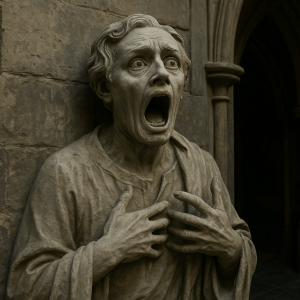
His arms locked rigid. His eyes bulged wide. His mouth gaped, forever in mid-cry. The ash hardened into granite, and in a heartbeat he was no longer man but statue.
The faceless figure stepped back. The congregation of shadows bowed.
“It is finished,” the cathedral breathed.
The organ heart slowed to its steady, dreadful pulse. The whispers folded back into the walls, nesting inside the stone for another century’s hunger.
The Last Thing He Heard
Before his ears sealed into cold rock, Michael heard a single, dreadful truth.
It was not the cathedral that was alive.
It was the thing beneath it.
The cathedral was only its shell, its body, its mask.
And every prayer, every hymn, every frightened whisper was a meal.
Epilogue – The Statue
Tourists shuffle through Christchurch every day, peering at tomb effigies, monuments, and curiosities in the crypt. Most never notice the statue tucked in the far corner of the nave: a man carved in stone, eyes wide, mouth open in eternal terror.
The guides call it a curiosity, a grotesque from some forgotten sculptor. Children laugh at it, take photos beside it.
But sometimes, when the cathedral is empty and the wind falls still, visitors swear they hear something.
Not an echo.
Not a draft.
But a whisper, rasping from stone lips that should not move:
“Turn back. Too late. He waits below…”
 The Crazymad Writer Writes Again