Sunbury Adventurers: The Sunbury Dragon
The Sunbury Dragon
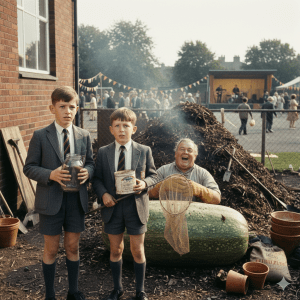
Gerard and Tony weren’t your average 1960s schoolboys. While their classmates at Saint Ignatius in Sunbury were busy with high-bouncing kickabouts and trading marbles, our two heroes were dreaming of something far grander. They were on a quest for the ultimate mythical beast: The Sunbury Dragon.
The dragon, as Tony and Gerard had concluded from a dog-eared fantasy novel found in a bin, was a creature of incredible power. It didn’t breathe fire; that was too dramatic for a Sunbury beast. This one, they were sure, was fueled by the aroma of overcooked school cabbage and the unholy screech of the Headmaster’s cane. Its lair? The forbidden territory behind the science block, where the compost heap festered and strange, bubbling potions were rumored to be brewed by the formidable groundskeeper, Old Man Henderson.
Tony, the shorter boy with boundless imagination and questionable logic, scoffed. “Nonsense! Look at the scorch marks.” He pointed to a small, brown smudge on a crude map scrawled on a hymn sheet. “That’s a classic dragon sign. Besides, why else would Old Man Henderson always wear those enormous gloves?”
Gerard, the taller and more cautious of the two, often served as the voice of reason. “Tony, are you sure it’s not just a big pile of soggy leaves?” he’d whisper, peering over Tony’s shoulder.
Their plan was audacious. They’d use the upcoming school fete as a diversion. While parents judged the jam and teachers were distracted by the tombola, they would sneak into the dragon’s lair. Their weapons were simple but effective: a jam jar to capture dragon breath, a fishing net for any loose scales, and a tin of stale biscuits as a peace offering.
The day of the fete arrived, filled with the usual chaos. The smell of frying onions hung in the air, a cacophony of amateur bands filled the playground, and Father Michael was having a spirited debate with the local baker. It was the perfect storm.
“Now!” Tony hissed, tugging at Gerard’s sleeve. They ducked behind trestle tables and headed towards the forbidden land. As they neared the compost heap, a low rumbling sound echoed from within. Gerard’s eyes widened. “That’s it, Tony! That’s the dragon’s stomach rumbling!”
They tiptoed closer, the smell of rotting vegetables growing stronger. The rumbling grew louder, and then, a head appeared from behind a sack of fertilizer. It was a massive, mottled green creature, its eyes blinking slowly in the afternoon sun. It had a long snout and a strange, bumpy texture. It wasn’t the majestic beast they had imagined. It was… Old Man Henderson’s prize-winning marrow, the one he’d been nurturing for months. The rumbling was just Old Man Henderson himself, having a quiet snooze while waiting for the vegetable judging. He was, as always, wearing his large gloves.
Tony and Gerard froze. Old Man Henderson’s eyes snapped open. He took one look at the two boys, the jam jar, the fishing net, and the pathetic tin of biscuits, and let out a bellowing laugh that shook the very foundations of the school.
They were caught, of course, and spent the rest of the fete on kitchen duty, peeling potatoes for the school dinner ladies. But as they worked, the smell of fried onions and the sound of the fete still buzzing in their ears, Tony nudged Gerard. “You know,” he whispered, “that marrow was a lot bigger than it looked. And did you see the size of those bumps? Definitely a sign of a rare Sunbury subspecies. A juvenile, I’m guessing. We’ll get him next year.”
Gerard just smiled, and for a moment, they forgot all about the potatoes. They were back on their quest, dreaming of dragons and daring adventures. After all, what else were school years for?
The Ghost in the Bell Tower

The dragon hunt had been a bust, but their reputation as Sunbury’s foremost adventurers was cemented in their own minds. Old Man Henderson’s bellowing laughter had quickly been re-categorized as the roar of a vanquished beast. The school term ambled on, a blur of Latin verbs, lukewarm custard, and the persistent, low-level dread of the Headmaster’s office. But for our heroes, a new obsession was already taking root.
It all started with a whisper from a third-form boy named Kevin, a known purveyor of playground gossip and a surprisingly accurate source of intel on the school’s secret snack-based economy. “Heard about the ghost in the bell tower?” Kevin had breathed, his eyes wide. “They say it’s the spirit of an old monk. He hides the school’s lost property—and all the missing conkers.”
This was a mission far more urgent than a dragon. The bell tower at Saint Ignatius was a magnificent, ivy-covered monolith, strictly off-limits, which of course, made it the perfect haunt for a poltergeist. Gerard, the more cautious one, was immediately suspicious. “A monk? What would a monk want with conkers?”
But Tony, a boy of boundless imagination, was no match for Kevin’s rumour. “Think, Gerard! He’s a collector! A keeper of forgotten treasures! The most powerful ghost in all of Sunbury!” Tony had already begun sketching out a plan on the back of his maths homework. This time, their equipment would be more sophisticated: a sturdy sack for the recovered conkers, a torch, and a thermos of lukewarm Bovril for courage.
Their window of opportunity came a few weeks later during the school’s annual cross-country run. While the other boys slogged through muddy fields, Tony and Gerard made their escape. They hid in the bushes until the last straggler disappeared over the hill, then made a mad dash for the bell tower. Inside, the tower was a spiral of dust motes dancing in slivers of light. The stone steps groaned under their weight, each footfall an alarm bell in the oppressive silence.
“Do you hear that?” Tony whispered, his hand on the thermos. “It’s the spirit.”
The sound was a faint scratching, a shuffling noise from somewhere above. They crept up, floor by floor, past cobwebs that clung like ghostly shrouds. The scratching grew louder, more frantic. Finally, they reached the top of the stairs and peered into the belfry. There, nestled amongst the ropes and pulleys, was a small, shadowy figure.
Gerard gripped the torch and, with a trembling hand, flicked it on. The beam of light sliced through the darkness, illuminating the “ghost” in all its spectral glory. It wasn’t a monk. It was Kevin, the same third-form boy, frantically digging through a pile of lost gloves and misplaced scarves. He froze, his hand deep in a lost-property box, a small, triumphant smile on his face.
“Found them!” Kevin squeaked, holding up a small bag. It was full of the most enormous, gleaming conkers they had ever seen. He was the ghost, or at least, the mastermind behind the conker-hiding. He had been sneaking up to the bell tower for weeks, pilfering the best conkers from the lost property box to sell on the black market of the school playground.
Tony and Gerard just stared, a mixture of disappointment and grudging respect washing over them. The bell tower wasn’t haunted, just a clever hiding spot for a budding entrepreneur. They didn’t get any conkers, but they had found the truth.
The Mystery of the Sticky Buns
The revelation of Kevin the Conker-Master had been a humbling experience, but it hadn’t deterred Tony and Gerard. The supernatural, it seemed, was merely a smokescreen for the mundane and the enterprising. Their next target, they decided, had to be a real mystery, one that couldn’t be explained by a boy with a penchant for playground commerce.
This new quest was born in the school tuck shop. Father Michael, their stout and jolly maths teacher, was known for his love of sticky buns, but for the past week, he had been acting strangely. He would stare mournfully at the empty space where the buns were usually kept. The tuck shop lady had a simple explanation: “Rationing. The baker’s having a tough time with his deliveries.”
But to Tony and Gerard, this was too simple. “Think about it,” Gerard whispered, leaning over a packet of Space Dust. “Why would a baker suddenly have a problem with deliveries? It’s not the war anymore.”
Tony’s mind was already racing. “It’s a conspiracy! They’re not just sticky buns, they’re… coded messages! Or maybe they’re a portal to another dimension, and someone’s closing it off!”
Gerard, ever the pragmatist, had a more grounded theory. “It’s a thief. Someone’s been stealing the buns.”
The evidence began to pile up. A mysterious floury footprint had been found near the tuck shop door. A strange, metallic clinking had been heard from the kitchen at night. And Father Michael had been seen leaving school with a sad, empty paper bag.
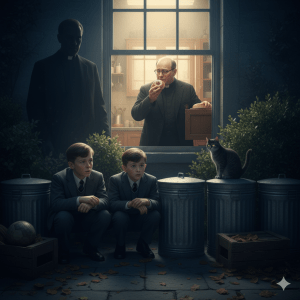
The boys’ plan was to conduct a stakeout. That evening, after a terrible supper of lumpy mashed potatoes, they crept out of their dormitory and hid behind a row of dustbins near the kitchen window, their eyes fixed on the target.
Hours passed. The moon rose, casting long shadows. A stray cat sauntered by. Then, a shape appeared in the kitchen window. It was Father Michael. He wasn’t stealing the buns; he was pacing, wringing his hands, looking utterly distraught. He opened a cupboard and took out a single, solitary sticky bun. He looked at it with reverence and sorrow, held it to his nose, and then, with a sigh, put it back.
Suddenly, a voice boomed from the darkness behind them. “A fine night for a bit of mischief, eh, boys?”
It was the Headmaster, a towering silhouette against the moonlight. Their mission, it seemed, was over. They were marched back to their dormitory and given the usual lecture about rules. But as they lay in their beds, the words of the Headmaster rang in their ears.
“You see, boys,” he had said, his voice softer than usual. “Some things in life are more complex than they seem. Father Michael, God bless him, has a sweet tooth, but his doctor says he’s to cut back on sugar. He’s been buying the buns and then forcing himself to put them back. A true test of faith, wouldn’t you say?”
A mystery solved not by a villain or a magical portal, but by a simple human struggle. It was, Tony and Gerard realized, a far more satisfying conclusion. As the long summer holidays stretched before them, a new idea began to form. A conspiracy of ice-cream vans? A haunted swimming pool? Or perhaps something even more mysterious, just waiting to be uncovered.
The Headmaster’s Secret Garden

The air in Saint Ignatius had shifted. It was no longer filled with the scent of chalk dust but with whispers of something far more potent. The Headmaster, a man known for his sternness, had a new, peculiar habit. He would disappear for hours behind his office, and strange noises would occasionally drift out—not the rustle of papers, but a low, murmuring sound, like a choir of miniature voices.
Tony and Gerard knew immediately what this meant. “It’s a secret garden,” Tony announced, his eyes gleaming. “And the Headmaster isn’t just growing prize-winning marrows. He’s cultivating intelligent life.”
Gerard, the taller boy and voice of caution, raised a skeptical eyebrow. “Tony, the man can barely keep the basil alive. Talking vegetables? That’s mad.”
But Tony was already sketching a blueprint. They needed to get a sample, a single, definitive piece of evidence. Their chance came during the annual school inspection. The Headmaster would be distracted, leading a stuffy inspector through every crevice of the school.
Their plan was simple: the Stealthy Scullion Maneuver. Posing as kitchen helpers, they’d make their way to the Headmaster’s office with a small trowel and an empty jam jar.
The day of the inspection was a blur of polished shoes and forced smiles. As the Headmaster and the inspector passed by, Tony and Gerard slipped into his office. They could hear the faint murmur of voices coming from a small, bolted door hidden behind a large oak bookshelf.
With a grunt, they pried the door open. It wasn’t a secret passage, but a small, sunlit courtyard. And there they were: rows of perfectly tended plants. Carrots, cabbages, and potatoes sat in neat rows, basking in the sun. And they were, indeed, speaking.
“Honestly, Brian, if you’re going to complain about the slugs again, I’m going to have to ask you to leave,” a deep voice rumbled.
“Don’t you start, Derek,” a high-pitched, whiny voice retorted. “It’s a disgrace! We’re being eaten alive!”
Tony and Gerard stared, wide-eyed. They had found it. The talking vegetables were real. They were also arguing about slugs and complaining about a grumpy-looking potato named Derek.
Tony, in a moment of pure zeal, moved in. He reached for a vibrant cabbage, his trowel poised to dig up a sample. But as he was about to touch it, a thunderous voice boomed from the doorway.
“What, in the name of all that is holy, are you boys doing?” It was the Headmaster, his face a mask of shock and fury.
Their mission was, once again, a complete and utter failure.
The punishment this time was less about manual labor and more about intellectual humiliation. They were to write a 2,000-word essay on the importance of respecting private property. The Headmaster’s parting words were a final, crushing blow.
“They’re not magical, boys. They’re just very sensitive to the vibrations of music. I play them classical tunes every afternoon. Helps them grow. Helps them… express themselves.”
The Headmaster’s secret garden was simply a sound experiment. The talking vegetables were a matter of acoustics, not magic. But as Tony and Gerard sat in their room that night, trying to think of 2,000 ways to say “private property,” Tony couldn’t shake the image of the complaining cabbage.
“You know,” he whispered to Gerard, “I think that cabbage was lying. He was trying to cover up something. A secret society of vegetables, maybe? We should investigate further.”
Gerard just smiled. The term was drawing to a close, but the mystery of the Headmaster’s garden was far from over.
The Curious Case of the Gherkin Jar

The next term arrived with the usual dreary gray skies and the faint, unsettling smell of formaldehyde from the science labs. But it also brought a new mystery that intrigued Tony and Gerard. It revolved around Mr. Fitzwilliam, the chemistry teacher. Mr. Fitzwilliam was a quiet, unassuming man with a perpetually stained lab coat and a passion for Bunsen burners. His most notable quirk was his lunch: every single day, without fail, he ate a cheese sandwich and a single gherkin, which he would ceremoniously pull from a large, cloudy glass jar.
But for the past week, the gherkin jar was empty. Mr. Fitzwilliam was visibly distressed. He would stare at the jar, his brow furrowed in confusion, muttering to himself about “the purity of the pickling solution” and “the unexpected absence of the final specimen.”
To their classmates, it was a simple matter of a man running out of pickles. But to Tony and Gerard, it was a profound mystery. “He’s not just a chemistry teacher,” Tony whispered to Gerard during a particularly boring lesson on titration. “He’s an alchemist. The gherkin isn’t just a gherkin; it’s a key ingredient in an ancient potion! The last one has gone missing!”
Gerard, the taller and more cautious of the two, leaned in. “Or maybe,” he suggested, “someone is stealing them to destabilize his experiments. It’s a rival alchemist! We need to find the culprit.”
Their plan was meticulous, a true work of investigative genius they called the “Gherkin Stakeout.” They would position themselves in the corridor outside the science lab during break time, armed with a notebook for observations and a small mirror to see around corners.
As the bell rang for break, they settled into their positions, watching as the pupils swarmed the playground. Suddenly, the door to the lab creaked open. It was Mr. Fitzwilliam, a look of grim determination on his face. He wasn’t leaving. He was pulling a long, metal tool from a drawer.
Tony’s eyes widened. “It’s a magical wand! He’s going to find the thief with sorcery!”
Gerard, however, saw something more grounded. “That’s a pair of tongs, Tony. The kind they use for handling hot test tubes.”
They watched as Mr. Fitzwilliam, with immense concentration, reached his tongs into the empty gherkin jar. He poked and prodded, then carefully lifted something out. It was a single, tiny, perfectly formed key. He held it up to the light, a look of profound relief washing over his face. He then carefully placed the key in his pocket and walked away.
Just as the boys were processing this anticlimax, the Headmaster appeared from his office, a bemused look on his face. “Looking for more of my secrets, are we, boys?”
Tony and Gerard were caught again. This time, the Headmaster led them to Mr. Fitzwilliam’s lab. The chemistry teacher stood there, beaming, holding up a small, locked metal box. “It was the best place I could think of to hide it, Headmaster!” he said, brandishing his tongs. “No one would ever think to look in a gherkin jar!”
The Headmaster smiled at the boys. “You see, this is the key to the school’s supply cupboard. I told Mr. Fitzwilliam he could have as many gherkins as he wanted if he agreed to be the keeper of the key for a week.”
Tony and Gerard’s quest had ended not in a magical potion or a nefarious plot, but with the revelation of a quirky, trust-based system for school supplies.
Gerard couldn’t help but smile. “A key, Tony. He was using a key all along.”
Tony, ever the optimist, wasn’t fazed. “But the fact he hid it in a gherkin jar? That’s definitely magic, Gerry. We just haven’t figured out the spell yet.”
 The Crazymad Writer Writes Again