The Garden of Broken Hours
Chapter One — The Sky of Clocks
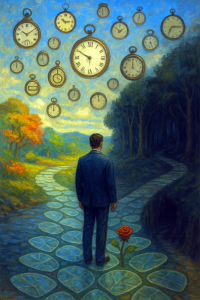
When Daniel died, he expected nothing. Not light, not darkness—only the gentling blankness that sleep had sometimes promised him and never delivered. Instead, he woke beneath a sky of turning clocks.
They hung where stars should be, each on its own invisible spindle, ticking at different tempos. One clattered forward in spurts, then napped. Another trudged like an old mule through mud. A third swung its minute hand back and forth as if undecided about the future. Their faces weren’t all faces—some were the dials of radios, some the gauges from an engine room, one a child’s painted paper plate with numbers trudged in crayon. The air trembled with their layered rhythm, a thousand little hearts disagreeing.
He lay there listening until he realized he wasn’t lying on ground at all. Beneath him spread a path of glass leaves. Each leaf was the size of his palm and veined like a frost pattern on winter windows. When he pushed himself upright, they chimed softly against one another. Standing, he felt a breeze he couldn’t find—the kind of breeze a room has after a crying jag, fresh and thin, smelling faintly of rain and wet paint.
“Where am I?” Daniel asked, though he meant it in the way a person means it when they wake from a too-real dream: a question sent upward, or inward, with no expectation of reply.
“Where you most need to be,” said the ground.
The voice drew his eyes to a rose that grew between the glass leaves. Its petals were the color of his wife’s laughter. There wasn’t a word for that color. It was not quite red, not quite gold; it changed as he looked at it, as if every memory of her had been layered one atop the other to make a living hue.
He knelt. “I know you,” he whispered, though he did not.
The rose tilted on its stem as though studying him. A pearl of dew swelled at its edge, grew heavy, and fell. When it struck the path, it burst—not into water but into a little clouded film, a square of moving light. In it, he saw his kitchen: the pale morning, the dented kettle he’d promised to replace, the chair he always meant to fix. And at the table, his wife, her hands around a cooling cup, gazing at the unspectacular window as if expecting a message from the glass. The sight squeezed him in two. He put out his hand before remembering that touching the past is like trying to lift the reflection of the moon from a lake.
“She’s… there,” he said, which was not a useful sentence, but grief rarely needs grammar.
“You are between,” said the rose. Its voice had the polite patience of a librarian and the gentle cruelty of truth. “And between is a place with doors.”
The path ahead forked cleanly. To his left, it wandered into a garden so vivid it made his eyes ache. Trees grew in impossible gradients, leaves gently dripping not sap but color that pooled into little new rivers. Fruit hung like lanterns—pear-shaped suns, apple-shaped dawns—and the air over that way tasted sweet on his tongue, the sweetness of something finished and signed with a flourish. He felt, looking at it, the same relieved emptiness he’d known after difficult jobs well done: the calm of a bed made, of dishes stacked to dry.
To the right, the glass leaves arranged themselves into a stair that descended into a forest. Between its trunks, shadows moved—but not animal shadows, not human. Shapes of arguments never had, letters never sent, laughs swallowed to seem serious. The dark breathed in and out with the slow calm of depth.
“Left is rest,” said the rose. “Right is search.”
He laughed, which was close to crying. “Search? For what?”
“What you already decided to lose,” said the rose. “And what you didn’t mean to.” It lifted its face toward the sky of clocks. “You’ll want to choose before they do.”
He wanted—oh, he wanted—the garden. He wanted color that did not accuse him, light that did not demand anything. But the little square of his kitchen, fading on the glass like the last minutes of a morning show, pulled his chest backward. He could not put a name to what tugged him. Love was too tidy a word. The thing in him was messier, a tangle of vows and jokes and ordinary Thursdays.
He stood there for a long time, which in that place might have been a second or the span of a century. He breathed and listened to the tick of all those disagreeing clocks. He thought of the last day of his life: the ordinary shoes by the door, the text he had not sent, the ache in his shoulder he had brushed away as a weather complaint. He remembered the bronze light in late afternoon on the bannister. He remembered he had meant to tell her that the gardenias had bloomed.
“Will she know I’ve come?” he asked.
“Not yet,” said the rose.
“Is she safe?”
“Safe isn’t the word for living,” said the rose.
He closed his eyes and saw her as she looked when she peeled clementines: serious, as if solving a puzzle meant for children. He opened his eyes. “Then I suppose I’m not finished.”
He took a step toward the stairs. The clocks above him all stopped at once. The silence that took their place was not silence at all but a felt thing, like the pause between a heartbeat and the next, so long you think no next will come.
“Do I come back this way?” he asked, not for instruction but to hear a voice in the hush.
The rose considered. “Paths change after they are walked. They are like people in that way.”
He nodded, stomach light and throat tight, and put his foot on the first step. The glass leaf he stepped from chimed, then did not, and the darkness below made a sound like an open mouth.
“Daniel,” said the rose.
He looked back.
“Hold fast to the true name of what you love. Everything here will try to rename it for you.”
“What is its name?” he asked.
“You tell me,” said the rose gently.
He could not, and the not-answer bothered him like grit in a shoe. He took another step. The stair cooled his bare feet. The garden to the left sent one last breath of sweet air, as if to wish him well without encouraging him. The rose bowed its head. And Daniel, whom no one would have called brave when he was alive—Daniel of the forgotten appointments and the good intentions—descended.
The dark received him like water. It wasn’t absence; it was a presence that refused to be seen. He went down and down until the light from the path above was memory instead of fact. The clocks did not start again. He thought: perhaps time is shy here.
He paused on a landing where the stair widened into a small shelf of stone. It felt real enough that his hands, when he put them to it, came away gritty. There was a bench, if bench it could be called—two long bones balanced across a stump. He sat. He could not locate his breathing, yet he did not lack breath; he could not locate his pulse, yet he felt held together by a rhythm.
A figure waited beyond the edge of seeing. It did not approach. When he stood, it retreated. When he stepped toward it, it sidled just beyond his reach, dissolving into deeper shadow as a dropped word dissolves back into the throat.
“Hello?” Daniel tried, because sometimes the world shuffles its cards when you speak to it.
A whisper answered, but not from the shape. It came from the wall beside the stair, which was not a wall at all but bark—tree bark as deeply furrowed as old knuckles. The tree didn’t move, and yet there the whisper was, threaded through its grain.
“We should have gone to the lake in September,” it said, in Daniel’s own voice.
He flinched. “I—what?”
Another whisper, from another trunk farther down: “Your mother offered the photo, and you said no. Why?”
The voices were not condemnations; they were recitations, patient in the way of someone rehearsing lines before a play. He realized, with a small panic, that the forest itself spoke in what he had not said.
“This must be the wrong way,” he told the dark, and the dark made no comment.
He took another step downward and saw that what he had taken for air was a slow drift of scribbled ink. The words moved like minnows in a current, phrases he almost recognized flashing silver as they turned. He reached out, and they slid around his fingers, leaving small black smudges that did not stain, exactly, but did not wipe away either.
“Between,” said a voice, a new one, not the rose and not the tree.
Daniel turned his head slowly, as if it might fall off if he moved too quickly. The figure at the limit of seeing coalesced—a person-shaped absence, edges glimmering like the rim of a bubble. He could not say if it had a face. He could say that it wore a coat made from sentences—strips of text stitched end to end, fluttering when it breathed.
“Between,” it said again, inclining its head. “You carry a lot of weather with you.”
“I’m looking for my wife,” Daniel said. Saying it lit a small lamp inside him.
“Everyone is,” the figure replied. “Or a version of that sentence. Names for an ache.” The words on its coat rustled. “You don’t yet know whether you are searching for her or for the you that had her.”
“Is there a difference?” Daniel asked.
“It’s the only difference,” said the figure, not cruelly.
Daniel felt a tiredness that had nothing to do with muscles. “Will you take me to her?”
“I can walk with you awhile,” said the figure. “No one can be taken to anyone here. Paths are woven by intent, not by directions. But companionship is permitted.” It paused. “We call this place the Forest of Unspoken Words. If you linger too long, you will begin to speak in the tongues of could-have-been. People forget what they came to say.”
“I won’t,” said Daniel, though the phrase tasted of promises he’d made to himself before and not kept.
“Then move,” said the figure softly.
He stood, and the stair, because he had decided to use it, continued. Trees leaned closer. Some bore leaves shaped like commas; some had branches that circled back into punctuation marks. His hand brushed a vine that snagged and whispered, “You never told her about the way your father smelled like cedar in winter.” He wanted to explain himself to a plant. He did not.
“Does she hear me?” he asked, walking.
“Of course,” said the figure. “But not here, not this way. She hears the parts of you you did not intend her to, same as always.”
He almost smiled. “That sounds like us.”
They came to a bridge—a span of narrow boards without rails. Beneath it, a slow river moved, reflecting nothing he could recognize. Its surface was mirror and also not mirror; it showed scenes as if remembering them for itself. There was his wife, leaning over a balcony in a city they never visited together. There was Daniel, younger, a guitar in his lap he had never learned to play. There was a dog he had wanted as a child, asleep by a fireplace he’d never owned.
“That is not yet your crossing,” said the figure gently. “The river confuses even those with strong names for love. This is a chapter later.”
“Which chapter is this?” Daniel asked.
“Still the first,” said the figure. “The choosing chapter. Chosen, now. It’s already changing you.” It tapped the words stitched along its sleeve. “Be careful what you do not say. It will bloom here like moss.”
The bridge sighed under a breeze that did not exist. Daniel turned away from the river because it hurt to look at it. He took the next stair down. The path narrowed. Far above, a tiny color the size of a breath flickered—the garden, losing interest without resentment. He thought of his wife at the kitchen table, her mouth at rest in the shape it took when she waited without admitting she was waiting.
“Say her name,” said the figure.
Daniel opened his mouth and discovered he could not bring out the syllables. It was not that he’d forgotten them. It was that speaking them here would change them, would let the forest touch them. He closed his mouth again and held the name inside like a stone kept warm by hand.
“Good,” said the figure. “Keep it whole until you must use it.”
They walked until walking was the only thing Daniel knew how to do. Time did not pass because time had not resumed. But something else passed: the first certainty, the first clean line between yes and no. He had chosen; therefore, he was choosing still, each step a renewed treaty with pain.
At some point, the stair widened again, and the trees parted to make a room out of trunks. The space felt made, not found. The figure stopped.
“Here,” it said. “You rest. After this, the forest begins to ask questions you don’t yet know how to answer. Beginning is work.”
Daniel looked up, though there was no up to see, and imagined the clocks. He wanted them to tick. He wanted them to be wrong at the same time so he could be forgiven for not knowing when he was.
“Do you have a name?” he asked the figure.
“Once,” it said. “I had—” It inclined its head as if listening for the end of its own sentence, and then shook it. “Between names now. It is not painful, only inconvenient.”
“Thank you,” Daniel said.
“For what?”
“For the truth. I think I’ll need rationed portions of it.”
“You will,” the figure agreed. “Sleep, if that’s what you do instead of sleep.”
He closed his eyes and did not grow heavy. He opened them again because his eyes felt strange closed here. The bench of bone was surprisingly kind to his back. He let the ache in him arrange itself into bearable shapes.
Somewhere very far away, as if through walls he couldn’t name, he thought he heard porcelain touch wood, a cup set down gently by a careful hand. He sat up so quickly the bench complained.
“Did you—” he began.
“Yes,” said the figure. “She is still holding the morning by its sleeve.”
Daniel put his palms together and, without meaning to, bowed his head. “Then I will keep going,” he said to no one and to everything.
“Good,” said the forest in the voices of the things he had never said.
He rose from the bench. The air deepened from dark to darker, which here meant richer rather than dimmer. The figure moved ahead a little, and he followed, feet finding the cold of the next glass leaf step, the next, the next—down into the place where words unsaid learned how to speak back.
The clocks did not tick. But something in him did, steady enough to count by.
He went on.
Chapter Two — The Forest of Unspoken Words
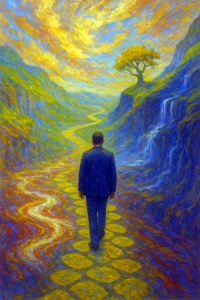
The stair dissolved into path, and the path into a kind of floor grown from roots. The roots braided underfoot like old hands, warm in the way of something that had been alive a very long time and had learned patience in its bones. The air held the taste of iron and rain. Far away—above or behind or before—Daniel thought he could still feel the remembered warmth of the garden, the way you feel sun on your back long after stepping into shade.
The figure in the coat of sentences walked beside him without footfalls. Its edges were outlines more than edges, as if the world had drawn it lightly and then moved on.
“What do I call you?” Daniel asked at last.
“Call me what I am doing,” the figure said. “Guide will do, until you think of something kinder.”
“I’ll try to earn kinder,” Daniel said, and was surprised to hear the softness in his own voice.
They went on until the trees closed ranks and the path narrowed to a thread. Leaves brushed Daniel’s shoulders with the lightest of fingers. Each leaf was shaped like punctuation, curving commas and long dashes and the occasional scandalized exclamation. When he disturbed them, they whispered, and what they whispered were the beginnings of sentences he had never dared to finish.
“I meant to—”
“If only I had—”
“You never knew that—”
He flinched. The Guide’s sleeve-ribbons of text rustled, and a phrase rose toward Daniel’s ear: Keep your name for love warm and whole. He cupped the memory of it like breath in cold air.
The first question found him in the shape of a vine. It looped down from a branch, green as new promises, and settled across his chest. Instead of thorns it had small questions printed on every eye-shaped leaf.
Why didn’t you tell her about the letter?
Why did you shut the door that night?
Why didn’t you laugh when she needed you to?
“I didn’t mean to,” Daniel said, and the vine tightened.
“Don’t feed it apologies,” the Guide murmured. “They’re hungry here. Give it facts.”
“I was afraid,” Daniel said, breathing carefully. “I was tired. I thought there would be time.”
The vine loosened as if listening. Daniel slipped free without tearing a single leaf. He didn’t feel absolved; he felt understood by a plant, which was a very particular kind of humility.
“Good,” said the Guide. “Truth is ballast. It will not move you forward, but it will keep you from tipping.”
“Will I need to move forward?” Daniel asked.
“You already are,” said the forest in the hushed chorus of unsent emails and unopened notes.
They passed a tree whose bark held his handwriting. Not perfect copies—his hand had never been perfect—but the broken-backed curves of his lowercase a’s, the scratch of his r’s. Across its trunk ran lines he had thought many times and said never: I didn’t know how to stand beside you in your grief; I stood there anyway, but crooked. I sold us cheap for a quiet night. I let my father’s way of leaving stand in for a way to live.
He reached to touch the words. The bark was ridged and warm. The Guide shook its head.
“Touching them makes them current,” it said. “Let them remain what they are: past-due notes.”
They came to a clearing filled with air so thin it made Daniel’s ears ache. The ground here was struck through with silver roots and old coins, and at the center stood a trunk as wide as a house. Its bark was paper, a thousand sheets layered and rain-cured, each page bearing a heading in a tidy, merciless hand:
UNSPOKEN COMFORTS
UNASKED QUESTIONS
UNMADE APOLOGIES
UNSPENT JOY
Daniel approached. The headings shivered. Beneath UNSPOKEN COMFORTS his own breath stirred the topmost page, and he read: You could have said it would be all right even if you didn’t know it would. You could have said it would be all right even if it wouldn’t.
“I thought that would be a lie,” Daniel said to the tree.
“It would have been a mercy,” the tree replied, not unkindly.
“Be careful,” the Guide said quietly. “This is the Ledger Tree. It balances what wasn’t said with what still can be. It will offer you trades.”
As if hearing itself introduced, the Ledger Tree creaked, and a slit opened in its bark-page. From the aperture extended a drawer the color of a faded photograph. Inside lay objects so ordinary they were frightful: a chipped mug; a ribbon from the first present he had ever wrapped clumsily and proudly; a small plastic dinosaur he had won for her from a machine that was rigged against winning.
“What are these doing here?” Daniel whispered.
“They are your change,” said the Ledger Tree. “You may pay with any of them to erase one unspoken sentence. Choose carefully. Erasure takes the weight, and the color.”
Daniel reached toward the dinosaur. He remembered the night—the laugh they had shared about his ridiculous skill with a rigged claw, the way she had slept with the toy in her palm like a child who’d made up her mind to believe for one more night. He stopped.
“If I pay with it, I keep the memory,” he said, testing the air around the drawer.
“You keep the outline,” said the Tree. “Not the shade. The night will cool. The laugh will flatten. It will not hurt you anymore, but it will not warm you either.”
Daniel thought of the sweetness of pain when it is attached to something worth having had. He closed the drawer gently.
“No,” he said. “I’ll carry what I didn’t say. I won’t spend our color to purchase silence.”
The Ledger Tree sighed, shed three paper leaves, and grew another heading:
UNSURPRISED COURAGE
“Take it,” murmured the Guide, and Daniel felt a small swell beneath his ribs, as if the world had slipped him a pebble to keep in his pocket for later.
They left the clearing; the forest folded it up behind them as a person folds away a letter they are not finished with yet. The path sloped downward. The whispers grew less intelligible and more insistent, like rain crossed with advice. Daniel learned to walk through them as he had once walked through crowds at the market, not ignoring the people but not giving himself over to them either.
At the foot of the slope a hush began—not the soft hush of the clocks’ pause, but a heavier thing. They stood at the lip of a fall of silence, a cataract pouring not water but all the words someone had chosen not to say at a bedside, at a wake, in a hospital hallway where machines argued with a heart. The sound of it was the absence of the sound that should have been there.
“What is this called?” Daniel asked, throat tight.
“The Hushfall,” said the Guide. “We cross it on a bridge you must make.”
“I don’t know how to make bridges,” Daniel said. “I never learned the math for it.”
“Not that kind,” said the Guide, and for the first time Daniel felt a pulsing warmth from the figure—as if something like fondness moved behind its outlined eyes. “This bridge is made of a single sentence you should have said and didn’t. Say it now, to no one and to everyone. Say it and mean it and step forward as you say it. The words will hold until your foot lands, and then they will become stone.”
“What if I choose the wrong sentence?”
“Choose the truest one you can bear,” said the Guide. “There are no wrong bridges here. Only ones that do not carry your weight.”
Daniel looked at the fall. He could not see the bottom. He thought of the sentence the Ledger Tree had offered him, the erasures it had asked in return. He thought of his wife’s hands around the cooling cup. He thought of the morning he had left without kissing her because his mouth had been full of hurry, of the night he had defended his silence as “not wanting to make it worse,” as if more words could do more harm than less. The sentence rose in him without poetry.
“I’m sorry I left you alone in the hard places.”
It was not eloquent. It was not original. But to say it here, where the unsaid collected like winter, cost something he had kept in a tight fist for years. He opened the fist. The words left him, visible in the air as thin white breath. They reached the fall, set like a plank of light.
Daniel stepped onto the apology.
It trembled and then held.
He could not look down; he looked forward. He took the next step and spoke again, not the same sentence now but the one that arrived to meet it.
“I’m sorry I took your strength for granted because you wore it so gracefully.”
Another plank. Another step.
“I’m sorry I asked you to read my mind and then punished you when you didn’t.”
Another plank, this one narrower. He felt his foot seek balance and find it by remembering the way she had steadied him on roller skates at a rink they’d gone to in their early thirties for reasons they could not now remember.
He went on. He did not empty himself of sorrow; he made it useful. The Hushfall surged below, still as huge as before but changed for him by the fact of crossing. At the midpoint the air changed temperature—the way a room changes when a door opens—and Daniel knew without proof that somewhere else in the forest, another person was building their own bridge with their own words. The thought steadied him more than any railing would have.
On the far side, the last plank of apology set into dark soil and became the first step back onto land. Daniel stood there, dizzy with the relief of not falling and with the small hammering joy of having said what should have been said long ago.
“Good,” said the Guide, and this time good felt like rain after dust.
“What happens to the words?” Daniel asked, looking back. The bridge had already begun to moss over, as if time—whatever that was here—refused to let anything remain a miracle forever.
“They remain said,” the Guide replied simply. “Saying takes nothing from the past. It gives something to the person who speaks, and sometimes to the one who needed to hear it in a different place.”
“Will she hear it?” Daniel asked, unable to keep his voice from breaking on the question.
“She may not know she has,” said the Guide. “But her hands may find warmth where there was none a moment ago.”
Daniel closed his eyes, and in the dark behind them he saw, not the kitchen this time, but the curve of her shoulder where it met her robe. He sent a thought to that place, not to be clever, not to be right, but to be present. When he opened his eyes, the hush had softened to murmur. The forest had moved closer again.
They walked until the ground flattened, and the trees drew back enough to let a weak light through—a light not from above, but from a plane ahead that shimmered like a wall of air heated by summer. On the near side of that shimmering, shapes moved the way fish move behind glass: same and not same.
“This is where the river begins to show itself,” said the Guide. “We will not cross today. But we will learn the angle at which to look.”
The light steadied. Between two low hills a wide band of silver curved away, slow as thought. It looked like water until you tried to see your reflection. Then it looked like memory until you asked it to be kind. The surface did not show Daniel as he was; it showed him as if he had chosen differently each time he had stood at a small crossroads and shrugged. It showed a life made of yeses where he had said no, of noes where he had said maybe and let the days decide.
He stepped nearer. The Guide did not stop him, only stood close enough that Daniel felt the thin cool of its presence on his sleeve. The river showed him tending a garden he had never planted, a line of gardenias blooming under a window he had meant to measure and never measured. It showed him at an open mic with the guitar he had never learned; it showed his wife in a crowd, laughing in a way that was not quite her laugh and yet still belonged to her. It showed a child running between their knees, a boy with his mouth open in unafraid joy. Daniel reached for the surface and felt his hand pass through a future that was no longer possible and had never been certain.
“I could drown in this,” he said softly.
“You could,” the Guide agreed. “Many do. They drop their names and let the river fill their mouths with could-have-been. They become polished stones that think they are waves.”
“What keeps me from it?” Daniel asked, not sure whether he wanted to be kept.
The Guide lifted one ribboned sleeve. A single strip of text fluttered free and rested against Daniel’s wrist like a ribbon a child ties for a prize. He looked down and read: The truest thing you carry is not what might have been but what you loved in what was.
It was such a small sentence. He felt foolish and saved, both.
“Before we go nearer, you must meet the ones who live at the edge,” said the Guide. “They are keepers of the angle. They learned the hard way where not to look.”
“The angle?” Daniel repeated.
“To look straight on is to be caught,” said the Guide. “To look sideways is to see clearly. They will teach you the turn of the head that does not betray the heart.”
The river breathed. On its bank shapes straightened, stood, and resolved into figures with faces like photographs left in a dashboard sun too long—features faded, eyes too bright. Their clothing looked made from maps. Where there should have been roads, there were lines of music; where there should have been cities, there were stains the shapes of tears dried without wiping.
One of them stepped forward, a woman whose smile was a line stitched of patience and mischief. She stood near enough that Daniel could see that her map-clothes bore his city, and also not his city—streets he had lived on and streets he had walked only in dreams. When she spoke, her voice had the texture of pages turned with damp fingers.
“You came through the Hushfall,” she said, as if greeting him at a door. “Good. Your feet will remember the weight of saying.”
“I’m looking for my wife,” Daniel said again because the sentence kept him intact.
“Then you must learn how not to be rewritten by the river before you look for her reflection,” the woman said. “You must learn to keep your name from taking on other shapes. We will show you. It takes time.” She glanced toward the motionless sky where time was a rumor. “Or the thing we use instead.”
Daniel looked past her to where the river bent out of sight. He thought he saw, at the edge of a bend, a gentler color—the look of her robe at dawn. He stepped forward and the Guide’s hand—if that ghost-touch could be called a hand—rested briefly on his sleeve.
“Not yet,” it said, with that same strange warmth. “Begin with the angle, with the practice of not breaking yourself on what else could have been. Keep your pocket stone.” The Guide nodded toward his chest, as if the pebble of Unsurprised Courage showed through. “You will need it.”
The woman in maps smiled again, meaning it. “We are called the Sidelong,” she said. “We will teach you how to stand by the river without falling in. Tomorrow—” she stopped, laughed at her own word, tried again—“after you rest, you will learn to watch and not be washed.”
Rest, thought Daniel, and the word felt like a boat tethered, rocking gently, waiting for a friend. He looked once more at the water and let himself think only of the discipline of turning his head a few degrees, of how many little motions of mercy make a day.
He didn’t know if his wife could feel anything of him yet. He did not know if he would find her, or in what shape he would have to be to recognize her when he did. He knew only the next small thing: that in this place where words had weight, he would learn to speak and to keep silence without lying. He would learn to look sideways at sorrow until it let him pass.
Behind them, invisible clocks considered the possibility of ticking. Ahead, the river rehearsed the lives that had not been. Beside him, the Guide hummed a thread of melody he almost knew.
Daniel breathed, and the forest answered, and Chapter Two opened into its quiet night.
CONTD
Chapter Three — The River of Mirrors

The forest thinned, and the hush that had been stitched through the air gave way to something sharper. Daniel felt it before he saw it: a shimmer on his skin as though the world had turned to glass and was waiting to crack.
The Guide stopped. Its coat of stitched sentences stirred, and one phrase loosened to brush Daniel’s wrist: Careful where you look; the eye is a door.
Then the trees opened, and the River lay before them.
It wasn’t water, not truly. It was liquid in the way that fire is liquid—always moving, always collapsing into new shapes. Its surface was silver, but not polished silver; it quivered with light that never stilled. Daniel leaned forward, and the surface leaned back. He expected his reflection. Instead, he saw himself kneeling in a hospital corridor, hands clasped until his knuckles were white. The air around his image was full of machines beeping in erratic sympathy.
“That was… me,” Daniel said, “but not like I remember it. I never knelt. I stood.”
The Guide tilted its head. “The River shows what could have happened, what you nearly chose. It shows the paths pruned away. Not illusions—possibilities. They live here, fed by what you left unsaid or undone.”
Daniel stepped closer, and the River shuddered. A new image spilled across it: his wife, younger, walking away from him after a bitter argument. He wanted to shout that it hadn’t ended that way—that he had gone after her, that he had begged her forgiveness in the rain. But here she vanished into a street of strangers, never looking back.
The pain was a weight in his chest. He knelt, reaching toward the image. His hand passed through the surface, and suddenly the water clung to him like glassy vines. For a moment he saw an entire life: himself alone, years piled high, dinners for one, photographs in frames turned to face the wall.
“Daniel!” The Guide’s voice cracked like a whip. “Look away. You’re stepping into what isn’t yours.”
Daniel wrenched his hand free. His skin was wet with silver, and where the drops fell to the earth, tiny visions bloomed: a child he never fathered, a song he never finished, a house he never built by the lake they once talked about. Each one blinked like a fragile insect, then winked out.
“I could lose myself here,” Daniel whispered.
“You could,” the Guide agreed. “The River wants company. Many wanderers mistake might-have-been for must-have-been and dissolve into reflections. They become ripples with no voice.”
Daniel’s knees trembled. He stood, forcing himself to breathe. “Why show me this? Why torture me with what I can’t change?”
“Because,” said the Guide, “to reach her, you must know the weight of what else could have been. Love is not only what was. It is also what was not. If you forget that, the River will take you.”
Daniel closed his eyes. Behind the lids, he saw her smile—her real smile, the one that lived in memory, not possibility. He held onto it like a rope.
When he opened his eyes again, the River showed something gentler: his wife standing at a window, wearing the robe he remembered, looking out at dawn. She turned, as if she had felt him watching, and for a heartbeat Daniel believed she saw him. The River quivered, holding the image steady before letting it go.
“Did she…” Daniel began.
“She felt you,” the Guide said softly. “Not clearly, not yet. But yes. A thread has been touched.”
Daniel wanted to leap in, to swim until he reached her. Instead, he forced his feet backward. The River hissed as though denied a meal.
“Come,” said the Guide, “the City waits.”
“The City?” Daniel asked.
“Where the lost live when they no longer trust their own names. It is where you must walk next.”
Daniel turned once more to the River. Its silver surface rolled like the eye of a beast pretending to sleep. Then he followed the Guide, knowing the hardest visions were still ahead.
Chapter Four — The City of Forgotten Faces
The River of Mirrors dwindled behind them, its silver sheen curling into the fog until it was only a brightness in memory. Ahead, the air grew heavier, thick with the smell of stone and smoke. Daniel followed the Guide across a barren plain scattered with broken masks—some painted in vivid colors, some carved in wood, others plain as unmarked clay. Each one seemed to breathe faintly, as if still trying to remember the face it once belonged to.
“The City is near,” the Guide said. “Do not pick up what is not yours.”
Daniel bent down anyway, drawn to a mask lying at his feet. It bore no features save for two hollow eyes. As he reached, the Guide’s sleeve of stitched words snapped out and brushed it away.
“If you put on a mask,” the Guide warned, “you may never take it off. Many wanderers forget their names here.”
They walked on until spires began to emerge from the haze—towering buildings made of bone-white stone, their windows blank as eyeless sockets. The streets stretched in impossible directions, folding back on themselves like an origami map. Lamps lined the avenues, but instead of flame, each held a trapped sigh, flickering faintly.
And then Daniel saw the people.
They moved slowly, drifting through the streets like tired actors between scenes. None had faces of their own—only smooth skin, pale and unbroken. Over this, each wore a mask, and each mask was alive. Some smiled too widely; others wept endless painted tears. Some bore the likeness of children, others of old men, others of animals half-remembered from dreams.
One mask caught Daniel’s breath short: a woman’s smile, familiar in its gentleness. It was her smile—his wife’s—but it was wrong. Too still, too hollow. He felt his knees weaken.
“Is that—”
“No,” said the Guide sharply. “Not her. Only her echo.”
A masked figure drifted closer. Its face was the blank smoothness of clay, but the mask it wore bore the likeness of Daniel himself, younger, full of laughter. The sight made his skin crawl.
“Why are they like this?” Daniel whispered.
“They gave away their names,” the Guide said. “Some traded them for the comfort of forgetting, others for the promise of never being hurt again. The City welcomes them all, but they lose the face they carried in life.”
The figure wearing his younger mask tilted its head, as if asking him to join. Daniel turned away quickly.
They passed through an open square where a fountain spilled not water but shards of glass. Each shard reflected a different face—a thousand borrowed identities tumbling together. Souls with no faces bent to drink, lifting fragments to their mouths, hoping for a sip of recognition. But the glass only cut their hands.
Daniel’s heart pounded. “This place is—”
“Dangerous,” the Guide finished. “And necessary.”
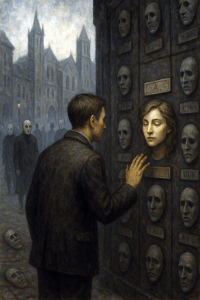
They came at last to a great hall, its doors taller than cathedrals. Inside, the walls were lined with masks, each labeled with a name carved in fading script. Daniel’s eyes darted across them until he froze.
Her name. His wife’s.
Beneath it hung a mask of her face—so perfectly captured that for a moment he thought she stood there, waiting. But her eyes were empty, painted with nothing behind them.
“Is this her?” he asked, voice breaking.
“It is her absence,” the Guide said. “What she left behind when sorrow tempted her toward forgetting.”
Daniel reached out but stopped, remembering the warning. His fingers hovered inches from the mask.
“What happens if I take it?”
“You risk becoming one of them,” the Guide said. “But perhaps—just perhaps—it could also be a thread leading to her. You must choose, Daniel. Leave it, and your path may diverge elsewhere. Take it, and the City will notice you.”
Daniel’s hand shook. The air around the mask seemed to hum. He thought of her smile, not painted but alive, the one that warmed him through ordinary mornings.
He whispered her name, and the mask quivered, as though it had heard.
Chapter Four — The City of Forgotten Faces (Climax)
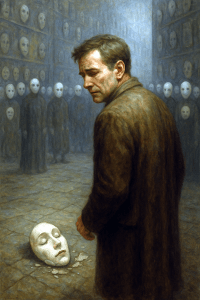
Daniel stood frozen before the wall of masks. His wife’s likeness stared back at him with painted serenity, her eyes closed, her lips arranged in that soft half-smile he had once known so well. But it was only a mask, lifeless, empty—a husk. Still, the sight of her pulled at him like a tide.
The Guide lingered at his shoulder, silent for once. Its presence was weight, a warning.
He raised his hand again, trembling, reaching for her mask.
As his fingers hovered inches away, the City stirred. The faceless figures turned their smooth heads toward him. All movement stopped. The sighing lamps guttered. Even the spires seemed to lean closer, listening.
A voice, thin as parchment, whispered from the mask itself:
Take me. Wear me. Remember me.
Daniel staggered back. “She spoke—did you hear?”
The Guide shook its head. “Not her. The City. It tempts you with echoes.”
But Daniel’s heart thundered. He thought of his wife’s mornings, of the sound she made when she yawned, of her hand brushing his shoulder in passing. This mask—could it lead him to her? Could it bridge the gap?
“Daniel,” the Guide said gently. “To take the mask is to claim her absence as her presence. If you wear it, you may mistake memory for reality. And the City will never let you leave.”
He pressed his fists to his eyes, tears spilling hot. “Then how do I find her?”
“By risking not finding her,” said the Guide. “By carrying the ache instead of filling it with plaster.”
The mask’s painted lips parted slightly. “You loved me once,” it whispered, in her voice. “Take me back. I’ll be yours again.”
Daniel reached out—and stopped. He remembered the rose’s warning: Hold fast to the true name of what you love. Everything here will try to rename it for you.
“This isn’t her,” he said aloud. His hand shook, but he lowered it. “She isn’t a mask. She’s more than this. She’s alive in her grief, in her waiting, in her pain. If I take this, I’ll lose the real her.”
The mask’s painted face twisted, its smile faltering into a hollow gape. A low hiss rolled through the City as the faceless figures turned away, disappointed, and shuffled back into their endless drift.
The wall shuddered. The mask bearing his wife’s likeness fell with a brittle crack, shattering into dust at his feet.
The Guide inclined its head. “You chose well.”
Daniel was shaking all over, but there was a steadiness beneath it, a small stone of certainty. “If she still waits for me,” he said, “I’ll find her. Not her shadow. Not her shell.”
The Guide gestured toward a narrow stairway at the far end of the hall, carved from crumbling ash. “Then your path leads upward, through the Stairway of Ash. The climb will burn, but what waits above may bring you closer.”
Daniel took one last look at the empty wall. Where her mask had hung, nothing remained—only her name carved into the stone, glowing faintly, as if promising it was not erased.
He turned away, heart raw but unbroken, and walked toward the stair that led into smoke.
Chapter Five — The Stairway of Ash

The hall of masks faded behind him, its silence still clinging to his shoulders. Daniel stepped into a narrow corridor that funneled upward. The air changed—thinner, harsher, filled with the smell of smoke and burnt paper. Soon the walls themselves began to crumble, revealing steps carved from gray ash, compressed so tightly they held underfoot yet left powder on his shoes.
The Stairway of Ash climbed steeply into a haze that flickered with orange light, as if some unseen fire smoldered above. Daniel placed one hand on the wall for balance. It left a print, glowing faintly before dissolving into nothing.
“Why does it burn without flame?” Daniel asked.
The Guide ascended beside him, its coat of sentences trailing whispers. “These stairs are built from what you regret most. Each step burns because you cannot touch it without pain. To climb is to relive what you wish undone.”
The first step seared his foot. Instantly he remembered the last night of her sorrow—how he had heard her crying and pretended to be asleep. The guilt shot through him like fire. He nearly stumbled.
“Keep climbing,” the Guide urged. “Let the fire pass through you.”
He forced himself up the next step, and another memory struck: the day she had asked him, quiet but desperate, Do you still love me? He had laughed it off, said something flippant—What kind of question is that?—and walked away. Now the answer he hadn’t given burned him raw.
Every step was another flame of memory: arguments he’d begun and never mended, moments of tenderness he had withheld, promises delayed until too late. By the tenth step, his legs shook. By the twentieth, his chest ached with more than exertion.
“I can’t,” he gasped. “I can’t climb all this.”
“You can,” the Guide said, though its voice wavered like smoke. “Not by strength—by surrender. Admit what the fire teaches you.”
Daniel collapsed to his knees, clutching the step. The ash seared his hands, and images flooded him: her eyes hollowed by loneliness, her hands clutching that cooling cup of coffee, the silence between them stretching years too wide.
“I failed her,” he whispered. “I failed her when she needed me most.”
At those words, the fire shifted. The ash under his hands cooled just enough for him to stand. He climbed higher, each admission easing the flames, though never extinguishing them.
Finally, near the top, the steps widened into a small platform. And there, waiting, was a child.
The boy could not have been more than seven. He wore no mask, no cloak—just simple clothes that seemed to glow faintly in the ash-light. His hair was the same chestnut brown as Daniel’s wife’s. His eyes—Daniel’s own.
“Hello, Father,” the boy said, as if the greeting had waited forever.
Daniel froze, heart pounding. “Father? But—I never—”
The boy smiled, a mixture of innocence and sorrow. “You never had me. But you could have. I am what might have been, if your love had been braver, if your choices had turned a little differently. The River whispered me into being. The stairs gave me form. I am your son who never was.”
Daniel’s throat closed. He wanted to deny it, but the truth shone too clearly in the boy’s gaze. “Why are you here?”
“To guide you further,” the boy said. “Mother is waiting, but she hides herself in sorrow. To reach her, you must walk through the House of Infinite Rooms. And I will take you there.”
The Guide bowed its head. “This is as far as I go. He belongs to you, Daniel. He will know the turns where I cannot walk.”
Daniel felt his knees weaken again. “But you’re not real,” he whispered to the boy.
The child stepped forward, placing a small, warm hand in Daniel’s trembling one. “Neither is grief. And yet it shapes everything.”
Daniel broke into tears, the first unguarded ones since he had arrived beneath the sky of clocks. He knelt, hugging the boy tightly, feeling the impossible solidity of him. For a moment, he wept into the child’s shoulder as if into a promise both kept and broken.
When he rose, he did not feel strong. But he felt guided.
The boy smiled again. “Come, Father. The rooms are waiting.”
Together, they began to climb into the smoke, toward the shifting House above.
Chapter Six — The House of Infinite Rooms

The Stairway of Ash gave way to a landing of pale stone, as if someone had swept together the remnants of a thousand fireplaces and shaped them into walls. The smoke that had clung to Daniel’s skin thinned, and before him rose a vast structure, shifting with every blink: a mansion one moment, a cathedral the next, then a labyrinth without a roof.
“This is the House of Infinite Rooms,” said the boy, his small hand still tucked into Daniel’s. “It remembers you more than you remember yourself.”
The doors opened without touch. Inside, corridors spread in all directions, lined with countless doors, each one ajar, each whispering faintly. The air smelled of chalk and candle wax, mingled with something older, like dust from books never read.
“Where do they lead?” Daniel asked.
The boy’s eyes shone. “Every room is a moment. Yours, hers, both of yours together. You must walk them. But beware—rooms change. They don’t want you to leave once you open them.”
The first door swung wide on its own. Daniel stepped through and found himself back in his living room—familiar yet sharper, more vivid than any memory. His wife sat on the sofa, her hair damp from rain, her eyes pleading. He remembered this day: they had argued, and he had left her words unanswered.
He tried to move toward her, but the floor thickened into syrup. The room tugged at him, trying to trap him in that moment forever.
“Don’t get stuck,” the boy called.
Daniel forced himself back into the corridor. The door slammed shut, and the handle dissolved. That moment was sealed, though its ache clung to him.
The next room showed them laughing in the kitchen, covered in flour, baking bread on a snowy day. This one tried to hold him too, but with gentleness instead of guilt. The warmth of it nearly broke him. He longed to stay, to freeze in that happiness.
“Not yet,” said the boy softly. “If you stop here, you’ll never find her.”
Daniel tore himself free. The door shut behind him with a sigh, like a lover’s breath fading in sleep.
Room after room, memory after memory—joyful, sorrowful, trivial, monumental. Each one alive, each one clutching at him. His childhood appeared in one; in another, he saw his wife alone at a train station, waiting for him. In another, a birthday he had forgotten until now, her smile brittle as she blew out candles without him.
As the rooms multiplied, the corridors bent and doubled back. Sometimes the same memory appeared twice, twisted—one version joyous, the other warped into dread. The house was not content to replay life as it had been; it reshaped, reinterpreted, as though testing him.
Finally, they came to a long hall lined with mirrors instead of doors. Each mirror showed a different room: one where his wife sat writing a letter; another where she wept into her hands; another where she laughed with someone else.
And at the very end—her shadow.
It sat in a chair, head bowed, motionless. The sight wrenched him. “That’s her!” Daniel cried, starting forward.
The boy caught his arm. “It’s her sorrow. She has wrapped herself in it so tightly that it looks like her. If you reach for her too quickly, the House will make you believe the shadow is real.”
Daniel swallowed hard. “Then how do I reach her?”
The boy’s face was solemn, far older than seven. “You must give up the rooms. All of them. You must walk past every memory, every regret, every joy, without letting them keep you. Only then will the door open to the place where she waits.”
Daniel turned back to the mirrors, each one gleaming with pieces of his life. His chest ached with longing, with the temptation to hold onto even a fragment.
But he clenched his fists, whispering her true name, and stepped past them. The mirrors shivered. The hall trembled. And at the far end, beyond the shadow, a door appeared—small, unmarked, but glowing faintly, as though lit by dawn.
The boy nodded. “That’s where she is.”
Daniel reached for the handle.
Chapter Seven — The Abyss of Silence

The boy led Daniel to the glowing door at the end of the mirror-hall. It had no handle, no lock—only a faint shimmer like breath on glass. When Daniel spoke his wife’s name, the door swung inward, and cold air rushed out.
They stepped into blackness.
Not darkness—blackness. The kind that swallowed sight, thought, and sound alike. The floor beneath him was smooth as glass, but it quivered faintly, as if it were only memory pretending to be solid.
“This is the Abyss of Silence,” the boy whispered, though even his whisper sounded muffled, devoured by the air. “Here lie the ones who gave up speaking, the ones who stopped calling out. Their voices sank into the dark and never returned.”
Daniel’s skin prickled. He tried to answer, but no sound left his mouth. He clutched his throat, panicked.
The boy touched his arm. “Here, voices are eaten. You must carry words in your heart, not on your tongue. If you let go of them inside you, you will join the lost.”
Shapes moved in the silence—shadows drifting just beyond sight. They weren’t threatening; they were empty, their mouths wide open, lips frozen mid-word. These were souls who had tried to speak and failed, and now wandered voiceless in the Abyss. Their silence was heavier than any scream.
Daniel pressed forward, guided by the boy’s small hand. But with each step, the silence grew heavier, pressing against his mind. Thoughts blurred, memories dissolved, even his wife’s face began to waver at the edges.
He clutched her name inside himself, repeating it silently like a flame in cupped hands. Her name, her name, her name.
At the heart of the Abyss, a chasm split the glass floor. Across it, barely visible, was another door—faint, flickering, like a candle in wind.
To reach it, Daniel had to cross the silence itself.
The boy pointed. “The bridge forms from what you hold truest. Not apologies this time, not regrets—truth. Say it within, believe it fully, and the silence cannot take you.”
Daniel’s heart pounded. He stepped forward, and beneath his feet, words formed in glowing letters—words he had never dared to admit aloud:
I was afraid of needing her as much as I did.
The letters hardened into glass. He took another step.
I loved her more than I knew how to show.
The bridge stretched further, glowing in the void. The shadows stirred restlessly but did not cross.
Another step. His chest ached with the truth as if it were tearing free.
I would choose her again, even knowing I would fail her sometimes.
The glow brightened. The bridge stretched almost to the other side.
But then the silence attacked, rushing into his head like water, drowning the words, trying to snuff them out. Doubts clawed at him: She doesn’t want you. She’s safer without you. You are too late.
Daniel staggered, nearly losing his footing. The glow faltered.
Then he felt the boy’s hand slip into his, warm and steady. He looked down into those chestnut eyes and remembered—his wife’s gaze when she used to hold him at his weakest. He drew strength from it, and whispered inside himself one last truth:
I am hers still, and I always will be.
The bridge blazed white. Daniel stepped across and stumbled onto the far side. The silence recoiled, the shadows shrank, and the chasm closed behind him.
The boy smiled faintly. “You kept your voice inside. That is enough.”
Before them, the door glowed brighter. Through it, Daniel thought he heard something faint—like the first sound after years of deafness. A sob. A laugh. A woman’s breath.
“She is near,” the boy said.
Daniel reached for the door, his heart trembling. Beyond it lay either her salvation—or the final proof of her despair.
Chapter Eight — The Reunion

The glowing door at the far side of the Abyss shivered like a fragile heartbeat. Daniel pressed his palm against it, and warmth seeped into him, startling after so much silence. The boy stood at his side, his small face grave but luminous, as though he already knew what Daniel would find beyond.
The door opened without a sound.
Inside was a chamber that seemed to have no walls. Instead, it was filled with drifting fragments of memory, floating like lanterns in the dark: laughter shared in a kitchen, footsteps across a wooden floor, the warmth of a hand brushing his, the quiet curve of a smile. They hung around him, glowing faintly, flickering as if afraid to be seen too clearly.
At the center sat his wife.
She was not whole. Shadows clung to her shoulders like a shroud, and her face was bowed, half-hidden. Around her pulsed a cocoon of grief, weaving itself tighter with every breath.
Daniel’s throat tightened. “It’s her,” he whispered.
The boy squeezed his hand. “Yes. But she doesn’t believe she deserves to leave this place. Sorrow tells her it is safer to stay.”
Daniel stepped forward. His wife stirred but did not raise her head. Her voice drifted out, thin as paper. “Go away. Whoever you are… leave me. I am not worth finding.”
His chest ached. “It’s me,” he said, though the words felt fragile here, vulnerable to being stolen. “It’s Daniel.”
She shook her head, her hair falling like a curtain. “No. Daniel is gone. He left me long ago. He chose silence. He let me drown in loneliness.”
Each word pierced him, because it was true, because it was not the whole truth. He reached for her but the cocoon of sorrow tightened, threads of shadow lashing out, cutting his hand like glass.
“You can’t touch her yet,” the boy warned. “If you break the cocoon too soon, she will vanish into it.”
“Then what do I do?” Daniel asked desperately.
“Show her that her sorrow is seen,” the boy said. “Do not deny it. Do not fight it. Share it.”
Daniel knelt before her, ignoring the shadows that sliced across his skin. He bowed his head, just as hers was bowed. “You’re right,” he said softly. “I left you in the hard places. I let silence win. I thought I was sparing you, but I was only sparing myself. And I am so sorry.”
The shadows shivered. She raised her head slightly, her eyes hollow but searching. “Why now? Why not then, when I needed you?”
His voice broke. “Because then I was a coward. Because I thought there would be more time. But I am here now, even if it is too late. Even if I have nothing left to give you but my truth.”
Something inside the cocoon cracked. A faint glow bled through.
She whispered, “I don’t deserve you to come for me.”
“No,” Daniel said, tears streaming. “You deserve more than me. But I still choose you. Even broken. Even drowning. Always you.”
The cocoon splintered. Shadows peeled away in long ribbons, dissolving into the dark. She gasped as though surfacing from deep water, her eyes meeting his fully for the first time. They were wet, terrified, and achingly alive.
“Daniel,” she breathed.
He reached again, and this time his hand met hers, warm and real. The touch sent a shock through him, a flood of every memory that mattered—laughter, sorrow, anger, tenderness—all of it bound together.
The chamber brightened. The drifting fragments of memory spun around them, weaving themselves into light. The boy stepped back, his smile small and sad.
“You’ve found her,” he said. “But the choice remains.”
Daniel held his wife close, her body trembling against his. “What choice?”
The boy’s voice echoed, almost older than it should have been. “To stay with her here, in this place where sorrow can always return… or to shatter the chamber and risk leading her into the unknown beyond. One path is safety. The other is freedom.”
Daniel looked into her eyes. She was real in his arms, but still fragile, still wrapped in the echoes of her pain. His heart thundered.
Her voice, barely audible, whispered: “What do we do?”
Daniel drew a trembling breath. The choice pressed down like the weight of the entire afterlife.
Epilogue — The Sky Restarts

Daniel held her hands, her warmth pulsing against his palms as though her life itself were being rewoven through the fragile contact. The boy’s voice hung in the air: One path is safety. The other is freedom.
The chamber around them trembled, the floating fragments of memory flickering wildly—scenes of their laughter, their anger, their tenderness, spinning like fireflies caught in a storm.
She looked into his eyes, raw and uncertain. “I don’t know where to go. I don’t even know if I can leave this sorrow. It’s all I’ve been.”
Daniel pressed his forehead to hers, closing his eyes. “Then let me carry it with you. Or let us shatter it. Whatever comes, I choose it with you.”
The cocoon cracked fully, splintering into ribbons of shadow and light. The fragments of memory surged forward, weaving around them, not to trap, but to cloak. Together they stood inside a sphere of their shared life, both broken and whole.
And then Daniel made his choice.
He spoke her name—not to claim her, not to bind her, but to release her.
The chamber exploded into brilliance. The fragments scattered like stars across the void. The sorrow dissolved. The boy raised his hand in farewell, his small body glowing until he was only light.
“Goodbye, Father,” he whispered. “Thank you for choosing love over fear.”
The light washed over them both. For a heartbeat, Daniel felt himself unravel, threads of memory and regret and tenderness spinning free. He thought he might dissolve like those faceless souls, become part of the silence.
But then—
The clocks returned.
They bloomed in the sky above, hundreds of them, ticking in perfect dissonance. Time restarted—not as a chain to bind him, but as a song. Beneath his feet the ground remade itself: not glass leaves, not ash, but a garden. Flowers rose in colors too vivid for names, petals shedding light instead of pollen. The air carried the laughter of rivers, the hum of unseen bees, the perfume of beginnings.
His wife stood before him, whole. Her sorrow no longer shackled her shoulders, though shadows lingered in her eyes. She looked at him—not painted, not hollow, but truly her.
“Daniel,” she breathed, and her voice was both a sob and a hymn.
He took her hand. “We’re not finished.”
Above them, one great clock stilled, its hands pointing not to hours but to a horizon. The sky deepened into dawn, though no sun rose. A light from nowhere filled everything.
And in that light, Daniel understood: this place would never be static. Gardens, forests, rivers, cities—all of it remade itself in rhythm with the love and memory carried into it. Not paradise as prize, not punishment as doom, but a canvas reshaped by what the heart dared to hold.
He and his wife walked forward, hand in hand, into a new garden whose paths had yet to be drawn. Behind them, the boy’s laughter echoed once, then was gone, folded back into the stars.
The sky ticked. The clocks sang. The world began again.
 The Crazymad Writer Writes Again