The Cats of Ballykillduff

The Cats of Ballykillduff
A Curious Tale of Whiskers, Whispers, and Whiskered Whispers
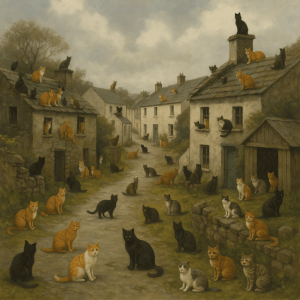
They came without warning. Not in a puff of smoke, nor on the back of a storm. No, the cats of Ballykillduff simply appeared one misty morning, as if they’d always been there. One minute, the village was its usual sleepy self—silent lanes, abandoned tractor tyres, and a lone crow that never quite made up its mind whether to caw or not. The next minute, the place was alive with fur and flickering tails.
They were everywhere.
Old Missus Deegan was the first to notice. She opened her curtain with the usual grumble, only to find three cats sitting on her windowsill, staring back at her with the eerie synchrony of a Greek chorus.
“Well,” she muttered, “you’re not the milkman.”
At Curran’s Lane, a dozen cats lounged on the half-collapsed roof of the haunted house, each of them perched on a tile as if auditioning for a gothic choir. Down at O’Shaughnessy’s shed, where once only old boots and rusting rakes resided, a regiment of tabbies had taken up residence, purring in harmony as if rehearsing for some feline opera.
The local postman, Gerry Malone, took to wearing shin guards and a helmet after a particularly hostile encounter involving three Siamese cats, a fence post, and a stolen rasher sandwich.
“It’s like they’re organising,” he said, trembling into his tea. “I saw one of them carryin’ a clipboard. Swear to God.”
At the Ballykillduff GAA pitch, the cats held court. No hurling, no football, just purring, sprawling, and the occasional hissed disagreement about who got to nap on the crossbar. The groundskeeper, who once prided himself on a pitch smooth enough to butter toast on, now spent his days chasing cats off the goalposts with a broom.
“Have ye noticed,” said Father Doyle during Sunday mass, “that there are more cats than people now?”
He wasn’t wrong. At last count, Ballykillduff had 117 residents and approximately 426 cats—though no one could be certain because the cats kept moving. Some claimed they were multiplying. Others whispered they were being summoned.
A theory, bold and as bonkers as it may sound, began to circulate.
“They’re her cats,” whispered Molly Kinsella, pointing toward the bog.
“Her?”
“Aye. The Catwoman of the Boglands. Lives out past the fairy tree. Hasn’t aged in forty years. Keeps a silver saucer on her roof for the full moon.”
And just like that, as if someone had meowed it into existence, the story took root. Children dared each other to go into the bog, to spot the silver saucer. One lad claimed he saw a giant Maine Coon riding a bicycle. Another said he heard a cat speaking Latin.
But no one found the Catwoman. Not really. Only scratch marks in the moss. And the sound of purring where there should have been silence.
Then, just as suddenly as they arrived, the cats began to disappear.
One by one, they melted back into the shadows, into hedgerows, up trees, down drains. Within a week, they were gone.
All except one.
A single black cat with green eyes and a crooked tail. It sat atop the scorched chimney of the house on Curran’s Lane, staring out over Ballykillduff like it owned the place.
Some say it’s a warning. Others say it’s a scout.
And some, like Missus Deegan, who still leaves a saucer of milk on the windowsill each night, believe the cats will return.
In Ballykillduff, you never know when something strange will stalk out of the mist.
But one thing’s for certain.
They weren’t just cats.
They were watching.
 The Crazymad Writer Writes Again