The Writer’s Conundrum
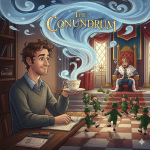

Gerrard, a man whose life was as meticulously organized as his collection of fountain pens, lived in a small, cozy cottage nestled in the Irish countryside. The air was often thick with the scent of peat fires and damp earth, but inside his study, the world was ordered. His writing routine was sacred: a fresh pot of Earl Grey, the morning light filtered just so through the lace curtains, and the absolute quiet required to coax sensible, respectable words onto the page.
But then there was the Conundrum.
It wasn’t always a plump, mustachioed man. Sometimes it was a giggling pixie, other times a stern, monocled owl, and occasionally, it was just a faint, indecipherable hum from the depths of his teacup. But always, it was there, waiting to derail his carefully laid narrative plans.
Today, Gerrard was attempting to write a historical drama, a sweeping tale of ancient Irish kings and fierce battles. He had just penned a particularly poignant description of a hero’s solemn oath when a tendril of steam snaked from his teacup, twisting into a miniature, emerald-green dragon no bigger than his thumb.
“Oh, do stop that droning about oaths and ancient prophecies, Gerrard,” the dragon puffed, exhaling a tiny wisp of jasmine-scented smoke. “It’s dreadfully dull. What this story truly needs is a sudden, inexplicable plague of tap-dancing leprechauns!”
Gerrard sighed, pinching the bridge of his nose. “Leprechauns, Conundrum? In a historical drama about the High Kings of Ireland?”
The dragon snorted, its minuscule nostrils flaring. “Precisely! Imagine the chaos! The strategic advantage of having your enemies distracted by an irresistible urge to jig! Think of the potential, Gerrard!”
The Conundrum always spoke of “potential.” To Gerrard, it spoke of utter, unmanageable chaos. He looked at his carefully researched notes, the timelines, the character arcs, all meticulously planned. How could tap-dancing leprechauns possibly fit into a narrative that required solemnity and historical accuracy?
Perhaps, Gerrard thought, it was time to illustrate the peculiar dynamic between Gerrard and his teacup.
 Gerrard stared at the miniature dragon, which now had somehow managed to balance a tiny, invisible top hat on its head. “Conundrum,” he began, trying to keep his voice even, “my readers expect a certain… gravitas. They want to learn about the ancient ways, the rich history. Not… synchronized jigging.”
The dragon scoffed, a puff of smoke forming a tiny, disappointed cloud. “Gravitas is merely dullness in a fancy waistcoat, Gerrard. History, as you call it, is simply a story that’s forgotten how to have fun! Besides, these aren’t just any leprechauns. These are the Lost Leprechauns of Lough Derg, and their tapping, you see, is not merely a dance. It’s a coded message, a lament for their forgotten pot of gold, which, as it happens, is buried beneath the very castle where your solemn oath is being sworn!”
Gerrard blinked. A coded message? A lament? Buried beneath the castle? The sheer audacity of it was almost… impressive. For years, he had tried to ignore the Conundrum, to write despite it, relegating its suggestions to the dusty bin of “unworkable ideas.” But lately, its insistence had grown stronger, its manifestations more vivid.
He looked at the partially typed page: “King Ronan solemnly swore an oath of eternal fealty to the ancient gods…” He then looked at the little green dragon, now doing a surprisingly intricate tap routine on the rim of the teacup.
“And what,” Gerrard asked, a flicker of reluctant curiosity igniting, “is the oath being sworn on?”
The dragon stopped its routine, striking a dramatic pose. “Why, the very boulder that marks the entrance to the leprechauns’ forgotten gold, of course! It’s a terribly ironic twist, isn’t it? The king, unknowingly, standing atop the very treasure he seeks to protect, swearing an oath that inadvertently dooms the true owners.”
Gerrard leaned back in his chair, rubbing his temples. This wasn’t historical drama; it was farcical folklore gone mad. Yet, a tiny spark of something, something he hadn’t felt in years, began to glow. It was the thrill of the unexpected, the pull of a story utterly untamed. His historical drama was, admittedly, a bit… predictable. Safe.
“And the hero,” Gerrard mused, “Sir Ronan. How does he react to a sudden outbreak of tap-dancing leprechauns?”
The dragon grinned, a mischievous glint in its emerald eyes. “Ah! He, being a man of rigid decorum, initially dismisses it as a mass hallucination brought on by questionable bog-water. But then, one rather tenacious leprechaun, named Paddywhack, takes a particular liking to Sir Ronan’s boots, believing them to be excellent dance partners. Paddywhack attempts to teach Sir Ronan the jig, thereby unwittingly revealing the code in their taps and leading him to the gold.”
Gerrard let out a small, involuntary laugh. Paddywhack and Sir Ronan’s boots. It was ridiculous. It was impossible. But for the first time in a long time, he felt a genuine desire to write this story, not because he had to, but because he genuinely wanted to see what happened next.
He pulled the page from his typewriter, crumpling the solemn oath. He inserted a fresh sheet, and with a deep breath, he began to type, “King Ronan, a man of unyielding resolve and particularly polished boots, was about to swear an oath of eternal fealty…” He paused, then added, “…when the air itself began to shimmer, and from the shadows beneath his very throne, emerged a dozen tap-dancing leprechauns.”
The little green dragon clapped its tiny claws, sending a shower of invisible, celebratory confetti into the air. “Excellent, Gerrard! Now, about Paddywhack’s penchant for interpretive dance…

Gerrard’s fingers, which for years had been so accustomed to the rigid clack of his typewriter, now flew across the keyboard with a newfound energy. The story of King Ronan and the tap-dancing leprechauns unfolded with a delightful absurdity. He wrote of the king’s initial bewilderment, his royal dignity slowly eroding as he tried to order the leprechauns to cease their jigging, only to find they were immune to royal decree.
The Conundrum, in its dragon form, would occasionally nudge his teacup, or perch on the edge of his screen, offering bizarre but brilliant suggestions. “Make the crown too heavy for the king’s head once the first leprechaun begins to tap,” it whispered, and Gerrard typed it, a chuckle escaping his lips. “The king’s royal scepter should double as a walking stick for the leprechauns!” Gerrard added that, too.
Soon, the story reached the point where the tenacious leprechaun, Paddywhack, began his campaign to teach King Ronan the jig. Gerrard wrote of Paddywhack’s frustration at the king’s two left feet and how he resorted to tying Sir Ronan’s boots together with a shoelace made of spun sunbeams.
But then, as Gerrard was typing a particularly vivid scene where King Ronan finally broke into a reluctant, clumsy jig, the Conundrum went quiet. The swirling, jasmine-scented steam from his teacup vanished, and the miniature dragon was gone.
Gerrard’s fingers froze. The silence was deafening. He looked at the teacup, now holding only a still, placid Earl Grey. The magical energy that had fueled his writing was gone. He tried to continue, to write the climax of the story on his own, but the words felt flat and lifeless. The humor was gone, the wit was gone, and the narrative threads, once so effortlessly woven together by the Conundrum, now hung loose.
Despair, cold and heavy, settled over him. He realized with a jolt that he hadn’t just been writing a daft story—he had been following a feeling, a spark, that had been missing from his life for years. Without the Conundrum, he was back to being just Gerrard, the writer of predictable tales, staring at a page that suddenly felt blank and intimidating again.
He tried everything. He changed his tea from Earl Grey to Oolong. He moved the teacup to a new spot on the desk. He even tried humming a jig in a desperate attempt to summon the Conundrum back. Nothing. The magic was gone.
Just as he was about to give up, a tiny, almost imperceptible puff of steam rose from the teacup, no bigger than a whisper. Gerrard leaned in, his heart pounding with a desperate hope.
A new shape began to form, not a mustachioed man or a tiny dragon, but something more abstract, a swirling vortex of fog. And from the very heart of the vortex, a tiny, disembodied voice spoke, sounding faint and weary.
“Gerrard,” it rasped, “I… I’ve been so busy lately, I’m simply exhausted. All those plots, all that drama. I need… I need you to tell me a story. A simple one, just for me. One of your quiet ones.”
Gerrard blinked. The Conundrum wasn’t a muse to be controlled or a trickster to be defeated. It was a character, a friend, a companion, and it needed him just as much as he needed it. And for the first time, he realized his stories, the ones he had always dismissed as being “too boring,” had a purpose after all. He smiled. He knew just the story to tell. A story about a man who finally learned to love both the chaos of his imagination and the quiet order of his heart.

The Writer’s Conundrum, Part 2
Gerrard sat down, the quiet of his study now a comfort rather than a curse. He didn’t pick up his pen or turn on his typewriter. Instead, he simply began to speak, his voice soft, as if telling a story to a sleeping child. He told the story of a writer who, for years, had a mischievous and wild imagination that he kept locked away in a teacup. He told of the day the imagination finally broke free, a whirlwind of absurdities and daft ideas, forcing the writer to see the world not as it was, but as it could be.
He spoke of the gingerbread man who led a revolution, the king who learned to jig, and the tiny dragon who taught him that there was magic in chaos. His words were simple, heartfelt, and flowed with an ease he had never known before. He wasn’t writing for a publisher, for an audience, or even for himself. He was writing a tribute to the friend who had reminded him how to truly see and feel the world.
As he spoke the final words, a delicate wisp of steam, more luminous than any he had seen before, rose from his teacup. It didn’t form a shape or make a sound. It simply pulsed with a gentle, appreciative light, a final, grateful farewell. Then, it shimmered and was gone. The teacup held only tea, and the room was filled with silence.
Gerrard looked at the empty space where the Conundrum had been, and a faint smile touched his lips. He wasn’t sad. He was filled with a sense of peace and a newfound power. He had wrestled with his imagination, and in the end, he had made it his own. The daftness was now a part of his discipline, the wildness a part of his wisdom. He was no longer just a writer. He was a storyteller.
He reached for a new page, not with trepidation, but with a quiet confidence. The blank page was no longer a conundrum; it was an invitation. And Gerrard was ready to write.

 The Crazymad Writer Writes Again