Alice and the March Hare
Alice and the March Hare
Chapter One: The Thirteenth Teacup
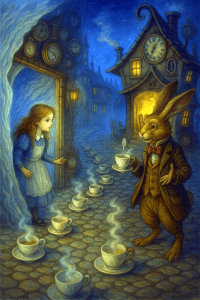
It was the sort of afternoon that was always nearly something. Nearly sunny, nearly raining, nearly tomorrow — but never quite there. Alice had been sitting by the window counting raindrops on the glass, though she couldn’t decide whether to count the ones that ran down or the ones that stayed put.
After she had lost count (twice), the clock on the mantel gave a most discourteous CLANG! and announced — in no uncertain tone — thirteen o’clock.
“Thirteen!” Alice exclaimed. “That’s not even polite. You might as well shout ‘seven-and-a-half!’”
“Seven-and-a-half is breakfast,” said a voice that was neither in front of her nor behind her, but rather, beside her thoughts.
Alice turned sharply. A pair of long ears poked through the curtain, followed by a waistcoat of uncertain cleanliness and a creature with a face full of whiskers and confidence.
“March Hare!” she cried. “I thought you were only around in spring!”
“Calendar nonsense,” said the Hare, brushing a raindrop off his paw. “I’ve changed my month. March was far too busy. I’ve moved into Whenever.”
“Whenever?” repeated Alice.
“Yes,” said the Hare. “It’s between Thursday and Someday, but only on alternate moods.”
He gave her a look that suggested she ought to understand perfectly, and when she didn’t, he added, “I’ve brought tea. You can’t think clearly without it — or think at all, if you do it properly.”
He produced a cup from his pocket. It was cracked, crooked, and empty except for a single floating teaspoon, which was humming “Rule, Britannia” through its handle.
Alice peered in. “It’s not full.”
“Neither am I,” said the Hare cheerfully. “That’s the point of tea — to fill the emptiness of being unfilled. You’ll see.”
And before she could protest, he poured the air directly into the cup, which somehow turned into liquid halfway down.
Alice sipped. It tasted like forgotten birthdays and cinnamon.
“It’s very peculiar,” she said.
“Then it’s working,” replied the Hare. “Come along, we’ve no time to understand — that always slows things down.”
He turned, stepped smartly through the wall, and vanished.
Alice hesitated only a moment before following, because by now she knew that hesitation in Wonderland (or Anywhere Very Similar) led to missing everything interesting.
Through the Wall
The wall was rather polite about the whole thing. It rippled gently, muttered “pardon me”, and let her through.
She found herself standing on a cobbled lane paved entirely with teacups, all neatly stacked sideways so that the handles formed a sort of wobbly railing. Every few steps, one of them sighed or burped out a bubble of steam.
At the end of the lane stood the March Hare’s house — or perhaps his idea of one. It was shaped like a question mark with windows for punctuation. The door was halfway up a ladder that led down instead of up, and from the chimney drifted the unmistakable aroma of burnt marmalade.
“This way!” shouted the Hare from the roof, though he was in the doorway at the same time.
Alice climbed down the ladder, which went upwards most of the way, and found herself in the sitting room. There were precisely thirteen chairs and twelve teacups.
“That won’t do,” she said automatically.
“Exactly what I thought,” said the Hare. “So I added one more teacup. Then there were fourteen, which was worse. So I drank one, and we’re back to thirteen again.”
Alice counted. “But I only see twelve.”
“Ah!” said the Hare proudly. “The thirteenth cup is invisible. You have to believe in it or it sulks.”
He pointed to an empty space on the table. “Mind you don’t knock it over. It’s very sensitive.”
Alice sat cautiously, trying not to disturb anything that wasn’t there. The table obligingly shifted itself a few inches to the left, just to be sure.
The Tea that Remembers You
The Hare poured tea from a pot that had a small brass plaque reading: ‘Best When Forgotten.’
Steam drifted out in shapes of faintly remembered faces — old teachers, lost umbrellas, and once (to Alice’s alarm) a portrait of herself yawning.
“It’s memory tea,” said the Hare. “Brewed backwards, so it remembers you before you drink it. That way it knows what you like.”
Alice took a sip and blinked. The tea tasted of exactly what she’d been thinking a moment before — which, unfortunately, was “I hope this doesn’t taste of cabbage.”
She made a face. “It’s… leafy.”
“Of course,” said the Hare. “It’s been reading your thoughts again. Don’t think anything you wouldn’t like to taste.”
That was difficult advice to follow. She tried thinking of strawberries, but the tea instantly decided to taste of strawberry-flavoured ink instead.
“It’s rather naughty,” said Alice.
“That’s because it’s underage,” said the Hare gravely. “Hasn’t quite steeped into adulthood yet.”
They drank in companionable nonsense for several minutes, during which the teapot told two limericks and a short moral fable about spoons.
Then, as the clock struck thirteen again (and sneezed), the March Hare leapt up, scattering crumbs of time all over the floor.
“It’s happening!” he cried.
“What is?” said Alice, alarmed.
“The Thirteenth Hour! The time that refuses to behave like a time! Quick — grab your shadow!”
Before Alice could find it, her shadow found her and tried to crawl into her teacup for safety. The floor began to tilt. The chairs began to applaud. The teapot began to hum the national anthem of Somewhere Else.
And the March Hare, with a delighted grin, whispered, “Hold on tight — it’s about to get unreasonably reasonable!”
With that, the room folded itself inside out like a tablecloth being shaken, and Alice found herself falling gently upwards into a garden full of ticking flowers.
 The Crazymad Writer Writes Again