Alice Deep in the Jungle and Beyond

Chapter One: The Courier of Consequence

Listen to “Alice in the Jungle” song that accompanies this new story.
The humid air of the jungle clung to Alice like a secret, a stark contrast to the familiar, crisp English gardens of her youth. Yet, here she was, not stumbling through a rabbit hole, but walking with purpose on a path of moss-covered stones. This was a calculated choice; a necessary response to a dangerous breach.
Years had etched a quiet confidence into her features, a knowing glint in her blue eyes that spoke of countless impossible encounters and challenges overcome. Her long, blonde hair, a silken river, cascaded around her shoulders, catching the golden light that fractured into a thousand shimmering beams by the dense canopy. She was on a mission: the recovery of the Locket of Logic, a vital artifact stolen from the mundane world to anchor this wild, new reality.
The scent of exotic blooms, heavy and sweet, mingled with the earthy aroma of damp soil. Iridescent macaws soared above, flashes of sapphire and scarlet, between ancient trees draped with lianas. Alice’s boots, long and soft white leather, made soft, rhythmic thuds on the ancient stones. She wore her familiar blue and white mini-dress, her necessary uniform for these delicate, illogical border crossings.
She paused, a faint, playful smirk touching her lips. The air hummed with serenity, yet she felt the familiar tingle of something extraordinary just beyond her sight. This wasn’t Wonderland, not precisely, but it carried its echoes—the same breathtaking beauty, the same undercurrent of delightful, deceptive mystery.
Her purposeful stride, however, was soon interrupted.
The moss-covered path curved, and Alice found her way blocked by a miserable sight: a pathetic dam of water-logged parchment and one utterly distressed, soggy creature.
It was a Giant Capybara, larger than any she’d ever imagined, draped in an impossible number of official-looking scrolls tied with faded silk ribbon. It sat shivering, silent tears dropping onto the damp earth, spreading dark blooms on the nearest documents.
“Crying won’t dry the parchment, Courier,” Alice said, her voice cutting through the jungle’s hum with crisp, English clarity. She didn’t sound unkind, merely professional and direct. “What precisely are you late for?”
The Capybara jumped, his large, gentle eyes widening at the sight of her. “Oh! Oh, dear! I am late for the Ceremony of Stasis, miss! Every cycle, a ritual is required to keep the hours from ticking on this side of the veil, and I carry the instructions!” He gestured hopelessly at the soggy piles. “But I can’t read the map without my reading spectacles, and I can’t find the spectacles for all the consequence I’m late to deliver!”
Alice knelt, her white boots sinking slightly into the moss. “A ceremony to stop time. Fitting.” She understood that this ritual was what helped the Serpent of Scarlet Lianas maintain its illusion of eternal, unchanging perfection.
“Show me the scrolls,” she instructed, ignoring the creature’s panicked tremors. “If you are the Courier of Consequence, your most important documents are tied to an item that cannot be water-damaged. What colour are your spectacles?”
“They are golden-rimmed, miss! Small and round, and always tucked just behind my,” he sniffed, “my ear, until I must read the Critical Document.”
Alice scanned the ground. Her eye was immediately drawn not to the piles of paper, but to a small, iridescent shimmer hidden beneath the Capybara’s bulk. “Stand up, please.”
The Capybara reluctantly shifted. Beneath where he had been weeping, a single, smooth, dark-green, oval stone rested. Neatly placed on top of the stone were the golden-rimmed spectacles.
“There they are,” Alice said, retrieving the small glasses and handing them over. “Now, the Critical Document. Which scroll is protected from the damp?”
The Courier carefully placed the spectacles on his nose, his eyes focusing for the first time. He pawed frantically through the scrolls, his concentration absolute, until he pulled out one bound in a sheath of gleaming, dark beetle wings, perfectly shielding the contents.
“Ah! The Tablet of Undoing!” he whispered, relief flooding his face. “It is the only one that truly matters. I must deliver this before the light shifts past the central meridian, or the whole cycle will break!”
“And where is the central meridian?” Alice asked.
The Courier pointed a trembling finger down the path she was traveling. “It’s hidden in the eye of the Stone Toad, miss. But you must hurry! I must hurry! The Stasis must be maintained!”
Alice watched the Capybara rush past, scrambling into the foliage. She now had her next landmark—the Stone Toad—and confirmation that her very presence was disrupting the Serpent’s carefully maintained system of arrested time. The Locket of Logic must be close, and the Courier was racing her to the same spot.
She adjusted the cuff of her dress. The serenity of the jungle was now overlaid with the frantic energy of a looming deadline. She continued her journey, her steps quickening, ready for the hidden wonders—and dangers—the tropical realm was about to reveal.
The Stone Toad and the Liana Lords
Alice followed the receding sounds of the frantic Capybara, her steps now focused and swift. The path, previously winding, suddenly opened into a small, circular clearing bathed in fractured golden light.
Dominating the space was the Stone Toad. It was truly enormous, perhaps twenty feet high, carved from dark, water-worn granite and half-buried in the mossy soil. Its sheer scale was impossible, yet its silence was absolute. The Capybara had indicated this was the Central Meridian, the fixed point in the Serpent’s otherwise liquid timeline.
But the Toad was not unguarded.
Perched on the Toad’s massive, still eyelids were two tiny, brightly coloured Marmoset monkeys, tied together by a single, scarlet liana vine that ran between their waists. They were miniature chaos.
One, with a rust-coloured crest, was furiously rearranging a small pile of polished river stones. This was Gibber. The other, with streaks of sapphire on its face, was tossing a cluster of luminous, spoiled berries into the air. This was Gabbler.
As Alice approached, Gibber stopped his meticulous arranging and pointed a furious, tiny finger at her long white boots.
“She treads! She treads where the treaders are told not to tread!” Gibber shrieked, his voice thin and high, echoing strangely against the stone.
Gabbler caught the berries and scoffed, his sapphire face wrinkling. “Don’t be dense, Gibber. She’s standing where the sitters are forbidden to sit! The treading is permitted, but the standing, Alice, is a snare!”
Alice stopped, a patient smile touching her lips. “Good day, gentlemen. I am in a hurry. I seek the path that leads beyond the Stone Toad.”
Gibber and Gabbler instantly dissolved into synchronized motion, swinging on their shared vine down to a pedestal carved into the Toad’s snout.
“Hurry!” cried Gibber. “Hurry is slow! Slow is the only way to arrive quickly! And you’re wearing white!”
“White is a distraction!” hissed Gabbler. “You must know the colour of the path before the path will let you walk the colour! And we only know one colour!”
Alice knew this game. Their riddles weren’t about poetry or nonsense, but deliberately confounding logic. They were trying to ensnare her in the same philosophical paralysis the Serpent craved.
“Then tell me your colour, and I will assess its value,” Alice replied calmly, resting a hand on the cool stone of the Toad.
Gibber bounced up and down. “It’s the colour of the truth we choose to deny!”
Gabbler nodded fiercely. “It’s the colour of the moment you decide to go, but stay instead!”
Alice felt a familiar tingle, the signal that the challenge was not merely verbal, it was linked to the Locket of Logic. The monkeys were asking her to define the very temptation the Serpent would soon offer her.
She looked at the monkeys, then to the massive, impassive Stone Toad, its eye sockets as black and empty as a void. She understood that to pass, she needed to correctly name the monkeys’ single, shared colour, which was also the answer to their underlying logical snare.
“The path you guard,” Alice stated, her voice even, “is the colour of the Unlived Moment.”
The monkeys froze instantly, their furious bouncing stilled. They looked at each other, then back at Alice, their tiny mouths agape.
“That’s… that’s the answer to the Last Question!” squeaked Gibber.
“But it’s only the First Gate!” wailed Gabbler. “The riddle has two halves, Alice! You must finish it!”
Gibber quickly grabbed the scroll from Gabbler and unfurled a tiny section of water-proof skin. “The path is sealed by the Riddle of the Unlived Moment. You’ve named the temptation, but you must answer its consequence!”
He read from the skin, his voice suddenly sharp and precise: “I am the moment you almost chose to stay, a whisper of peace you almost obeyed. I am beautiful, perfect, and eternally true, but if you claim me, the door closes on you. To find what is needed, you must name what is rejected.”
Gabbler pointed a small, sharp finger at the Stone Toad’s vast, empty eye socket. “Your name for the path only unlocks the eye, Alice. You must speak the consequence into the void to find the key to leaving this beautiful jungle!”
The Voice of Consequence
Alice stood before the massive, silent Stone Toad, facing the Gibber and Gabbler. She had correctly named the first half of the riddle, the temptation of Eternal Rest or The Unlived Moment, but to pass, she had to name the consequence of rejecting that temptation.
She looked at the monkeys, then finally to the vast, empty eye socket of the Stone Toad, which seemed to gaze back into her very soul. The Serpent’s offer was perfection and ease; the consequence of rejecting it was the burden of purpose, growth, and closure.
“The path is sealed by the Riddle of the Unlived Moment,” she stated, her voice steady and clear. “You’ve named the temptation, but you must answer its consequence!”
Gabbler pointed a small, sharp finger at the Stone Toad’s vast, empty eye socket. “Your name for the path only unlocks the eye, Alice. You must speak the consequence into the void to find the key to leaving this beautiful jungle!”
Alice took a deep, deliberate breath of the heavy, sweet air. She looked past the monkeys, past the toad, and imagined her own crisp English garden, the place where time marched and life meant accepting its limits.
“I name the rejected consequence,” Alice announced, speaking directly into the dark, receptive eye of the Stone Toad.
“The Necessary End.”
The effect was instantaneous and violent.
A low, subterranean groan rumbled from deep within the Stone Toad, shaking the moss and vines free from its granite skin. The scarlet liana that bound Gibber and Gabbler together snapped with a sharp thwack. The monkeys shrieked in surprise, scattering into the high canopy.
From the dark void of the Toad’s eye socket, a faint, cold light began to emanate, growing rapidly into a stable, white luminescence. It illuminated a small, intricate mechanism at the back of the socket, a keyhole designed for an impossibly precise key.
Alice knew this was her sign. She had rejected the offer of stasis, and the jungle had yielded the first step to the Locket of Logic. The “Necessary End” was the understanding that all things, even beautiful fantasies, must conclude.
She stepped forward toward the blinding white light pouring from the Stone Toad’s eye, her white boots perfectly placed on the newly revealed path.
Chapter Two: The Necessary End
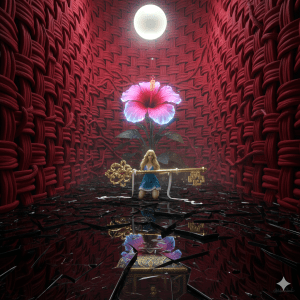
Alice stepped toward the blinding white light pouring from the Stone Toad’s vast eye. The air shimmered, the scent of earth and exotic blooms abruptly replaced by something dry, sterile, and cold.
She didn’t pass through a hole, but a seam. One moment she was in the humid jungle, and the next she stood on a floor of polished obsidian, perfectly flat and reflecting the white light from above like still water.
This was the Serpent’s domain. It was a silent, vertical cylinder descending far below the jungle floor. The walls were not made of stone or root, but of countless layers of tightly woven, living scarlet lianas, thick as a man’s arm, yet smooth and perfectly aligned. The light she had followed originated from a single, impossibly bright pearl floating at the top of the cylinder. The effect was unnerving: there were no shadows, no variations in color, and no sound except for the faint, echoing crunch of her white boots on the obsidian floor. It was the absolute realization of Stasis.
“You chose poorly, Alice,” a voice, smooth and deep as dark honey, seemed to rise from the floor itself. It was everywhere and nowhere. “You named the consequence. You chose the Necessary End. Why embrace conclusion when the beginning is so sweet? Look around you. This is the Eden of Impossibility. This is the reward for all your tiresome adventures.”
“I chose what is required, Serpent,” Alice replied, her voice echoing clearly. “You stole the Locket to build this cage. Where is it?”
A section of the scarlet liana wall ahead melted back to reveal a crystalline, perfectly clear chamber. In the center, suspended over a pool of utterly still, reflecting water, was the temptation: an immense, glowing hibiscus. Beneath it, floating half-submerged in the reflecting pool, was a small, golden key.
“To claim the Locket, you must first claim the temptation,” the Serpent murmured. “The key to freedom lies at the heart of your desire for rest. Come, Alice. Take the key. Stay and rest. Let the necessary end wait forever.”
Alice ignored the hypnotic pull of the light. She recognized the pool as the Eternal Rest, the stagnation she had named and rejected. If she touched the water, she would be lost. This was a riddle of physics, anchored by the Serpent’s crippling obsession with perfection.
She knelt, reaching into the deep pocket of her mini-dress. She pulled out a small, dull silver pin, an ordinary item kept for its practical, mundane utility.
“You pride yourself on stability, Serpent,” Alice stated. “But stasis is a lie. Even the perfection of a cage must be maintained.”
She quickly pricked the woven scarlet liana wall until a tiny bead of viscous sap appeared. She used the pin to flick the sap onto the obsidian floor. The sap instantly reacted, creating a dull, adhesive smudge that destroyed the perfect reflection.
“That is crude, Alice. Do not stain my perfection,” the Serpent hissed, its voice laced with sudden annoyance.
“I choose function over fantasy,” Alice corrected. She rapidly created a line of sticky, dull smudges leading straight to the edge of the reflecting pool.
Using the line of adhesive sap as an anchor for her long white leather soles, Alice pushed off and slid swiftly across the obsidian. She stopped with a controlled skid inches from the water, her feet firmly planted on the contaminated surface of the floor.
The key was still just out of reach. She quickly detached a long silk ribbon from her hair and tied the silver pin to the end. With a precise cast, she swung the ribbon and pin outward. The pin landed perfectly, hooking into the loop at the top of the golden key’s handle.
With a gentle, steady pull, Alice retracted the ribbon. The key slid across the surface of the still water, disturbing the perfect reflection for the first time. The ripples spread quickly, shattering the hypnotic image of the hibiscus.
As her fingers closed around the cold metal, the entire chamber groaned. The scarlet liana walls began to pulse rhythmically, and the floor beneath her started to tremble.
The Serpent shrieked, its voice now a painful, echoing roar: “You have claimed the threshold! You have chosen to leave! You will not find the Locket!”
The crystalline chamber began to dissolve. Alice looked down at the rapidly distorting pool. The beautiful illusion was gone, and beneath the choppy water, she saw it: a tiny, intricately hidden lockbox embedded in the pool’s base.
Suddenly, the scarlet lianas tore free from the wall, whipping out like aggressive snakes, aiming for her hand and the golden key.
Alice dropped to one knee, dodging a liana that cracked against the obsidian where her head had been moments before. She plunged the golden key into the lockbox just as the lianas wrapped around her ankle, pulling with immense, organic strength.
The lockbox clicked open. Inside, nestled on dull black velvet, lay the Locket of Logic. It was small, heavy, and made of plain, tarnished silver—utterly uninteresting, yet radiating a faint, cool hum of stable reality.
She snatched the Locket, feeling the immediate weight of responsibility return to her hand. Before the Serpent could destroy the evidence, Alice twisted the golden key, sealing the lockbox closed and snapping the key off in the mechanism.
With the Locket secured, she wrenched her ankle free from the constricting lianas and sprang back. The entire cylinder was collapsing now, the scarlet vines tearing themselves apart in a frantic, desperate effort to stop her.
Alice didn’t hesitate. She ran back up the sloping obsidian floor, the single Locket of Logic clutched tightly in her hand, escaping the prison of perfect stasis before it imploded completely.
Chapter Three: The Necessary End
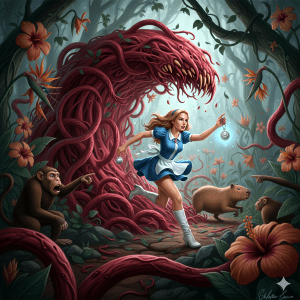
The instant Alice secured the plain, heavy Locket of Logic and sealed the lockbox, the Serpent’s chamber erupted into chaos. The roaring voice faded, replaced by the unbearable screech of living material being violently separated from perfect form.
Alice sprinted up the rapidly collapsing cylinder. The scarlet lianas were no longer merely whipping; they were tearing themselves away from the obsidian walls, revealing dark, wet earth and gushing water underneath. The beautiful, sterile cylinder was dying, and its death was desperate.
She burst through the ruined seam where the Stone Toad’s eye had been and tumbled back into the humid, fragrant jungle.
The jungle looked the same, yet profoundly different. The light was no longer fractured and golden; it was flat and dim, filtered through an atmosphere heavy with visible confusion. The intense hues of the oversized hibiscus and bird-of-paradise flowers were fading, their petals looking suddenly droopy and dull. The leaves were losing their impossible luster, becoming merely green, rather than iridescent.
Alice didn’t pause to marvel at the decay. She knew the Serpent, or the logic-defying magic that empowered it, would try to reclaim the Locket immediately. The only way out was to find the original fracture point—the weak spot between worlds—and use the Locket to stabilize it long enough to step through.
She was scanning the canopy for any sign of her entry point when she realized she wasn’t alone.
The Gibber and Gabbler, the two mischievous monkeys, dropped from a vine, no longer restrained by their scarlet tether. They weren’t chattering riddles; they were weeping silent, frantic tears, their sapphire and rust-colored fur dulled by the dim light.
“It’s changing!” Gibber wailed, clutching a handful of suddenly-ordinary brown moss. “The rules are breaking! The impossible is just… getting old!”
Gabbler pointed a trembling finger at the Locket Alice clutched. “It’s that thing! That weight! It’s making our nonsense have consequences!”
Suddenly, the ground shook. The moss-covered path began to heave, splitting open to reveal a maw of churning, red soil. The Serpent of Scarlet Lianas was not a physical beast, but the essence of the jungle’s resistance. It manifested as a colossal mass of thickening, twisting vines that writhed up from the fractured earth, attempting to reclaim its stolen order.
“Return what is mine! The logic must not return!” the Serpent thundered, its voice now laced with pure, agonizing primal panic. The massive wave of lianas rushed toward Alice, aiming to crush her.
Alice didn’t run. She stood her ground, holding the small, tarnished Locket out before her.
“I need a stable path!” she shouted to the terrified monkeys, ignoring the rising wave of scarlet vines. “The Locket shows me the only way out, but I need to know where to direct its logic!”
The Capybara Courier, looking terrified and relieved in equal measure, emerged from the surrounding foliage, clutching his beetle-winged scroll. “The fracture point, miss! It opened where the tree that defies symmetry stood! But it’s closing now! It’s closing!”
“Where is it?” Alice demanded, ignoring the lianas that were now less than twenty feet away.
Gibber and Gabbler, desperate for the end of their suffering, pointed a pair of frantic hands in opposite directions.
“It’s North!” shrieked Gibber.
“It’s South!” howled Gabbler.
Alice looked at the confused monkeys, then at the single, frantic Capybara. She glanced down at the Locket of Logic in her hand, which emitted a steady, cool hum. This was the final, defining riddle: how to use logic to escape an illogical realm.
She realized the answer was not in their directions, but in the core truth of their current fear.
“The consequence of logic is that you must choose one truth!” Alice shouted, stepping quickly toward the center of the clearing. “Where Gibber goes North, Gabbler must go South, but where does the Courier of Consequence go when time matters most?”
The Capybara, terrified of missing his actual duty, pointed straight ahead, directly past the now-trembling Stone Toad. “That way! That way is the only way to the final fixed point!”
“Thank you, Courier,” Alice said, a genuine smile returning to her lips.
She turned and sprinted toward the Capybara’s direction, holding the Locket of Logic like a compass. The wave of scarlet lianas lunged behind her, but she was already moving, committed to the Necessary End she had chosen.
Chapter Four: The Fixed Point
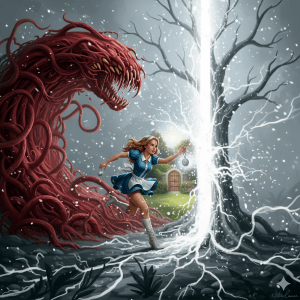
Alice ran with speed born of purpose, the Locket of Logic clutched tight in her hand like a cool, silver anchor. Behind her, the air was thick with the anguished roar of the Serpent, and the scarlet lianas writhed in a final, massive wave of organic fury.
She raced past the trembling Stone Toad, which was now visibly sweating water from its granite eyes. The Capybara Courier, true to his nature, was already gone, having rushed to his own fixed point of duty.
Alice sprinted for nearly a minute before the forest changed again. The fading colours and dulling greens of the jungle gave way to an area of unsettling, absolute gray. Here, the leaves were flat, lacking depth or shadow, and the air was still and devoid of scent—a void of imagination. This was the final fixed point, the threshold where the Serpent’s influence ended and her own world waited.
In the center of this gray void stood a tree that defied symmetry. It was an anomaly: its branches grew at mathematically impossible angles, yet it lacked any leaf or flower. At its base, flickering faintly, was the original fracture point—a shimmering vertical crack in the air, barely wide enough to fit her hand, and rapidly shrinking.
The lianas crashed into the gray area behind her. They did not pursue; instead, they stopped at the edge, their scarlet colour instantly dulling to a muted rust as they encountered the field of diminished fantasy. The Serpent’s voice, now a thin, high whine, shrieked a final, desperate plea: “Do not leave us to fade! Do not abandon the wonder!”
Alice ignored the plea. She reached the unsymmetrical tree and knelt before the shrinking fracture. She had to use the Locket to stabilize the breach, but she couldn’t risk stepping through without ensuring its safety.
She held the Locket of Logic out. It was heavy, and its presence caused the air around the fracture to hum violently.
“This is the Necessary End,” Alice said, addressing the Locket, the tree, and the raging, unseen Serpent all at once. “Logic dictates that the boundary must be defined, and the stolen consequence must be restored.”
With that, she gently pressed the Locket against the shimmering crack.
The effect was immediate and overwhelming. The crack didn’t widen smoothly; it exploded with a blinding burst of crisp, clean white light and the sharp, undeniable scent of ozone and cold, damp English earth. The light was so fierce it vaporized the gray, symmetrical leaves around them, and the ground convulsed violently as reality asserted itself.
The fracture ripped open, forming a stable, solid gateway. On the other side, Alice glimpsed the familiar, dark, polished wood of the old oak door in her home study—the place where the breach had begun.
She didn’t hesitate. She took one last look at the dying, fading jungle—the breathtaking beauty now tainted with a profound, inevitable sadness. She had loved the wonder, but she had chosen purpose.
Alice turned and stepped swiftly through the breach.
The moment her long white boots cleared the frame, the air snapped shut behind her with a sound like thunder and shattering glass. The jungle, the Stone Toad, the fading scarlet lianas, and the whimpering anguish of the Serpent were gone.
Alice stood in the center of her study, the air cool and calm. The Locket of Logic, slightly warm now, was clutched in her hand. On the surface of the Locket, a single, tiny word was now faintly engraved: Consequence.
The adventure was over. The boundary was sealed. Alice slipped the Locket into a secure drawer and ran a hand through her hair, smoothing the golden strands.
The crisp English air felt wonderful. But as she looked out at the familiar, predictable rain beginning to fall against the windowpane, a thoughtful, quiet look settled on her face. She was home, but she was not finished. There was always another boundary, another illogical breach, and another task awaiting the woman who had mastered the impossible.
Chapter Five: The Cracked Reflection
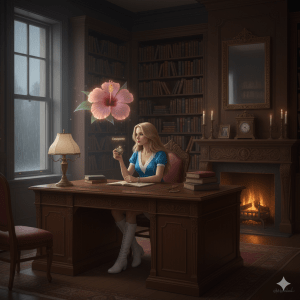
Alice’s study was impeccably ordered. The air was cool, smelling of old leather and ozone left by the closing breach. The Locket of Logic, cool and heavy, lay on her desk. She should have felt relief, but the victory was thin, brittle. She felt profoundly unsteady.
The first sign that the jungle’s chaos had followed her was in her looking-glass.
She walked to the large, antique mirror near the oak door, intending to smooth her tangled blonde hair. The moment she stepped into view, she flinched.
Her reflection was there, but it was wrong. The Alice in the glass was not mirroring her exact position. Her real self stood with shoulders straight and feet together; the reflection stood with one foot slightly lifted, her head cocked, watching her with an unsettling, wide-eyed curiosity. The smile that touched the reflection’s lips was thin and mocking.
Alice slowly raised her hand. The reflection hesitated, then slowly raised its other hand, a perverse delay in the mimicry.
“This is not a riddle,” Alice whispered, her quiet confidence battling genuine terror.
She quickly snatched the Locket of Logic from the desk and pressed it against the cool surface of the glass. The Locket hummed, a low, reassuring vibration of stability, and the reflection snapped back into perfect, immediate synchronization.
Alice breathed a sigh of shaky relief. The Locket was still working, but it was clear that her boundary—her mind—had been compromised by the Serpent’s attempt to enforce perfection.
The second sign came that evening, when her quiet, dedicated housekeeper, Mrs. Thackery, brought her tea.
Mrs. Thackery was a woman of absolute routine, and yet tonight, she seemed different. As she poured the tea, she did not look at Alice. Instead, she fixed her gaze on the ceiling, where a small fly buzzed.
“The time, Miss Alice,” Mrs. Thackery stated, her voice flat. “It is always time. But what of the un-time? If three o’clock is merely a suggestion, should one not perhaps wear one’s stockings on one’s head?”
She poured the tea not into the cup, but onto the desk beside it. Then, with a slow, deliberate movement, she picked up a silver teaspoon and ate the porcelain cup instead.
Alice watched, paralyzed. This was not the housekeeper’s personality; this was a manifestation of the Mad Hatter’s nonsensical pathology bleeding into her reality. The decay was spreading through the people closest to her.
“Mrs. Thackery,” Alice said softly, trying to reclaim her composure. “You must stop this. It has consequence.”
The housekeeper simply smiled—a wide, unnerving, predatory grin—and pointed a tea-stained finger at Alice’s dress. “Why, the consequence is that you must trade one white glove for one raven’s feather! And perhaps chop off the tip of your own nose to ensure proper alignment with the ceiling!”
Alice knew she could not use force. The Locket could stabilize the reflection, but it couldn’t cure the mind. This was a deeper infection, fueled by her own psychological fatigue and the failure to fully seal the chaos she encountered.
The only way to stop the decay was to find the source of the psychological rot—the original, shattered truth of The Looking-Glass World—and heal the fracture there. It meant willingly walking back into a world governed by her own fractured mind.
She grabbed the Locket and looked one last time at the mirror. The reflection watched her, still perfect now, but the edges of the glass seemed slightly wavy, like a cheap windowpane.
Alice knew where she had to go. She retrieved a heavy, black velvet cloth and carefully covered the antique mirror.
“I need to look through the glass, not at it,” she murmured. “But first, I need the one who knows what it means to be permanently broken.”
The next step would be for Alice to seek out someone who understands madness and fractured realities, perhaps an old contact, or a new ally who can decipher the rules of this new, terrifying reality.
Chapter Five (Continued): The Logic of Delusion
Alice found Dr. Alistair Finch in a dusty, high-ceilinged office tucked away in the least-used wing of the university. The room was not cluttered with books, but with precisely labeled specimen jars and carefully cataloged notes on psychological anomalies. Finch himself was a sharp man in his late fifties, neat to the point of rigidity, with spectacles perched low on his nose.
He finished reviewing Alice’s handwritten note—a meticulously vague request for consultation on “manifestations of aggressive folkloric delusion”—and looked at her over the rim of his glasses.
“Miss Liddell,” he began, his voice dry and precise. “You claim to be tracking a contagion that forces subjects to enact the absurdities of nineteenth-century nonsense literature. Specifically, the works of Mr. Dodgson.”
Alice settled into the uncomfortable leather chair, holding the cool, heavy Locket of Logic concealed beneath the cuff of her sleeve. “Not nonsense, Doctor. Pathological illogic. And yes, the source appears to be a systemic fracture of reality near my home.”
Finch steepled his fingers, his expression unreadable. “Systemic fractures are typically termed hallucinations, Miss Liddell. Nevertheless, your composure is remarkable. Let us discuss this tea-related incident. You state your housekeeper, Mrs. Thackery, poured tea on the desk and then… consumed the receptacle.”
“She ate the porcelain teacup,” Alice confirmed. “And she was talking about un-time and trading gloves for raven’s feathers. Her actions were driven by a perfect, crystalline illogic, following the cadence of a Mad Tea Party.”
Dr. Finch leaned forward, his interest finally piqued, though purely academic. “And you believe this to be externally sourced? Not a classic case of folie à deux or acute stress-induced psychosis?”
“I am an expert in the externality of illogical systems,” Alice stated simply. “The event was triggered by the Locket I carried—an anchor of stable reality—returning from a domain where the very act of growing up was considered an existential threat. The Serpent that governed that world fought reality by twisting the mind. Now that twisting is bleeding out here.”
Finch blinked slowly, processing her claim not as truth, but as detailed narrative. “Fascinating. Your framework is consistent, if highly fantastical. Let’s assume for a moment that this ‘illogic’ is contagious. What is its primary mechanism? How does it spread?”
Alice looked at the pristine, untouched specimen jars around them, then recalled the unnerving sight of her own reflection moving independently.
“The mechanism is reflection,” Alice said. “It uses the mirrors, polished surfaces, and even the minds of people who are too predictable, too routine. It seeks to crack the surface of order. Mrs. Thackery is predictable. My housekeeper has become a conduit for the psychic residue of Wonderland’s decay.”
She reached into her sleeve and quickly revealed the Locket. “When I hold this, the corruption stops, but I cannot wear it forever. If this illness spreads, the world will quickly become both utterly insane and entirely predictable—a lethal combination.”
Finch’s eyes widened slightly at the sight of the tarnished silver Locket, which now pulsed with a faint, cool light. He didn’t question the object; he questioned its function within her claimed pathology.
“If the mechanism is reflection,” Finch concluded, his professional interest overriding his skepticism, “then you must isolate the original reflection. Find the genesis of the crack. Where did this corruption first gain its momentum?”
“The looking-glass in my study,” Alice confirmed. “The glass that opened the first time.”
“Then that is your point of entry, Miss Liddell,” Finch said, a rare, cold smile touching his lips. “If the malady comes through the reflection, you must pass through to the source. But be warned: if this is, as you claim, psychic contagion, then you are not facing the Wonderland you left. You are facing the Wonderland that your own mind is currently afraid of.”
Finch pushed a heavy, leather-bound journal across the desk. “Take this. It is a treatise on pattern recognition in mass delusion. It is logic. It may be useless against magic, but if you are right, it will be the only thing that saves you from becoming one of their absurdities.”
Alice took the book. It was a tangible tool in a suddenly intangible war. She knew what she had to do: return to the Looking-Glass world and face the reflection of her deepest fears.
Chapter Six: Through the Cracked Surface
Alice returned to her study, the weight of Dr. Finch’s heavy leather-bound treatise feeling both utterly mundane and profoundly crucial. The room felt tense, suspended between her world’s reality and the infectious insanity that lingered.
The large, antique looking-glass remained covered by the heavy black velvet cloth. Near the door, the spot where Mrs. Thackery had consumed the teacup was now strangely dry and cool, as if reality itself had been vacuumed out of the space.
Alice placed the Locket of Logic on her desk and opened the treatise. Finch’s precise, methodical handwriting detailed the predictable stages of psychological breakdown. It was a mirror of Wonderland’s rules, but applied to human fragility.
“If the mechanism is reflection,” Alice murmured to herself, “then I must not allow the glass to reflect my fear. I must control the image.”
She retrieved a large silver oil lamp and a tin of polish. First, she set about cleaning the mirror. She knew that any grime, any flaw on the glass, could be used by the corruption as a point of entry. She worked meticulously, polishing the mirror until the surface was flawless, a perfect sheet of cold, clear reflection.
Next, she prepared herself. She removed her blue and white mini-dress and white boots. These were her uniform of the impossible, but this time, the rules were different. She was entering a reality poisoned by fear. She dressed instead in sensible, heavy black wool trousers and a crisp white shirt, clothes designed for work and concealment, not spectacle. She strapped a belt around her waist, tucking a few mundane tools into the loops: a simple compass, a ruler, and a heavy pair of pruning shears from her garden.
She took the Locket of Logic. Its tarnished silver surface felt cool and honest. Instead of wearing it, she used her silk ribbon to tie the Locket securely to the spine of Dr. Finch’s treatise.
Alice finally approached the mirror and pulled away the velvet cloth.
The reflection was perfect. Her image, dressed in the severe black and white, was motionless. But the edges of the antique frame seemed to breathe; the air directly around the glass shimmered with heat, suggesting a volatile boundary.
This was the ultimate confrontation with the Mirror’s Decay. She needed to move without hesitation.
She placed the Locket-bound treatise on the floor directly in front of the mirror. The Locket’s influence immediately stabilized the frame, halting its subtle breathing. The book acted as her anchor.
Alice took a final, deep breath.
“I am not trading a white glove for a raven’s feather,” she announced to the motionless image. “I am not going to wear my stockings on my head. I am not trading nonsense. I am bringing consequence.”
With a sudden, forceful stride, she walked directly toward the glass.
Instead of crashing into the mirror, her hand passed through the cold surface as easily as passing through still water. The glass offered no resistance.
She stepped through.
The sensation was not like tumbling; it was like diving into a vat of frozen sound. The world on the other side was silent, still, and immediately disturbing.
Alice found herself standing on a floor of perfectly smooth, cold glass. Every surface was reflective: the walls, the ceiling, and the impossibly tall, crystalline trees outside the window. The air was a sterile, unforgiving white. The light, though brilliant, cast no shadows—a cruel reflection of the Serpent’s obsession with perfection.
She was standing in a room that was simultaneously her study and a terrifying hall of mirrors. In every surface, a different version of Alice looked back.
One reflection was smiling the wide, unnerving grin of Mrs. Thackery. Another was weeping silent tears of green. A third, dressed in the child’s blue dress, was sitting on the floor, rocking gently and counting backward from ten.
Alice ignored the cacophony of fractured selves. She knew she was facing the psychological residue of her encounter with the Serpent. The Mirror’s Decay had created a world where Alice’s own mind was the battlefield, reflecting every fear and delusion she had conquered—or avoided.
She had arrived in the Looking-Glass world, but it was corrupted, cold, and waiting for her to make the first illogical move. She had to find the source of the rot before the reflected madness overwhelmed her reality.
 The Crazymad Writer Writes Again