Alice and the White House of Backwards Decisions
Alice and the White House of Backwards Decisions
Chapter One
The Letter That Was Already Waiting
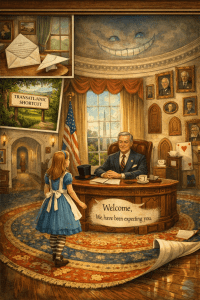
On a morning in Ballykillduff that could not quite decide whether it wished to be winter or spring, Alice discovered a letter waiting for her.
This was not unusual in itself — letters occasionally appeared in Ballykillduff without anyone remembering the postman delivering them — but this letter possessed three particularly suspicious qualities.
First, it was addressed in handwriting Alice recognized as her own.
Second, it was already open.
Third, it was warm.
Alice found it resting upon the small table beside the window of the cottage where she had been staying ever since Ballykillduff had politely refused to let her leave permanently.
Outside, the hedges were still wet from the previous night’s rain. Somewhere in the village square, a dog barked with the confidence of a creature that had never once doubted its understanding of the world.
Alice picked up the letter.
It felt as though it had been held only moments before.
“Curious,” she said, which in Alice’s experience usually meant something extremely peculiar was about to happen.
Inside the envelope was a single sheet of paper. The paper was perfectly blank.
Alice examined it carefully, turning it upside down and sideways in case the words were shy.
Nothing.
“Perhaps it is an invisible message,” she suggested.
The paper grew slightly warmer.
Then, very slowly, words appeared, as though remembering how to exist.
They read:
Miss Alice, Occasional Visitor to Impossible Places,
You are cordially invited to attend a matter of considerable confusion.
Washington, Immediately.
Below this was a line for a signature.
The signature wrote itself.
The White House
Alice nodded thoughtfully.
“Yes,” she said. “That sounds exactly the sort of invitation one should accept without understanding.”
She folded the letter.
The moment the paper creased, it refused to remain a letter at all. Instead, it rearranged itself with cheerful determination into a paper aeroplane.
Alice watched this transformation with calm interest.
“I suspected as much,” she said.
The aeroplane lifted gently from her hands and hovered in the air like a hummingbird made of stationery.
It waited.
Alice did what any sensible traveller between worlds would do — she opened the cottage door and followed it.
The paper aeroplane drifted down Ballykillduff’s main lane, passing the cream-and-green telephone box that never rang unless someone was already speaking, and gliding across the quiet village square where puddles reflected a sky that looked slightly unfinished.
No one in Ballykillduff found this remarkable.
Mrs O’Daly, sweeping her step, merely said:
“Morning, Alice.”
“Morning,” Alice replied, walking past a floating invitation as though this were ordinary.
At the edge of the village, the aeroplane stopped beside a gate that had not been there yesterday.
It was a small white gate set into a hedge that Alice was quite certain had always been continuous.
A brass plaque hung from the latch.
It read:
TRANSATLANTIC SHORTCUT
“Well,” Alice said, “that saves time.”
She opened the gate.
On the other side was not a field, nor a road, nor even another hedge.
There was a long, polished corridor.
The paper aeroplane sailed inside.
Alice followed.
The gate closed behind her with the polite click of something that did not intend to reopen immediately.
The corridor smelled faintly of paper, polished wood, and decisions that had not yet been made.
Portraits lined the walls.
They were not portraits Alice recognized, but they behaved in the familiar manner of Wonderland portraits — pretending not to move when observed.
The carpet stretched ahead in a straight line that suggested great seriousness, though it occasionally wrinkled itself when Alice wasn’t looking directly at it.
The aeroplane continued forward until it reached a tall white door.
On the door was a brass plate.
THE WHITE HOUSE
Alice paused.
“I wonder,” she said, “whether this is the real one, or the sensible version.”
The paper aeroplane flattened itself back into a letter and slid beneath the door.
After a moment, the door opened inward of its own accord.
Alice stepped through.
The room beyond was circular.
Very circular.
So circular, in fact, that Alice briefly suspected the room might be quietly spinning.
A large desk stood in the center. Behind it sat a perfectly polite gentleman with an expression suggesting he had been waiting since yesterday afternoon.
He smiled.
“Welcome,” he said.
“We have been expecting you before you arrived.”
Alice curtsied politely.
“I hope I am not early.”
“You are exactly confusing,” the gentleman replied.
Alice felt immediately at home.
Behind the gentleman, the walls of the circular room seemed to stretch further than the outside of the building should reasonably allow.
There were doors everywhere.
Dozens of them.
Perhaps hundreds.
Some were tiny. Some were enormous. One appeared to be made of folded newspapers. Another looked like a playing card pretending to be architecture.
One door opened briefly, and Alice thought she heard teacups arguing.
It closed again.
Alice smiled.
“Yes,” she said quietly.
“This is definitely Wonderland.”
The gentleman behind the desk shook his head gently.
“No,” he said.
“This is Washington.”
The floor shifted slightly, as though reconsidering.
Alice suspected they were both correct.
And with that, the building began to rearrange itself.
Chapter Two
The Corridor of Necessary Confusion
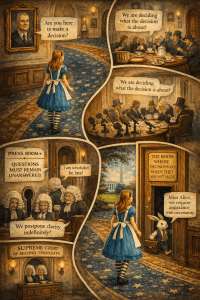
Alice had long ago learned that when a building began rearranging itself, the wisest course of action was simply to stand still and allow architecture to finish its thinking.
The circular room — which insisted it was not called the Oval Office, though it admitted the resemblance was unfortunate — gently rotated until one of the many doors slid forward like a volunteer.
It was a medium-sized door, painted a colour that could not decide whether it was red or merely embarrassed.
It opened.
From inside came the unmistakable sound of teacups disagreeing with one another.
Alice looked at the gentleman behind the desk.
“Is that door important?” she asked.
“All doors are important,” he replied.
“That one is unavoidable.”
Alice nodded politely and stepped through.
The corridor beyond was longer than the building could possibly contain.
It was lined with tall windows through which Alice could see Washington — or something pretending to be Washington.
The sky outside was blue in a very official manner.
The Washington Monument stood in the distance, though it occasionally leaned slightly left, as if reconsidering its position.
The corridor carpet was deep blue and patterned with tiny white stars that rearranged themselves whenever Alice blinked.
“That seems unnecessarily patriotic,” Alice remarked.
The carpet replied, “We prefer the term decorative.”
Alice continued walking.
The first portrait she passed cleared its throat.
“Good afternoon,” said the portrait.
Alice stopped.
The man in the painting looked dignified and slightly dusty, as though history had not been properly shaken out.
“Good afternoon,” Alice replied.
“Are you here to make a decision?” the portrait asked.
“I am rarely sure,” Alice said.
The portrait nodded approvingly.
“Excellent. That is how most decisions are made here.”
Further along, Alice came to a table covered in teacups.
Around the table sat several people in perfectly respectable clothing, all speaking at once.
In the center was a tall teapot wearing spectacles.
“More tea before we decide!” it announced.
“We have already decided!” cried one chair.
“We have not decided what we decided!” shouted another.
“No decisions without biscuits!” insisted the teapot.
Alice smiled.
This was unmistakably a Cabinet Meeting, though it behaved exactly like the Mad Tea Party.
One of the chairs slid toward Alice.
“Sit,” it said. “You look undecided.”
Alice sat.
A cup immediately filled itself with tea that tasted faintly of punctuation.
“What is the decision?” Alice asked.
“We are deciding what the decision is about,” said the teapot.
“That sounds difficult.”
“It is impossible,” said the table happily.
The teacups suddenly froze.
Somewhere down the corridor, a bell rang twice and then reconsidered.
The cabinet members spoke in whispers.
“The Oval Room is thinking,” said the teapot.
“Thinking about what?” Alice asked.
“Everything,” replied a spoon.
Alice stood.
“I should probably continue,” she said.
“That would be procedurally acceptable,” the teapot agreed.
Back in the corridor, the walls had moved slightly closer together, as though listening.
Alice passed a door labelled:
PRESS ROOM — QUESTIONS MUST REMAIN UNANSWERED
From inside came voices:
“Why—”
“Who—”
“Is it true that—”
The questions dissolved into static.
Only the microphones remained visible through the glass, standing alone like polite metal flowers.
Alice waved.
One microphone waved back.
At the end of the corridor stood a very small door.
It was no taller than Alice’s knee.
A brass plate read:
SUPREME COURT OF SECOND THOUGHTS
Alice crouched and peered through the keyhole.
Inside were three enormous wigs sitting on tiny chairs.
They were arguing.
“We reverse ourselves!” said one wig.
“We uphold confusion!” said another.
“We postpone clarity indefinitely!” cried the third.
Alice closed the keyhole gently.
“Best not interrupt,” she said.
The corridor suddenly curved.
It had not been curved a moment before.
Alice followed it until she reached a tall window.
Outside stood the White House garden, perfectly trimmed and extremely serious.
In the center of the lawn was the White Rabbit, wearing a striped tie and carrying his briefcase.
He looked up at Alice.
“I am scheduled to be late!” he shouted.
“For what?” Alice called.
“For knowing!” he replied.
Then he ran behind a hedge and vanished.
Alice sighed contentedly.
“Yes,” she said.
“Things are becoming properly confusing now.”
Behind her, a new door appeared in the wall.
It had not been there before, but it behaved as though it had always existed.
On it was written:
THE ROOM WHERE DECISIONS GO WHEN THEY ARE NOT MADE
The handle turned slowly.
The door opened.
Inside was darkness.
Not frightening darkness — just unfinished.
A voice from within said politely:
“Miss Alice, we require assistance with uncertainty.”
Alice stepped forward.
And the corridor disappeared behind her.
Alright — let’s continue the story inside the strange room of unfinished decisions.
Chapter Three
The Room Where Decisions Wait
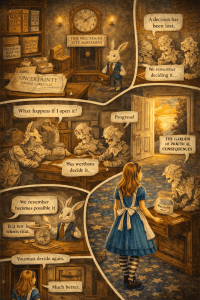
The darkness inside the room was not empty.
It was merely undecided.
Alice stepped forward carefully, and the floor appeared beneath her feet only after she had taken each step, as though the room preferred to see where she intended to go before committing itself to existence.
“That seems sensible,” Alice said.
A soft voice replied from somewhere ahead:
“We try not to assume too much.”
A small lamp flickered into being, followed by a chair, then a table, then several stacks of paper that looked exhausted.
At the center of the room stood the White Rabbit, adjusting his striped tie with professional concern.
“You arrived exactly when expected,” he said.
“When was that?” Alice asked.
“We have not decided yet,” he replied.
The room slowly assembled itself.
Shelves appeared along the walls, filled with labeled boxes.
Alice read some of the labels:
DECISIONS POSTPONED UNTIL MONDAY
DECISIONS MADE TOO QUICKLY
DECISIONS MADE BY ACCIDENT
DECISIONS THAT MADE SENSE AT THE TIME
DECISIONS NOBODY REMEMBERS MAKING
One box trembled slightly.
Its label read:
VERY IMPORTANT LATER
Alice pointed.
“That one seems nervous.”
“It is always tomorrow,” said the Rabbit.
A long table formed itself from shadow and paperwork.
Around it appeared several figures made entirely of crumpled documents.
They shuffled politely.
“These,” said the Rabbit, “are Unfinished Decisions.”
One of them bowed.
“We nearly exist,” it said.
Another added:
“We are waiting for certainty.”
Alice considered this.
“That may take a while.”
The figures sighed.
Paper rustled like autumn leaves.
At the far end of the room stood a tall clock.
It had no hands.
Instead, a small sign hung from it:
TIME WILL RESUME AFTER AGREEMENT
Alice approached the clock.
“Does time often stop here?” she asked.
“Only when necessary,” said the Rabbit.
“Is it necessary now?”
“Extremely.”
A large book dropped onto the table with a thud that sounded official.
The cover read:
THE BOOK OF POSSIBLE OUTCOMES
It opened itself.
Every page was blank.
“We cannot write until a decision is made,” explained the Rabbit.
Alice turned a page.
Still blank.
Another page.
Nothing.
“How many pages are there?” she asked.
“More than consequences,” said the Rabbit.
“That seems backwards.”
“This building specializes in backwards.”
The paper-people began murmuring.
One stepped forward.
It was made from maps, speeches, and shopping lists.
“We have a problem,” it said.
“What sort?” Alice asked.
“A decision has been lost.”
Alice blinked.
“Lost?”
“Completely,” said the Rabbit gravely.
“We remember deciding it,” said the paper figure.
“But not what it was.”
The room dimmed slightly, as though embarrassed.
A drawer slid open by itself.
Inside lay a single object:
A small glass jar containing fog.
A label read:
UNCERTAINTY — HANDLE CAREFULLY
Alice lifted the jar.
The fog inside swirled thoughtfully.
“What happens if I open it?” she asked.
“Everything becomes possible again,” said the Rabbit.
“That sounds promising.”
“It is also extremely inconvenient.”
Alice thought for a moment.
Then she did something nobody in the room had considered doing.
She laughed.
The sound echoed gently across the shelves of unfinished decisions.
“You cannot remember the decision,” Alice said,
“because you are trying to remember it before making it.”
The paper-figures froze.
The Rabbit’s ears lifted.
“That is… administratively alarming,” he said.
Alice placed the jar back in the drawer.
“You must decide again,” she said.
“But we might choose differently,” whispered one of the paper-people.
Alice smiled.
“Yes,” she said.
“That is what deciding is.”
The clock on the wall flickered.
For the first time, a single hand appeared.
It ticked once.
The Book of Possible Outcomes rustled.
One page filled itself with ink.
The Unfinished Decisions straightened their paper shoulders.
“We exist!” one cried.
“Partially,” said another.
“Progress!” said the Rabbit.
The room brightened.
Some of the shelves disappeared, no longer needed.
The box labeled VERY IMPORTANT LATER shrank to half its size.
“That is better,” said the Rabbit.
Alice nodded.
“Much.”
Behind her, a new door appeared.
This one was tall and white and perfectly certain of itself.
On it was written:
THE GARDEN OF PRACTICAL CONSEQUENCES
The Rabbit looked relieved.
“You may continue,” he said.
Alice curtsied politely.
“I usually do.”
She opened the door.
Warm sunlight spilled into the room.
And somewhere far away in Ballykillduff, a letter quietly finished writing itself.
To be continued.
 The Crazymad Writer Writes Again