Alice on Top of the World
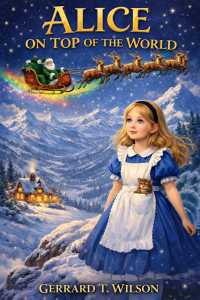
Alice on Top of the World
The continuing adventures of a girl named Alice
Ever since I began writing, I wanted to create something special, a story to capture the hearts, minds and, above all, imagination of you, the readers, I hope that, in completing this little tome, about the continuing adventures of a girl named Alice, I might, just might have achieved this ambition…
Gerrard T Wilson
Contents
Chapter One: Into the Abyss
Chapter Two: The Fertilizer Mine
Chapter Three: A Series of Confusing Directions
Chapter Four: A Most Unexpected Encounter
Chapter Five: The Trip of a Lifetime and the Fright of her Life
Chapter Six: Off With Her Head!
Chapter Seven: Bells, Again
Chapter Eight: A Song, a Plot, Some Merriment – or Not?
Chapter Nine: The Off
Chapter Ten: A Calamity!
Chapter Eleven: A Nice Surprise
Chapter Twelve: How Can You Possibly Be Me?
Chapter Thirteen: An Old Friend Revisited
Chapter Fourteen: A Magical Combination
Chapter Fifteen: Rabbit Bound
Chapter Sixteen: Goodnight, My Child
Chapter One
Into The Abyss
It was many years later when Alice had her next adventure, and whilst she was quite surprised to be having one at all, after the passing of so many years, she was even more surprised to see that she was a child again, no older than when she had first entered Wonderland and slipped through that fascinating Looking Glass.
“How curious,” she whispered, trying to recall the child she had once been.
“You took your time getting here,” said the White Rabbit who suddenly appeared in front of her.
“I beg your pardon?” Alice replied, remembering how rude he could be, if he felt so inclined.
“I said you took your time getting here. You should have been here fourteen years ago,” the Rabbit huffed indignantly as he began hopping quickly away from Alice.
“But,” Alice spluttered, running after him, “I have no idea how I arrived, let alone why I am so late!”
“We accept no ifs or buts, here – you should know that by now,” said the Rabbit, as he opened a door which had appeared as suddenly as he. Stepping through, he said, “Hurry up, please don’t dawdle.”
As she followed him through the doorway, trying her to keep up with the fast-hopping Rabbit, Alice surmised that he must have got out his bed on the wrong side, this morning, to be so grumpy on so wonderful a day. And it really was a wonderful day, with a warm sun shining brightly upon them.
‘I wonder where I might possibly be?’ thought Alice, as she admired the pink forget-me-nots skirting a winding path before her. “Am I in Wonderland?” she asked, just as another door, the same as the first one, appeared.
Giving Alice a most peculiar look, the Rabbit said, “Of course we are not in Wonderland.” Opening the door, he told her, “We are on the top of the world.” Having said that, he scurried off, hopping down another winding path, also bordered by pink forget-me-nots.
“The top of the world?” Alice cried out, quite in surprise. “Why, that’s impossible!”
The Rabbit stopped hopping. Turning around, facing Alice, he said, “Then how can you be here, if it’s impossible?”
Flummoxed by the Rabbit’s question, Alice found herself struggling to find a reply. The only thing she was able to come up with was, “I bet you are mad!”
“That all depends,” the Rabbit replied quite matter-of-factly.
“It all depends on what?”
“On whether you mean mad or mad.”
“That’s silly,” said Alice. “They both mean the very same thing.”
“If you were mad number one,” said the White Rabbit, with full conviction of the soundness of his case, “and someone happened to tell you that you were mad number two, you might be very mad indeed, at so fundamental a mistake.”
“But I’m not mad!” Alice insisted, becoming ever more frustrated at so silly a conversation.
“How do you know that you aren’t mad,” asked the Rabbit, who appeared to be enjoying flummoxing Alice, so “when you can’t tell the difference between mad number one and mad number two, I might ask?”
“I just know that I’m not mad!” Alice insisted, stamping her foot, displaying her annoyance at what she considered was questionable logic. Changing the subject, from her possible madness or claimed sanity, Alice informed the Rabbit that another door had appeared and was awaiting his attention.
Turning round, the White Rabbit took hold of the handle and tried to open the door, but it remained stubbornly shut.
“Might I try?” Alice asked, feeling very un-mad. Standing away from the door, the White Rabbit said nothing, but his pink, beady eyes watched her intently.
The door opened easily for Alice. Feeling vindicated, she said, “Could a mad person have done that?” Without waiting for a reply, she stepped through the doorway and fell into a gaping hole on the far side.
“No, they mightn’t,” said the Rabbit, laughing as she disappeared into the hole. “But would they have fallen down there?” Laughing again, he hopped through doorway and into the hole, following Alice…
After a long fall in near to total darkness, a fall that reminded Alice of the time she had fallen down the rabbit hole, into Wonderland, the speed of her descent began to slow. In fact it slowed so much it stopped altogether, and she began rising again. “I don’t want to return up there, even if it is to the top of the world,” she insisted. Staring at the speck of light high above her, she said, “It’s far too far!”
Hearing something passing her by (she had no idea what it could be, for it was far too dark to see properly), Alice jumped onto its back. Holding on tightly, she rode out from the well.
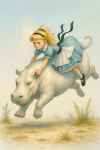
Alice was surprised to see that she was riding a baby hippopotamus, whose skin was as smooth as silk. She wondered how she had been able to stay upon it for second let alone long enough to escape from the dark, dreary place. Alice had so sooner begun thinking about this, when she felt herself slipping, sliding off the baby hippopotamus. Landing with a bump on the hard, dusty ground, she moaned, “I don’t like this place I don’t like it at all.”
“You don’t like it!” said the baby hippopotamus, in a surprisingly high-pitched voice for such an extreme animal. “How do you think I feel? There’s not a drop of water to be seen – anywhere. And we hippos need so much of it!”
Brushing her dress, removing the dust from it, Alice said, “Mr Hippopotamus, I would like to thank you for the ride from out of that cave, or whatever it happens to be. Moreover, it was the most comfortable hippopotamus ride I have ever had (Alice omitted to tell the hippopotamus that it was the only one she had had), thank you, again.”
“My dear child,” it answered, “you are so light I hardly noticed you there. Any time you feel the need to take a ride from out of that dark space, please feel free to jump on my back as I pass you by.”
“Thank you, thank you so much,” she told him. “I shall keep your invitation in my invitation book, and if I don’t find a need for it, I will treasure it always.”
After that the hippopotamus returned to the darkness, searching for some water. However, before he had a chance to begin, Alice heard another soft landing (though it has to be said that it was not as soft as hers). Before she could say Jack Robinson, the White Rabbit appeared, sitting back to front on the baby hippo’s back, riding out, into the bright light.
After the White Rabbit had thanked the baby hippopotamus for the ride (Alice felt he was nowhere near as grateful as she had been), he scolded Alice for having fallen down the hole, before him. He said, “If there is to be any hole-falling done around here, we must first have a vote, to decide who shall be first and who second. Is that clear?”
Although Alice nodded in agreement, she harboured a suspicion that he was quite possibly mad number one, and if not that he was most certainly mad number two.
Another winding path suddenly appeared before them, but this one, although also bordered by flowers, was in no way as inviting as the previous ones. You see, instead of pink forget-me-nots, giant aspidistras sporting green, snapping beaks awaited them.
“Come on, Alice, we have to find our way up, to the very top of the world” said the Rabbit as he hurried past the plants with their snap, snapping beaks.
Alice gasped as the first plant, snapping hungrily at his thick fur, tore a large wad from his back. “Come on, we must return to the top of the world,” he ordered, seemingly oblivious to the dangers posed by the snapping beaks. Having no intention of admitting that she was afraid of some silly old flowers that the Rabbit considered quite harmless, and having even less intention of asking him for his help, Alice got ready to pass down the dangerous path.
By now the White Rabbit was so far ahead of her, Alice doubted she might ever catch up with him. Closing her eyes, taking a first tentative step, she began her way down the aspidistra-bordered path, hoping, just hoping to catch up with the fast hopping Rabbit.
Alice hadn’t finished taking her first step, when one of the snapping beaks tried to remove a piece from her left ear. A second beak, sensing an easy target, pulled violently at her hair, while a third green beak tried to bite off her nose.
“Stop that!” Alice told the bad-mannered plants. “Stop that this instant or I shall be forced to dig you all up, and replant you with rhubarb,” she warned.
Like a switch had been turned, the beaks stopped attacking. Inspecting her head, Alice made sure that it was intact. After she was satisfied that everything was as it had previously been, she said, “Thank you. I can’t ever imagine what has got into you, to behave so rudely. Don’t you know that plants are supposed to be nice, not terrible, awful things?”
As she studied the giant plants, with their green beaklike mouths close in front of her, Alice thought she heard a cry, so she asked, “Who is crying?”
Despite listening intently, Alice heard no reply, as all the while the cry from somewhere deep within the group of plants continued. Then they began swaying, their beak mouths on stalks high above them, also swaying.
“Stop it, stop it,” Alice ordered. “Tell me which of you is crying?”
Although it was still swaying, one of the plants began speaking, it said, “She is crying, the little offshoot, close to my wife – see.” One of its long strappy leaves pointed across to the right.
“Your wife?” Alice asked, in surprise that a plant might actually be married.
“Yes,” the aspidistra replied, swaying some more. “Can you see them?”
“I might, if you stopped swaying,” she said. “I am beginning to feel quite sick from it all.”
“I can’t,” the plant told her. “None of us can. When we are upset, we sway. That’s why we sway so much in the wind, because we don’t like it, because it upsets us so.”
“Oh, I am so sorry to hear that. Is there anything I can do to help?”
“You can promise that you won’t dig us up…” a baby voice sobbed.
“Of course I won’t dig you up,” Alice promised. “I only said that because of the terrible way you were treating me.”
The plants stopped swaying, allowing Alice to see the child aspidistra tucked lovingly under its mother’s green leaves. Showing no fear for her safety, disappearing beneath the huge plants (she now trusted them unquestionably), Alice approached the baby plant and its doting mother.
“I am sorry,” she said, “if I upset you. Will you please forgive me?”
“Yes, I will,” said the baby plant, trying to hold back sob. “And we are sorry, so sorry that we frightened you. We are like this because we are so hungry… we are usually happy, with smiling beaks to welcome the weary traveller.”
Confused, Alice asked, “Hungry? How can you be hungry when your roots can find all the food that you need?”
“Fertilizer, all plants need fertilizer at some time in their lives,” the baby aspidistra explained. “None of us have had any fertilizer for ages. I have never had any – ever! I don’t even know what it looks like!”
“This is a most terrible state of affairs,” said Alice, scratching her head, trying to work out what could be done to remedy the unfortunate situation. Raising a finger, she asked, “Can I go fetch you some?”
If their beaks had been able to smile, every last beak skirting that path would have been smiling radiantly at Alice. They became so excited at the prospect of getting some fertilizer they began talking furiously amongst themselves. In fact, the plants’ conversation became so loud, so noisy Alice could hardly hear herself think. In the end she had to ask them to stop. “Stop, stop talking, please,” she said, “my ears are hurting from it all.”
It stopped; the excited talking stopped, except for one of the plants, the mother aspidistra, who said, “Do you know where you can find us some fertilizer?”
“I, I don’t know,” Alice replied uncertainly.
Smiling, Alice was sure she saw the beak smiling, when it said, “Go to the fertilizer mine, there you will find all the fertilizer we need.”
“Where is it, the mine?” Alice asked.
“I am sorry, I don’t know, none of us know where it is located,” the mother aspidistra confessed. “But we do know that it most surely exists.”
Seeing how sad the mother plant had become, Alice said, “I will find you some fertilizer, I will find enough fertilizer to feed you all – I promise.”
Chapter Two
The Fertilizer Mine
Despite feeling so bad, having to leave the aspidistras behind, Alice had given them her word that she would return with some fertilizer, and so she would. “All that I have to do,” she said, “is to find the mine, and get a bag of it, that can’t be so hard, can it? Now, I wonder…” she said, “Which way shall I go, to the left, to the right or continue straight ahead?” Without having any idea as to where the mine was actually located, Alice thought it best to follow her nose. “I can’t go too far wrong, doing that,” she said as she stepped off the path, onto a swathe of neatly cut lawn.
As she walked further away from the path, the neat grasses of the lawn gave way to a wild terrain, where hill after hill beckoned her on. Alice tried, she tried so hard to cross all of those hills, going up and down and up and down, but after climbing ten (or was it perhaps twenty?) she was too tired to go on any further. “They must go on forever,” Alice groaned, in exasperation at the hopelessness of it all. “I can’t take another step,” she said, sitting down, taking off her shoes and socks to give her poor feet a rest. As she gazed across hill after hill, thinking she might never see a flat piece of land again, Alice noticed something halfway up the next hill, something that looked incredibly like the entrance to a mine.
Scrambling to her feet, shouting excitedly, she said, “That must be it! That must be the mine entrance!” With her shoes and socks tucked under her arms, Alice set off, running towards the mine entrance, determined to find the aspidistras some fertilizer.
Although she had seen the mine entrance quite clearly from where she was standing, it took Alice another long time (or was it a short time?) until she reached it. “I am so glad to see you,” she said to the ramshackle gates, when she finally reached the mine entrance. “If I had taken me one minute longer, I fear I might never have arrived here at all.” Sitting upon the ground, Alice put on her shoes and socks. Noticing a sign attached to one of the gates, she stood up and studied it in detail. With a finger across her lips (she found it easier to work things out that way) Alice inspected the square, yellow-painted metal sign; it read:
‘This is a mine, of that you well know,
But what kind of mine be it tin, be it coal?
If you dares to pass through and goes down for a see,
Can you hope to return and be free?’
“What a strange sign to hang outside a mine,” she thought as she read it again, in the hope that it made more sense the second time around. It didn’t; the rhyme was still just as confusing to her.
Tugging hard on the rusty old gates, Alice managed to prise them open. Seeing how dark it was inside, she searched for to use as a torch. Finding nothing, she entered the mine, hoping that her eyes became accustomed to the darkness within.
The way into the fertilizer mine (if that’s what it actually was) sloped gently downwards, allowing the light from the entrance to spill far into its mysterious interior. Alice searched high and low, inside the mine, she searched every nook and cranny, where even the faintest wisp of light entered, without finding even one speck of fertilizer.
Sitting upon a rock jutting out from the floor, she groaned, “It’s useless, I’ll never find anything in this silly old mine.”
“Yous’ll never find anything, if yous don’t look for it,” said a voice from a particularly dark part of the mine.
“Who said that?” Alice asked, staring into the darkness, where she thought the voice had come from.
“I might be asking yous the same q’estion,” the voice replied, “considering it’s yous who are invaading my home.”
“Invading?” said Alice, taken aback by the cruel accusation being hurled against her. “How can I be invading your home, when all that I am doing is looking for some fertilizer?”
“It depends, on how yous sees it,” the voice replied.
“On how yous sees it?” said Alice, highlighting his incorrect use of the English language.
“Let me explain,” the voice continued. “If I wur t’break into yours home…”
“I did not break into – anywhere!” Alice insisted, hurt that she could be accused of so despicable a crime.
“If yous will allow me t’continue?”
“I am sorry, please go on,” she said, trying to hold back a tear.
“Now where wus I?”
“I was breaking into your home…”
“Oh, yes,” said the voice from the darkness. “If I wur t’break into yours home, I might very well end up before a gistrate.”
“A what?” said Alice, confused by the strange words he was using.
“A gistrate – who could easily see fit t’send me t’jail.”
“Oh, you mean a magistrate.”
“Yes, that’s what I be saying, a gistrate,” the voice replied. “But yous cuum down here, willy-nilly, like yous owns the place, and are upset if I reprimand yous for doing so.”
“I can understand if this was a house,” said Alice, “but it’s only an old mine.”
“It might be an old mine t’yous, but it’s a home t’me,” said the voice that seemed to be getting closer by the second.
“If you were an elf or a troll – or even a goblin, I might believe that,” said Alice, fearing the conversation would go on forever, that she might never resume her hunt for the fertilizer, “but…”
“And what makes you think that I am not one of those creatures?” the voice asked as its body appeared from out of the darkness.
“You are an elf!” Alice gasped. “And an incredibly old one at that!”
“There is no need t’be rude,” the little, big-eared man replied, as he sat upon a small rock, opposite Alice.
Inspecting his clothes, they were of a terribly coarse material – hessian, Alice surmised – she asked, “Are you really an elf?” She attempted to touch one of his long, pointy ears.
“Less of that, m’dear,” he said, “don’t you know that elves’ ears are sensitive things?”
“They are?”
“Yes, of course,” he replied in a happier tone of voice, appearing to have forgotten all about the house invasion.
Just then, Alice remembered the aspidistras waiting for the fertilizer, and she began crying, thinking she might never secure them some.
“Let’s not be haaving any of that,” said the elf, who felt even smaller than his meagre two foot six inches in height. Grinning, he nudged Alice, saying, “Yous did say fertilizer, didn’t yous?”
Taking her hanky from out of her apron pocket, Alice blew her nose. “Oh, yes, Mr Elf, I did,” she said. “You see, it’s not for me, it’s for the aspidistras – they haven’t been fertilised for ages. I think it might be years and years!”
Still grinning, the little man said, “Fle, my name is Fle. And before yous start laughing, let me tell yous that it’s spelt FLE. That’s Elf, backwards, you know. Old mum thought it would be easier for her to r’member it, that way.”
“I shan’t laugh, Mr Fle,” Alice promised.
“Just Fle,” he chuckled. “Forget ‘bout the Mr bit – makes me feel older than yous already think I am.” He laughed again, so also did Alice.
“Is all of this really fertilizer?” Alice asked when Fle led her through a concealed passageway, into a hidden part of the mine, packed to the ceiling with white cotton sacks and bags.
“Every bit of it, m’dear,” he proudly proclaimed. Pulling a rope Fle opened a window high in the roof, flooding the dark cavern with daylight. Bringing Alice on a tour of his mine, he showed her how much fertilizer he had stashed within it. “How many sacks will yous be requiring?” he asked. “Yous can have as many as y’like, y’know.”
“Only need the one bag,” she told him. “That is all I can carry.”
“Only the one bag?” he asked, scratching his head, confused. “Hardly seems wurth putting it on.”
“Yes, just the one bag, please,” Alice repeated.
Still scratching his head, Fle asked, “How many of them oispidistries did yous say there wur?”
Laughing at how funny he could be, Alice said, “They’re called aspidistras. And there must be, now let me see…” Raising her hands Alice began counting on her fingers, trying to work out how many plants needed fertilising. She counted and counted and then counted some more. Just as she thought she had finished calculating the amount, Alice remembered a ten she had carried over, but had forgotten to add on, so she had to start all over again. When she had finally finished, the smile had all but disappeared from her face, as she whispered, “There are one hundred aspidistras, perhaps two hundred on a good day. That is way too many plants for one bag of fertilizer. Oh, Fle, what am I going to do?”
“Never yous mind, m’dear,” Fle answered “There will be plenty of fertilizer for all of them there oispidistries.”
Ordering Alice to return to the surface, Fle set about organising the fertilizer, and its means of carriage. Thirty minutes later he arrived at the surface, pulling a dilapidated cart behind him, containing two bags, one small and one large, filled with his prized fertilizer. Peering through the rickety gates, he said, “Hello m’dear.”
“Oh, Mr Fle,” Alice excitedly replied, “is this all for me?”
“It’s Fle, no Mr, remember?”
“Sorry, Fle,” she giggled.
“And, yes,” the little man replied, as he pulled his cart to a halt, “all of this is for those oispidistries of yours.”
“You are the nicest elf that I could ever have hoped to meet,” said Alice.
Once again noticing the yellow painted sign on the gates, Alice asked, “Why did you put that sign up?”
“That be t’stop folks cuuming in an staaling the fertilizer,” the wily old elf explained.
“But there’s no shortage – you have loads of it!” a puzzled Alice replied.
Patting the side of his nose, Fle said, “Keeps everyone on their toes, it dus, thinking there might be…”
Chapter Three
A Series of Confusing Directions
When Alice and Fle (pulling his little cart and its precious cargo behind him) arrived at the aspidistra-bordered path, they wasted no time in feeding the hungry plants, spreading generous amounts of fertilizer around the base of each and every one.
“Heavens above,” said the mother aspidistra, when Alice and Fle began watering it in, “I feel better already.”
“So do I,” said the baby plant, enjoying its first taste of the precious stuff.
“My,” said Alice standing back in astonishment, watching the baby plant’s sudden spurt of new growth, “I can see you growing before my very eyes!”
“They all are,” said Fle, as he finished watering in the last granules of fertilizer. And he was right; every last plant was putting on so much new growth, their strappy green leaves had soon covered the path entirely from view.
“Oh dear,” said Alice, in fright, “now how shall I ever be able to find my way along it?” The plant nearest to Alice (the father plant) began swaying, and very soon all the plants had joined in with his lurching motion, making her feel terribly dizzy. “Oh please do stop it,” she implored, trying to steady herself against Fle’s little cart.
“We can’t stop,” said the father plant.
“But why?” Alice asked, in puzzlement. “Haven’t I fertilised every one of you?”
“You have,” the plant gratefully acknowledged.
“Then what is the problem?” she asked with a flourish of her upturned hands, to emphasise her growing concern.
“We are unhappy, again,” the plant explained. “We are upset that we have overgrown the path, and ruined your chances of ever finding the White Rabbit.” The plants began swaying all the more.
Tugging at the huge leaves, hoping to see a way through, Alice saw nothing but greenery, greenery and yet more greenery. “I see what you mean,” she said. Then turning to Fle, she asked, “Fle, have you any idea how I can find the White Rabbit, if there is no path for me to follow?”
“Ah, the White Rabbit,” Fle replied with a grin. “Why did yous naat say that before?”
Alice thought she had told Fle all about her adventure, including the Rabbit, but being in such a strange place, she knew that anything was possible, including her mind playing tricks on her, so she said, “Do you know where he might possibly be found, Fle? He said we must return to the very top of the world, and I’m terribly afraid I might never find my way up there.”
“That I moight,” Fle replied, taking a notebook from out of his trouser pocket and flicking through its dog-eared pages. “Let me sees,” he said, “would that be under R for Rabbit or W for White?”
“I should think it’s under W,” said Alice, without any hesitation at all.
“Hmm, W, you ses…” Fle worked his way through the notebook, to the section marked W. “Nope,” he said, “nuthing under W.”
“Then is must surely be under R,” Alice insisted. She watched the elf’s little fingers troll their way through the raggedy pages, until he had found the R section.
“Nope, it’s not there, either,” he said, scratching his head, trying to work out where he had actually recorded the Rabbit’s personal details.
As she waited, Alice wondered how Fle managed to find anything, considering his difficulty with something so basic as recording a name and address into a notebook. Then she had an idea, and squealing with delight, she said, “That’s it! Fle, look under B, for Bunny!”
“Hmm, B, yous ses?” The elf began working his way through the pages, again. After a few seconds he stopped, and smiling a mischievous little smile, he said, “Moi God, yous’re right, I haave found it.”
“How do I find him, Fle? Please tell me!” Alice implored.
“Ah,” said Fle, going over the details, to be sure he had them perfectly right.
“Well, Fle?” Alice asked, stamping her foot on the ground, hoping to hurry along the old elf.
“It is never wurth hurryn too much,” he replied, “cos I figure the more yous rush the slower yous will be goin…”
“Oh please, Mr Fle (Alice decided to address him by Mr, thinking it might spur him on, a bit), please tell me where I can find the White Rabbit?”
“Oh, that’s easy,” said Fle, surprised that she did not already know how, “the Rabbit lives in his house…”
“In his house?” Alice replied, aghast by his logic, “What sort of an address is that?”
“It’s his address,” Fle explained, at a loss as to why she would ask so foolish a thing. “Look, it says so here!” he said, showing her the page. Then he added, “All that yous have to do is follow yours nose, and before long yous will see his neat little house – I hear it’s the very same one as the one he has in Wonderland – with a shiny, brass plate on the front door, spelling his name W. Rabbit. Sees, I told yous it wus easy!”
“Thank you so much,” said Alice as she stepped off the path, again following her nose. Then waving to the aspidistras, she said, “Goodbye plants.” And with that she disappeared from sight behind a fat Castor Oil Plant.
No sooner had Alice rounded the fat plant, a whole new landscape appeared before her. And as landscapes go, this one, although a bit peculiar, was certainly nice. “How strange a place,” she thought as she gazed out across it, in wonder. And it was a strange place, with waterfalls absolutely everywhere, not large ones, though, just nice, small ones, with little pools beneath them, the right size for refreshing one’s tired feet.
“What a great idea,” said Alice, “I shall take off my shoes and socks and bathe my tired feet.” With that she sat on the soft, grassy bank close to a particularly beautiful waterfall, took off her shoes and socks and plunged her aching feet into the refreshing waters of the pool.
It was relaxing, dangling her feet in the cool waters, so relaxing that before long Alice felt herself getting sleepy. “No, I mustn’t fall asleep,” she said, struggling to keep her eyelids open. “No, I mustn’t….” she said as she leant back onto the lush grass and fell fast asleep.
“Excuse me! I said, excuse me!” a voice barked out. Alice, however, heard nothing for she was fast asleep. “Little girl, can you hear me?” it said, barking again.
“Pardon?” Alice muttered, struggling to open her sleepy eyes.
“If you had been paying attention, as you should have been,” the voice scolded, “you might have heard me, when I said excuse me!”
Sitting up, rubbing her eyes, Alice tried to focus on the person addressing her. And when she saw who it was, she was absolutely and utterly flabbergasted, for standing in front of her, on four sturdy flippers, was a majestic white coloured
sea lion, with a red, spinning ball balanced precariously on the end of its shiny black nose.
“Mind you don’t drop that onto me,” Alice warned, shuffling away.
“You do me an injustice, to even suggest that I am capable of such a thing,” the sea lion replied, unsmilingly.
Feeling that she might have been a wee bit abrupt, Alice apologised, saying, “I am sorry if I offended you, but I am not in the habit of seeing balls spinning so close to my face, especially so when I have just awoken.”
Happy to have received an apology, the sea lion said, “Oh, it’s all right, really, everyone says that to me…”
“They do?”
“Yes,” he coyly admitted. “Ball-spinning comes as second nature to me, and half the time I don’t remember that I am actually doing it.”
“Now that we have settled that,” said Alice, “please allow me to introduce myself.”
“You didn’t,” the sea lion blankly replied.
“I didn’t what?”
“Introduce yourself.”
Confused by his words, Alice apologised again, saying, “I am getting so frightfully forgetful, since my arrival, to wherever I am. I might wonder if I had remembered to bring my own head, if it were not still attached to my body.”
Seeing that she had once again forgotten to introduce herself, the sea lion took the initiative, saying, “I am King Tut, king of the white sea lions.”
Alice struggled to contain a laugh, for the only person she had ever heard of with so strange name was one of the Pharaohs of ancient Egypt (though she wasn’t too sure how to spell that, thinking it might possibly be ‘Faerows’), and they had lived an awfully long time ago. She also wondered how many white sea lions there
were in existence, to be king over, but thinking the number to be low, Alice decided to keep that observation to herself.
“I am happy to meet you, King Tut,” Alice replied with a curtsy (to make up for her rude little laugh). Then remembering her own name, she said, “And I am Alice, if it pleases your royal highness.”
It obviously did please, because the King stopped spinning his ball, and with a quick flick of his nose he tossed it to Alice who, despite catching it, struggled to hold on to the slippery object.
“That is for you,” said the King, his shiny black nose reminding Alice of a dog she had once owned.
“Thank you, your royal highness,” Alice replied, almost dropping the ball as she spoke.
“It’s Tut,” said the King, “I have never been one for formalities, just call me Tut.”
“Thank you – Tut,” said Alice, dropping the ball as she curtsied again.
Laughing at Alice’s dilemma, trying to keep hold of so slippery an object, the King offered to mind it for her. Returning the ball, Alice threw it in the direction of the King’s nose. He caught all too easily, and began spinning the ball again. This was a far better arrangement for Alice, and she smiled a thanks. Somehow, she thought, Tut’s nose looked so much better with a ball balanced upon it…
Remembering the White Rabbit, and her quest to find him, Alice began following her nose. Seeing this, the King asked, “May I be so bold as to ask where you are going?”
“I am off to find the White Rabbit,” she explained, turning awkwardly this way and then that. “But I am having some difficulty…” she admitted with a sigh.
“And what might that be?” asked the King, the ball spinning feverishly as he spoke.
“The directions that I was given,” she explained, “were to follow my nose – but I am getting so confused…”
“Pray, why?” Tut asked.
“I am wondering,” she said, “if it is the left or the right-hand side of my nose that I should be following? Oh, Tut, can you see what a peculiar quandary I am in?”
The King laughed at poor Alice, in fact he laughed so much she became embarrassed, and stamping her foot (as was her habit when annoyed) Alice demanded it cease.
“I am sorry,” the King chuckled, wiping a tear from his eye with a flipper. “But don’t you know that left is right and right is left, when you are in this part of the world?”
“Left is right and right is left – how can that be?” she asked, touching her nose, to see if the sides had somehow swapped with each other.
“Everything’s different at the top of the world,” Tut chuckled. “Look at my compass (Alice had no idea where he had procured it from), see how the needle spins – didn’t the White Rabbit tell you anything?”
“I see what you mean,” she said, watching the needle spinning erratically. Trying her best to work it out, Alice stared down her nose, deciding that the way forward must surely be up. “I have it,” she cried out, “I must go up – but to where?” she sighed, getting confused all over again.
“Remember what I have told you, Alice,” said Tut, feeling quite sorry for her torment.
“Oh, you are such a dear,” she exclaimed when she heard these last words and finally understood how to proceed. “Looking down my nose means I must travel upwards,” she said, “and if this is indeed right, the direction I must go is surely over to the left.” Shrieking with joy at having finally worked it all out, Alice clapped her hands with excitement.
Clapping his flippers, showing his approval of Alice’s hypothesis, Tut span his ball faster and faster until it was a red blur at the tip of his nose.
“But how shall I travel up and over to the left?” Alice wondered gloomily, looking across the waterfall-strewn countryside stretching far into the distance.
After tossing the spinning ball onto a nearby rock, where it continued to spin all by itself, King Tut dived into the pool and disappeared under the water. Seeing this, Alice feared that she had seen the last of him, but when he reappeared, holding a kipper in his mouth, she was, to say the least, a bit surprised, and she said, “A kipper? You can’t possibly have caught a kipper in there! Don’t you know that kippers are made in smoky old sheds?”
Grinning, Tut asked, “So how did I get it?”
“You wished it, didn’t you?” Alice cried out, in her growing excitement. “That’s what I must do – isn’t it? I must wish for help – to get me up and over to the left!”
Grinning like a Cheshire Cat, the king promptly swallowed his kipper and let out a loud burp, then flicking the ball up and onto his nose with one of his flippers, he swam away from Alice without saying another word.
Watching the king disappear into the distance, Alice said, “It took me a while to work it out, all of those confusing directions. But I got there in the end… Now, how shall I begin? I know, I will close my eyes and make a wish. Yes, that’s
a good place to start. But what shall I wish for? Let’s see…” Alice thought and thought and then thought some more, and when she had finished thinking, she decided that the White Rabbit’s house must surely be above and over to the left. “But how can I get all the way up there?” she asked, her eyes gazing skyward. Then shrieking again, she said, “I have it! I wish, I wish – I wish for an escalator, an escalator to take me all the way up to the top of the world.”
Alice had no sooner finished speaking, when a tall, shiny escalator appeared directly in front of her. She looked up, trying to see how high it went, but it was just so high, twisting left and right and then left again it disappeared into the clouds.
“This must surely lead to the top of the world,” she said. “I shall step onto it at once, perhaps then I shall catch up with the White Rabbit at his neat little house…”
Chapter Four
A Most Unexpected Ecounter
After placing her foot onto the first step of the escalator, and then holding on tightly to the fast-moving banister, Alice began rising from the ground.
“This is indeed a fast escalator,” she said as she tried to admire the countryside that was soon far below. “It’s a pity it’s so fast, though, I might have enjoyed the view immensely if I had risen at a more leisurely pace.”
As the picturesque countryside grew smaller and smaller beneath her, the speed of the escalator increased, forcing Alice to hold on for dear life in the increasingly blustery conditions that she was exposed to. Nevertheless, Alice was enchanted by the many wonderfully coloured birds she saw flying above and below her, and all of them enjoying the weather more than her. “Oh, this wind is just too much, “she complained, trying to stop her hair from flying about as fast as the birds. With her hair flapping wildly in her eyes, Alice never saw the top of the escalator as she approached it. And tumbling ungainly off the top step, she made an ungainly entrance to the top of the world.
On hands and knees, Alice inspected the place she had entered, hoping to see the White Rabbit’s neat house, and thus putting her silly game of catch up at an end. But she didn’t. It wasn’t. All that she saw was snow, snow and yet more snow.
“It’s so cold up here,” she said, shivering, her teeth chattering like mad, “this must surely be the top of the world. I must have wished too hard, and gone all the way to the North Pole itself!”
It began snowing. At first Alice danced around in delight, marvelling at the beautiful particles falling upon her. But in spite of their beautiful appearance, these snowy particles were cold, so cold Alice soon realised that she had to find something warmer to wear, and fast. “A fur coat, a hat and some gloves are what I need,” she said, “lest I catch my death of cold out here. But where will I find such things, when all that I can see is snow?” Slapping her arms around her back, Alice tried her best to keep warm. “And a pair of fur boots, if I do say so myself, will keep my toes snugly warm,” she added.
The snow fell heavier and heavier, and thicker and thicker until poor Alice was almost totally covered by the white stuff. Shaking her head, setting free the white particles that had settled upon it, Alice wished and wished and then wished again, that someone – anyone – might come to save her from being frozen to death.
Bells, Alice heard the sound of bells in the distance. “Where are they?” she said, her eyes searching the frozen landscape, with intent. “Oh, where can they be?” she huffed, trying to see through the heavily falling snow. Then she saw something, Alice saw something coming closer and closer. “I wonder what it might be?” she said, straining her eyes, trying to see the mysterious object.
“Whoa, whoa,” a voice boomed, “whoa.”
Alice blinked; only half believing her eyes.
“Whoa, good, stay, stay,” the voice boomed out again.
“It’s a sleigh, a dog sleigh!” she said in sheer disbelief, watching as the fur-clad man settled his dogs, before making his way across to her.
“Here you are,” he said, offering Alice some fur clothes to put on. “And when you are ready, I will bring you somewhere warmer.”
Even though Alice had no idea who this man happened to be (he might well have been Jack the Ripper for all she knew), she obediently donned the fur clothes – coat, hat, gloves and boots – before jumping onto the sleigh and burrowing deep into the mountain of fur blankets heaped upon it.
“Rarr,” the man shouted, urging his dogs on, “Rarr,” he shouted again as the sleigh, with Alice snuggled warmly inside, disappeared into the blizzard…
When the sleigh had finally come to a halt, the same kindly voice as before said, “There you are, little girl, safe and sound.” Searching their way through the many blankets heaped high upon the sleigh, two large, timeworn old hands tried to locate Alice.
Peeping out from under the mountainous heap of warm, snug blankets, squinting in the bright light, Alice wondered where she had been taken, hoping against hope that it might, just might be the White Rabbit’s little house. “Where are we?” she asked.
The round-faced, bearded old man replied, “You are in Santa’s workshop, of course.”
“Santa’s workshop – are you sure?” she asked, her head turning round and round, inspecting the room, with curious eyes.
“I’m as sure as I can be,” the old man replied, laughing heartily, “considering the fact that I am Santa Claus”
“Santa Claus?” Alice spluttered (you see, she really did believe in him), recalling the wonderful present he had given her, last Christmas, the very same one she had asked for in the letter she had taken so much time to compose. “Are you really Santa Claus?” she asked.
The old man nodded. “Though, I have to admit that I prefer to be called Father Christmas. I’m a bit a traditionalist at heart. Santa Claus sounds so colonial.”
“And I am Alice, “she said, trying to find a way out from under the heavy blankets.
“I am pleased to meet you, Alice,” he replied, with a jovial laugh. “Let me help you,” he said, lifting her out from the sleigh, onto the heavily waxed floorboards.
Still struggling to believe that he really and truly was Father Christmas, Alice asked, “Where is your red and white suit?”
Chuckling, he replied, “That’s only for Christmastime – another import from our colonial friends across the water, I’m sorry to say. For the rest of the year I find these clothes more comfortable.” He pulled at his loose-fitting jumper and jeans.
Up until then Alice had not even noticed what the old man was wearing, but now that he had pointed them out, she laughed at the very thought of Santa – Father Christmas – wearing jeans and a woollen Fair Isle pullover.
“Why are you laughing?” he asked, truly ignorant of the reason.
“Oh, it just seems so funny,” she said, with a mischievous giggle, “you wearing such ordinary clothes.”
“I used to wear a green and white suit for Christmastime, in the old days,” he confessed. “I’ve been playing around with the idea of returning to that colour scheme – what do you think about that, Alice?”
“I think it sounds like a splendid idea,” she replied. “Much more Christmassy than red and white, if you ask me.”
Changing the subject, Father Christmas, clicking his fingers, said, “You must be hungry?” Alice nodded that she was.
Two little men suddenly appeared (Alice assumed they were some of his elves), each carrying a tray, the first piled high with crispy, tasty-looking biscuits, and the other with the largest mug Alice had ever laid eyes on, full to the brim with piping hot chocolate drink. Bowing, they offered her the refreshments.
“Take them,” said the old man. “And there’s more where that came from. Oh, I almost forgot,” he said. “If you want sugar, just wish for it.”
After she had finished the wonderful repast (without having the need to wish for any sugar), Alice felt strong enough to resume her quest to find the Rabbit, but being in Santa’s – Father Christmas’s workshop, a thing that most children would give their eye teeth to see, she held back on saying so. And, anyway, she had so many questions to ask the old man, like what he did during the rest of the year, when the rush of Christmastime was over, and was he really considering returning to the green-and-white theme, she was in no rush to leave.
“I suppose you would like a tour of my workshop?” Father Christmas said, stepping away from the window he had been looking through. “It’s still snowing, out there, so you can’t be in any great hurry to go, can you?”
“I love the snow,” Alice replied. “But I do admit that I was getting a bit too much of it, before you saved me.”
“I found you,” the old man insisted. “You were in no real danger. There are so many of my elves out there, going about their business, I’m surprised that no one spotted you before I did.”
“Why were you out there, anyway?” Alice asked.
“Sport,” Father Christmas replied, “sport and exercise, to be precise.”
“But with dogs?”
“Of course,” he replied, “Now don’t get me wrong, reindeer are top dog up here (he laughed at this comment), but for sheer excitement, on the ground, you can’t beat a dog sleigh.”
“It was rather exciting,” Alice giggled, “even hidden beneath all of those blankets…”
Rubbing his long beard (you know, Alice was sure she saw rainbow colours shimmering within it), the old man asked, “And might I be so bold as to enquire what you were doing out there?”
That question returned Alice’s attention, and with a start, to the matter of the missing Rabbit, and she told Father Christmas her story, from the Rabbit’s sudden appearance, to how she had ended up being lost in the snow (though Alice omitted to say anything about her really being a grownup, with no idea how her adventure had begun).
“My, my,” said Father Christmas, rubbing his beard once again. Alice watched in amazement as some rainbow-coloured particles fall slowly from it. “That is quite a story.”
“It’s the truth!” she said, fearing he did not believe her.
“I am sure that it is,” he chuckled. “And it seems that you could do with a hand in finding this Rabbit of yours?”
“Oh, yes please,” she said clapping her hands with delight.
“I think we can kill two birds with one stone,” he said, clicking his fingers again.
“Kill two birds with a stone?” Alice asked, worried for the birds, wherever they might be (you see, she had never before heard this expression). He laughed; Father Christmas laughed his Merry Christmas laugh.
Three elves, entering the room through a small, green painted door that Alice had up until then not seen, approached the old man and listened to his instructions. Then exiting through the same door, they disappeared from sight.
“Where are they going?” Alice asked, watching the door close behind the last elf.
“I have asked them to ensure that everything is ready for our search,” he replied, standing erect in his jeans and pullover that Alice found so amusing. Then strolling over to a regular-sized green painted door, adjacent to the smaller one, he asked, “Are you ready for your tour?”
Jumping up, Alice clapped her hands again, answering, “I still can’t believe that I am actually here, in Santa’s – sorry – Father Christmas’s workshop.”
“Come on,” he said, opening the door, leading the way through…
Passing through the doorway, Alice found herself transported (as if by magic) to a huge room – a workshop – where a multitude of elves, both male and female, were feverishly working on the toys for Christmas.
“I always wondered what you did during the rest of the year,” she said, marvelling at the piles of toys reaching almost to the ceiling. “It must take the whole year to make this lot!” Picking up a simple black cube, Alice asked, “What sort of a toy is this?”
“I was hoping you’d ask me that,” said Father Christmas, picking up another one of the cubes as he spoke. “It’s new,” he said proudly. “We developed it ourselves…”
“But what does it do?” she asked, confused by its simplicity.
“It’s a wishing cube…”
“A wishing cube?”
“Yes, go on, give it a go,” he insisted. “You never know what you might get…”
“I just wish for something?”
“That’s it – but don’t tell me what you are wishing for, it has to be a secret – go on…”
Alice thought hard and long of all the many things she might wish for, but in the end there was only one thing she felt important enough – the whereabouts of the White Rabbit’s neat little house. So closing her eyes, she wished and wished and wished…
All of a sudden, Alice felt a tingling in her fingers, and this tingling slowly began travelling up her arms and into her body. Opening her eyes, she gazed at the cube; it was now filled with bright shining stars, too many to count. The cube then began fading away, slowly, slowly, until it had all but disappeared, but the stars, the wonderfully coloured stars, now growing in size and intensity, surrounded Alice. They began spinning, round and round they went, and faster and faster until Alice was feeling quite dizzy. Just as she was about to complain, to say how sick she was feeling, they stopped, giving her leave to study their full beauty. And they were so beautiful. Alice might have watched them forever. But this beauty, like all things in life, was transient, blurring and fading almost as fast it had appeared.
At first, Alice thought her eyes were playing tricks on her, but as the stars continued to blur, transforming into a foggy whiteness, she started to panic. “How will I ever see the White Rabbit’s house,” she bemoaned, “in this dreadful fog.” Forgetting about the invisible cube that she was still holding, Alice began waving her hands, trying to disperse the troublesome fog. Crash! Falling from her hand, the cube struck the hard floor, shattering into thousand pieces, scattering the fog and with it any hope she had of seeing the Rabbit’s neat little house in the near future.
“Oh no,” Alice sobbed when she realised what she had done. “How will I ever find the Rabbit’s house, now?”
Two elves running across to Alice, one holding a brush and the other a dustpan swept up the broken pieces. Watching them sweep away the last pieces of cube, Alice felt hopeful again, and she said, “It was a cube – that’s
it! There are loads more! Oh, dear Father Christmas, can I please try another one?” she asked him hopefully.
Although he was a kind, caring man, Father Christmas replied, “I’m sorry, but afraid that you can’t…”
“I can’t?” Alice whispered, gazing across to the rest of the cubes on the table.
“I’m sorry,” Father Christmas continued, “but their magic will only work on each person, the once.”
Alice was devastated, to be so close to finding the whereabouts of the Rabbit, but to lose it for so foolish a reason was unforgivable.
Trying to take her mind away from the broken cube, to cheer her up, Father Christmas, putting his arm around Alice, resumed the tour of his workshop. As he took Alice around his workshop, showing her so many wonderful, fantastical toys she had never imagined it possible to make, let alone wish for, she forgot about the unfortunate accident.
As the tour drew to a close, Father Christmas called for his elves to come closer. “I am sure Alice would love to hear one of your songs,” he said.
“I would, I would,” she replied in all honesty. The elves drew closely around them. “I know it’s not Christmas yet,” she said, “but might you sing me a Christmassy song, anyhow?”
After discussing it amongst themselves, the smallest elf, raising his hand, said, “Especially for you, we are going to sing ‘Oh, why wait for Christmas?’” After coughing discreetly, to clear their throats, they sang:
“Oh, why wait for Christmas when you can have it every day,
Be it June or September, March, April or May.
The thing to remember is not the date or day,
But the feeling that goes behind it, so share it right away.
Enjoy your time for living; enjoy your time on earth,
A time for celebration, a chance to spend in mirth,
Each day will go brightly as you strike out forth,
And all of this made possible because of the virgin birth.
Oh, why wait for Christmas when you can have it every day,
Be it June or September, March, April or May.
The thing to remember is not the date or day,
But the feeling that goes behind it, so share it right away.”
Alice clapped; she clapped so much for the beautiful song the elves had performed – and especially for her. “Thank you,” she said, still clapping “Thank you so much, each and every one of you,” she added in true appreciation for their wonderful, impromptu performance.
“I think it’s about time we were off,” said Father Christmas, exiting the room, to the loading bay outside, where he approached his sleigh.
Following the old man, Alice asked, “Where did that come from?” Stroking his beard, he just smiled, releasing some rainbow coloured in the process.
Understanding that it was by magic, Alice said, “Can I say hello to the reindeer?”
“Of course you can,” he laughed, “And where better to begin than at the front?” Leading the way, he brought Alice to the head of the line of waiting animals, to the liveliest one, Rudolf.
“He’s a bit frisky,” she remarked as Rudolf reared up on his hind legs.
“He had some oats this morning – they all had some,” Father Christmas chuckled. “It always does that to them,” he said, chuckling again.
After Rudolf had settled down, Alice asked, “Can I pat him?”
As if he understood her every word, Rudolf lowered his huge antlered head, allowing Alice to pat him as much as she liked.
“He seems to have taken a shine to you, Alice. That one was always a good judge of character…”
“He’s lovely, just like I always imagined,” she replied.
“Come on, Alice, you still have to meet the rest of them,” said the old man, leading the way down the line of reindeer. “This one is Dasher and next to him Dancer. He can also be a handful, that one.”
Alice offered a hand to Dasher. He also lowered his head, ready for a pat. Not wanting to miss out on the attention, Dancer also lowered his.
“I told you he can be a handful,” said Father Christmas laughing.
“They’re funny,” Alice giggled, sharing her hands between the two friendly reindeer.
“Come on, we still have the rest of them to see,” said the old man making his way further down the line of reindeer. “Next we have Prancer and Vixen, then Comet and Cupid, and last but certainly not least we have Donner and Blixen.”
“I love them all,” said Alice, giving Blixen an extra special pat before following Father Christmas to his sleigh.
“Now up with you,” he said beckoning for Alice to step up.
Poor Alice did try to get up, into the sleigh, but the step was simply too high for her child-sized legs. Laughing, Father Christmas clicked his fingers. Two elves, carrying a small set of steps between them, ran over to the sleigh and placed them against it. Thanking them, Alice stepped up and boarded the sky vehicle.
As Alice settled into the comfortable bench seat, one of the elves climbed up and tucked her in snugly with a warm, thick blanket. Waving a goodbye, the little man jumped down from the sleigh. Before she was able to say Jack Robinson, Father Christmas was shouting, “Rarr, rarr,” and the galloping reindeer whisked them up and away into the cold of the night.
Chapter Five
The Trip of a Lifetime, And the Fright of her Life
As the sleigh sped bumpily through the snowy terrain, illuminated by only a pale quarter moon hanging lazily in the rapidly darkening sky, Alice marvelled at the wintry landscape, watching it rush faster and faster toward her. Her eyes, watering from the icy cold blast of wind, saw many strange things in that half-light, like igloos, and beavers, small houses and kittens, babies and hatters and even a walrus reclining next to a coat stand. She saw all these things – and more – in that bitter cold night of the far north.
“Oh, I do hope that’s not Dinah,” she said in concern, when she saw a small feline, alone. “And if it is her, she’ll surely catch her death of cold out there…”
The sleigh sped ever faster, and although Alice was fascinated by these strange and bizarre things she was half seeing, she began to wonder why the magical sleigh was still set firmly upon the ground. For the moment, however, she decided to say nothing, for although Father Christmas was undeniably an amicable old man his attention was set fully on driving his sleigh.
“Rarr, rarr,” he shouted at the top of his voice. “Rarr, rarr,” he shouted again, his eyes fixed firmly upon the terrain ahead.
Following his gaze, Alice became immediately aware of the reason he was getting so worked up. You see, directly in front of the sleigh (they were approaching it at a frighteningly fast speed) was the biggest, darkest forest she had ever seen.
“Rarr, rarr,” the old man shouted, spurring the reindeer to gallop faster and faster. “Rarr, rarr,” he shouted again, wrestling to keep control of the reins.
‘We will surely drive right into those trees, and be smashed to pieces,’ thought Alice, ducking beneath the blanket, in fright.
For a split second Father Christmas looked across to Alice, to see that she was securely seated. Then shouting, roaring at the top of his voice, he said, “RARR, RARR, RARR” And with that, with one huge effort from his loyal reindeer, the speed of his sleigh increased exponentially and it rose from the icy cold ground, missing the trees by mere inches.
It was quiet up there, in the black of the night sky, and although Rudolf and his companions were still galloping at full pelt, not a sound could be heard from their hooves pulling on the cold air for traction.
Looking across to Alice, whose head was still tucked firmly beneath the warm blanket, the old man said, “I’m sorry if I gave you a fright, back there…”
Alice peered out from under her blanket and when she saw how high they had already climbed, she let out a gasp of astonishment. “Are we really flying?” she asked.
“As sure as there is a Father Christmas,” he replied laughing.
Alice liked that; in fact she liked everything about the old man. “It’s so quiet up here,” she said, looking tentatively over the side of the sleigh, into the inky darkness far below. “How high are we?”
“Not yet at our cruising altitude,” he said, “but when we have achieved it, we will be nine hundred feet, give or take a couple.”
“Nine hundred feet,” said Alice, in surprise that anything could be so high. “Is that as high as the moon?”
“No, I’m afraid that it isn’t.” Father Christmas chuckled. Then gazing up, he said, “The moon is over a quarter of a million miles away, not even my magical reindeer can get us that far.”
Alice laughed at the funny old man, and he laughed along with her.
“You can relax now, Alice, we’re at our cruising height, nine hundred feet,” said Father Christmas. “The air up here is as smooth as a hippopotamus’ hide.” And it was, they might well have been on the ground for all the sense of movement Alice felt.
“Where do you think he is?” she asked, feeling down, thinking she might never catch up with the hard-to-find Rabbit.
Stroking his bead, giving Alice’s question some considerable thought, the old man eventually replied, “It all depends…”
“It all depends on what?”
“On where you think he might be…” he replied. Uneasy with this answer, Alice asked him to explain further. “You already know that things behave differently up here, in the north,” he went on, “how left can be right, and up likewise down.”
“Yes,” said Alice, recalling her conversation with King Tut.
“Being here for so much of the year, I tend to forget this, but for someone like you, Alice, on a mission, this is perhaps the most important piece of advice I can give…”
The old man said no more after that, nor did Alice, as they crisscrossed far above the icy cold wastes, searching for the Rabbit’s house.
And he was thorough, for hour after hour Father Christmas searched doggedly, trying to find the Rabbit’s abode, until the coming dawn, chipping away at the darkness, heralded a new day…
“I’m afraid that’s about it,” said the old man, finally admitting defeat (and tactfully saying nothing about Alice’s accident with the black cube). Pulling on the reins, Father Christmas said, “Come on, Rudolf, Dasher, Dancer, Prancer, Vixen, Comet, Cupid, Donner and Blixen – we have a home to return to…”
“NO!” Alice shouted, surprising even herself by her forcefulness. “No, I must go on,” she said, her eyes desperately searching the bleak terrain far below. Then she saw something, something moving. Letting out a shout of wild excitement, Alice tugged at his sleeve, saying, “Look, Father Christmas, look, there’s someone down there.” And there was, far below, barely visible in the deep snow, a lone figure was moving silently through it, apparently oblivious of the eyes staring down on him.
“Let me off, please,” said Alice, feeling a newfound confidence in her quest to find the Rabbit.
Looking down at the figure, and with a great deal of uncertainty, Father Christmas asked, “Are you sure that you want to do this? You have no idea who he might be… You are more than welcome to stay in my workshop, especially with Christmas being so near.”
“Christmas so near?” said Alice. “But it’s not yet past October!” Putting the matter, for the time being at least, to the back of her mind, she said, “Yes, I am certain that I want to do it, to meet that person, whoever it might be!” After saying that Alice refused to say anything more on the subject, as she kept her eyes set firmly on the figure below.
“Rarr,” Father Christmas whispered to Rudolf, “Rarr,” he whispered again, guiding the sleigh to soft landing in front of the lonely figure.
It stopped; the figure, which had been making its way silently through the snowy terrain, stopped. Jumping out from the sleigh, Alice thanked the old man and his reindeer for the wonderful ride.
“Take this,” said Father Christmas, handing Alice another black cube (though this one being a great deal smaller than the first). “If you need me, you can use it to call.” Lifting the reins, shouting, “Rarr, rarr,” he guided the sleigh up and away. Alice watched as the nine galloping reindeer whisked the old man high into the early morning sky. He was gone.
After placing the cube safely into her coat pocket, Alice approached the silent figure. Straining to see its face (there were so many layers of torn and tattered clothing surrounding it), Alice said, “Good morning, my name is Alice, and I am pleased to make your acquaintance.”
It said nothing; the figure, its head lowered, remained eerily silent.
Undaunted, Alice repeated, “Good morning, my name is Alice, and I am plea–,” Alice froze in fright, for the creature had raised its head.
Staggering away, coughing, heaving with fright, from the terrible visage that she had seen – a skull and bones, that she had supposed to be human, Alice dove a hand into her coat pocket, trying to find the cube that she been given only minutes earlier. As her trembling fingers caught hold of it, and she withdrew the cube from her coat pocket, Alice began wishing so much for the old man’s speedy return.
She heard nothing; she saw nothing in the rapidly lightening sky, as all the while the brooding figure, slowly lifting its bony arm and even bonier fingers to where its lips should have been, whispered, “Wait…”
“Wait?” Alice whispered, afraid.
Whispering again, it said, “Wait…” Alice watched in horror as it pointed its bony arm and fingers ahead of them, into the heavily falling snow.
“What are you?” she asked, yet afraid to hear its reply.
Barely audible, it said, “I am Death…”
“Death?” Alice whispered, shuffling away, in her growing fear.
“Yes, Death,” it replied, “but also Life…”
Now this confused poor Alice, and she began to wonder whether the terrifying figure might perhaps be only a figment of that overactive imagination her parents were so fond of telling her she had. Having said that, the figure remained stubbornly present, so guessing that it had to be real, she plucked up enough courage to ask, “How can you possibly be both Life and Death, when the two things are such opposites?”
The figure, its breathing laboured, its bony arm outstretched, showing the way forward, said nothing else, it just glided away from her.
“Do you want me to follow you?” Alice asked quizzically. “I thought I was supposed to wait!”
Without answering her, without saying a single word, the figure continued on its way, through near whiteout conditions, and Alice obediently followed.
After the wonderful friendship and warmth of Father Christmas, not to mention his little helpers, Alice felt only an icy coldness from the skeletal being gliding over the ground, ahead of her. However, despite its foreboding demeanour, she so wished it would speak some more. She so wished it would say something – anything friendly – to cast away the fear she harboured that it was pure evil. But it didn’t. It just kept on gliding; its bony arm outstretched before it, pointing the way forward…
The snow continued to fall, but Alice struggled on, doggedly following the frightening figure, picking her steps carefully in the treacherously icy conditions. It
was hard going, with no rest breaks, and only a bony, brooding figure for company, and with the faint hope that the White Rabbit’s little house might be somewhere ahead.
Alice walked. The figure glided. She was tired. It kept on going. She felt as if she had been following it for hours, as it continued moving, gliding over the ground a few yards ahead of her, without saying another word.
A blister began to form on Alice’s foot, and with each new step that she took it grew that little bit more painful, that little bit closer to the point where she feared she would have to say, she would have to shout, ‘NO, I can’t go on another step.’
Despite her acute pain, Alice forced herself on for another mile (or was it two?), until her blister, suddenly bursting, soaked her foot in its clear warm liquid, sending her crashing to the ground, in agony. “I can’t go on another step!” she shouted, “I CAN’T!”
The bony figure stopped; the travelling was over, the journey complete – but had the purging been done?
Finding herself outside a strange building, Alice was at her next destination. With no warning as to the how or the why, the pain in her foot suddenly stopped. She was so surprised by this she tore off her shoe and sock, to inspect the blister in fine detail. As she gazed down at her bare foot, Alice was astonished to see that the blister had gone, that it had healed completely. “To be sure,” she said, “it’s gone. What a curious thing to happen, but then, come to think of it, hasn’t everything up here been curious?”
After donning her sock and shoe, Alice stood up and inspected the building she was outside. It was large, with leaded windows and ornately carved columns, one on either side of a tremendously sturdy front door. And attached to this door
there was a holly wreathe. “Perhaps Christmas really is near,” she said, feeling the prickly leaves with a gloved hand. “I wonder where I can possibly be?” she said, taking hold of the door knocker and giving it a good bang. “If there is anyone inside,” she said confidently, “they will be in no doubts at all that they have a visitor and, hopefully, I will be invited inside, where I can warm myself in front of their fire, away from this awful snow. Alice shivered at the mere mention of the word snow.
The door, creaking slowly open, invited Alice to enter. Seeing no one behind it, she asked, “Hello! Is anyone there?” But she received no reply. The wind began to pick up, sending the falling snowflakes through the open doorway and far into the building. “I will catch my death of cold if I remain out here,” said Alice, stepping into the eerily quiet building.
Making her way down a long corridor, Alice called out again, “Hello! Is anyone there? Is there anyone at home?”But for a second time she received no reply. Undaunted, Alice opened a white painted door at the far end of the corridor, and passing through it she entered a large room devoid of furniture. The only thing within it was a crackling log fire in a grand old fireplace. “Well, at least I’m out of the cold,” she mused, warming her hands in front of the golden flames, “and away from that frightful figure. He had such dreadfully bony fingers, in fact he had such dreadful bony – everything.”
Out of the corner of her eye, Alice thought she saw something moving, a little mouse running. She looked again, and she was right, she had seen a mouse running, and it was still running, scuttling along the white painted skirting board, circumnavigating the room. Having nothing better to do, she decided to follow the little rodent as it disappeared beneath a door at the far side of the room.
Carefully opening the door, Alice tiptoed into the next room. Once inside (it was as sparsely furnished as the previous room), she caught another, fleeting glimpse of the mouse as it scuttled along the skirting board and then under the door at the far side. Again showing no hesitation
or fear, Alice turned the handle, opened the door and passed through into the next room. However, unlike the previous ones, this room was anything but sparsely furnished – there was furniture absolutely everywhere. In fact there was so much furniture Alice had difficulty in finding a free place to stand, without bumping into something or other.
Holding her breath, keeping her tummy in, Alice tried to make her way through the jumble of furniture, squeezing past tall cupboards, presses, wardrobes and tables, until she arrived at an open area, to the rear, where two exquisitely carved chairs were standing.
“My, they are so beautiful,” she said, “I must try them out.” Sitting upon the first and larger one, Alice liked it enormously, but she felt it was perhaps a little too firm. So moving across to the second chair, she sat upon it, trying it out for size and comfort. “I do like this one,” she mused. “It’s so comfortable, I feel like taking a little nap.” Alice yawned and yawned again, and before long she had fallen fast asleep, snuggled up upon the wonderfully comfortable chair.
Chapter Six
Off With Her head!
“OFF WITH HER HEAD!”
Awakening with a start, Alice mumbled, “What, what was that? Did someone say something?”
“I said off with your head!” the Queen of Hearts roared at her. Looking about her royal self, she said, “Where is that executioner when you have need of him? Off with his head!”
Although suffering the Queen’s icy cold glare, Alice tried to be as polite as she might possibly be, considering the circumstances. “Excuse me, please,” she said, “is it really you? And if so, is this your seat?” Uncharacteristically silent, the Queen eyed Alice most suspiciously. Alice, however, pressed her further. “If it really is you, the Queen of Hearts – your majesty – I am delighted to meet you again, and I am most frightfully sorry for having fallen asleep in your chair. It is your chair, isn’t it?” she asked, and all of this in the one long breath. Taking another deep breath, trying to explain further, Alice said, “Unfortunately, since my arrival here, at the top of the world, if that is where I really am, I have been overtaken by these sudden spells of acute tiredness…”
“Where is the King?” the Queen asked, changing the subject from her chair, and why Alice was sitting upon it, to her missing husband, without as much as a by your leave.
Stepping away from the chair (Alice had no intention of being the target of the Queen’s rage for a second longer than was absolutely necessary), she replied, “I have only just arrived in this house, but if it pleases you, m’am, I will help you to find him.”
“If it pleases me?” the Queen roared, eying Alice with even greater suspicion than before. “It will please me if you stop assuming that you know what I want before even I do!”
“I was only trying to…”
“Off with her head!” the Queen shouted again, weaving between the wardrobes, tables, tallboys and presses, hoping to find the missing executioner, there.
“Please will you stop that!” said Alice in as firm a tone as she dared, considering it was a queen she was addressing.
The Queen’s jaw dropped in sheer disbelief that anyone might dare to address her in such a wanton manner. And she was just about to repeat her call for the beheading of Alice, when the King stepped out from one of the wardrobes.
Seeing her husband, the Queen cheered up considerably, and calling Alice to come closer, she said, “Thank you, my child, for having found my King.”
“B, but,” Alice spluttered, trying to explain that the King’s appearance had been nothing to do with her.
“I will hear no more on the matter,” the Queen ordered, returning to her usual gruff manner. Then stepping up to her chair (it was actually her throne), she sat upon it and bade her husband to do likewise.
Although Alice thought it most peculiar for the King to have been inside one of the wardrobes, the Queen appeared to see nothing unusual with it, so following her example Alice said nothing about it, either. Holding her tongue, Alice waited to see what the outspoken monarch might do next.
“The top of the world,” said the Queen, without the slightest trace of emotion in her voice.
“I beg your pardon, ma’m,” Alice replied, again in her politest tone of voice (you see, she wanted to keep the Queen onside, thinking her far better a friend than a foe).
“You said you were still not convinced that you were really on the top of the world, child.”
“That is most true, your majesty,” said Alice, baring her fears to the Queen sitting so proudly before her. “You see,” Alice continued, “I do so want to believe that I am on the top of the world, but whenever I take something for granted, it changes – like being here with you and the King, in this room, or house or whatever it happens to be – that makes me think I am somewhere else, or dreaming. It’s all so terribly confusing,” Alice sighed.
After studying Alice’s face in minute detail, the Queen leant over to the King and whispered something into his ear, then returning her attention to Alice, she said, “We have discussed this problem of yours, and have decided that you are taking far too many things for granted.”
Speaking for the first time, the King said, “Yes, the Queen is right, you are taking far too many things for granted, this night.”
“But it’s not night,” Alice spluttered. “And why are you speaking in rhyme?”
The king, however, would have none of her questions, and he continued, “How do you think Wonderland might be, if the executioner took the Queen’s orders for granted – Can’t you see?”
“I don’t know,” said Alice, watching the Queen for any sign that she might disapprove of the conversation, wondering where it might actually be going, and also feeling almost as confused as the King and Queen seemingly were.
“I can help you, to understand – this is true,” said the King, standing up and strolling across to one of the wardrobes, which he duly opened.
Alice watched in silence as the King opened the door, stepped into the wardrobe and closed it behind him.
Once again, the Queen appeared to see nothing unusual with the King’s actions. Indeed, she was now so relaxed she began singing a song. Rubbing her hands along the gold painted armrests of her throne, she sang:
“If you take things for granted, be they right or they wrong,
You will surely get into a pickle before very long.
So listen to my words as I sing you this song
And we’ll all get by swimmingly, am I right or am I wrong?”
Despite feeling quite frustrated by the King and Queen’s eccentric behaviour, Alice held her temper and her ground, then following the King, she stepped up to the wardrobe and knocked on its door.
From within the wardrobe, and without a hint of a rhyme in his voice, the King asked “Yes?”
“It’s me, you wanted to show me something,” said Alice.
“Me – who is me?” he asked, surprised that he was having a visitor at all.
“Alice,” said Alice, tapping her foot on the floor, in growing frustration at the King’s increasingly erratic behaviour.
Opening the door, the King looked out from the wardrobe and saw Alice. “Ah, it’s young Alice,” he said. “What an unexpected surprise!” Opening the door fully, he said, “Please do come in…” Before accepting the King’s invitation, Alice tried to see past him, into the wardrobe’s mysterious interior, in case anything dangerous might be lurking there, but she was unable to see anything more threatening than a shadow or two. So stepping up, she accepted the King’s invitation and, for the time being at least, left her concerns over his unusual behaviour, outside.
“Shoes off, first,” the King ordered, scolding Alice for having taken for granted that she could enter with them on.
After slipping off her shoes, Alice placed them to one side of the entrance, and then squeezing past the King’s rotund body, she stepped cautiously into the wardrobe.
Once inside, Alice was pleasantly surprised by what she found. “This is so nice,” she said, as she continued her inspection of the surprisingly roomy interior.
“I designed it myself,” said the King, walking on ahead of her, lifting an arm, here and there, to show off a painting, a candelabra or some other such item that he was particularly proud of.
“How were you able to find so much room inside an old wardrobe?” Alice asked, as she came upon an exquisitely carved chaise longue. Sitting upon it, to see if it was as comfortable as it looked, Alice sank deep into its soft upholstery.
“That’s one of my favourite pieces of furniture,” said the King, sitting next to Alice, running his hand along the rich, red and gold fabric.
Wondering why the King would want to have such a splendid interior to a common old wardrobe, Alice said, “This wardrobe is as good as a palace.”
“It is a palace,” the King replied quite matter-of-factly. “And so are all the others – that’s why we need so much room inside them…”
“Others – what others?”
“All the other wardrobes the Queen and I own, of course. You saw them outside.”
“This palace is undeniably nice,” said Alice, feeling increasing confused by the concept of palaces within wardrobes, “but don’t you have a real one, anymore?”
“We do – in Wonderland – you know that,” said the King, giving Alice a look as peculiar as the one the White Rabbit had given, when she had asked if she was in Wonderland. Temporarily at a loss for words, Alice said nothing. Seeing how confused she still was, the King, trying to clarify the matter further, said, “These wardrobes are our Travelling Palaces – now do you understand?”
“If I am to be perfectly honest with you,” Alice replied, “No, I do not.” Shaking her head in bewilderment, Alice struggled, trying to understand the need for one Travelling Palace, let alone so many.
“Ah,” said the King, “you are wondering why we have so many of them, aren’t you?”
Alice nodded.
“That’s easy,” he said, happy that he had finally got to the bottom of Alice’s quandary. “They are spares!”
“Spares?”
“Yes,” he said adamantly. “You never know when you might misplace a palace or two – do you?”
“If I owned some, perhaps I might find it possible to mislay a palace or two,” said Alice, trying to understand the logic of the King’s argument. “But considering the fact that I don’t even own one, I am finding it difficult to understand how it might feel. I am sorry.”
With no hesitation, the King said, “It’s yours,” and with that he handed Alice a brass key.
“Mine? What’s mine?”
“The palace, this Travelling Palace, that is,” the King said. “You can have it. It’s yours. We really have far too many of them, anyhow.”
Looking at the key, Alice asked, “What do I need this for?”
“To lock it, of course, you never know when someone might want to steal it. Why, only last week I had two palaces stolen from right under my nose… Do you think it might be that dreadful Knave of Hearts, again?”
Having no intention of getting involved in another trial, the last one having tested her patience to the limit, Alice steered the conversation away from the alleged theft, saying, “Thank you so very much for this Travelling Palace, I will always treasure it.” Then, accepting the key, she slipped it into her apron pocket.
“I must be on my way,” said the King.
“Oh, must you leave so soon,” said Alice, upset that her first guest was leaving so abruptly. “I had taken for granted that you would be staying for tea…”
On those words, looking deep into Alice’s eyes, the King smiled. And she then understood the lesson he had invited her into the wardrobe, to learn. “I have been taking far too many things for granted, haven’t I?” she declared. “I can see that, now.” Then opening the door, Alice laughed, saying, “Come on, let’s see how the Queen is getting on with her song…”
Stepping out of the wardrobe, Alice picked up her shoes and walked away from her Travelling Palace without giving it a backward glance.
“Don’t forget to lock it,” said the King, pointing to Alice’s apron pocket, and her key.
Laughing, she replied, “If I lock it, I shall be taking it for granted that someone wants to steal it, so I won’t. And do you know, your majesty, what I am thinking of?”
The King shrugged his shoulders.
“I am thinking that I must surely be on the top of the world, that I must not take my search for the White Rabbit for granted, and after that anything is possible. Oh, King, you are so clever.”
Embarrassed by the unexpected compliment, the King turned redder than he already was.
“Come on,” said Alice, “I think the Queen is nearing the end of her song.” And she was, the Queen of Hearts though still singing contentedly, was beginning the twenty-third and final verse. The song finished thus…
“So don’t take for granted the slightest thing you see,
And your life will run smoother; your life will feel so free.
So listen to my words now as I sing you this song
And we’ll all get by so swimmingly, am I right or am I wrong?”
After the Queen had finished singing, Alice and the King gave her a tremendous round of applause. While she at first appeared quite overcome by the unexpected praise, the Queen all too soon returned to her usual state of mind, and she shouted, “You missed most of my song – Off with your heads!”
“See,” said the King. “We can’t take for granted that she really means that, now, can we?”
“I hope not,” said Alice, “I certainly hope not.”
Having already forgotten the lesson of her song, the Queen shouted, “Off with your heads – Where is that executioner when you have need of him?”
Chapter Seven
Bells, Again
“Where are you going, child?” asked the Queen of Hearts, when Alice curtsied, bidding both her and the King goodbye.
“I really have no idea,” Alice admitted, curtsying again, trying to decide which of the two doors might lead her out from the building, the easiest.
Seeing her dilemma, the King said,” It matters not which one you take, both doors will lead you, make no mistake.” (Once again Alice found herself wondering why the King was speaking in rhyme).
Raising an eyebrow, she said, “Both doors will lead me out?”
“Yes,” said the King. “For sure you will walk right out from here, but tread carefully lest Life and Death might hear.”
“Life and Death? You mean that frightful, skeletal thing?” Alice asked the fear patently obvious in her young voice.
The King, however, offered Alice no reply, he just strolled over to another one of his wardrobes and, opening its door, stepped into it. He was gone.
Turning her attention to the Queen of Hearts, Alice tried asking her, to see if she knew anything about Life and Death, but snoring loudly, having fallen asleep on her throne as fast as the King had disappeared into yet another one of his Travelling Palaces, she was of no use.
“I shan’t risk waking her,” Alice whispered. “Going by her mood when fully awake, I dread to think of how cranky she must be when awoken, and especially so before she is good and ready. No, I will have to work this out for myself, taking nothing for granted.”
Just then, from out of the corner of her eye, Alice saw the same little mouse as before, running along the skirting board. “Perhaps that little mouse can tell me where the White Rabbit’s house is located. To be sure, I can’t be that far away, after all of the travelling I have done.”
Alice got down onto her hands and knees (thinking it easier to follow a mouse in this manner), following the fast-moving rodent. Stopping at a hole in the wall, in the corner of the room, she said, “That’s a mouse hole if ever I saw one.” Alice lowered her head, trying to see into its dark interior.
“Excuse me! I said excuse me!”
Shuffling round, to see who was addressing her, Alice was pleasantly surprised to see that it was the Cheshire Cat – and wearing a fine white coloured coat and pants, no less.
“Hello, Cat,” she said with a smile. “What are you doing, here?”
Giving Alice a disapproving look, without even bothering to return her greeting, the Cat said, “I was chasing after that mouse, if you must know. It was to be my supper, but it will surely be many miles away from here by now.” The Cat hissed, displaying its annoyance at missing its intended meal.
“I am terribly sorry to have been the cause of you missing your supper,” Alice apologised. “Not that it makes any difference; I haven’t eaten since I met Father Christmas.” Scratching her head, Alice struggled to remember when she had actually met the old man, “It was last October, I think.”
Grinning, the Cat replied, “That is a long time, considering it’s now well into December.”
Once again, on hearing that it was actually December, Alice fought hard with her memory, trying to remember where the time might have gone. But after trying hard for more than five minutes, she was still none the wiser, so returning to her conversation with the grinning Cat, she said, “If it pleases you, Cat, I might be able to find you something to eat in my Travelling Palace…” Delving a hand into her apron pocket, Alice withdrew the brass key and showed it the Cat.
Edging back apiece, the Cat hissed again, saying, “I prefer to find food by own means, and I can certainly do without suffering from travel sickness in one of those hideous things.” He pointed a paw at one of the wardrobes and began fading away.
“I have no time for that game, now!” Alice retorted. “Will you please reappear?”
Grinning, a scrawny little tail dangling from out of its mouth, the Cheshire Cat reappeared,
“Oh, you didn’t – you can’t have,” said Alice, in shock at the sight of the tail wriggling, so.
Speaking though his grin, the Cat replied, “Why not? I am a cat, you know!”
Choosing her words carefully, for fear he might suddenly swallow the unfortunate mouse, Alice said, “Have you not considered that this poor mouse might be the very same one I met in Wonderland?”
Although still grinning, the Cat’s face displayed a hint of remorse. “The same one?” he asked.
“Yes, the very same one,” said Alice, feeling she might be getting through to the bold feline.
“Did you know him well?” the Cat asked (Alice thought she saw a bit more remorse appearing on the Cat’s grinning face).
“Quite well,” she replied, “and well enough to know that he has a lifelong fear of cats…”
At Alice’s last remark, what little remorse the Cheshire Cat might or might not have been feeling suddenly vanished, and he said, “That’s how we cats like it.” The mouse’s tail began wriggling about in a most agitated manner.
Feeling the situation was now desperate, that the poor mouse might at any moment be eaten alive, Alice begged the Cat to release it, making a promise to find it a Grand Supper, far better than a scrawny old mouse.
“If I let it go,” said the Cat through its tightly clenched teeth, “you will find me a Grand Supper?”
“Yes, yes,” said Alice, panicking that the poor mouse might be eaten alive.
“Fish?”
“I beg your pardon?”
“Will there be fish in my Grand Supper?” the Cat asked, his grip on the mouse loosening a touch.
“Yes, as much as you can eat,” Alice promised (though, in truth, she had absolutely no idea where she might find some).
“In that case,” said the Cat, releasing its grip on the rodent, “the mouse is free.” Running across to Alice, the mouse began thanking her for saving its life.
Picking up the small creature, immediately recognising it as the very same mouse she had met in the pool of tears, Alice said, “Hello again, I am so pleased to see you, and all in the one piece.”
The Mouse shuddered at the thought of being in more than one piece. Then sizing up Alice, it said, “My how you’ve grown, the last time I saw you, you were no taller than a grasshopper’s knee.”
“And you recited the ‘Mouse’s Tail’.”
“Hmm,” the Mouse replied, remembering her less than polite reception of his epic story.
“My supper?” said the Cat, butting in.
“I beg your pardon,” said Alice (you see, she had already forgotten about her promise to find the Cat a Grand Supper).
“If I have to wait any longer,” he said, “it will be past December and well into January before I have eaten.”
“I am so sorry, Cat,” said Alice, in fright that she could be so unthinking to a dumb animal.
“I heard that,” the Cat warned, giving her a curt look, for thinking of him as something that was so blatantly untrue, and also quite hurtful.
“It was just a figure of speech,” Alice explained; perplexed at how the Cat had been able to read her thoughts, in the first place. “Though in this case,” she explained, “it was a figure of thought, I think…”
Returning her attention to the Mouse, Alice asked was it also hungry. It said that it was. After placing the Mouse into her apron pocket, Alice asked the Cat to lead the way out from the building (although Alice assumed the Cat knew the way, she had no intention of taking it for granted).
Although it was still snowing heavily outside, and bitterly cold to boot, there was no sign to be seen of Life and Death, so pulling her coat tightly closed and tugging hard on her hat (the wind was blowing wildly by now) Alice followed the Cat through the bleak wintry landscape. Beneath Alice’s coat, tucked up snug in her apron pocket, the Mouse was fast asleep, oblivious to the extreme weather that she and the Cat were forced to endure.
“I know that I should be following my nose,” thought Alice, “but the Cat is following his – that must surely be as good.” Just then, stepping into a deep drift of snow, Alice felt the cold particles making their way down the inside of her boots. “I do hope it’s not too far,” she said, pulling herself out, running awkwardly, and trying to catch up with the free-thinking feline. Squinting, trying to see the Cat, Alice said, “I wish his clothes were of another colour. White is just so hard to see in this snow.”
Unhearing, the Cat kept up his fast pace, fading in and out at regular intervals. In fact they were so regular Alice suspected he was doing it on purpose, to annoy her.
After trekking through the snow for a good thirty minutes, the Cat suddenly stopped, allowing Alice to finally catch up.
Still grinning, he said, “Well?”
“Well – what?” she asked, in surprise that he had stopped, let alone be asking her questions.
“Where is my Supper?”
“Your Supper?” said Alice, looking about herself, wondering where she could hope to procure the promised Grand Supper, in so bleak a landscape.
His yellow eyes narrowing, the Cat hissed, “I have brought you this far, now it’s your turn – you did promise…”
“I know, I hadn’t forgotten,” said Alice, telling a white lie (for she had in truth completely forgotten about the promised meal).
“Where is the Mouse?” asked the Cat licking his lips as he spoke. Alice was sure she saw little dribbles of saliva running down from them).
Fearing for the Mouse’s safety, Alice wished that she had all the food necessary for the promised Grand Supper. She wished and she wished, and then she wished some more until after what seemed like an eternally of wishing she heard the sound of bells ringing, ringing joyfully from somewhere high above her.
“Look!” shouted the Cat, pointing into the snowy sky, with a paw. “Is that who I think it is?” he asked, meowing with excitement.
“It’s Father Christmas – I am sure of it!” Alice shouted, taking off her hat and waving it even though she saw nothing at all. “But I can’t see him, for all this snow!”
Seeing her consternation, the Cat said, “Don’t you mind, my dear, us cats have far better eyesight than you humans – even that of little girls. I can see him clearly enough for us all. He’s up there, believe me.”
Although believing the Cat, Alice’s eyes continued (but in vain) to search the wintry sky for signs of Father Christmas and his sky vehicle.
As the sound of the sleigh bells grew louder, Alice’s heart beat faster and faster, until she feared at any moment it might jump out from her chest and leave her totally heartless. “I do hope he arrives soon,” she said holding her chest, trying to calm her speeding heart, and hoping that the sound of it didn’t awaken the sleeping mouse.
“Can you see him, now?” asked the Cheshire Cat, surprised that she was still trying to the fast-approaching sleigh.
“No, Cat, I cannot see a thing through all this snow,” Alice bemoaned, worried that she might miss the arrival of the old man.
Pointing a paw, the Cat said, “Look, he’s close to us now. He’s over there, to the left.”
Alice looked to the left, but she saw nothing.
“Get back!” the Cat suddenly shouted, slapping Alice with one of its paws, scratching her face.
Falling hard to the ground, Alice almost disappeared into the thick layer of snow. “Why did you do that?” she asked, struggling to her feet and rubbing the painful scratch, only to be struck down again by the troublesome feline. The sound of sleigh bells, reindeer and a jolly old man laughing away heartily, whizzing past just over their heads, told her why; Father Christmas was landing.
Pulling herself up, Alice said, “I do wish you would stop doing that, I shall be covered all over in cuts and bruises if you continue.” The Cat’s yellow eyes narrowed, showing its disgust at the ungrateful young girl. “Now, will you please tell me why you did that?” she insisted. “And can you please tell me what is going on, for I am now finding it hard to see anything at all.” Fumbling about with her outstretched hands, Alice searched for the Cat.
Waving a paw in front of Alice’s face (she was totally oblivious to it), the Cat realised that she was blind. And although he was a cat, and quite capable of being hard and cruel whenever it suited, he was also a kindred spirit far from home, so taking her by the hand, he told Alice that the sleigh had just landed, and offered to lead her to it.
Although she was blind, Alice had no idea that she was, thinking the heavily falling snow being the reason she could see. She said, “Thank you, Cat, I don’t know what would have happened if you had not been here to guide me through all this snow with your excellent eyesight.” Guiding her towards the sleigh, the Cat remained silent.
“Well, what have we got here?” asked Father Christmas when he saw Alice and the Cat emerging from the whiteout.
“Is that really you, Father Christmas?” Alice asked. “This snowstorm is so terribly heavy I cannot see a thing, and if it were not for the Cat helping me I might be lost somewhere deep within it.”
Laughing amicably, the old man took hold of Alice and lifted her into his sleigh. As the Cat jumped in beside her, Father Christmas tucked them warmly into the bench seat. Then grabbing hold of the reins, he shouted, “Rarr,” rarr.” And with that, the sky vehicle sped fast along the icy cold surface, rising into the snowy sky and disappearing far over the horizon.
Chapter Eight
A Song, a Plot, Some Merriment – or Not?
A Song
As the sleigh rose higher and higher into the wintry sky, above the clouds and under a veil of twinkling stars, Alice’s sight suddenly returned, and she cried out, “I can see again – I knew it was that dreadful snow getting in my way.” The Cat meowed. “And thank you for saving me, Cat.” The Cat meowed for a second time. “Sorry, Cat,” Alice apologised. “Thank you for saving us both, the Mouse and I, from that dreadful wintry waste down there.” The Cat grinned. Then turning to Father Christmas, she said, “But how did you know where we were, and that we needed your help?”
“Father Christmas smiled, and he said, “Your hand.”
“My hand?”
“Yes,” said the old man rubbing his beard, releasing an abundance of sparkling rainbow colours that floated gently onto the floor of the sleigh. “What are you holding?” he asked.
Only then did Alice realise that she was still holding onto the cube he had given her, earlier. “Oh, Father Christmas, you are such a dear,” she said laughing. The old man laughed with her a merry ho, ho, ho…”
Noticing the myriad bright stars in the black sky above her, Alice exclaimed, “Why, it’s night time again, and look at all those wonderful stars – they are so pretty, Santa.” The old man gave Alice a stern look. “Sorry.” she said, “Oh, Father Christmas – It’s so Christmassy.”
“And so it should be,” he replied in his best ho, ho, ho, “there are only two days left until it’s here.”
“Only two days left?” said Alice, in shock at how fast time was going in her new adventure. “I do hope that I am home in time to put my stocking over the mantelpiece…” Father Christmas laughed again and began steering his reindeer into the final approach to his workshop.
Inside, the workshop was all action with elves running about in all directions, busily occupied with all of the last minute preparations necessary to ensure that Father Christmas’s big night – Christmas Eve – ran smoothly.
Clicking his fingers, the old man said, “Sit down, Alice, and I will see about getting you and that cat of yours some refreshments.” On hearing this, the Cat meowed. Three little elves running over to him, awaited his instructions. “Please bring some fine food for Alice and the Cat,” he said. The Cat meowed for a second time, delighted at the thought of finally getting some food, even if it wasn’t the promised Grand Supper. The little people rushed off with great haste, disappearing through a small, green painted door. In less than a few moments two of them returned, each carrying a large tray overflowing with fine food and drink.
“Here you are, Alice,” said the two elves in unison, each offering her a tray.
“Eat your fill,” said Father Christmas to Alice, as the third elf emerged through the door, carrying a tray laden with food specially prepared for the Cat.
Seeing so much fine food, Alice’s only complaint was the difficulty she had in deciding what to eat, first. The Cat, however, had no such problem and he began scoffing the food like there was no tomorrow. Then she remembered, Alice suddenly remembered the Mouse tucked away in her apron pocket, and delving a hand in, she carefully withdrew him. The Mouse was still fast asleep. Tickling his tummy, she whispered, “Little Mouse, it’s time to wake up.” The Mouse’s whiskers twitched, at bit, but he remained fast asleep. “Little Mouse,” she said again, though slightly louder this time, “little Mouse, we have arrived.” The Mouse, however, continued to sleep peacefully, in fact it rolled over, curled into a ball and began snoring.
“MOUSE!” the cat hissed. “IT’S FEEDING TIME!”
The Mouse awoke with a start and shot up Alice’s sleeve, all the way up to her shoulder where it hid shaking with fright.
Giving the Cat a most annoyed look, Alice, trying to calm the frightened Mouse, said, “Don’t you be minding him, Mouse, we have arrived safely in Father Christmas’s workshop, and we are wondering if you’d like something to eat – you did say you were hungry, earlier.”
Edging his way down, the Mouse peered cautiously out from her sleeve. “I am rather hungry,” he whispered. “Might there possibly be a piece of cheese?”
Picking up a plate with a huge wedge of cheese upon it, Alice laughed, saying, “Of course there is – as much as you can eat.”
Seeing the cheese, the Mouse scuttled down Alice’s hand, then onto the table, where after giving the Cat a cautious glance, it ensconced itself on the plate where it began eating the said cheese, with gusto.
Happy for the Mouse, Alice turned her attention to other matters, and she said, “I know that I’m being a bit presumptuous…” She took a bite of a chicken
drumstick, “…but, Father Christmas, do you think your little helpers might possibly sing me another song?”
“Why don’t you ask them, yourself?” he replied, waving a hand, catching the elves’ attention.
“Can I?”
“Of course, and the request can be for as Christmassy a song as you like.”
“In that case,” said Alice, returning the chicken drumstick to her plate, and wiping her hands in her apron, “I shall ask for ‘Christmastime Is
Nowhere At All.’ They do know it, don’t they?” Alice needn’t have worried, for no sooner had she named the song, the elves, gathering closely together, began singing it. It went as follows:
“Christmastime is nowhere at all,
It’s nowhere at all, if it’s not in your heart.
If it’s not in your wishes, right there from the start,
Christmastime is nowhere at all.
Christmastime, a time to be glad,
A time to rejoice in all that you have,
But let us remember this time of good cheer,
Is also a time to erase every fear.
Christmastime is nowhere at all,
It’s nowhere at all, if it’s not in your heart.
If it’s not in your wishes, right there from the start,
Christmastime is nowhere at all.
Christmastime, it’s a time to be glad,
It a time to rejoice in all that you have,
But let us remember this time of good cheer,
Is a time to share blessings, this is my prayer.”
After the elves had finished singing, Alice enthusiastically applauded their efforts, showing her gratitude for their wonderful rendition of her favourite Christmas song. Going over to them, she personally thanked each and every one.
When Alice had finished eating, Father Christmas took off his hat, and after settling his flowing white hair and scratching his head, he said, “I’ve been thinking…”
“Thinking?” said Alice.
“Yes, I’ve been thinking about that loss of eyesight you experienced, back there.”
“I wasn’t really blind,” she explained. “It was all that snow…”
“Are you sure?”
“Yes, well, I think so…” she replied, thought secretly remembering the King of Hearts warning to be careful lest Life and Death might reappear.
“And you don’t think it might be anything to do with that figure you met?” he asked, his head lowered but eyes fixed firmly upon her.
“Life and Death?” Alice whispered, scared to say it any louder, lest he might hear.
The old man nodded.
“I, I don’t know…” she replied, her voice trailing off.
Jumping up from his seat, Father Christmas, suddenly changing the subject to a cheerier note, said, “Come on, Alice, we have a lot more work to complete before we are finished.”
After that brief conversation, about Life and Death, neither Alice nor Father Christmas said anything more about him, or his alleged meddling with her eyesight. With Christmas Eve less than forty-eight hours away, everyone’s thoughts were focused firmly on getting the children’s presents ready for delivery.
Over the following two days Alice found no time for sleeping, and, anyway, as far as she was concerned, time at the top of the world had little by way of similarity to time back home, so it was fine with her. Forgetting about sleep, she busied herself helping Father Christmas and his elves as the final countdown to Christmas fast approached.
Although the Cat made an effort to help Alice, his heart wasn’t really in it and he kept fading away whenever he was most needed. So, offering him a soft cushion, Alice suggested he take a nap. She giggled as he stepped onto it and immediately fell fast asleep, fading away in the process with only his tail still visible. The Mouse, meanwhile, having returned to Alice’s apron pocket, was sleeping soundly.
A Plot
Far away, the bony figure – Life and Death – glided silently above the snowy ground, making preparations for the final purging of Alice.
Some Merriment
Finally, everything was made ready, every toy finished, every last sweet wrapped, and every present addressed and packed into the huge red sacks Father Christmas delivered them in.
“Well,” said the old man, rubbing his hands across his rotund belly, gazing at the clock on his workshop wall, which told the time in seasons and days, rather than hours and minutes, “I’d say we are about ready, and in record time too.” On hearing this the elves let out a tremendous cheer, throwing their colourful hats high into the air. “And let’s not forget young Alice,” he reminded them. “She’s been a blessing, and a real joy to work with.” Another equally loud cheer erupted throughout the workshop.
Father Christmas continued, he said, “And since we have some time on our hands I suggest we have a fine party.” A third and even louder cheer erupted, with Alice cheering the loudest.
Once the party had been sanctioned, the elves ran about preparing for it almost as fast as the race of little people – The Orlu – in the mystical land of Onisha, would have done. Sliding the workbenches to the sides of the room, they created an open area of polished floorboards in which to dance and merrymake.
Sitting back in his favourite chair, Father Christmas clapped his hands to the music, which had already begun. “Come on, Alice,” he said, “let’s be hearing you sing.”
To be put on the spot, so, embarrassed poor Alice, and she nervously fumbled with reasons as to why she was unable to comply. The old man, however, would have none of it, and he said, “Come on, I’ll sing along with you.” Getting up from his chair, Father Christmas walked across to the centre of the cleared area, and bid Alice to do likewise. She smiled a weak smile as she trailed after him. When she reached the very centre of the open space, everyone stopped what they were doing, and silence descended in anticipation of the singing that was about to begin.
Waving a hand to a group of elves, who had procured some musical instruments, Father Christmas signalled for them to come over.
“I’m not sure if this is a good idea…” said Alice, who was feeling nervous at the prospect of her impromptu performance.
“Now, don’t you be worrying,” said the old man as he began speaking to the elves who had assembled around them. Once he was satisfied they knew exactly what he wanted, Father Christmas asked them to get ready. Then turning to Alice, he said, “It’s all arranged, Alice, all that you have to do is follow my lead.”
“All right, I’ll do it,” she replied in a chirpier tone, having resigned to the fact that she would be singing, “but if I make a mess of it, don’t blame me.”
“You’ll do just fine,” said the old, amicable man. With everything thus agreed, Father Christmas cleared his throat and began singing:
“Christmas Eve, so still I know, but something’s in the air. Now you, Alice…” he said.
Alice sang, “Christmas Eve, so still I know, but something’s in the air.”
“Good, good,” he said, “now do the same with the rest.”
Alice, accompanied by Father Christmas, sang:
“Christmas Eve, so still I know, there’s something in the wind.”
“Christmas Eve, so still I know, there’s something in the wind.”
“It’s Christmas Eve, and still I know it’s now we need our friends.”
“It’s Christmas Eve, and still I know it’s now we need our friends.”
“At Christmas Eve, it’s here I know, a time to make amends.”
“At Christmas Eve, it’s here I know, a time to make amends.”
“That was great, Alice, now the whole song, together, from the beginning…”
“Christmas Eve, so still I know, but something’s in the air,
Christmas Eve, so still I know, there’s something in the wind.
It’s Christmas Eve, and still I know it’s now we need our friends,
Christmas Eve, it’s here I know, a time to make amends.
Christmas Eve, so still I know, the magic’s all about,
Christmas Eve, so still I know, so near to Christmas Day.
It’s Christmas Eve, and still I know, so full of blessed truth,
Christmas Eve, it’s here I know, a time to thank my God.
Christmas Eve, so still, I know, but something’s in the air,
Christmas Eve, so still I know, there’s something in the wind.
It’s Christmas Eve, and still I know it’s now we need our friends,
Christmas Eve (it’s here I know); a time for Virgin Birth.”
Alice and Father Christmas had no sooner finished singing, when another round of applause, far louder than anything before it, broke out, signalling everyone’s delight with the impromptu performance
Sitting down, resting after her singing, Alice’s throat felt so incredibly dry, and she asked might she have a glass of water.
“Water?” Father Christmas replied, with a merry ho, ho, ho. “We have something far better than that.” Clicking his fingers, the old man whispered a few words to a female elf that had suddenly appeared, as if from nowhere. Signalling her understanding, the little woman scampered away, disappearing through one of the small, green painted doors.
Wondering what sort of drink the old man had in mind, Alice imagined all sorts of strange concoctions she might be offered. She imagined carrot and root beer, asparagus and lemonade, ginger nut and toffee – even liquorice and lemon juice, but none of these were in any way close to the wonderful drink the female elf was about to give her.
Seeing the little door open again, Alice’s heart skipped a beat when she saw the female elf emerge; struggling under the weight of a huge tray with a pitcher and silver goblets perched precariously upon it. Fearing the worst, thinking she might at any moment collapse under the weight, and thus spill the promised drink all over the floor, Alice stood up, offering to help carry it. The little woman smiled, but declined her kind offer. Alice’s eyes, however, continued to watch her intently, until she had placed the tray safely on a small table in front of her.
Clapping his hands, Father Christmas strolled over to the table, where, lifting the pitcher, he poured a goblet full of the pale coloured liquid. “Here you are, Alice,” he said offering her the first taste.
Accepting it, Alice peered in, thinking the murky liquid resembled skimmed milk – and she hated skimmed milk.
“Go on,” he said, “drink it.”
“It’s a bit cloudy,” she said sniffing the brew, hoping it smelt better than it looked. It was at this moment, at this precise moment, that Alice got her first hint of how wonderful the drink promised to be, for the aroma she inhaled sent her senses into overload. “Yummy,” she said. “It does smell rather good!”
“It is good,” said Father Christmas as he began filling the remaining goblets. “Go on, try it.”
Taking a sip, Alice was overwhelmed by how tasty the drink actually was. The aroma was nothing compared to the taste that exploded in a million fizzing bubbles within her mouth. A taste of chocolate, mango and vanilla – without doubt the best-tasting drink she had ever tasted.
Finishing her drink in the one long swig, Alice said, “It’s fantastic! What is it called?”
“Fizzing Fruit juice drink,” said the old man proudly.
“Fizzing Fruit juice drink, I’ve never heard of it,” she replied.
“That’s because it comes from a very special place…”
“Where?”
Lifting a finger to the side of his nose, Father Christmas said, “Somewhere as magical as the North Pole and my workshop combined, somewhere that, if you are ever fortunate enough to be invited to, will change your life forever.” After refilling Alice’s goblet, he offered the remaining drink to the elves that had been playing the music.
Or Not
After the party was over, and everyone had eaten and drunk their fill, Father Christmas said, “Listen, everybody.” A hush descended onto the room. “We have one hour to go until I set off, so rest awhile. I will see you all by my sleigh, then.” After saying this Father Christmas retired to bed, for his last rest until every last toy had been safely delivered. Following his lead, the elves made their way through the many small doors lining the room, also retiring for a much-needed rest.
Left alone, at a loose end, Alice wandered about a workshop devoid of toys, everything having been carefully packed into the many large sacks stacked ready for delivery that night. “Hmm, I wonder what that is,” she said, noticing a scrap of paper lying on the ground. Picking it up, Alice turned it over and discovered that it was a handwritten note – from Life and Death. “How can this be,” she asked, unwilling to believe what she was holding. It read:
“Everything’s ready for Christmas, you see,
Every last parcel and present,
But don’t you forget that your purging is not done,
And until that time comes the Rabbit stays missing.”
Signed: L+D
“Have I not suffered enough?” Alice asked. “Without him threatening me with this, this purging, whatever it is?”
Although the note had unsettled her, Alice decided to say nothing about it. Tucking it away safely in her apron pocket, she said, “No, it’s far too close to Christmas for me to be worrying that nice man and his elves. I shall say nothing about it, and that is that.”
Chapter Nine
The Off
The hour passed quickly, and soon the patter of so many small feet could be heard returning to the workshop. Watching the little doors open, Alice was surprised to see that the elves were now dressed in their coats and hats. Then remembering that the remaining duties involved working outside, in the loading bay, where they would be exposed to the harsh wintry conditions, Alice searched for her own hat and coat. Finding them, she buttoned her coat all the way up to the very top button, donned her fur hat and then followed the elves through to the loading bay.
Outside, the icy cold wind blowing into the bay made Alice shiver, to the core. Father Christmas would have a long, hard night ahead of him.
“Hello, again, my name is Miranda,” said the female elf; the very same one that Alice had offered to help with the tray, earlier.
“Hello, Miranda, I am pleased to meet you,” said Alice, surprised to see her on the outside, having assumed she only worked indoors. “Is there anything I can do,” she asked.
“I’m in charge of ensuring that each sack of toys is addressed correctly and loaded into the sleigh in the right order,” Miranda replied, showing Alice one of the tags she was responsible for filling in. “Would you like to help me?” she asked. “It can get a bit hectic, out here, so I could do with a hand…”
“I’d love to,” Alice replied, following the elf as she made her way over to the line of sacks, ready for loading. On reaching them, Alice said, “They’re huge! How can you possibly get them all onto the sleigh?”
Laughing at Alice’s innocence, the elf replied, “They don’t all go at the same time.”
“They don’t?”
“Of course not,” she laughed. “Father Christmas brings them, one at a time – that’s why we are here, to ensure he takes the correct one each time he sets off.”
“Oh,” Alice whispered, feeling quite foolish for having thought they were all loaded in the one go.
All of a sudden the loading bay erupted into a hive of activity, with elves running about in all directions. “What’s happening?” Alice asked, her eyes following some elves dashing past, carrying hessian bags overflowing with oat flakes.
“Just the usual last minute rush,” Miranda explained, without giving them a second glance.
Alice watched with interest as the elves attached a hessian bag to the head of each reindeer.
Looking up from the label she had been checking, Miranda said, “The old man says oat flakes give his reindeer that extra bit of energy they need, this night.” Returning her attention to the sacks, she began inspecting the next label.
“Don’t you?”
Miranda laughed, “It keeps them going all right, but the old codger has another ingredient.”
“Another ingredient? What can you mean,” Alice asked, intrigued by what she was hinting at.
“Don’t tell me you haven’t noticed those rainbow colours within his beard?” Miranda asked, turning her full attention to Alice.
“I might have seen some…”
“Magic.”
“I beg your pardon,” said Alice, becoming ever more intrigued by what she was hearing.
“Those colours are magical,” said Miranda, her gaze drifting upward, away from the label and Alice. “Every year, around this time, when Father Christmas thinks no one is watching, he sprinkles a handful of those rainbow coloured particles into the reindeer’s nosebags…”
“Whiz-popping,” Alice giggled.
“Pardon?”
“Oh, nothing,” she replied, “it just reminded me of something I once read.”
Just then, to the rear of the loading bay, Father Christmas appeared. Crouching low, hiding, Miranda instructed Alice to do likewise. “Shush,” she whispered, “and watch.”
Peeking out from behind the sack, Alice and Miranda watched as the old man casually strolled over to his prized reindeer. After patting the first one, Rudolf, he furtively looked about, to ensure that no one was watching him. Thus satisfied, he slipped a handful of rainbow coloured particles into its nosebags. Patting Rudolf, again, he made his way to the next reindeer. After repeating this process with each and every one of his reindeer, Father Christmas exited the loading bay, only to return a few seconds later loudly ho, ho, hoeing as if he was only just arriving.
Laughing, Alice and Miranda made their way across to the old man, as he was stepping up in to his sleigh.
“Hello, Miranda,” he said merrily, like he hadn’t got a care in the world. “I see you have a new friend.” He nodded in the direction of Alice. “Is she helping you?”
“Yes,” the elf replied. “And your first sack is already loaded, and ready to go.”
After checking to see that the huge sack was securely in place (it completely filled the rear of the sleigh), and reading the attached instructions (to see in which direction he must head), Father Christmas returned his attention to Alice. “When I have finished delivering all of the presents,” he said, “I will help you on your way.” Without further adieu, he ordered, “Nosebags away.” The elves promptly removed the now empty nosebags. Then lifting the reins, Father Christmas spurred his reindeer into action, shouting, “Rarr, rarr, rarr.”
Having eaten the extraordinary combination of oat flakes and magical rainbow coloured particles, the reindeer galloped out of the loading bay like animals possessed, lifting the sky vehicle and its occupant high into the night sky, disappearing fast into the darkness.
Her eyes trailing the sleigh, Alice walked outside, into the snow. Miranda followed. “How does he find his way, Miranda, without even a light for guidance” she asked, staring into the night sky, with a renewed admiration for the old man.
“It’s like I said – magic,” Miranda replied, tugging Alice, trying to get her to return to the loading bay. “Come on, he’ll be back before you know it. We have to get the next sack checked…”
And he was, in no time at all Alice heard the sound of sleigh bells, signalling Father Christmas’s imminent return. “Have you filled in the details on the tag?” Alice asked Miranda, worried they might have overlooked even one detail. Miranda nodded that she had. “Did you remember to have that broken toy repaired?” Alice asked her anxiously.
“Yes, don’t worry, everything’s been done,” the elf assured her.
“Whoa, whoa,” Father Christmas commanded his reindeer, guiding them and his sleigh to a stop.
“I am so happy that you have returned safely, Father Christmas” said Alice, as the elves began scrambling all over his sleigh, removing the empty sack, and then replacing it with the second, full one. “Was everything okay?” she asked.
“Everything was perfect,” he laughed. “Though I am a bit thirsty – you don’t happen to have a goblet of Fizzing Fruit juice drink, handy?”
In a flash, Miranda appeared with one of the silver-coloured goblets, full to the brim with the wonderful imbibe, which she duly handed to the old, thirsty man.
“Thank you, Miranda,” he said, knocking the drink back, with gusto. “That sure hit the spot,” he said, burping. “Sorry! But it does that sometimes…”
After returning the goblet to Miranda, Father Christmas briefly inspected the sack, and then grabbing hold of the reins, he shouted,
“Rarr, rarr rarr” And once again the reindeer set off like animals possessed, whisking him and his sleigh up and away on the second part of his epic night’s work.
In total, Father Christmas returned twenty-three times, for refills of toys and presents. Late into the night, after drinking his seventh goblet of Fizzing Fruit juice drink, the old man wiped his tired brow, ready to set off on the final run. “I’m getting a bit long in the tooth for all this gadding about,” he mused, winking, smiling at Alice.
“I can give you a hand!” she blurted, hoping, wishing that he might, just might agree to her extraordinary proposal.
“Do you mean that?” he asked, studying the small girl before him.
“Of course I do,” she replied, “I have never been a one to shirk responsibility, the Cat, Mouse and I would be only too happy to accompany you.”
“The Cat and the Mouse?” he asked, surprised that she was also including them.
“Why yes,” she replied, “we don’t go anywhere alone, when we are at the top of the world.” Opening a coat button, Alice delved a hand through to her apron pocket and produced the sleeping Mouse for his inspection. “The Cat is nearby,” she assured him matter-of-factly, returning the Mouse to its pocket.
Rubbing his beard, Father Christmas laughed a merry ho, ho, ho, and said, “Why not – it is Christmas, after all. Come on, Alice, hop in.”
“I shan’t be a moment,” she replied, running happily away from him and into the workshop.
When Alice reappeared, she was holding the soft cushion with the invisible Cat (apart from its tail, that is) still sleeping soundly upon it.
“He does know that he’s coming?” the old man asked, eying the tail with some curiosity.
“We are travelling companions,” Alice replied, avoiding the question like a skilled politician.
Father Christmas raised a finger, but Miranda butted in, saying, “You get up, Alice, I’ll hold that cushion for you.” Alice mounted the little stepladder (it had quite suddenly appeared without an elf in sight, apart from Miranda, that is).
“Thank you, Miranda,” said Alice, accepting the cushion, and placing it securely in a free space next to the huge sack full of presents.
Checking to see that Alice was safely tucked in, Father Christmas asked, “Are you ready?”
“As ready as I’ll ever be,” she giggled with excitement, ready for the off.
“Right then, here we go,” he said, taking hold of the reins. “Rrarr, rarr rarr,” he shouted, “rarr, rarr, rarr.” With that the sleigh, pulled by nine excited reindeer, exited the loading bay.
“Rarr, rarr, rarr!” the old man shouted again (you see, by now he was almost as excited as his reindeer), “Rarr, rarr, rarr!” The speed of the sleigh increased exponentially with each and every new roar.
The blast of icy cold wind cut into Alice’s face and her eyes began to water, but she smiled, having no intention of letting anything take away from this, her trip of a lifetime.
With one last, “Rarr,” the sleigh, snapping its final bond with the surly earth, began gliding its way through the heavens in complete silence.
“It’s so peaceful up here,” said Alice to the old man who had calmed down considerably.
“Yes, it’s a wonderful place,” he replied, staring into the darkness, “that puts all of mankind’s differences into perspective, showing how petty they really are…”
“If only everyone might see it that way,” Alice said dreamily.
“If only, the old man replied, “if only…”.
Travelling in silence, the sleigh’s passengers enjoyed their ride; Alice and Father Christmas enjoying the peace, the Mouse enjoying his sleep and the Cat, well, although he was also asleep he enjoyed being himself.
Pulling on the reins, Father Christmas guided the sleigh lower. Then speaking softly, he said, “This is my first stop, Alice.” Looking over the side, he pointed to a rambling old building directly below.
Staring down at the timeworn old slates, Alice asked, “What is it?”
“It’s an orphanage…”
“How many children are living there?”
“One hundred and five, this year,” he replied with a sigh.
“That’s dreadful, and all with no parents to love them?”
“That’s about it, I’m afraid – and the number increases with the passing of each year.”
“Can’t anything be done about it?” Alice asked, feeling a genuine concern for the children.
“Yes, they might all have a good home,” Father Christmas explained, “if everyone held to the spirit of Christmas, throughout the year…”
Jiggling the reins, Father Christmas guided the sleigh to a quiet landing upon the old roof. The ancient beams groaned under its weight.
“I shan’t be a tick,” he said grabbing the huge sack and heading for the chimneystack.
Alice was perplexed at the ease with which he was able to carry it. Then remembering Miranda’s words, she said, “Magic, that’s how he does it – with magic.” As the old man climbed into the chimney, before disappearing from sight, Alice was sure she saw a swirl of rainbow colours surrounding him.
In less than two minutes the old man returned, smiling, happy that each and every child in the orphanage now had a present under their Christmas tree.
“How did you do that so quickly?” Alice asked as he took hold of the reins and began spurring the reindeer into action.
Grinning (Alice thought he resembled the Cat, but only a bit), he replied, “You know the answer to that, Alice, just as you are beginning to see where the White Rabbit is to be found.”
It was true, Alice knew that he used magic to help him deliver the huge number of presents in the course of one night, but how he had come to the conclusion that she was beginning to understand where the Rabbit could be found baffled her no end…
During the next thirty-eight minutes they made many more stops, on roofs, paths, gardens, hills, valleys – even a hayshed or two, so many Alice lost count of them. In the end, she simply sat back and enjoyed the wonderful excursion.
“This is the last delivery,” said Father Christmas, delving a hand into his sack and withdrawing the final two presents.
“The last delivery?” Alice asked, disappointed that the time had passed so quickly.
“I’m afraid so,” he replied. Scratching his beard, he asked, “Would you like to help me with it?”
Alice’s eyes lit up, and she sprang out of her seat so quickly she lost her balance and very nearly fell out of the sleigh.
“Careful,” he warned, “we don’t want to lose you.”
“Thank you,” she said settling her hat, then checking to see if the Mouse was still secure in her apron pocket. It was beginning to awaken, so she asked, “Are you all right, Mouse?”
His whiskers twitching, the Mouse replied sleepily, “Might there be a piece of cheese for a poor mouse?” Alice laughed, but before closing her coat she promised to keep an eye out for some cheese.
Guiding the sleigh down, Father Christmas landed it safely onto a snow covered the roof. “Come on,” he said, “let’s be having you.”
As they crept carefully across the snow-covered roof, Alice found herself wondering what it would feel like, to actually go down a chimney. ‘Would it be like floating down the Rabbit Hole, and into Wonderland?’ she thought. ‘Or like falling out of the sleigh, and landing with a bump?’
When they reached the chimneystack, Father Christmas handed Alice one of the two presents, saying, “Go on, you first.”
Staring into the dark chimney, Alice felt terribly afraid.
Seeing her fear, he said, “There’s nothing to be afraid of, Alice,” Gently rubbing his beard, he released thousands of rainbow-coloured particles that quickly encircled Alice, lifting her high over the chimney. And before she was able to say Jack Robinson, she found herself standing in the hearth far below.
Looking up the dark chimney, Alice laughed at how easy it had been. Calling up, wondering why Father Christmas was taking so long, she whispered, “Where are you?”
“I’m here,” the old man replied from behind her.
“How did you do that?” she asked in amazement.
“There are more things in heaven and earth, Horatio, than are dreamt of in your philosophy.”
“Horatio – who is Horatio?”
He smiled; Father Christmas smiled a smile of the passing of time. “Oh, don’t take any notice of me,” he said. “It’s just something I once heard…”
“Where do we put the presents?”Alice asked, her eyes drawn to the two Christmas stockings hanging from the mantelpiece.
“Not there,” he replied without any hesitation. “Here,” he instructed, pointing under a beautifully decorated Christmas tree, placing his present beneath it.
Alice followed his example and also placed her present under the tree. “Hmm,” she said, breathing in the heady smell of the pine needles. “Norway
Spruce is best. Mum doesn’t like them – she says the needles fall far too soon, ruining her carpet, but they do smell good!”
“They’re my favourite, too,” said Father Christmas, also enjoying the heady scent of the pine needles.
Hearing the sound of movement in one of the bedrooms, Father Christmas hurried Alice back to the fireplace, and in a flash of rainbow-coloured particles they disappeared up the chimney just as a door opened and two children, yawning and stretching, entered the room. Seeing the last of the rainbow-coloured articles descending into the warm hearth, they instantly knew who had just been there.
On the roof, an old man and a young girl, stepping into a magical sky vehicle, disappeared into the brightening sky…
As they sped high above the snow-covered rooftops, beginning their long, return journey to the North Pole, Alice and the kind old man felt a kindred spirit that few, if any, are lucky enough to experience. As the reindeer clawed, pulling the cold air for traction, speeding the sleigh through the bitterly cold air, Alice and Father Christmas were each blissfully happy, and as warm as toast.
Chapter Ten
A Calamity!
Most of the journey back was uneventful; as smooth as a baby hippopotamus’s skin. In fact it was so quiet, Alice, along with the Cat and the Mouse, fell fast asleep.
“Easy does it, Rudolf,” Father Christmas whispered, struggling with the reins, when they were caught in some unexpected turbulence. “Easy, easy.” The rough weather, however, soon passed and the old man looked across the seat, to see if Alice was still asleep. She was.
All of a sudden, the sleigh, lurching and heaving violently, in yet another patch of turbulence, caught the old man by surprise, and he struggled desperately to maintain control. And this time he spoke louder, “Easy, easy,” he ordered, trying to calm his reindeer that were struggling to find traction in the unstable air.
Waking up, Alice asked, “What’s happening?”
“Just a bit of turbulence,” Father Christmas replied reassuringly. “It’s nothing for you to be worrying yourself about.”
“I thought you said the air up here was always still?”
Forcing a smile, he replied, “It usually is…” The sleigh jolted violently again, forcing Alice to grab hold of the handrail to steady herself. Forcing another smile, Father Christmas said, “There’s nothing like a bit of excitement to get the blood going, is there?” Alice said nothing; she just held on tightly to the rail, as another jolt battered the sleigh, sending the panicky reindeer all over the place. “Here, take this,” said Father Christmas, offering Alice one of his gloves. Alice had no idea why he had offered it, but she accepted the glove nevertheless. “Put it on,” he ordered, emphasising the importance by agitating his own, gloved hand. Removing one of her own gloves, Alice inserted her small hand into the large, leathery one. And when she had done this she was shocked, for it immediately began changing, shrinking until it fitted her – like a glove. Staring up at him, she saw a hint of rainbow colours glistening within his long beard, and she again understood – it was magic!
The sleigh shuddered again – even more violently than before. Grabbing the rail with her newly gloved hand, Alice held on with a renewed determination.
“Meow,” said the Cat from behind, having finally awoken.
Turning round, Alice asked was it all right. “I am,” he said, “if you call air sickness an acceptable condition.” Then it said, “How did I get up here, anyway?” On hearing this, the old man gave Alice a disapproving look.
Changing the subject, Alice said, “Your cushion is tucked tightly in, Cat, so hold on tightly with your long nails and everything will be just fine.” Eying her suspiciously, the Cat clawed hold of the said cushion.
Another jolt struck the sleigh, it shuddered violently again and began falling through the air at a frightening speed.
Struggling to regain control, Father Christmas shouted, “Hold on, Alice! Hold on with your gloved hand!”
Although they were falling fast, with the help of the magical glove, Alice was able to hold on surprisingly easy.
“That’s it, Alice. I’ll have us out of this bedlam, in a jiff…” the old man promised, trying desperately to regain control of the sleigh.
Calling on the reindeer for one last, huge effort, he said, “Come on Rudolf, come on Dasher, Dancer, Prancer, Vixen, Comet, Cupid, Donner and Blixen – come on, you can do it, you can ALL do it! RARR, RARR, RARR!”
As if in response, in contempt of the old man’s brave words, the sleigh tossed and tumbled about with renewed ferocity. He struggled, Father Christmas struggled so hard to keep control, but the sleigh continued its downward descent ever faster.
All of a sudden their falling, their tumbling to earth stopped, and the sleigh returned to its original height and course as if nothing had happened.
“Is it over?” Alice whispered, hardly daring to believe that it was.
“It appears so,” said Father Christmas, scratching his head in bewilderment with what had just happened. “Come on, we’ll have you back at my workshop before even I can say Jack Rob – what was his name, again?”
“Robinson,” Alice laughed. “And in that case,” she continued, “I won’t need this.” She removed the magical glove from her hand, offering it to him.
Raising an eyebrow, he said, “You can keep it until we return…”
“No, I am quite all right, thank you,” she replied. “The turbulence is over, you said so yourself. Here, take it!” The old man begrudgingly accepted his glove. Alice relaxed in her seat, trusting the old man’s words, forgetting all about the recent turbulence, and letting go of the handrail…
WHOOSH.
“What was that?” asked Alice, her eyes unable to follow the fast-moving object.
WHOOSH. It sped past them again.
“What is that, Father Christmas?” she asked, in her confusion.
The old man’s eyes easily followed the object, but he remained peculiarly silent,
WHOOSH, WHOOSH, WHOOSH, it came at them again.
Beginning to feel scared, Alice asked, and louder this time, “Father Christmas, can you hear me?”
“Yes, I can hear you, Alice,” he replied slowly, methodically.
“Then please tell me what that is!”
WHOOSH. It passed them by, and closer this time, but still too fast for Alice to see what it was.
“Father Christmas?”
“It is someone…”
“Someone?” Alice asked, quite in surprise. “Someone – who?”
Choosing his words carefully, the old man said, “I don’t know quite how to tell you this, Alice…. But we – you – have a visitor…”
“Me?”
“Yes.”
“Who could possibly be looking for me, all the way out here?” she asked.
“Hmm,” Father Christmas mumbled, wishing this particular chalice be taken from him.
“WHO?” Alice asked again.
“Life and Death,” he whispered.
Alice said nothing; after hearing those words she was far too frightened to speak. Dipping a hand into her apron pocket, she felt the paper, the note that she had found earlier, from L+D, and she understood.
WHOOSH. The thing – Life and Death – swooped past them again. It was slower this time, and with each new pass Alice saw the frightening figure that bit clearer. “I can see him,” she whispered, her eyes following the bony figure, with fear. “Can we get away?” she asked, her eyes betraying her emotions.
“I’m afraid that isn’t possible,” Father Christmas replied. “Alice…” he said.
“Yes, what is it?” she asked, not daring to take her eyes off the fast moving object.
“This is a part of your learning – your purging – you must go with him…”
“But, I don’t want to go…” she protested.
WHOOSH, WHOOSH, WHOOSH, sweeping in with a vengeance, Life and Death suddenly tipped the sleigh over. Screaming with fright, Alice fell out from the sleigh. She was gone.
With his long claws digging deep into his cushion, the Cat held on for dear life.
High above, the old man did nothing to save Alice, he simply watched, waiting for Life and Death to react. And he did, in less than a millisecond the whooshing, bony figure had swooped down and saved Alice before she smashed into the ground.
Landing them both safely, the bony figure – Life and Death – said nothing. All that he did was point the way forward.
“I might have known you would do that,” said Alice, having surprisingly found her confidence, again. “And if I am to be following your instructions,” she said, “you must first tell me if the White Rabbit – and Father Christmas are all right.” With a bony outstretched arm, he pointed to a northbound trail of light in the brightening eastern sky. “Is that Father Christmas?” she asked. And if it is, then what about the Rabbit?”
Chapter Eleven
A Nice Surprise
Once again Alice found herself outside in the cold, once again she found herself with only a bony, brooding figure for company and once again she found herself wishing that she had already found the White Rabbit’s neat little house. Pulling her coat tightly around her, Alice began following Life and Death, hoping that this time her journey was shorter than before…
It was, in little more than a few minutes, Life and Death had stopped moving, and he began pointing at the snowy ground.
Alice was confused, for the only thing she saw was snow. “What can you mean?” she asked, staring at the snow in bewilderment.
In silence, Life and Death continued to point down.
“What?”
He said nothing.
“All right,” Alice said angrily, getting onto her hands and knees, “if it makes you any happier, I will dig you a hole, to prove there’s nothing down there, only snow.” She scooped up a handful of snow and began sifting it through her gloved hands.
Taking off her gloves, Alice’s fingers dug deep into the soft snow, and she had soon excavated a considerable hole. “There,” she said with a flourish of an upturned hand, presenting the hole for his inspection, “I told you there was nothing to find.” But despite her best efforts to convince him, the silent figure continued to point into the hole.
Frustrated, Alice gritted her teeth, saying, “I will dig for one more minute, and if I have found nothing by then, you will have to stay here forever, pointing into it, for all that I care.” (Alice was quite surprised by the amount of courage she was showing, considering how much he had frightened her, earlier).
Clambering into the hole, grumbling and mumbling her annoyance with L+D, Alice continued with her digging. Almost at once one of her hands felt something hard, something concealed by the snow. “I think I’ve found something,” she whispered to the brooding figure above her. Life and Death, however, remained silent. Becoming excited, wondering what might actually be there, Alice dug feverishly into the snow, removing huge armfuls of the stuff, until she had completely uncovered the hidden object.
Wiping the sweat from her brow, she cried out in astonishment, “Why, it’s a trapdoor!” Looking up, she asked, “Do you want me to open it?” L+D said nothing, he just continued to point silently into the hole.
“Okay,” she said, “I don’t care what you think. It makes no difference to me, now I’m going to open it.” Tugging at the trapdoor, Alice discovered that saying she was going to open it and actually doing it were two entirely different things, for it was frozen solid. She tried again, pulling and tugging harder, but the trapdoor remained firmly shut. “It’s no use,” she complained, “It won’t budge an inch. I can’t open it.”
Barely audible, the brooding figure whispered, “Try again.” She did, Alice pulled ferociously at the trapdoor, which suddenly swung open, sending her falling backwards into the snow.
Getting up, brushing the white particles from her coat, and then settling her hat, Alice tried to regain her composure. Having done so, her eyes drifted curiously to the space below. “It’s so bright,” she said, shielding her eyes from the brightness within. “Shall I go down?” she asked, casting her eyes upwards, to Life and Death, but he was nowhere to be seen.
“How peculiar,” Alice whispered. “I wonder where he has gone.” Then delving a hand into her coat, to her apron pocket, she carefully withdrew the Mouse. “What do you think I should do, Mouse?” she said, rubbing its soft fur delicately with her little finger. The Mouse rolled over, mumbling a few words about some cheese. “I’m sorry, but the cheese will have to wait,” she said, returning him to the warmth of the pocket. “I do so wish the Cat was here,” she mused, “at least he listens…”
In the end, out in the middle of nowhere, with nothing else better to do, Alice decided to explore, to go underground and see what she had uncovered. After making her way down a short flight of steps she was surprised by how warm it was inside. “It’s so warm in here,” she said loosening her coat buttons. Then noticing the snow falling in through the open trapdoor, she pulled it closed, saying, “There, that’s better.”
“And I should think so!”
“Who, who said that?” Alice asked, spinning round to see who it was.
“Me,” said a little man, dressed in tartan clothes, including a fine kilt and sporran, struggling under the weight of an enormous set of bagpipes.
“I am pleased to meet you, I am sure,” said Alice, trying to stifle a laugh, but failing.
“And so was I, to meet you, until you began laughing at me,” the little man replied.
“I do beg your pardon,” Alice giggled, “but it’s really your bagpipes that I am laughing at.”
“My bagpipes?” he said, both hurt and taken aback by her rude comment.
“Yes,” she said, “they look so funny.”
“And pray tell me why that might be?” he asked, his eyes narrowing.
“It’s because they’re so big” she explained.
“Big?”
“Yes, they’re enormous!”
“These bagpipes are the very same size as every other set of bagpipes,” he said crossly, annoyed at Alice’s careless observation.
“But, but they look so big…”
“Has it not occurred, to you, how very small I happen to be?” the little man asked, tapping a finger on one of the pipes.
“Now that you mention it,” she said, realising the error of her ways, “perhaps I was rather hasty in my judgement.”
“Am I to assume that you are now about to make a scathing attack on my diminutive size, also?” the little man asked, taping a foot on the ground.
In an effort to extricate herself from the sticky situation she had landed herself in, Alice decided to start again. Walking across to the small man, she said, “My name is Alice, and I am pleased to make your acquaintance, no matter how large or small you happen to be, and that also applies to your wonderful set of bagpipes.”
“Hmm,” he replied, looking her up and down, before saying, “My name is Mortar, and I am also pleased to meet you, no matter how fat or thin you happen to be, or how hungry or full your Mouse is feeling.”
Stunned by his remark, Alice asked, “How did you know that I have a mouse?”
“I know many things,” he replied, “some good, some bad…”
“Can you tell me where I am?”
“I can.”
“You can?”
“Yes.”
“Where?”
“I can tell you anywhere – it doesn’t matter where I happen to be, I can still tell you.”
Her mind reeling, Alice said, “My mind is all asunder, I will have to sit down lest I fall.” In all politeness, Mortar handed her a chair. Sitting down, she said, “Thank you, I fell better already.” It was only then that Alice noticed the place she had entered, a wonderful homely place filled with fine furniture, paintings and carpets. “This is indeed as fine a place as my Travelling Palace,” she said in surprise.
“Are you a queen?” Mortar asked her, inquiringly.
“I’m afraid that I’m not,” she replied, “only a young girl, I think?” After resting enough, Alice stood up and asked, “Mortar?”
“Yes, what do you wish me to answer?”
“I was wondering…”
“Yes?”
“I was wondering how you got your name.”
“My name?”
“Yes – did your parents give it to you?”
“Parents?” he replied, walking back and forth as he listened. “No, no parents.”
“You don’t have parents?”
“No, no parents, I’m afraid,” he insisted.
“Then how did you get your name?”
“You gave it to me!” Mortar said candidly.
“Me?” Alice asked, wondering how he had come to that conclusion.
“Yes,” he said again. “You named me, when you entered this place, a few minutes ago…”
“But how?” Alice asked, in confusion at Mortar’s, to say the least, peculiar explanation.
“In your mind,” he continued. “But you still haven’t decided…”
“I haven’t decided, on what?”
“On which meaning you want my name to track.”
Her mind was reeling again, even more than before. Trying to help her to understand, Mortar said, “Think; think of all the possible meanings for my name…”
“Well,” said Alice, following his instructions as best she could. “The first one that I can think of is quite obvious – it’s guns!”
“I thought you might say that,” he said, pushing up his bagpipes to a more comfortable position. “But it’s wrong. Try again…”
“Raising a hand, Alice said, “It can also mean plaster, you know, the stuff they put between bricks, to stick them together.”
“Good, yes, that’s true, but it’s also wrong,” the little man replied. “Can you think of another meaning?” he asked.
Although Alice thought and thought and then thought some more, she found it impossible to come up with another meaning. Finally, giving up, she said, “It’s no use, Mortar, that’s all I can think of.”
Having no intention of accepting failure, Mortar said, “You named me! You already know the meaning, come on – THINK!”
Afraid to upset him any further, Alice began thinking again. And it took her a while, but finally, after many minutes of hard, cranial activity, she thought, just
thought she might have the correct meaning for his name. “I think I have it,” she whispered uncertainly.
“You have?” Mortar asked, coming closer and cocking an ear.
“Yes,” she said, “I can remember reading about it, in class, I think it was only last week – or was it last year?”
“Yes, yes, and what is it?”
“I think it might possibly mean light.”
Mortar’s eyes beamed with excitement, now that the true meaning of his name had finally been announced. “Yes, yes,” he said running around in a circle, jumping about and clapping his hands with excitement.
“Can I ask you something?” said Alice.
“Yes, of course,” he replied cheerfully.
“Why did you need me to tell you, if you already knew it?”
The smile faded from Mortar’s face, and he said, “Purging…”
“Purging?” Alice gasped. “Why does everyone say that to me?”
“To help you to find your way?” the little man replied, and ever so quietly.
“To find my way – my way to where?” asked Alice, forgetting all about her quest to find the Rabbit and his neat little house.
With a wink and a nod, Mortar replied, “You know where!”
“To the White Rabbit and his neat little house?” Alice exclaimed, suddenly remembering.
“Yes, if that is what you truly want,” he said, “and if not, then to wherever your destiny might be waiting…”
Like a veil had been lifted, Alice immediately knew where the White Rabbit’s house was to be found. “I know where I can find it – and him!” she said, hugging both Mortar and his bagpipes, with a passion. “Thank you, thank you,
Mortar, you are such a dear.” Alice hugged him again, squeezing the little man and his bagpipes so hard they began playing (though, it has to be said, quite badly).
“I am happy to have been of some help,” he said, when Alice finally stopped hugging both him and his bagpipes.
“Sorry about the bagpipes,” she said, seeing the little man inspecting his prized possession for signs of damage.
“Oh, it’s all right,” he replied, “and to show there are no hard feelings, I will play you a little tune – any requests?”
“Hmm,” said Alice, holding a finger to her lips, wondering which of her favourite songs might sound best, played on such an unusual instrument. She thought, pondering over this quandary for several minutes, finally coming to the conclusion that it was, perhaps, best to keep her favourite tunes as far removed from bagpipes as it was possible to get. “I’m sorry,” she said diplomatically “But I can’t even think of one.”
“That’s okay,” said Mortar with another quick wink. “You know, you’re not the first one to say something along those lines, and perhaps you’re right… Instead, I will play you a genuine bagpipe tune that I composed myself, are you ready?”
“Of course,” Alice replied, though secretly wondering how the little man could have managed to read her thoughts.
“Oh, I almost forgot,” he said. “If you want to join in, and sing, please feel free to do so.” Mortar began blowing into one of the pipes, and the bladder grew larger and larger. Squeals (no one could dare to say they were anything akin to music) began to emerge from deep within the instrument. Despite this appalling noise, Mortar continued to blow, pumping the instrument more and more (Alice thought he resembled someone trying to kill a pig) until, finally, placing his fingers on one of the pipes, he began playing his tune.
Alice wondered if something had gone dreadfully wrong with the bagpipes, for the terrible noises coming out from them were anything but music.
“Come on,” he said, with a mischievous grin, “you can join in at any time…”
Alice, however, had no intention of even trying to accompany so awful a sound. But she didn’t want to hurt the little man’s feeling, either, so she said, “I’m afraid I don’t know that tune.”
“Nor does anyone,” said Mortar, blowing and pumping the bagpipes some more. “You can make up the words as you sing,” he said, resuming his bagpipe playing, with gusto. “They all do.”
As Mortar enthusiastically played his ‘music’, seemingly oblivious to the fact that it was so bad, Alice found herself beginning to be strangely drawn to it. She even began humming; feeling words, stringing together, entering her mind. She began singing:
“A life I have, but here for a day – that’s me,
The time I spend is soon gone away – that’s sad.
As the spirit of the night soon fades with the day,
And the shadows of old Hades flee the sun’s rays,
I am gone, left, departed until I am next called,
Resurrected, reborn, renamed again, that’s all…”
When Alice had finished singing, she was quite surprised that she had started let alone finished the entire song, for she had no idea where the words had come from or, indeed, what they actually meant. Mortar, however, had no such doubts, and he heaped praise upon Alice, cheering her over and over again, saying no one had ever accompanied his tune with as much conviction as she had.
“Thank you,” said Alice. “I don’t know what came over me, but I do have to admit that I really enjoyed singing it.” When the little man had finished his cheering, Alice said, “Mortar, can I ask you a question?”
“Of course,” he replied, “that’s why I am here.”
“I have already asked you this, though…”
“Hmm,” the little man replied, rubbing his chin, in thought. “You still want to know where you are, don’t you?”
“Oh yes,” she said, approaching closer, “more than anything else in the whole world…”
“Well, if that’s how you feel, if it’s what you really want, I suppose I should tell you.” But instead of telling her, Mortar stared deep into her intense blue eyes, and then clammed up again.
“Yes?” Alice asked, prodding him in the ribs, urging him on.
Rubbing his chin, again, Mortar said, “You are at the top of the world…”
“But I already know that!” said Alice, deeply disappointed by his reply. “I want to know where I am, right now – here!” she said, desperately hoping he would, that could be more accurate in his reply.
Scratching his head and then poking his ear, Mortar searched for the right words. Finally, he said, “You are, wherever you want to be…”
Exasperated by his continually ambiguous answers, Alice fumed, “The only thing that I know, that I am sure of, is that am fed up of being here, listening to your confusing replies to questions that I feel are simple enough in the first place.”
“Is life simple?” Mortar asked his head crooked over to one side, his eyes staring awkwardly up at her.
“Why are you asking me this?” Alice replied, getting increasingly annoyed by the little man, who obviously had a problem with answering her original question. Lifting his hands, shrugging his shoulders – and smiling, Mortar said nothing. The effect this had on Alice was to make her even more annoyed than she already was, and she said, “Of all the people I have met, while here at the top of the world, including Life and Death himself, you are surely the most annoying.” In response to this, the little man shrugged again, hoisting his bagpipes to a more comfortable position. “And why you should want to carry such a weight,” Alice pointed at the bagpipes. They let out a little squeal, “is certainly beyond me.”
“We all carry our weights,” Mortar said slowly, quietly.
“I beg your pardon.”
“Weights, worries, fears – and confusion, we all carry them, at times. That’s why we don’t always know where we are…”
Alice looked about herself.
“You can look,” he said, “but will you see?”
Alice stared intently at Mortar, the tiny man whose words were beginning to make sense. “I know where the Rabbit’s house is located,” she said, “but in order to find it – I must know where I am, right now, is that it?”
“Yes,” he replied encouragingly, “but go on…”
“If I stop looking, I can start seeing – is that it?” Alice asked, getting excited, thinking she had finally cracked it.
“Yes, but to a point,” he replied ambiguously.
“To a point?” Alice asked, her voice trailing off, her confidence waning.
“What you have said is correct,” the tiny man explained, “but to see clearly you must know where you want to be, not just in the future but also in the here and now – and always.”
“I want to be home,” Alice proclaimed triumphantly, happily. Then she knew exactly where she was – she was with herself, at ease with the world.
Having worked it out, Alice had no further need for Mortar, and he promptly faded away, until he was needed again, by someone else, on another day. All the fine furnishings also disappeared, and Alice was left alone in that hole, wondering if they had ever been there at all.
Chapter Twelve
“How Can You Possibly Be Me?”
After everything had disappeared, instead of finding herself outside, in the cold, and the snow, Alice was pleasantly surprised to see the narrow, winding path, ahead of her. “Hmm, it seems Mortar was right,” she said, making her way up to it. “You are wherever you want to be… I’m sure that’s how he put it,” she said, stepping onto the path and looking both ways, wondering which might be the correct one to take. Both directions beckoned her on. “To be sure, I have no idea which way to go,” she said, forgetting Mortar’s wise words. So taking a guess, she said, “Eany, meany, miny, mo, which way to follow, which way to go. Left or right, up or down it makes no difference as time turns round.” After this, Alice turned right, then left, and then right again before marching off down the winding path.
Although it was the same path, Alice saw many strange new things as she walked along it. Despite feeling in no way threatened by them, they did, nevertheless, pep up her step, hurrying her on her way to find the elusive White Rabbit.
The first thing that Alice came across was a beautiful brown leather handbag, cast carelessly across the path which, suddenly growing arms and legs, ran speedily away from her, when she leant down and attempted to pick it up, Then she found a coin, an old one, a thruppeny bit. Picking it up, she said, “I shall keep this for our Christmas pudding.” Another thing that Alice saw was a hedgehog curled up, still and silent. “If I had a flamingo,” she said, gently prodding the animal with a foot, “I might begin a croquet match, if there were some people for me to play with, that is.” The last thing she came across was the strangest, weirdest of all. You see, turning a particularly sharp bend in the path, Alice came face to face with – herself.
The two Alices stood there, facing each other, neither one daring to move, first. All each of them did was stare silently at the other, inspecting every small detail of her facsimile’s appearance. And while their physical appearance was truly identical, their clothes were most certainly not. The original Alice (we shall call her Alice number one) was wearing warm boots and a fur hat and coat, but Alice number two was wearing only her blue dress and apron.
“How can this be?” Alice number one mumbled. Hearing this, Alice number two repeated the very same words. Remembering her experience with the Looking Glass, Alice number one raised a hand, to see if the other Alice might do the same. She did, but it was slower and in a slightly different manner. On seeing this, Alice number on jumped back in fright, until pulling herself together, deciding it was quite foolish to be afraid of – herself, she circled the other Alice, trying to work out who she might really be.
“I do wish you would stop doing that,” said Alice number two, “it’s making me frightfully dizzy.” On hearing this Alice number one jumped back again. “I also wish you would stop that silly jumping about,” she complained. “Anyone would think you had just seen a ghost.”
“Are you really me?” Alice number one asked, having finally picked up enough courage to speak.
“I am me,” Alice number two replied. “Does that means you are me?” she asked, by way of return.
“I am Alice,” Alice number one stated as assertively as she was able, considering the bizarre situation she found herself in.
“And so am I,” said Alice number two, equally as assertive.
The two Alices continued to inspect each other.
Finally, Alice number one had an idea, and she said, “Are you on your way to find some fertilizer?”
“I am, and might I assume that you are also looking for some, despite wearing such inappropriate clothing for the task?”
“You might assume it,” Alice number one replied happily, having an idea of what actually was going on. “But if you did, you would be making a big mistake.”
“I would?” Alice number two replied, eying her counterpart, quizzically.
“Yes, of course,” explained Alice number one. “I have already secured the fertilizer, spread it all around the aspidistras and since then travelled far from there.”
“You have? Then where does that leave me?” her facsimile asked, in growing her confusion.
“Don’t you see?”
“See what?”
“See that it’s Mortar.”
“Mortar? What has a gun got to do with it?”
“No, not a gun – or some silly old plaster,” said Alice number one.
“I said nothing about a plaster,” said Alice number two. “Have you cut yourself?”
“NO, NO,” Alice number one retorted, frustrated with having to deal with so many misunderstandings.
“Then what are you talking about?” asked Alice number two, stamping a foot on the ground, showing her annoyance with her double-talking double. “And there’s no need to shout, you know.”
“I am sorry,” Alice number one replied. “Please listen.”
“Go on…”
“Not too long ago, I met a tiny man called Mortar–”
“Is he an elf?”
“No,” Alice number one replied. Then she asked, “Why did you say that?
“I, I don’t really know,” said Alice number two, trying to explain how she was feeling. “It’s like words and thoughts are entering my mind. Fle is one of them. Does that name mean anything to you?” she asked.
Feeling that she had already said too much, that there were other things at work, things that she didn’t understand, Alice number one came to the inevitable conclusion that she must have taken the wrong direction, and thus travelling the wrong way. So, saying no more on the subject, she wished the other Alice good travelling, and bid her goodbye.
“But,” said Alice number two, in bewilderment at her copy’s sudden departure, “you never explained about Fle…”
“You don’t need to know,” said Alice number one, “its best that way… you must find out and learn for yourself…”
Retracing her steps, Alice, (the original one that is) saw no more of the strange things along that path. Indeed, the return journey was so uneventful, she found herself wishing that she had some company, someone to speak to.
“Oh, how I wish someone were here,” she said, picking up a daisy flower from the side of the path, “someone to have a conversation with.” She stooped down and picked another one.
“Hello!” a voice weakly called out.
“Who said that?” Alice asked, in surprise, for she saw no one at all.
“I did,” the diminutive voice replied.
“But who?”
“Me.”
“Me? What sort of a name is that?” she asked, unable to see who was addressing her.
“That’s not my name, you silly thing, it’s who I am!” it replied.
“If you are me,” said Alice, struggling to get her head round the invisible person’s peculiar style of conversation, “Does that, in the same way, make me you?”
There was a short pause, and then the voice said, “I am me, and you are you, I think. It’s all getting so terribly complicated. You don’t happen to have a grain or two of fertilizer, do you? That usually sorts me out, when I begin to feel flustered, like this.”
“You aren’t invisible!” said Alice, looking down and laughing at a patch of daisies by her feet. “You’re a flower!”
“I am, and mind you don’t stand on me,” it warned, “why only last week–”
Searching through the patch of daisies, Alice interrupted the plant, asking, “But which one of these lovely daisies are you?”
There was another short silence before the plant continued, it said, “None of them, they’re all fast asleep!”
“Soft ground?”
“Yes, it’s far too soft over there. Turn round,” it said, “I’m behind you.”
Turning round, Alice came face-to-face with the plant that was addressing her – a large, yellow flowering Feverfew plant. “I am pleased to meet you,” she said in the usual polite manner she saved for meeting new acquaintances.
“And likewise,” the plant replied waving a leaf.
“And judging by your size,” Alice continued, “I don’t imagine you have any need for fertilizer, or concern that you will be walked upon.”
The Feverfew spoke again, though avoiding any mention of the said fertilizer, it said, “And might I be so bold as to ask what you want to speak to me about?”
It’s true, Alice had wished for someone to speak to, but being asked by a plant to choose a topic of conversation knocked her for six. So returning the question, she said, “No, you are my guest, you choose the topic.”
“In that case,” said the Feverfew, “the topic of conversation will be – you.”
“Me?” Alice asked, astonished that it had actually chosen her as the topic of conversation.
“Yes, and the first question will be – who do you think you are?”
“Who do I think I am?” said Alice, still in some shock that she was the chosen topic. “Didn’t we only just discuss this?” she asked. Then narrowing her eyes she said, “You don’t happen to know Alice number two, do you?”
The Feverfew, laughed, but failed to answer; instead, it just asked her another question, “Where are you?”
“I am here!” Alice replied forcefully, “and so are you! And whether it pleases you or not, I feel obliged to tell you that I have already had this, or at least a very similar conversation, with someone already (Alice implied Mortar, but, at this point, had no intention of divulging his name).”
“You can ask me a question…” said the Feverfew, precipitating another pause in the planned conversation.
Kneeling down, closer to the plant, to address it at its own level, Alice said, “How can I ask you a question, when the only topic of conversation is me?”
“Are you telling me that you already know everything there is to know about yourself?”
“I should think so, lest I might forget who I am, if I didn’t.”
“Then where were you the day before yesterday week, two years ago?” the plant asked, feeling justified in its chosen topic of conversation, and also its line of questioning.
“How can I remember that?” said Alice, flummoxed by the Feverfew’s unexpected question. “That was so long ago, it must be ancient history by now.”
Once again, the plant made no reply. As the seconds ticked past, Alice began to see the point in the plants argument, and she realised just how little she knew about herself. “All right,” she said, “I will ask you a question about myself, but you must promise to tell me the correct and full details. I’m a bit tired of getting only half answers, while in this place, wherever it happens to be (you see, Alice was unsure if she was still at the top of the world, or somewhere else completely).
“The question?”
“Yes, to the question,” said Alice, sitting herself comfortably upon the ground. “The question,” she said, “is whether or not I am going to have another adventure after this one?”
Another pause followed, and during this time Alice thought she heard the plant’s roots moving about underground – perhaps looking for information, she thought. When the plant finally resumed speaking, Alice’s blood pressure shot up, for instead of answering her question, it asked her for some fertilizer.
“Why are you obsessed with fertilizer?” she asked. “You are by far the strongest plant along this entire section of path.”
“We plants can never have enough of a good thing,” it replied loftily. Then believing that none was forthcoming, it turned her question upon her, asking, “Do you want another adventure, before you have even finished this one?”
“No, no I do not, and I never said that I did!”
“Then why ask?”
“Because you asked me to…”
Because I asked you to ask a question about yourself, or because you wanted to ask it?” said the Feverfew, resting its case with those words.
“Because I wanted to ask it,” Alice humbly admitted, “but I don’t want to know the answer anymore. One adventure is more enough, at any one time.”
The plant whispered, “Still no chance of some fertilizer?”
Now understanding why she had met her double – because she had drifted away from the tiny man’s wise words ‘you are wherever you want to be’, Alice said, “I am sorry, plant, but there will be no fertilizer passing along this path, today. I must dash…” And with that she skipped happily away, forgetting all about her double, the Feverfew plant, the wrong direction she had taken and the many other distracting things that she had seen along the way.
Chapter Thirteen
An Old Friend Revisited
As she travelled further along the path, and in the right direction this time, Alice felt that she would soon be going home. Yes, she had a long way to go and, yes, she still had to find the White Rabbit in his neat little house, but she felt happy, content in the knowledge that she knew who she was, and where she was in her life. Turning a bend, Alice said, “I hope it’s not far, for it must be getting quite late by now, and I am beginning to feel dreadfully hungry.” She continued walking. There were no plants bordering this section of path, only orange-painted curbs and the occasional bench. Alice walked some more. Despite the lateness of the hour, the sun shone brightly down, making Alice thirsty as well as hungry. Taking off her fur coat, wiping her brow, she said, “This is terrible, I am hungry and thirsty, with nothing to satisfy my needs.” Approaching the next bench, she sat upon it, to take a much need rest. “If I weren’t so dreadfully uncomfortable within myself,” she said, “I might enjoy this fine view.” And it was indeed a fine view, with hill after hill drawing her eyes far into the countryside, across the wonderful landscape to a particular spot on a particular hill where, halfway up it, Alice thought she saw something familiar…
“Why, that’s the entrance to the fertilizer mine!” she cried out, quite in surprise, for up until then she had no inkling that she had travelled so far. “Fle must surely have something in there that I can eat – and drink,” she said in a happier tone of voice. Standing up, abandoning her hat and coat, Alice set off for the fertilizer mine…
Although it was a good distance – and hard travelling (all those hills, you know), Alice felt happy in the knowledge that her good friend, Fle, would offer her a fine welcome.
When she got to within shouting distance of the mine entrance, Alice called out, “Fle, it’s me – I’m back!” But the mine and its entrance remained eerily silent. All that she heard was the yellow-painted sign rattling ominously in the wind. “Fle, it’s me, Alice,” she called out again, but no one answered, no one invited her in. Increasing her pace, Alice dashed the last few yards to the mine entrance, worried for the wellbeing of her small friend. On reaching the gates, she found them padlocked, shut to the world. But knowing this meant nothing, that Fle kept them locked most of the time, to protect his precious fertilizer, she pulled hard on one of the gates, squeezed through the gap and into the mine. “Fle?” she whispered, (within the confines of the mine Alice’s voice sounded so much louder).
“Are you there?” She heard nothing. “Fle – I said it’s me, Alice!” But yet again she received no answer, no reply.
Making her way in, down the sloping entranceway, towards the dark interior of the mine, Alice was unable to see any sign of the little elf. Then she remembered the secret area, the place where he kept his stash of fertilizer, safe from prying eyes. “Yes, that’s it,” she said hopefully. “He must be in there.” Alice searched for the concealed passageway and, finding it, she entered the hidden cavern, where she hoped to find the elf busy at work, packing his sacks of prized fertilizer.
On entering the cavern, she found it in complete darkness, “Fle,” she called out. “Are you there? Fle, it’s me, Alice!” Nothing, no one replied. Fearing the worst, Alice panicked, thinking the old elf must have fallen, that he was lying unconscious somewhere in the inky darkness. With trembling fingers, Alice searched for the rope she had seen him using, to allow light into the darkest areas.
Finding it, she quickly untied it and pulled the rope with all of her might. The trapdoor swung open, sending beams of bright sunlight streaming into the cavern.
As the sunlight banished the darkness, Alice’s eyes searched frantically for her friend. Hurrying between the piles of fertilizer sacks she searched and searched and then searched some more, but Fle was nowhere to be seen. Alice even climbed to the top of one of the piles, in case Fle had collapsed up there, but he hadn’t.
Eventually Alice was forced to accept that he was not in his mine. She didn’t like doing it, but she knew in her heart and her soul that if she was ever to find him it was not going to be there.
Pulling the gates ajar, Alice slipped through, into the daylight. “What can I do, to find him?” she said worryingly. “Hmm, I wonder what Mortar would do – he has a level head, or King Tut, or the Cat or––?” Then she had it, Alice knew who she must ask. Delving a hand into her apron pocket, she took out the out the little rodent. “Mouse,” she said, gently rubbing its soft fur with a finger. “Oh, little Mouse…”
Stretching its legs, the Mouse yawned sleepily, asking, “Cheese?”
“No,” said Alice, “I am sorry; I don’t have any cheese. But if you help me, I am sure Fle will give you all the cheese you can eat!”
Yawning again, it said, “I could really do with some… Not even the smallest bit?”
“No,” Alice replied, shaking a finger at the Mouse, to show how serious she was. “No cheese until we have found Fle!”
“Fle?”
“Yes, Fle, he’s my best friend, here at the top of the world, I think.”
The Mouse listened to all that Alice told him about her friend, Fle, from how she had met him in the fertilizer mine, to how he had helped her to fertilize the talking aspidistras. Then she explained how she had found him missing, only minutes earlier, on her return to the mine.
“So you see, Mouse, we must find Fle!”
Thinking deeply (well, as deep as a mouse is capable of thinking), the Mouse replied, “I still owe you, for saving me from that Cat…” His eyes darted from side to side, and he said, “Where is he, anyhow?”
“Far away,” Alice replied, having no interest in going into any more detail than was necessary.
“In that case,” said the Mouse, lifting its head high into the air, to get as a clear a view on the subject as was possible, “we must make haste.”
“Haste, I agree with,” said Alice, worried for her friend, “but in which direction?”
“Ah,” said the Mouse, yawning lazily, “Ah,” it said again – and then again, causing Alice’s blood pressure to begin rising (you see, she thought the Mouse to be dillydallying far too much). The Mouse, however, was not dillydallying, he was hatching a plan. Raising a paw, he said, “Your friend, this Fle person – he is a person, isn’t he?”
“He’s an elf!” said Alice, annoyed with the Mouse and his new line of enquiry.
“Ah,” said the Mouse, “how unfortunate…”
“Why is being an elf unfortunate?”
“Size, for one thing,” he replied drolly, at a loss as to why Alice was getting so worked up. He continued, “If he had not been an elf, I hazard a guess he might well have been a great deal taller…”
“And I’d hazard a guess he might well have been a great deal smaller,” Alice retorted, shaking a finger at the Mouse, “if he happened to have been – a silly old mouse!”
Seeing how angry Alice was getting, the Mouse, having no intention of suffering her wrath, decided to move on with his thinking. He told her about his plan…
After the Mouse had finished speaking, telling her about his plan, Alice found herself harbouring some doubts as to the possibility of it working, but having no alternative plan, she went along with it, anyhow.
“Are you ready?” she asked.
“As ready as I’ll ever be,” the Mouse replied, “considering what I have let myself in for…”
“Then what are we waiting for?” she said, picking him up and throwing him as hard as she could.
The little Mouse flew through the air, getting smaller and smaller until Alice lost sight of him. It was only the Mouse’s forward thinking that saved the day, because when he landed, when he fell to hard earth, he began squeaking, he began squeaking so loud and so shrill, Alice had no other option other than hearing him.
“I can hear him!” said Alice. “In those tall grasses, up ahead, a bit to the right.”
Although Alice knew where the Mouse had landed, she was unable to see him. This was also a part of the plan…
To an outsider, this action, throwing a Mouse, might appear foolhardy. The Mouse, however, knew exactly what he was doing, and when he landed (he knew how to land safely by rolling in the grasses without even suffering a bruise), he waited…
On hearing a rustling sound within the tall grasses, the Mouse remained perfectly motionless until, emerging through the tall blades, the ever so friendly face of the old elf – Fle – appeared.
“Hello,” he said, “I saws yous flying through the air, and I heard yous squeaking. It wus pretty frightening I can tell yous. Then I heard a crash. Thought yous might need a helping hand… Wus it a cat, that did this? They can be nasty beggars, you know.”
The Mouse made no effort to reply. Instead, he let out a squeak, a squeak so loud it travelled across, through the tall grasses, to Alice. On hearing it, Alice tore through the grasses, to the Mouse. At first she was unable to see him (she had strayed a little off course), then she spotted Fle and running over to him, she shouted, “Fle! It’s me, Alice!”
“Alice?” he replied, taken aback by her sudden appearance. “What are yous doing here?”
“I might well ask you the very same question,” Alice replied, panting from her exertions, “if the Mouse hadn’t already worked it out.”
“The Mouse?”
Stooping down and picking the Mouse up, she said, “Yes, of course.”
Raising an eyebrow, Fle asked, “How?”
Returning the Mouse to her apron pocket from which his little head looked out, Alice said, “We went into your secret cavern… I hope you’re not mad at us, we were worried about you…”
“And how did that help him t’know where I wus?”
“The fertilizer,” Alice explained. “The Mouse sniffed the bags, to see if he was able to pick up a clue. He’s got a good nose. He said there was another ingredient in it, something you cannot get from the mine… We guessed you were out somewhere, fetching it. Nodding, Fle listened in silence as the story unfolded. “The Mouse figured out a way of attracting your attention – and it worked!”
Scratching his head, in sheer disbelief at the ingenuity of the little rodent, Fle said, “He’s a cheeky little beggar, and clever to boot, finding out ‘bout my secret ingredient.”
“You’re not mad at us?” asked Alice, lowering her head, looking out from under her eyes.
Laughing, the old elf replied, “Me, maad at yous, Alice? That’s like the Queen of Hearts getting maad at the King, for asking her if she wants t’go on a trip in one of them there Travelling Palaces of his.” Alice laughed with the funny little man. “I suppose yous’ll be wanting to see how I gets my secret ingredient, now that yous’re here?” said Fle to Alice and the Mouse.
“No,” Alice replied vigorously, shying away from encroaching upon the elf’s private affairs any more than was absolutely necessary. From its pocket, the Mouse squeaked his agreement. “No,” she repeated again, “that’s your secret.”
With a mischievous grin, Fle whispered, “Ah, cuum on, I’ve been wanting to show someone – for years, and who better to be showing than my bestest of all friends, Alice? Oh, I mustn’t forget your furry little friend, also!”
“Are you sure?”
“Yep, cuum on, follow me…” With that Fle began retracing his steps through the tall grasses, to where he had been hiding, before the little rodent had gone flying past overhead.
It was a dip in the land; nothing special to look at, the only difference between it and the surrounding area being the grasses growing within it were decidedly taller. As they walked down the gently sloping incline, Fle became strangely quiet, not a word passed his lips. Alice wondered why this was so. The Mouse, peeking out from its pocket, watched, but it dared not to squeak, not even a bit.
On reaching the centre, Fle stopped, and, turning round, he whispered, “This is a special place…”
“A special place?” Alice whispered in reply, even lower than he.
“Yes, a very special place indeed… I cuums here, every now and then, when I aam running short of my special, secret ingredient…”
It all sounded so exciting, to Alice, listening about Fle’s special secret. But on looking about, and seeing nothing unusual, she wondered where he managed to find it.
“I can sees yous are a wundering,” said Fle, grinning at Alice’s consternation. “And if it pleases yous, can I continue?”
“Of course,” she replied, still at a loss as to where the secret ingredient was to be found.
“Whenever I cuums out here, right here to this very spot,” said Fle looking about as if he were afraid someone else, other than Alice and the Mouse might hear. “I settles myself down, hiding in these tall grasses, waiting for it to begin…”
“To begin?” said Alice, her voice rising with her confusion. “Waiting for what to begin?”
After looking about again, to be one hundred percent sure that no one else was listening, Fle whispered, “Why, the approach, of course!”
“The approach – what approach?” Alice asked, thinking the little man was talking in riddles.
Eyeing Alice and the Mouse (it was still peeking out from her apron pocket) curiously, Fle said, “The approach of the bats, is what I do mean.”
“Bats?”
“Oh, yes,” said Fle, gazing skyward. “Bats gives me my secret ingredient.”
Alice stared into the sky, but saw nothing, not one single, solitary bat.
“I sees that yous are a doubting me…”
“No, I don’t doubt your word!” Alice insisted, returning her gaze to Fle. “It’s just that I can’t see any.”
Chuckling at Alice’s innocence, Fle said, “That’s because there aren’t any, silly girl!”
“Then why are you out here?” she asked, riled at being called a silly girl.
“I have to be out early, I needs the time to gets ready, so that when they cuums – WHAM – I gets my secret ingredient,” Fle explained excitedly, pounding a clenched fist into his open palm.
“Y, you kill the bats?” Alice spluttered; shocked at the wanton cruelty she envisaged.
“No, no,” Fle insisted, peeved that she could envisage him doing such a thing. “I whammy them. It doesn’t hurts them at all!”
“Whamming sounds terribly painful…” Alice continued.
Feeing that he was at nothing, trying to explain what he actually meant, Fle said, “Wait for a short while, it won’t be longs until they arrives – then yous will be understanding what I dus mean.” Hunched down, hiding in the tall grasses, Alice, Fle and the Mouse silently waited for the arrival of the bats…
It soon began; at first it was only the faintest of sounds, far away in the distance, but as the seconds ticked slowly away, the noise gradually increased, until it was so loud Alice began to get scared.
“Now don’t yous be a worrying,” said Fle, when he saw how worried Alice was getting, “there’s no danger in the process.”
Alice listened to Fle’s words, and she wanted to believe them, but when the bats finally came into sight, she crouched down even further, under the ‘protection’ of the tall grasses, afraid. Ignoring her concerns, Fle made himself ready to secure his next batch of secret ingredient.
The bats flew closer, closer, their dark leathery wings flapping, flapping. Shrieking, crying, ever closer to the recessed area, its tall grasses beckoning, beckoning, where unbeknownst to them, Fle waited lying.
Undaunted by the imminent arrival of so many of the black-skinned flying creatures, Fle suddenly jumped up, breaking cover, ready to whammy them.
Peeking cautiously, watching through the ‘safety’ of the tall grasses, Alice had no intention of offering the old elf any help if he got into difficulties – he was on his own as far as she was concerned.
The bats were so close now, Alice was sure she could smell them. Fle must have been able to smell them also, because, taking an enormously deep intake of breath, he suddenly sprang into action. And he was fast, Alice was sure it was the fastest he had ever moved in his entire life, so fast he was little more than a blur to her eyes.
“I wills be a getting my secret ingredient!” he roared above the noise of the panicking bats, “And I wills be a getting it NOW!” From out of nowhere (that’s how Alice remembered it, later), Fle produced a net.
And it was huge. Twirling, spinning this net high above his head, Fle span it faster and faster and faster, so fast Alice lost sight of it. Letting out a cry of wild excitement, Fle suddenly let go of it, sending the net hurtling toward the screaming bats. It hit them, it struck them, it WHAMMIED them. Seeing this, Alice had no doubts the old elf was about to secure his secret ingredient – but how?
WHAM! The fast-moving net slammed into the panicking bats. But they weren’t caught. No. They passed harmlessly through it. Alice was stunned. The bats, however, having passed through the net continued their descent as if nothing had happened, landing in the tall grasses, chattering to each other in their own unique way.
Stretching an arm high out above him, Fle caught hold of the net as it returned fast to earth. “There, I told yous I would be getting the secret ingredient,” he said, grinning, slinging the bulging net over his shoulder.
Standing up, though watching the roosting bats with some suspicion, Alice asked, “How did you do that? And what’s in the net?”
Struggling under the weight of his net, Fle replied, “I caught them with a little bit of – magic. And it’s Arcanum – pure Arcanum.”
The roosting bats began to fade from Alice’s consciousness, and feeling braver she approached the old elf and his bulging net. She touched it. It moved. The net moved as if it was alive. Pulling her hand away – and fast, she asked, “What is this Arcanum stuff?”
It’s an elixir – the magic I uses allows me to extract it from all of them bats.” Then pointing to the bats, Fle continued, “They don’t feels a thing, and it’s all for a good cause, y’know.”
“But it’s moving!”
“That’s the life, the power of it,” Fle explained, “and what better creature to extract it from than fast-moving critters such as them.” He pointed at the roosting bats. “It’s also a liquid – all elixirs are liquids, y’know.”
“Then why doesn’t it seep through the holes?”
“Tapping a finger against the side of his nose, Fle said, “It’s magic, r’member? I have tolds you that already.” Thinking he had explained enough, for the time being at least, the old elf asked Alice if she wanted to see how he added it to the raw fertilizer.
“Oh, yes please,” she replied, offering to help carry the heavy net.
“No needs to,” he replied, pointing over to one side. “I have brought my cart along with me.” Then she saw it, half hidden in the long grasses, Alice saw Fle’s battered old cart.
Watching the elf deposit his heavy net upon the little cart, Alice listened to it creak and groan under the weight. “Will it be strong enough?” she asked.
Tapping the cart, and laughing, Fle said, “Yep, this here old cart will most surely outlast even me.” He had no sooner said this, when a spoke in one of the wooden wheels shattered with a loud crack. The cart creaked and groaned some more. “Perhaps we had better be quickening to go, before that happens again,” Fle chuckled.
“Yes,” Alice agreed, “I think we had better.”
As they steered the cart carefully back to the mine, something troubled Alice, and she said, “Fle?”
“Yes, whats be yous a wanting to know?”
“It’s nothing, really,” she said, beginning to feel silly for asking.
“What bees it?”Fle asked her again.
“Back there, when you threw the net… You held your breath, I was just wondering – why?”
“Oh, that’s easy enough to answers,” said the elf, chortling at her innocence. “I wus holding my bref – them bats can be smelly beggars, hah, hah!”
“I know what you mean,” Alice replied, laughing along with him, “I certainly do.”
“Come on, Alice,” said Fle, pushing his cart all the faster, “I think it’s ‘bout time we all were back at the mine – home – for some refreshments…”
On hearing this, Alice remembered how hungry and thirsty she still was. The Mouse, his furry ears cocking, asked, “Might there happen to be some cheese, there?”
“As much as yous like,” Fle laughed.
Chapter Fourteen
A Magical Combination
“When they arrived at the mine entrance, Fle removed the padlock from the gates without the need for a key. Seeing this, Alice asked, “You never locked it?”
“Nope, said Fle, with a wink, “there’s no needs to be a doing it, a lock is enough as far as I’s concerned… Peoples tend t’make assumptions on looks, so’s a padlock is enough, whether it’s locked or not, is how I’s do sees it.” He winked at Alice again.
“You are a funny man,” she said, giving him a hug, flushing his face with crimson.
As soon as they were safely ensconced within the secret cavern, Fle wasted no time in offering Alice and the Mouse some refreshments. “Would yous like to be eating it a’formally or in the informality?” he asked.
“Informally, will do just fine,” Alice replied, removing the Mouse from her apron pocket, and placing him on the table in front of her.
“Sit yous down,” said the elf, “I’s will be just a moment. As soon as I’s got the recipe ready…”
“The recipe?” asked Alice, in surprise that the elf was even considering cooking a meal.
“It’s not for the cooking, though,” he explained, as if reading her mind. “That would take far too long of the time. No’s it’s a magical recipe, for producing the vittals. Yes, magicking is the way to do it.”
This was the second time that Fle had suggested magic as a way of doing things, and Alice wondered how many other things the little man was still hiding up his sleeve.
“There yous are,” said Fle, producing a tray heaped with fine foods, almost as fast as he had said it. “Food for the weary traveller – it wus in the informality, yous said?”
“Yes,” Alice replied, thanking the elf for the abundance of fine food. Hearing a pitiful squeak from the Mouse, she said, “You haven’t forgotten the Mouse, have you?”
“Oh my gorsh,” said Fle, embarrassed that he had forgotten the creature. “The poor old Mouse, I’s have forgotten all about him.” While trying to sort out the Mouse’s food, the elf ran about in ever decreasing circles, but still forgetting to actually produce any.
“Just a small piece of cheese, will suffice,” said the Mouse. “I will be quite happy with that.”
If these words were intended to calm the old elf, they certainly fell short of their target because, on hearing them, Fle ran about even more excited than before. It was only the calm thinking of Alice that brought Fle to his senses, when she said, “Fle, calm down. Look, I am giving the Mouse a piece of my pie’s crusty pastry. He’s fine, really, he’s all right.”
Stopping, watching the Mouse munching contentedly upon the pastry crust, Fle regained his composure (though it has to be said that soon afterwards he produced another, smaller tray, laden down with an assortment of fine cheeses, and all of them especially for the Mouse). The Mouse was now very happy indeed.
“That was a wonderful meal, Fle, thank you so much,” said Alice, pushing the empty tray away from her.
“Oh, it wus nothing,” he replied, “I’m just glaad that yous were a liking to it.” Glancing across to the Mouse, Fle saw that he was still nibbling away happily on a piece of Gorgonzola, so he said, “I think we’ll leave him to his Gorgon’s Zola.” Laughing at the funny elf, Alice agreed that they should.
The meal being over, Fle set about showing Alice how he mixed his secret ingredient with the raw fertilizer. “Come on,” he said, pushing his battered old cart ahead of him, “follow me.”
Arriving at the far end of the cavern, Alice was surprised to see a large piece of machinery there, for she was sure nothing had been in that space earlier, when she had been searching for Fle. Deciding not to bother him with such mundane matters, Alice listened carefully as the elf began explaining. He said, “This is where I do mix the fertilizer, in this here machine.” Fle patted the piece of equipment as if it was a family pet. Then opening a small door on the top of it, he said, “And this is where I insert the fertilizer, the raw stuff, y’know?” Alice nodded. “And this here door,” Fle released a catch and opened a second, smaller door, “is where I be putting in the Arcanum.” Once again Alice nodded her understanding. “Now where’s did I put that there net?”
“Here, it’s on your cart,” said Alice pushing it closer.
Oh my gorsh, so it is,” he laughed, “I’d be about losing my own head if it weren’t screwed on.” Alice laughed at this. His expression changing, Fle said, seriously, quietly, “I’s be about to open the net, Alice. And I’s must be absolute careful that I don’t spill any of the stuff – the Arcanum – ‘cos that would spell the trouble.”
“Is it dangerous?”
“Hmm, that all depends on what yous think danger might be,” he whispered.
“Where is the raw fertilizer?” Alice asked, seeing none of it anywhere.
“That be already in this here machine,” Fle replied, patting the machine again. Scratching his head, the elf asked, “Now where was I?”
Alice giggled, and she said, “You were telling me how dangerous Arcanum is.”
“Not is,” the elf explained, trying to put the danger into context. “It can be, it might be, if we are not careful…” Then lightening up, he handed Alice a shiny copper ladle, saying, “Here, holds this.”
Admiring its shiny surface, Alice took the ladle and gazed at her distorted reflection.
Opening the net (and in complete silence), Fle revealed the Arcanum. Alice gasped when she saw it. “It’s beautiful,” she exclaimed, “it’s really, really beautiful.”
“Beautiful, maybe,” Fle mumbled, poking a finger into it.
“Be careful!” said Alice, afraid for the elf’s safety.
“Shh,” we’s don’t want to be awakekening it,” he whispered, holding a finger to his lips, chastising her – and then licking it.
“Sorry,” she whispered.
“Now come yous here, and dip that there ladle into this stuff…”
Alice cautiously approached the old cart.
“Go on; dip that ladle of yours in.”
Cautiously, slowly, Alice dipped the ladle into the Arcanum, and when she did, she was astonished at how it reacted to the utensil. For no sooner had the ladle entered the liquid, the Arcanum began moving as if it was truly alive. Afraid, Alice withdrew the ladle.
“Puts it back in, Alice, we can’t be dillydallying, Arcanum don’t like the indecisiveness,” Fle warned.
Reinserting the ladle into the Arcanum, Alice scooped some out, and removing it, she said, “What do I do now?”
Pointing to the small opening on top of the machine, Fle said, “In here – and don’t be dropping any of the stuff!”
Emptying the ladle, Alice watched as the Arcanum dripped, gurgled and oozed down into the machine. “Won’t it be dangerous, you know when the machine starts up, and begins mixing it all together?” she asked.
“It might be, if it were powered by that electrical stuff, “ the elf replied, “but we will be doing the mixing of it by our very own selves – see this handle?”
Up until then Alice had failed to notice the stout metal handle sticking out from the side of the machine, in fact she harboured doubts it had been there, seconds earlier. Putting it down to yet more magic, she moved on from this dilemma, asking, “Shall I take another scoop?”
“Yes, yes,” said Fle. “Wes’ll be needin ten ladlefuls in total and after that wes’ll be able to begin mixin it all togethers.” Alice set to work, filling the ladle a second time…
Closing the lid, Fle thanked Alice for her help in filling the machine with his secret ingredient. Pushing the cart and the net carefully to one side, he said, “Okay, Alice, do yous want to be mixing it on the first or after me?”
“You can go first,” Alice told him, (you see, she wanted to see how he dealt with such a potentially dangerous concoction, before daring to attempt it herself).
Taking hold of the metal handle, Fle began turning it. Alice imagined it must have been quite difficult to do, because it moved so slowly at first. As it began turning, the handle (or was it the machine?) began making a sound, a humming sound that Fle must have liked, because he began smiling from ear to ear.
“Can yous hear the music?” he asked. Alice nodded. As he continued turning the handle, it began picking up speed, and so also did the sound. Smiling and grinning even more than before, Fle shouted, “I feels like a singing…”
Alice was surprised he said this, for she feared the mixture might explode with a bang at any moment, but there he was, the old elf, shouting in full heart, proclaiming that he wanted to sing! He began:
“Oh I’s do love my job mixing these things,
Mixing them together – there’s no finer thing.
Fertilizer first, then Arcanum poured on,
And if it’s done just rightly it won’t go bang like a bomb.
I’s closes up the door at the top of the machine,
Then I turns this here handle until the music rings.
I can’t help myself; I just have to join in
Singing my little song until I’s come to the fin.
When I’s come to the end and it’s mixed up so fine,
I bags it all up, in the dark of the mine.
I stores it away until it needed, for sure,
Be it here, be it there or anywhere else at all.”
Without waiting to see if Alice had enjoyed his song, or not, Fle produced another, smaller cart (Alice had no idea where it had come from). Pushing it across to the mixing machine, he carefully opened a door at its base and began draining the mixture into this cart.
“There yous are,” he said opening a small door on the top of it, and plunging a hand into the yellow-coloured granules. Grabbing a handful, Fle lifted it up, showing it to Alice, allowing the finished product to sift through his fingers, “And all ready for the packings.”
“The packings?” Alice asked, confused yet again by Fle’s oftentimes strange use and interpretation of the English language.
“Watch,” he replied, pointing under the cart, asking Alice to hand him one of the cotton sacks stored there.” Alice handed him one. “Thanks,” he said. “Now holds it under that spout, and I will be a turning on this here tap (he pointed to a valve just above the spout) to drain the mixture into your sack.” Following his instructions, Alice watched the finished product drain into her sack.
When the sack was full, Fle turned off the tap, and he said, “Now all that I’s need to be doing is to tie it all up, and yous can stores it away for me, Alice,” Fle proudly proclaimed.
Having stored the sack of finished fertilizer with all the others, Alice felt so proud to have helped with its production, and she asked, “Can I help you some more?”
Grinning, Fle replied, “Of course, yous can, Alice. And I’s must admit that I’s wus hoping yous would ask, ‘cos that Arcanum won’t wait, you know.” The young girl and the old elf worked long, hard and happy together, until all of the Arcanum had been mixed with the fertilizer, packed into sacks and stored away. After they were finished, Alice and Fle returned to the far side of the cavern, where they rejoined the Mouse who was still munching away happily on his piece of Gorgonzola.
“Here you are, Alice,” said Fle, offering her a glass of ice-cold water.
“Thank you,” she replied, taking a long gulp of the refreshing liquid. Feeling the elf’s eyes fixed rigidly upon her, Alice placed the glass on the table, and said, “Why are you staring at me?”
“Oh, I’s wus just wondering…”
“Wondering what?”
“I’s wus wondering if yous’d like to hear the fertilizer song?” he said, rubbing the sandy ground, with a foot, thoughtfully.”
“Haven’t I heard it already?”
“Nar, that wus only the mixing song,” he replied with a grin. “The fertilizer song is much better than that.”
Although Alice thought it an odd title for a song, and strange that Fle would want to sing one song about the stuff let alone two, she graciously accepted his offer, and she said, “I’d love to hear it.”
Smiling from ear to ear, the old elf cleared his throat, and said, “This is the Fertilizer Song – I wrotes it myself, you knows!”
“Fertilizer is a thing we don’t always sees,
Though it’s used all the time, know yous this if yous please.
It’s a spread on the ground, all around and around,
The plants that are a needing it, by the once and the pound.
Oh, I’s loves my business, where I’m mining the stuff,
I’s carts it around and then I’s bags it right up.
I’s stores it away until it’s needed, for sure,
T’bring on the plants in a glorious rapport.
I’m the luckiest, here, elf in charge of this mine,
This wonderful place, the luckiest of finds.
And I’s thank my stars that I’s can be of some help,
T’bring on the plants into a wonderful health.
T’end this here ditty, let me tell yous right proud,
If yous ever come t’visit the top of the world,
Yous’ll get a right welcome, and a tour of this mine,
And yous’ll return home again in a new frame of mind,
“Come on, Alice,” he said, “join in.” Fle began singing the song over again, and this time Alice and the Mouse sang it along with him. They sang…
“Fertilizer is a thing we don’t sees,
Though it’s used all the time, know yous this if yous please.
It’s a spread on the ground, all around and around,
The plants that are a needing it, by the once and the pound…”
They really enjoyed singing this song, and so much so, Alice and the Mouse sing it again and again and again. And when they had finished singing it for the fourth time, they wanted to go on for a fifth rendition, but calling the lyrical interlude to an end, Fle, lifting his hand, said, “Alice, I think it’s about time yous were heading off, on your’s way home, finding that White Rabbit of yours!”
Chapter Fifteen
Rabbit Bound
Bidding the kind, loveable old elf a fond farewell, Alice began making her way across the many hills and valleys leading away from the mine, on her way home, hopefully, via the White Rabbit’s neat house.
“I know where the Rabbit’s house is located,” she said, thinking aloud, “but not the way to it. This is such a strange place, this top of the world…” She continued walking in silence, hoping that her quest to find the evasive Rabbit might soon came to a happy ending.
Without Fle for company, Alice had only the Mouse to talk to, if she felt lonely. However, since eating his fill of Gorgonzola, the Mouse had fallen into a deep sleep. Peeping in at him, fast asleep in her apron pocket, Alice, trying to put her best face forward, said, “No, I shan’t be bothering him.”
After walking for over an hour (it might well have been two, because being alone, and with no watch for assistance, Alice had lost all track of time), she came across a path. Unfortunately, it was not the narrow winding path she was searching for, but another, a path as different from the former as it was possible to be. Shrouded in darkness by huge, louring trees bordering it, whose limbs and branches blocked almost all available light from reaching ground level, this path was in no way welcoming.
Despite feeling real trepidation, Alice stepped onto the path and, making her way along it, began whistling, trying to abate her growing fears. To a point, this worked, and she convinced herself there was nothing strange or untoward along it – until she heard a scream, that is!
“Who’s that?” Alice whispered, afraid to speak any louder, lest the perpetrator, the one who caused the person to scream, might hear. She thought she saw someone moving, up ahead, in the shadows, ‘but who could it be?’ she wondered. Calling out for a second time, and a bit louder, Alice said, “Hello is anyone there?”
No reply.
Opening her apron pocket, Alice gazed down onto the sleeping Mouse. “Oh, Mouse,” she said, the fear cracking her voice, “Oh, Mouse if only you were the Cat, at least then I’d have someone whom I could speak to, someone who might perhaps listen…” She closed the pocket, leaving the Mouse to his slumbers.
For a second time, Alice thought she saw something, half hidden in the shadows. Trying to be brave, she crept forward, hoping to catch a glimpse of whoever, or whatever it might be. Then she saw it again, a figure scampering between the huge trees bordering the grimy path.
Saying nothing, Alice furtively followed the figure, determined to catch up and see who it might be. Another scream, much closer now, and Alice jumped high in the air, with fright.
From somewhere deep within the shadows, a voice timidly asked, “Who’s there?”
Alice said nothing.
“I said who’s there?” the voice called out again.
“I am not going to reply,” said Alice, “until you first tell me who you are.”
“You did.”
“I did what?”
“Reply, in fact you replied twice,” the voice informed her.
“Grr,” said Alice, annoyed by the clever talking individual, lurking in the shadows.
“Well?” the voice asked.
“Well what?”
“Who are you?”
Deciding to go along with the charade, and to be as ‘clever’ as he, Alice replied, “Me”
There was a short pause, and then the voice asked, “Me?”
“Yes, me.”
Another short pause, and the voice said, “Don’t you mean I?”
She had him now, Alice had beaten him at his own game, and she laughed, “How can I be you, that’s silly.”
There was another pause, a longer one this time, before the concealed person resumed speaking, and when he did, he said, “Start again?”
“I will agree to start our conversation, over again,” Alice replied, “but only if you promise to speak clearly and honestly.”
“I agree,” the voice said ever so quietly.
Happy to have sorted that out, Alice waited for the voice to begin. She waited and waited for him to begin speaking, but he failed to say anything, not a even single word passed his lips. Finally, tired of it all, she called out, saying,” I’m waiting?”
“You are?”
“Yes,” she replied, “Why haven’t you begun?”
“I was going to let you start, this time,” the voice said, trailing off uncertainly.
Believing the conversation to be going nowhere, taking the initiative, Alice said, “If you come out from the shadows and let me see you, perhaps then we can speak with some civility and decorum.”
There was a rustling in the trees, twigs snapped, leaves crackled underfoot and an owl somewhere high above hooted its annoyance at being disturbed. Then she saw him, Alice saw the White Rabbit emerging from out of the shadows. “It’s you!” she gasped quite in surprise, the very second she laid eyes on the fur clad individual. “I’d have thought it was anyone but you!” she said, and then running over to him, she gave the Rabbit a big hug. Suddenly remembering how smart-alecky he had just been, she stood back and chastised him. “Why were you speaking to me like that?” she asked.
“Like what?” the Rabbit replied, shrugging his shoulders, raising his upturned open hands, so innocently.
“Like you’re doing right now,” she said, stamping a foot on the ground.
“Sorry,” he replied, “I always get a bit on the defensive when I don’t know who I am speaking to, and especially so when I’m in the Forest of Doubts.”
“The Forest of Doubts?”
“The Forest of Doubts and Fears, to give it its full title,” he replied, brushing the dust and leaves off his jacket and trousers. Coming closer, he asked, “Where have you been? I’ve been looking all over the place for you.”
“You’ve been looking for me?” said Alice, stunned by the Rabbit’s nonchalant statement. “I’ve been looking for you – everywhere!” she said.
“Eyeing her with his pink beady eyes, the Rabbit asked, “Everywhere?”
“Well, not everywhere,” Alice admitted. “But I have searched for you in an awful lot of places, really.” Returning her attention to the forest, Alice asked, “Who did I hear screaming?”
“You, me – who knows. It’s anyone’s guess, that’s why they call it The Forest of Doubts and Fears,” the Rabbit explained.
“What were you doing in there?”
“I’ve already told you,” the Rabbit replied. “I was looking for you.”
Sensing that he was hiding something, Alice pressed him further, “And what else?”
“Well,” he continued, and ever so sheepish. “A Rabbit can’t be expected to remain looking – forever”
“Go on…”
“If you really must know,” he said, “I was out searching for earthnuts – now are you happy?”
Confused (for she had never before heard of such things), Alice asked, “Earthnuts?”
“Yes,” the Rabbit replied, “though some people prefer to call them truffles.”
“Truffles?” said Alice. “Aren’t they something so rare and exotic, the Queen of Hearts said she’d personally chop of the head of anyone found digging them up, without her sole permission?” Just then, she noticed the Rabbit’s bulging pockets.
Swallowing hard, the Rabbit ever so humbly whispered, “You won’t tell her, will you?”
“That depends…”
“It depends on what?”
“On whether or not you are going to share them with me,” she giggled mischievously. “Show me what you have found…”
Alice counted as the Rabbit emptied his pockets, “One, two, three, four, five, six, seven – seven fine earthnuts, no less!” Picking up the finest specimen, she held it close to her nose, inhaling its unusual aroma. “Hmm,” she said, “I’m not at all sure if I like them.”
“Picking up another, the Rabbit also smelt it, and he said, “You will, after I have prepared them in my own special way…”
As the Rabbit set about preparing the earthnuts, Alice sat on the ground, watching, waiting patiently while warming her hands on the fire the Rabbit had set to cook the dainty treat.
“They will be done in less than a jiff,” the Rabbit called out, placing a shell (Alice had no idea where he had found it) full of water into the hot embers, then dropping the earthnuts into it.
As they began cooking, the aroma produced drifted into Alice’s nostrils, and she exclaimed, “You’re right, Rabbit, they smell absolutely delicious.” The Rabbit smiled.
Fishing an earthnut from out the steaming hot water, the Rabbit said, “Here you are, Alice, you can have first taste.”
Accepting the hot article, Alice closed her eyes as she took a small bite. Then she took another and another and another, until she had consumed the entire earthnut, and all without saying a single, solitary word.
“Well? What do you think?” the Rabbit asked, holding a second hot nut in his furry paws.
“Mmm, they’re fantastic,” she replied, opening her eyes to see the second earthnut held temptingly in front of her. “Can I have another one?”
Saying nothing, but feeling justified, even exonerated for having secured them illegally, the White Rabbit offered her the second nut. Returning his paw to the steaming waters, he withdrew another tasty specimen, this time for himself. “Yummy,” he said, laughing, the hot juicy waters dribbling down his whiskers.
Having each eaten three of the hot, tasty morsels, Alice and the Rabbit stared into the shell, at the last remaining earthnut languishing in the cooling waters. They both wanted to eat it, yet they were both unwilling to admit their greed to the other. In the end, Alice saw a way out from their predicament, suggesting, “Why don’t we share the last one?”
“Share it?” the Rabbit asked incredulously.
“Yes,” Alice replied. “We shall both eat it, toasting the Queen’s health!”
“What a splendid idea,” said the Rabbit, removing the last nut from the water and quickly cutting it in half with a small knife he had procured from somewhere. “And how could she ever be annoyed with us, after doing such a noble thing?” Taking a piece each, Alice and the Rabbit chewed contentedly on the last groundnut, to the Queen of Hearts’ health.
Having finished eating, Alice began speaking, she said, “Rabbit?”
“Yes, my dear child, what is it?” he replied lazily.
“I’ve been thinking…”
“Thinking – about what?”
“About your neat little house…”
The Rabbit’s ears cocked.
Alice continued, she said, “Rabbit?”
“Yes?”
“I’ve been thinking, and I’ve come to the conclusion that you are like a gypsy…”
“A gypsy?”
“Yes, I know you’re not really a gypsy, but that’s the best way I can describe what I’m thinking. Like a gypsy, I think you have no fixed abode – Does this make any sense to you?”
“Go on,” said the Rabbit, in all seriousness.
Turning, to face him directly, Alice said, “That’s why I couldn’t find you – or your neat little house…”
The Rabbit continued to listen.
“I know you do have a house – I’ve seen it. Why, I very nearly knocked it down, when I grew so terribly big, all that time ago, in Wonderland.”
“Yes, I remember,” said the Rabbit, in full agreement with the unfortunate episode.
“But your house…” Alice struggled to find the right, the correct words to continue. “Your house – I think it can be anywhere. Yes, I am sure
it can be anywhere. That’s why it’s here, at the top of the world, and yet also in Wonderland! And that is why I had no hope of finding it, when I was searching for it. Rabbit, your house is a congeniality home. A house – a home that can only be found when you don’t think about it, but know you will find it, anyhow.”
“I’ve heard it called many things down through the years,” said the Rabbit, “but never a congeniality home…”
“You haven’t?” Alice asked, her face dropping noticeably.
“No, a congeniality home is the one thing that it has most certainly never been called,” he said, pulling his long whiskers at he spoke. “However, the gist of what you are saying is correct. My home is there for you or, indeed, anyone who needs it, and at any time. And if that means calling it a congeniality home, then so be it, it is one!”
Smiling, laughing, Alice hugged the Rabbit with all her might.
“Now there’s no need for that,” he said, embarrassed by the attention being lavished upon him, just as his house appeared, complete with white-painted picket fence, a beautiful garden with a vegetable plot to the rear, including a fine selection of cucumber frames, and a shiny, brass plate on the front door, spelling his name, W. Rabbit .
Chapter Sixteen
Goodnight, My Child.
Standing outside the front door of his house, with a theatrical wave of his paw, the White Rabbit asked, “Would you like to come in, Alice?”
“I would love to,” she replied, stepping through the entranceway, into the homely interior.
Dashing about, wanting to make Alice feel perfectly at home, now that she had finally found his neat little house, the Rabbit offered her a chair. Accepting his offer, Alice settled into the wonderfully comfortable armchair.
“We shall have tea in less than a jiff,” he mumbled as he disappeared into the tiny kitchen.
“Tea for two,” Alice giggled.
Despite banging and clattering about in the kitchen for more than ten minutes, the Rabbit failed to produce any tea.
“Do you need a hand?” Alice asked, getting up from her chair.
Poking his head around the door, the Rabbit insisted that she remain seated. “No, it’s all right; I will have the coffee ready in less than half a jiff.”
“Tea, it was tea that you promised,” said Alice.
Holding a jar of coffee in his paw, the Rabbit poked his head around the door for a second time, asking, “Tea?”
“Yes, it was tea that you offered – don’t you remember?”
“Remember, of course I remember,” he insisted, trying to hide the jar of coffee behind his back. “Now where was I?”
“The tea!” Alice laughed.
“Oh, yes, I‘ll have it ready in a tick,” he said, disappearing once again into the kitchen where the banging and clattering resumed with a vengeance.
Although the Rabbit was making an awful din, trying his best to secure the promised tea, Alice wondered if he might ever produce any, so closing her eyes, laying back into the wonderfully comfortable armchair, she relaxed and had soon fallen fast asleep.
In that wonderful and much needed sleep, Alice dreamed of a Cat and a Mouse, a king called Tut, plants that spoke to her, begging for fertilizer, a loveable old elf called Fle and a jolly old man going by the name of Father Christmas. It was a good dream, a wonderful dream – until the scary figure of Life and Death suddenly appeared.
Alice began screaming, she began shouting for it to go away; she shouted and shouted and shouted again. Then she heard a soft voice calling, calling ever so gently to her. It said, “Mummy, wake up, you’re having a bad dream.”
Opening her eyes, Alice struggled to remember where she was, who she was.
“Mummy,” the voice called out, “You fell asleep – and you never finished reading me that story…”
Then she saw her, Alice saw her daughter, Alison, in bed, her young head resting on her soft pillow, her eyes staring innocently up at her. Alice then knew who she was, where she was and what she was doing. She knew that was sitting in the armchair next to her daughter’s bed, reading her favourite bedtime story, also about a girl named Alice.
“It’s all right,” she said, leaning across to her daughter, kissing her on the forehead. “You’re right, Alison, it was just a dream – but it wasn’t all bad, in fact most of it was good, really and truly good.”
“Will you finish the story tomorrow?” Alison asked her mother hopefully.
“I will, I promise you,” Alice replied, smiling at her beloved daughter, the tears of happiness welling up in her eyes.
“Mummy, are you all right?”
“I am, Alison,” she replied. “In fact I have never felt happier.” Tucking her daughter in, kissing her goodnight, she said, “Go to sleep, my child, it’s Christmas tomorrow, and you don’t want to be awake when Santa – Father Christmas arrives, do you?”
As she pulled the door closed, Alice noticed something moving outside the window on the landing. Drawing the curtain back, she gazed out, onto the bleak winter’s night. It had begun snowing. “That’s nice,” she whispered. “Just like at the top of the world…” As she let go of the curtain, something flew past the window, ringing and jingling – like sleigh bells.
With fingers trembling, with heart pounding, Alice pulled back the curtain, and to her surprise, her great surprise, she saw, a few short feet away from the windowpane, nine reindeer and a sleigh glowing resplendent in a myriad of rainbow coloured particles. And in that sleigh there was a man, a very old but tremendously happy man, dressed in a green and white suit.
Waving, he sang out, “Ho ho ho, a Merry Christmas to you, Alice.” Then opening his jacket pocket, he withdrew a little Mouse for her inspection. Smiling tenderly at the Mouse, Alice received a smile in return.
After stroking the Mouse ever so caringly, Father Christmas returned it to the safety of his pocket, then pulling hard on the reins, he shouted, “Rarr, rarr, rarr.” And with that, the nine magical reindeer, clawing excitedly upon the cold night air, whisked the old man and his sleigh away and into the night, on its once-a-year journey of excellence.
THE END
 The Crazymad Writer Writes Again
Art By Karen M Purves
February 25, 2014 at 4:09 pm
wonderful wonderful wonderful……..A Mad Hatterly Jump for joy ;) Very well done indeed :)
LikeLike
The Crazymad Writer
February 25, 2014 at 4:36 pm
Thanks for the comment. I am glad you liked the post, and the new Alice in Wonderland story.
LikeLike