Alice in Steampunk Wonderland

Chapter 1: Down the Chronometric Rabbit Hole
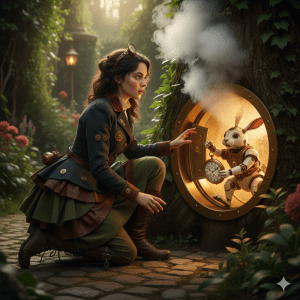
Alice lived in a world of predictable rhythms. Her days were a tapestry of embroidery, piano lessons, and polite conversation. But Alice herself was a weaver of a different sort, drawn more to the mechanical puzzles and clockwork wonders hidden in her father’s study. While other girls her age practiced their curtsies, she was sketching schematics for miniature steam engines and toying with complex gears. It was her secret life, one she longed to make real.
One afternoon, as she sat listlessly on a stone bench in the garden, a peculiar sight caught her eye. At the base of the grand oak tree, a deep, round hole had appeared overnight. It wasn’t an ordinary burrow. It was a perfectly cylindrical shaft lined with polished brass, from which a steady plume of white steam rose into the air, smelling faintly of hot oil and cloves. As she drew closer, she saw something even more astonishing: a white rabbit, but not one of fur and twitching whiskers. This was a frantic automaton, its limbs made of articulated ivory and gold, its body a complex weave of gears and copper.
“Oh dear, oh dear! I’m dreadfully behind schedule!” the clockwork creature whirred, its glass eyes darting in a panic. It clutched a magnificent pocket watch, its face displaying not just the hour, but the millisecond and a series of strange, swirling symbols. The automaton was struggling with a loose panel on the side of the shaft, a vital cog slipping from its grasp.
Alice, her curiosity overpowering her Victorian propriety, knelt to help. “Here, let me get that for you,” she said, reaching for the dropped gear.
“Don’t touch!” the rabbit clanked, but it was too late. As her fingers brushed against the brass, a powerful, unseen force surged from the hole, pulling her forward. She tumbled in, her scream swallowed by the sudden, deafening whir of machinery. The fall was not a dizzying, weightless plummet, but a controlled descent through a cylindrical chute lined with whirring gears and polished brass tubes. The walls flashed by, a tapestry of steam pipes and pulsing hydraulic pistons, each marked with a precise, copper-plated gauge.
When she finally landed, it was not on a pile of leaves, but on a soft velvet ottoman positioned perfectly at the bottom of the shaft. Her usual blue dress had been replaced with something far more suitable for this metallic realm. A multi-layered skirt of sturdy canvas and leather gave way to a tailored jacket, its lapels adorned with miniature cogs that turned in gentle synchronization. Her boots, stout and practical, were fitted with tiny springs and polished buckles, and her hairband now sported a miniature, gleaming barometer. Alice felt a strange sense of purpose in these new clothes; they felt like a uniform for an adventure she had yet to understand.

Before her stood the White Rabbit, a vision of mechanical anxiety. His body was a masterpiece of clockwork engineering, his waistcoat a finely tuned chronometer displaying not just the hour, but the millisecond. His pocket watch, a complex device of interlocking gears, chimed each passing second with a precise, metallic ‘tick-tock’. His eyes, made of polished glass lenses, darted left and right with frantic, robotic movements.
“Oh dear, oh dear! I’m dreadfully behind schedule!” he whirred, a wisp of steam escaping a tiny vent on his back. “The Duchess will be furious if the tea ceremony isn’t perfectly synchronized! A temporal anomaly in the east wing has thrown off the entire aetheric flow!” With a final, desperate clank, he scurried down a narrow, bustling causeway, his mechanical feet clicking rapidly against the metal floor.
Alice, with a spark of curiosity ignited by the sheer oddity of the scene, decided to follow. The causeway opened up into a vast, subterranean city, a true marvel of engineering. Towers of brass and glass pierced the dim light, connected by a latticework of aerial pipes and suspended walkways. Overhead, miniature dirigibles, no larger than a child’s toy, ferried messages and parcels through the air. This was no wonderland of nonsense; it was a world of pure, logical, mechanical precision.
She meandered through a bustling market, where automatons of all shapes and sizes peddled their wares from polished copper stalls. A tall, articulated gentleman with a top hat made of intertwined gears sold miniature airships that hovered in mid-air. A squat, barrel-chested lady with a funnel for a head offered perpetual motion machines, their gears spinning endlessly with a soft, hypnotic hum. Alice passed a shop selling intricate clockwork animals, their tiny limbs moving with unnervingly lifelike grace.
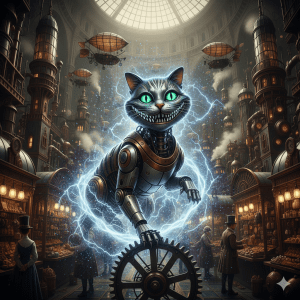
It was here, perched on a towering, spinning cog-wheel that served as a central hub for the marketplace, that she saw him. The Cheshire Cat, a sleek, metallic feline with glowing green eyes, materialized from a shimmering field of static electricity. Its grin was not a simple curve, but a series of interlocking, silver plates that shifted and clicked into position.
“Lost, little cog?” it purred, its voice a synthesized whisper that seemed to come from the very air around her. “All paths here lead to… interesting discoveries. The key to understanding this world is not in what you see, but in the unseen forces that move it. Don’t look at the gears, look at the aetheric flow. Don’t listen to the clicks, listen for the song of the pistons.”
Alice blinked, trying to make sense of the cryptic advice. “What is an aetheric flow?”
The cat’s grin widened, the plates of its mouth shifting to form an even more impossible smile. “It is the invisible energy that powers this reality. Without it, the world stands still. It’s a bit like… an idea. Without it, nothing works.” With that, it faded back into the static, its last gleaming eye winking out.
Still pondering the cat’s words, Alice continued down the main thoroughfare. The sound of a frantic, clanking melody drew her attention, and she found herself at a table set for tea. It was a chaotic symphony of whirring teacups and clanking mechanisms. The Mad Hatter, a master inventor with a top hat adorned with countless gauges and valves, was shouting instructions to a team of miniature, steam-powered tea pots. The March Hare, a rather anxious automaton, kept winding himself up, occasionally spouting jets of steam from his ears.
“No room, no room!” cried the Hatter, his voice a jovial bellow, as Alice approached. “Not unless you can offer a solution to our temporal discombobulation! The teapots are firing at erratic intervals, and the sugar lumps are not entering the cups at precisely the moment the steam reaches its optimal temperature! It’s a disaster, I tell you!”
Alice, with a keen eye for detail, noticed a crucial gear on the central teapot was misaligned, causing a ripple effect throughout the entire tea-making apparatus. Using a small wrench she found in her pocket (a curious addition to her new outfit), she gently adjusted it. The tiny teapots whirred into perfect harmony, their steam vents firing in a coordinated ballet.
“Splendid, simply splendid!” exclaimed the Hatter, offering her a cup of tea that poured itself from a self-stirring teapot. “A mechanical prodigy, you are! Now, what is your next task? To face the Queen’s tyrannical rule? A most perplexing system to solve, I assure you!”
Alice took a sip of her tea, the liquid tasting of spiced ginger and something akin to electricity. “The Queen?” she asked.
“The Queen of Hearts, of course!” replied the Hatter, his gears clicking merrily. “She’s built a kingdom on arbitrary rules and has a temper that could shatter a diamond-tipped chisel. And her favorite game? A game of croquet, played not with mallets and balls, but with a complex network of levers, steam-powered hedgehogs, and flamingo automatons. It’s a nightmare of a system, my dear, a true nightmare!”
Chapter 2: The Queen’s Croquet Circuit

The Hatter’s warning lingered in the air, a final, clanking echo as Alice set off. “A nightmare of a system, my dear, a true nightmare!” he had said. Following the White Rabbit’s path, she found herself on a wide, elevated causeway that hummed with a low, constant energy. Below, a dizzying array of pipes, pumps, and gleaming copper-plated boilers churned in a perpetual cycle, a vast, complex heart beating at the core of the city.
The causeway led to a grand, iron gate, its intricate carvings depicting clockwork roses and steam-powered griffins. On a brass plaque, an inscription read: “The Sovereign Circuit of Spleen and Regulation.” This, she realized, must be the Queen’s domain.
As she passed through the gates, she was met by a guard, a towering automaton with a poker-straight spine and a helmet made from a polished boiler. The guard’s voice was a deep, resonant rumble. “State your purpose, temporal anomaly. Unauthorized access is punishable by… well, a thorough re-calibration.”
“I am here to see the Queen,” Alice stated, her voice steady. “I have a… solution to her croquet system.”
The automaton’s head swiveled on a frictionless bearing. “A solution? Many have tried. Few have retained their primary directives.” It let her pass, the gate’s heavy gears grinding open with a resounding clang.
The Queen’s garden was not one of flowers, but of perfectly manicured topiary shaped like gears and levers. The croquet grounds were a marvel of mechanical complexity. The wickets were not simple arches, but elaborate, multi-jointed gates that moved and re-configured themselves on a whim. The mallets were steam-powered contraptions, and the balls were tiny, polished orbs of brass. The players, a deck of cards brought to life as clockwork automatons, stood rigidly at attention.
And at the center of it all was the Queen of Hearts, a woman of unyielding posture and a crimson gown that pulsed with a faint, internal light. A complex series of levers and gauges were built into the armrests of her throne, which she used to control the field. Her face was a mask of cold fury, and her voice, when she spoke, was a sharp, percussive crack. “Off with their heads!” she shrieked at a hapless two-of-clubs who had accidentally sent his ball into a steam vent.
Alice watched, her mind already working to decipher the system. The Queen’s croquet was not a game of skill, but of absolute control. The player who could predict and react to the Queen’s commands would win. But the Queen’s commands seemed random, born of pure caprice.

Suddenly, a new figure stepped onto the field. It was the Caterpillar, but he was no longer a languid smoker. He was a plump, caterpillar-shaped automaton, his body composed of articulated, bellows-like segments that expanded and contracted with a soft, rhythmic hiss. He sat upon a large, mushroom-shaped pressure gauge, a pipe in his hand that released puffs of perfumed steam.
“And who are you?” the Queen demanded, her voice a sharp-edged knife.
“I am… a chronicler of aetheric fluctuations,” the Caterpillar hummed, its voice low and contemplative. “And I observe that your game, Your Majesty, is… inefficient. The aetheric flow is erratic, and your players’ reactions are delayed. Your system lacks a certain… fluidity.”
The Queen’s face turned a shade of puce, her gauges flaring in alarm. “Nonsense! My system is absolute!”
“It is arbitrary, not absolute,” the Caterpillar countered calmly. “And arbitrary systems are prone to catastrophic failure. One errant command, one unforeseen pressure spike, and the entire circuit will seize.”
Alice, listening closely, saw a flicker of something in the Queen’s eyes: not anger, but a deep, unsettling fear. She was afraid of losing control.
“I can prove it,” the Caterpillar continued. “The next command you give, will be a ‘left turn’ for the two-of-spades, and a ‘right spin’ for the three-of-diamonds.”

The Queen, her jaw set, looked at the controls. With a swift movement, she pulled two levers. The two-of-spades lurched left, and the three-of-diamonds began to spin wildly. The Caterpillar had been right.
“How… how did you know?” the Queen whispered, her voice a tremor.
“The system has a pattern,” the Caterpillar replied simply. “A pattern of unpredictability that is, in itself, predictable.” It looked directly at Alice. “One must find the pattern to solve the game. And to solve the game, one must understand the Queen.”
Alice realized with a jolt that the croquet game wasn’t just a sport; it was an external manifestation of the Queen’s own psyche, a chaotic, temperamental system that needed to be understood and fixed. To win, she couldn’t just play the game. She had to solve the Queen.
Chapter 3: The Two and the Three
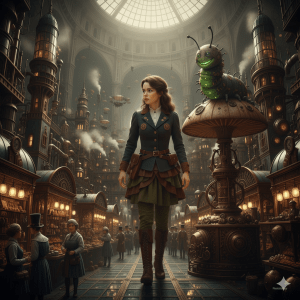
The Caterpillar’s words echoed in Alice’s mind. To solve the game, she had to solve the Queen. But how? She couldn’t simply walk up to the tyrannical monarch and ask about her deepest fears. She needed more information, a way to understand the volatile system from the inside. She looked back at the Caterpillar, still seated serenely on his mushroom-shaped pressure gauge.
“How can I solve her?” Alice asked. “The system seems designed to be unsolvable.”
The Caterpillar let out a slow, rhythmic hiss of steam. “All systems have a tell, little cog. The trick is to observe the output, not the input. The Queen’s commands are the input. Her players’ reactions are the output. Look closer.” He pointed a segmented limb towards the two automatons who had been the subject of his earlier prediction. The Two-of-Spades was sulking in a corner, his mechanical head held low. The Three-of-Diamonds was nervously polishing his brass orb, his gears whirring with a high-pitched anxiety.
“They are the keys,” the Caterpillar hummed. “They are the physical manifestation of her chaos. Ask them.”
Taking his advice, Alice approached the two automatons. The Two-of-Spades looked up, his faceplate etched with what appeared to be a permanent frown. “What do you want, temporal anomaly? Another query about our existential despair?” His voice was a low, metallic groan. “I’m telling you, this is a truly dreadful system. One moment, ‘forward spin,’ the next, ‘rapid rewind.’ There’s no consistency, no logical progression. It’s simply madness.”
“I’m trying to understand the Queen’s game,” Alice said gently. “The Caterpillar told me it has a pattern, even in its unpredictability.”

The Two-of-Spades snorted, a brief, sharp puff of steam from his vents. “A pattern? The only pattern is ‘Off with their heads!’ But you can ask the Three-of-Diamonds. He’s a sensitive soul; he sees things differently.”
Alice turned to the Three-of-Diamonds, who flinched, his optical sensors flickering nervously. “H-hello,” he stammered, his voice a soft, tinkling sound, as if made of delicate chimes. “Are you here to re-calibrate me? I just… I tried my best. I really did.”
“No, no, I’m not here to re-calibrate you,” Alice said quickly. “I’m trying to understand the game. The Caterpillar said you might be able to help.”
The Three-of-Diamonds looked around, then leaned in conspiratorially. “The Queen has… moods,” he whispered. “When she’s angry, the commands are sharp and fast, like rapid-fire pistons. When she’s bored, they’re slow and drawn out. But when she’s… afraid… the system doesn’t work at all. It just… stalls.”
“Afraid?” Alice asked, intrigued. “What could the Queen possibly be afraid of?”

“Losing control,” the Three-of-Diamonds whispered, his voice barely audible over the hum of the machinery. “The more unpredictable her game becomes, the more she fears it. And the more she fears it, the more erratic the commands become. It’s a feedback loop of chaos. The Caterpillar is right. The system is a reflection of her inner workings.”
Alice’s mind raced, piecing together the information. The Queen’s game wasn’t just a physical circuit; it was an emotional one. To win, she didn’t need to predict the next move; she needed to understand the Queen’s emotional state. And to do that, she had to get the Queen to reveal her fear.
“Thank you,” Alice said to the two automatons. “You’ve been a great help.”
The Two-of-Spades merely grunted, but the Three-of-Diamonds offered a timid nod, a faint, metallic smile on his face.
As Alice walked back to the Caterpillar, she felt a surge of confidence. She finally had a plan. To win the game, she wouldn’t play at all. She would find a way to break the Queen’s circuit of control, not with force, but with vulnerability. She would use the very thing the Queen feared most to defeat her.
 The Crazymad Writer Writes Again