February in Ballykillduff

Prologue
February in Ballykillduff
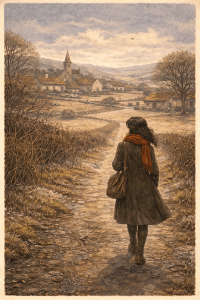
February is not a confident month in Ballykillduff.
It sits between winter and spring like a visitor unsure whether to stay or leave, bringing with it mornings that begin in frost and afternoons that end in birdsong. The fields are still pale, the hedges still thin, and the river runs with the steady patience of cold water.
Nothing much happens in February.
And yet, in Ballykillduff, February is when small things sometimes forget how the world is supposed to work.
Roads shorten without warning.
Squares become lakes for an afternoon.
The wind remembers voices.
Shadows lose their direction.
Rivers reconsider their journeys.
No one in Ballykillduff finds this especially alarming.
February has always been a month when the village listens more carefully than usual — to the land, to memory, and to the quiet feeling that the year is beginning again somewhere beneath the soil.
The sheep notice it first, though they never explain how.
Jimmy McGroggan keeps notes, though he rarely reads them back.
And Alice, when she visits, simply watches and waits, as though February were telling a story too slow for most people to hear.
By the time March arrives, everything has usually remembered how to behave again.
But Ballykillduff never quite forgets February.
It is the month when the world loosens its grip on certainty —
and the village remembers how close it lives to wonder.
February in Ballykillduff
The Day the Road Took a Shortcut
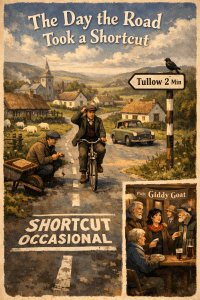
No one in Ballykillduff noticed anything unusual at first.
The morning of February 10th began as most February mornings did — pale sky, damp hedgerows, and the faint smell of turf smoke drifting lazily across the fields. The sheep beside the monument chewed with their usual philosophical indifference, and Mrs Donnelly’s gate squeaked in its customary key of complaint.
But at about half past nine, the road to Tullow decided to improve itself.
It did not announce this decision. Roads rarely do.
Instead, it simply became shorter.
The First Discovery
Seamus Fitzgerald was the first to notice.
He set off from the village on his bicycle, expecting the usual steady ten-minute ride past Curran’s Lane, over the little rise, and down toward the crossroads.
But after only three minutes of pedalling, he arrived at the crossroads.
He looked behind him.
The village sat exactly where it always had.
He looked ahead.
Tullow lay the proper distance away.
Seamus scratched his head, turned around, and cycled back.
This time, the road was normal again.
He tried once more.
Three minutes.
Crossroads.
Normal distance back.
“Ah,” said Seamus wisely, “one of those things.”
And he continued on his way.
The Second Discovery
By midday, half the village knew.
Jimmy McGroggan attempted to measure the phenomenon using:
- a measuring tape,
- a wheelbarrow,
- and a sandwich as a timing device.
His results were inconclusive, though the sandwich proved reliable.
Alice, who happened to be visiting Ballykillduff that week (as she often did when reality grew tired), walked the road with careful curiosity.
“I believe,” she said, “the road is occasionally remembering where it used to be.”
“Where it used to be?” Jimmy asked.
“Yes,” Alice said. “Places sometimes recall earlier versions of themselves. It’s terribly inconvenient for maps.”
The Third Discovery
At precisely three o’clock, the road performed its most dramatic shortcut.
Miss Battle-Scars, driving home from the shop, turned onto the Ballykillduff road—
—and arrived directly outside her own house.
She had skipped the entire journey.
She sat in the car for several seconds.
“Well,” she said at last, “that was efficient.”
The Explanation (Sort Of)
That evening, the villagers gathered at the Giddy Goat.
Theories were proposed.
Bridget suggested underground tunnels.
Jimmy suggested gravitational mischief.
Barmy Bernard suggested the road was tired.
Alice listened quietly before speaking.
“Winter roads,” she said, “sometimes fold themselves to keep warm.”
No one understood this, but everyone agreed it sounded correct.
The Resolution
At sunset, the road returned to its proper length.
The hedges seemed satisfied.
The ditches relaxed.
The crossroads resumed being exactly ten minutes away.
By morning, February 11th behaved normally again.
Afterward
Only one small sign remained.
On the road just outside the village, someone had painted a neat white marking:
SHORTCUT — OCCASIONAL
No one admitted to painting it.
The sheep refused to comment.
And every now and then, when February feels particularly thoughtful, the road to Tullow still arrives sooner than expected.
February in Ballykillduff
February 11th — The Day the Square Became a Lake
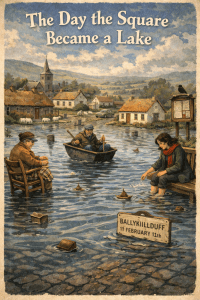
In Ballykillduff, February is a month when the world sometimes forgets exactly what it is supposed to be doing.
Winter is not quite finished.
Spring is not quite ready.
And the village itself occasionally becomes confused.
The confusion on February 11th began under the postman’s boots.
At precisely twenty-two minutes to eleven, he crossed the village square carrying a canvas bag of letters, three catalogues nobody wanted, and a parcel that rattled suspiciously.
The cobblestones beneath his feet went squelch.
Then splosh.
Then, without any warning whatsoever, water bubbled up between the stones and surrounded his boots like an unexpected welcome.
The postman stepped backward.
The water did not apologise.
The Arrival
The bubbling spread in a neat, circular fashion, as though the square had decided to install a pond without consulting anyone.
Mrs Donnelly arrived from the shop just in time to see a small fountain appear beside the bench nobody repaired.
“Well now,” she said, which in Ballykillduff counts as the beginning of an investigation.
Within minutes, the water had formed a shallow pool.
Jimmy McGroggan arrived with a measuring stick and an expression of deep mechanical curiosity.
“It’s coming from underneath,” he said.
“That’s generally where springs come from,” said Alice, who had appeared quietly at the edge of the square.
No one questioned her arrival. They rarely did.
By Lunchtime
By twelve o’clock, the square was ankle-deep.
Children sailed twigs like boats.
The sheep refused to cross the cobbles.
Miss Battle-Scars blamed the council in advance.
The water continued to rise with calm determination.
Jimmy placed his wheelbarrow into the growing pool to test buoyancy. It floated immediately, which he found encouraging.
“Progress,” he said.
The Discovery
At two o’clock, Alice removed her shoes and stepped into the water.
She stood very still.
Then she said, in the thoughtful voice she used when reality was behaving incorrectly:
“It believes it is a lake.”
“A lake?” Bridget asked.
“Yes,” Alice said. “A small one, but confident.”
Jimmy lowered a bucket on a rope into the centre of the square.
The bucket never touched bottom.
This concerned everyone except Alice, who seemed pleased.
The Sensible Response
After some discussion — and two cups of tea — the villagers agreed on the only reasonable solution.
They behaved as though the square truly were a lake.
Seamus brought a folding chair.
Jimmy floated the wheelbarrow like a boat.
Bridget scattered crumbs for ducks that were not present.
Alice sat on the bench and trailed her fingers in the water.
The square seemed satisfied.
The water stopped rising.
Then, slowly and politely, it began to sink.
The Departure
By sunset, the lake was gone.
The cobblestones returned to themselves.
The wheelbarrow rolled again.
The sheep crossed cautiously.
Only dampness remained — and the faint smell of freshwater.
The Memory
The next morning, carved into a single cobblestone in careful lettering, were the words:
BALLYKILLDUFF LAKE
FEBRUARY 11th
No one admitted writing them.
The sheep remained silent on the matter.
And every so often, on mild afternoons, the square smells faintly of distant water.
As though it remembers being deeper than it is.
February in Ballykillduff
February 14th — The Wind Brought Back Old Voices
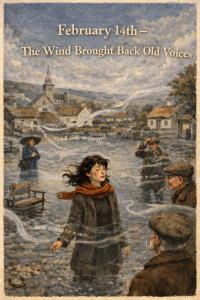
The wind arrived in Ballykillduff before dawn, long before anyone was awake to object.
It did not howl or rattle the windows or topple bins as respectable winds usually do.
Instead, it moved quietly through the hedges, across the fields, and into the village like someone searching for a particular memory.
By morning, the sky was pale and restless, and the air carried a feeling that something had been misplaced.
The First Voice
Mrs Donnelly heard it while opening her kitchen window.
Just beneath the sound of the wind, she heard a voice say:
“Mind the step there.”
She froze.
It was her mother’s voice — clear as it had been thirty years ago.
Mrs Donnelly closed the window, waited a moment, then opened it again.
The wind said nothing.
“Well,” she said carefully, “that was unexpected.”
Around the Village
By mid-morning, others had begun to notice.
Seamus heard his father calling cattle from a field that no longer existed.
Bridget heard children laughing in the lane behind the shop, though no children were there.
Jimmy McGroggan, standing outside his shed, heard the unmistakable clang of the old blacksmith’s hammer that had been silent for decades.
He removed his cap without quite knowing why.
Alice Listens
Alice stood in the square, her hair moving gently in the wind, listening as though the air were speaking directly to her.
“It’s not ghosts,” she said when the villagers gathered.
“What is it then?” Bridget asked.
“February,” Alice replied. “It’s remembering aloud.”
The Pattern
The voices did not speak in sentences.
They came and went like fragments of conversation carried across fields.
A greeting.
A warning.
A laugh.
A song half-finished.
Nothing frightening.
Only familiar.
Even the sheep paused their chewing once or twice, ears tilted toward the hedgerows.
The Strongest Moment
At noon, the wind passed through the square all at once.
For a single minute, the entire village heard voices together:
market days,
school bells,
steam trains at distant stations,
boots on gravel,
doors closing gently,
someone singing in a pub long gone.
Then it passed.
And Ballykillduff was quiet again.
The Explanation (As Much As There Was One)
Jimmy said it was air pressure.
Bridget said it was imagination.
Miss Battle-Scars said it was drafts.
Alice said nothing more.
She simply watched the hedges as though they were finishing a conversation.
The End of the Wind
By afternoon, the air grew still.
The village returned to ordinary sounds:
kettles,
gates,
distant tractors,
the steady certainty of sheep.
Yet something remained — not a voice, but the feeling of one.
Afterward
That evening in the Giddy Goat, people spoke more softly than usual.
Names were mentioned that had not been spoken in years.
Stories were told twice.
And nobody hurried home.
The Small Sign of It
The next morning, February 15th, the wind was gone.
But in the hedgerow beside the square, someone found an old rusted horseshoe half-buried in the soil.
No one recognised it.
Jimmy placed it carefully on the bench nobody repaired.
It stayed there for weeks.
February in Ballykillduff was changing.
The strange things were no longer only curious.
They were beginning to remember.
February in Ballykillduff
February 18th — The Day Shadows Pointed the Wrong Way
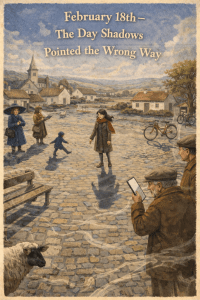
The trouble with the shadows in Ballykillduff began on a perfectly respectable morning.
The sun rose exactly where it always rose, over the low fields beyond Curran’s Lane, and the village woke to the ordinary sounds of kettles, gates, and sheep negotiating breakfast.
Nothing seemed unusual.
Except the shadows.
The First Notice
Seamus Fitzgerald discovered it while opening the shed behind his house.
The sunlight fell across the yard as expected.
But his shadow stretched not behind him, nor beside him, but toward the sun.
He stepped forward.
The shadow followed — still pointing the wrong way.
He stepped backward.
The shadow considered this and continued pointing east.
“Well now,” Seamus said, in the voice Ballykillduff reserved for mild impossibilities.
Around the Village
Within an hour, the problem had spread everywhere.
Chimney shadows climbed roofs instead of falling across them.
Fence-post shadows leaned politely into the morning light.
The church steeple cast a shadow straight toward the sunrise, as if trying to return it.
Children discovered they could step away from their shadows entirely for several seconds before the shadows remembered their duties.
This caused considerable running.
Jimmy Investigates
Jimmy McGroggan arrived in the square carrying a mirror, a notebook, and a biscuit.
He tested shadows from several angles.
The mirror reflected properly.
The sun shone correctly.
Only the shadows disagreed.
“They’ve misunderstood the instructions,” Jimmy concluded.
Alice Explains (Slightly)
Alice stood in the square watching the cobblestones.
“Winter shadows,” she said, “sometimes forget which side of the world they belong to.”
“Can they be reminded?” Bridget asked.
Alice shrugged.
“They usually remember by afternoon.”
Noon
At midday, the situation became briefly worse.
For nearly five minutes, there were two shadows for everything:
one correct,
one pointing toward the sun.
The sheep found this deeply suspicious.
Miss Battle-Scars declared it “unnecessary duplication.”
Jimmy attempted to step on the incorrect shadow, which achieved nothing.
The Correction
At exactly twenty minutes past one, the shadows realigned.
No sound marked the moment.
No flash of light.
They simply returned to proper behaviour, as though embarrassed.
The village resumed normal geometry.
The Last Sign
Only one trace remained.
Behind the bench nobody repaired, where the cobblestones were slightly uneven, a shadow stayed visible for several seconds after the bench itself was moved.
It faded slowly, like breath on glass.
Alice watched it disappear.
“Spring is getting closer,” she said.
February in Ballykillduff was becoming steadily less certain.
The world was loosening.
And shadows, like everything else, were beginning to remember movement again.
February in Ballykillduff
February 22nd — The Day the River Forgot the Sea
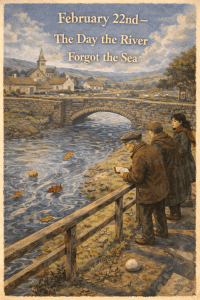
The river that passed Ballykillduff had always known exactly where it was going.
It came down from the hills beyond Haroldstown, slipped past hedges and fields, curved politely around the village, and continued on its long and patient journey toward the sea.
It had done so for longer than anyone could remember.
Until February 22nd.
The First Sign
Seamus noticed it while checking the footbridge just after breakfast.
The river was flowing normally.
Except it was flowing the wrong direction.
Instead of moving away from Ballykillduff, the water slid gently upstream, returning toward the hills it had come from.
Seamus watched for a full minute.
The river did not change its mind.
“Well now,” he said, and went to find Jimmy.
Confirmation
Jimmy McGroggan arrived carrying:
- a stick,
- a cork,
- and a professional sense of curiosity.
He placed the cork in the water.
It floated upstream immediately.
Jimmy nodded gravely.
“Yes,” he said. “That’s backwards.”
The News Spreads
By mid-morning, the villagers lined the banks.
The river moved calmly in reverse, as though retracing its own memory.
Leaves floated past in the wrong direction.
Twigs returned upstream.
A lost football from last autumn reappeared briefly before continuing toward the hills.
The sheep watched with narrowed eyes.
Alice Listens
Alice stood beside the bridge, watching the water slip past the stones.
“It hasn’t forgotten the sea entirely,” she said.
“It’s remembering where it began.”
“Why would it do that?” Bridget asked.
“Because winter is ending,” Alice replied.
“And beginnings become interesting again.”
Noon
At midday, the river slowed.
For several minutes, the water stood perfectly still — flat as glass.
The village reflected clearly in its surface.
Jimmy said later it was the quietest water he had ever seen.
The Turning
At exactly one o’clock, the river chose again.
The surface trembled.
The current hesitated.
Then the water resumed its journey toward the sea, as it always had.
Steady.
Certain.
Old.
What the River Returned
Something remained on the bank beneath the bridge.
A smooth stone, pale and round, unlike any stone from the nearby fields.
Alice picked it up.
“It’s from the hills,” she said.
No one knew how she could tell.
Jimmy placed it beside the horseshoe on the bench nobody repaired.
The two objects seemed to belong together.
Afterward
The river flowed normally for the rest of the day.
But that evening, the sound of it seemed louder than usual, as though it were relieved to remember its purpose.
Or perhaps grateful.
February in Ballykillduff was nearing its end.
The village was no longer merely remembering.
It was preparing.
February in Ballykillduff
February 28th — The Day Spring Knocked Twice
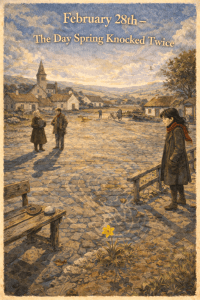
Spring did not arrive in Ballykillduff all at once.
It never did.
Instead, it came cautiously, like a visitor unsure whether it was welcome yet.
On February 28th, it knocked twice.
The First Knock
The first knock happened just after sunrise.
It was not a sound exactly, but something very close to one — a soft, hollow tap that seemed to come from everywhere at once.
Mrs Donnelly heard it while opening her front door.
Jimmy McGroggan heard it inside his shed.
Seamus heard it standing beside the river.
Even the sheep paused their chewing, which they did not do lightly.
The village waited.
Nothing happened.
“Well,” said Bridget eventually, “that was polite.”
The Day Continues
The morning passed normally.
The river flowed in the correct direction.
The shadows behaved.
The square remained dry.
But small changes began to appear.
A patch of grass near the monument looked greener than yesterday.
The air felt less like winter and more like a promise.
Somewhere in the hedgerow, a bird sang experimentally, as though checking the calendar.
Alice noticed everything.
“Spring is deciding,” she said.
“Deciding what?” Jimmy asked.
“Whether to stay.”
The Second Knock
The second knock came in the late afternoon.
This one was unmistakable.
Tap.
It sounded like knuckles on a wooden door.
The hedges rustled.
The clouds shifted.
The village seemed to inhale.
And then spring stepped inside.
The Changes
They were small, but certain.
A single daffodil opened beside the bench nobody repaired.
The river sounded brighter as it passed the bridge.
The wind lost its winter edge.
And on the cobblestones of the square — just for a moment — the shadows pointed in every direction at once, like compass needles deciding.
Then they settled.
Evening
That night, Ballykillduff felt lighter.
The sky held its colour longer.
The fields seemed to stretch.
The sheep became slightly more optimistic.
Jimmy placed the pale hill-stone beside the horseshoe again, adjusting them until they looked correct.
No one knew why.
The Quiet Understanding
Alice stood at the edge of the village as evening fell.
“It always knocks twice,” she said.
No one asked how she knew.
After February
The next morning was March.
Nothing unusual happened.
Which, in Ballykillduff, was often the surest sign that something important had just taken place.
Sure — here’s the epilogue again, written cleanly so you can place it at the end of February in Ballykillduff.
Epilogue
After February
When March arrived in Ballykillduff, it did so quietly.
There were no announcements, no bells, and no sudden changes — only a softer morning light and the faintest suggestion of warmth in the air.
The village returned to its ordinary ways.
The road remained the proper length.
The square stayed dry.
The wind spoke only in wind.
Shadows followed the sun faithfully once more.
The river remembered the sea without hesitation.
Everything behaved exactly as it should.
And yet, something of February remained.
On the bench nobody repaired, Jimmy McGroggan placed the small reminders of the month together:
the rusted horseshoe from the hedgerow,
the pale stone returned by the river,
and a scrap of chalk he insisted had once been part of a shell.
They seemed comfortable there, as though they understood one another.
No one moved them.
The fields began to soften.
Birdsong grew more confident.
The hedges prepared themselves for leaves.
Life in Ballykillduff moved forward, as it always did.
But now and then, on quiet afternoons, someone would pause in the square and feel the faintest sense that the world might still do something unexpected — something small, something harmless, something February-shaped.
No one found this worrying.
It meant the village was awake.
Alice left Ballykillduff one morning without saying goodbye, which was her usual habit.
At the end of the lane, she stopped and looked back.
The bench stood in the square.
The daffodil nodded in the breeze.
The river moved steadily beyond the fields.
Everything was exactly as it should be.
Almost.
Alice smiled, as though hearing a distant knock no one else could hear.
Then she walked on.
And Ballykillduff continued, as it always did —
patient with its seasons,
certain of its roads,
and quietly ready for February to return.
 The Crazymad Writer Writes Again