DALEK 2084
DALEK 2084 — A Six-Episode Serial
Episode One — The Loudspeaker That Went Quiet
The loudspeakers woke the city at 05:00, same as always.
LOUDSPEAKER: CITIZENS. OBEDIENCE IS PEACE. RESISTANCE IS FUTILE. REPORT TO LABOUR BAYS.
Mara tightened the strap on her scavenged carbine and kept moving through the culvert, ankle-deep in black water. Tomás sloshed behind her, a battered satchel banging his hip. Above them, through hairline cracks in the concrete, day broke in a cold strip of light and the marching hiss of patrol skids.
“Breathe when you can,” Mara said. “Not when you want.”
“Right,” Tomás whispered, and breathed anyway.
They reached the power junction under Civic Square. The junction box was older than the occupation; orange ceramic guts, human writing scratched in a hand that no longer existed. Doctor Elias Vey knelt over it, fingers steady, greying hair tied back with copper wire.
“Four seconds,” he said. “Maybe five.”
“Four is enough,” Mara said.
Elias clipped the bypass onto live pins. Somewhere far above, the speaker grid coughed—once, twice—and died.
For the first time in years, the square above them was silent.
They stood in it. Silences have weight; this one settled like new snow.
Then the siren began.
“Go,” Mara said.
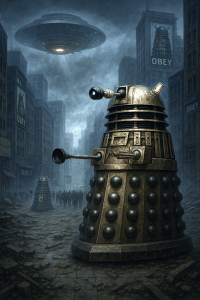
They were already running when the skids screamed down. Three Daleks dropped to street level on antigrav fields, bronze casings burnished by rain. Their eyestalks found the humans in a breath.
DALEK: HALT. HALT.
DALEK: OBEY OR BE—
Mara: Now!
Tomás shoved the satchel’s open mouth toward the nearest Dalek. The compact coil inside spat blue. The Dalek’s dome lights flared. The world cracked white.
When the afterimage cleared, the machine lay on its side, its gun blackened, its casing hissing where the EMP had bitten deep.
People in the square stared at the fallen Dalek as if it were a myth undone. Then someone laughed—not sanity, not yet, but the sound of a door giving way.
The remaining two Daleks reoriented.
DALEK: RESISTANCE DETECTED. EXTERMINATE!
Mara yanked Tomás into the alley. A beam bit stone into steam at their backs. They ran through washing lines and sagging brick, sirens stacking into a choir. Elias limped, but his hands were sure; he had a second coil, smaller, hidden beneath his coat—
He never fired it. A drone dropped, netted him in a gauze of light, and lifted him screaming into the churned sky.
“Mara!” he shouted. “The Tower—listen—the Core is under—”
The drone’s beam cut his words. He went to the sky like a moth into a lamp.
Mara’s heart became a single hard thing. “We get him back,” she said, not to Tomás, not to herself, but to the city.
Above them, higher still, something new glimmered: a vast black saucer easing from the cloud, panels unfurling like the petals of a carnivorous flower.
LOUDSPEAKER (returning, colder): ATTENTION. DISTURBANCE CONTAINED. CITIZENS WILL REMAIN CALM.
“Too late,” Tomás said, voice small and fierce. “We heard it.”
The saucer rotated, bringing a golden figure into view on a balcony of light: the Supreme Dalek.
SUPREME: YOU DEFY. YOU DIE.
Fade to black.
Cliffhanger: Elias captured; Supreme Dalek arrives; the city braces.
Episode Two — The Book of Banned Words
The bunker smelled of oil and the ghost of bread. The walls were papered with maps of streets that no longer existed and children’s drawings of skies without ships.
Mara placed a book on the table. The others gathered, faces cut by lamplight: scrappers, medics, a grandmother with a mechanic’s hands, a boy no older than Tomás whose eyes never settled.
“What’s that?” he asked.
“A crime,” Mara said. “Printed before the Rule. It teaches the word I.”
She opened it: a slim volume of poetry, foxed at the edges, the binding repaired with thread. The room bent toward it.
“We’ll start with three words,” Mara said. “Truth. Love. Free.”
“They’ll hear you,” warned Noreen, the short, square woman who ran the water rations and had once run a council chamber. “They always hear.”
“Then let them,” Mara said. “It’s time they heard something else.”
Tomás hunched over the parts for their next cut-in. “If I can get into the main broadcast trunk, I can ride the civic safety channel,” he said, solder popping like sparks from a bonfire. “Sixty seconds. Maybe ninety.”
“Enough,” Mara said again.
They moved at dusk. In a subway tunnel whose timetable still listed Saturday, they found an inspection shaft that rose like a throat through the city’s concrete. Tomás went first, pack tight to his back, mouth set. Mara came behind him, counting steps. Noreen covered their exit with a shotgun older than she was.
At the top, a grate. Beyond, a maintenance gallery: pale, humming, full of cables as thick as a child’s chest.
“Fast,” Mara said.
Tomás clamped his relay onto the insulator, teeth clenched. The city’s voice rose under his hands—millions of watts, a river in metal. He cut, bridged, winced, breathed—
“Go,” he said.
Mara leaned to the grille. “People of the Enclave,” she said, voice steady. “My name is Mara. I remember my brother’s song. Perhaps you remember yours. The loudspeakers have one story. We have another. The Daleks are not forever. Nothing is. Listen.”
She read three lines from the book. Nothing lofty, nothing treasonous; a child’s rhyme about a door and a field beyond it. The maintenance gallery felt larger after the words, as if they’d pushed the walls back with their breath.
Then the gallery filled with light.
DALEK: INTRUSION. ELIMINATE.
Mara shoved Tomás through the grate. They fell onto the catwalk as a beam carved the air where their heads had been. The catwalk shuddered; the rails burned.
Tomás grabbed the relay to yank it free. Metal screamed; the cable spat. Electricity leapt like a snake and bit his wrist. He cried out, but kept pulling, teeth bare.
Mara swung the coil pack like a flail. It struck the Dalek’s gun; the beam hiccupped; the deck plates boiled.
They ran blind, smoke thick around them.
Behind them, the broadcast trunk carried one last echo from their cut-in, just long enough to be heard in a thousand grey rooms:
There is a door.
In the Tower, far above the square, Elias Vey opened his eyes on a slab and saw the conversion rig descending like a crown of thorns.
TECH-DRONE: PREPARE FOR INTEGRATION. YOUR INDIVIDUALITY IS WASTE.
Elias smiled without humour. “You have no idea how much waste I’ve hidden in your systems,” he said softly.
The rig found his temples. The room went white.
Cliffhanger: Broadcast lands; Tomás shocked but alive; Elias enters conversion.
Episode Three — The Foundry of the Forgiven
The Conversion Foundry sat where a cathedral had once punched the skyline. Light rose from it in sheets. The air smelt of ozone and something like burnt mint.
Mara watched through binoculars that used to be part of a toy. “We go in under the condenser,” she said. “Tomás, you stay with Noreen. If we’re not out in twenty minutes—”
“You will be,” Tomás said, as if saying it made the plan a fact. He had a new strip of cloth tied over his wrist, a tremor in the fingers that didn’t hold his toolbag.
Inside, heat. Catwalks over pits of surgical light. Human silhouettes pinned like butterflies under rigs.
A tech-drone drifted toward Mara, arms like alphabet letters. She put a knife into its optic, another into the speaker grille. It died in a shower of punctuation.
“Elias!” she hissed, though the name was death if a mic heard it.
A voice answered from the far slab, altered by pain and machinery. “Mara?”
He looked wrong—paler, thinner, a ring of connectors like frostbite around his skull—but his eyes were his.
“Hold still,” Mara said, which was amusing given the circumstances. She leapt onto the gantry controls and pulled. Clamps released with a hydraulic sigh.
Alarms flowered.
DALEK: TRESPASS. SECURE. EXTERMINATE.
Noreen’s shotgun spoke from the corridor like thunder left in a drawer too long. Tomás flung a mag-pulse into the pit. Lights strobed; a rig stalled against a woman’s throat and then lifted, uncertain, like a bully surprised by a punch.
“Can you walk?” Mara asked Elias.
“Define walk,” he muttered, and proved it anyway.
They should have been too slow. They should have died there. They didn’t, because the conversion protocol, halfway through Elias’s brain, kept trying to finish as it ran—and the only path to completion was to save the unit designated ELIAS VEY.
Doors opened. Lifts arrived full of air. Turrets hesitated a tick too long, as if a little voice said: Not him.
They spilled into the alley, lungs burning with chemical heat.
“Side effect,” Elias said, voice rough. “I talked to your God while I was between the gears. He wasn’t listening. But your machines were.”
Above them the sky turned iron. The black saucer angled, panels blooming, a bomb bay irising.
“Run,” Mara said.
The first bomb hit the Foundry. The second hit the street outside. The third never landed; an ancient anti-air gun, welded from tractor parts and a century of rage, woke on the museum roof and spat a single arc of light that took the bomb in its belly and made a sun.
The saucer shifted its aim—toward the museum, toward the neighbourhood beyond it, toward the river—
“Not there,” Tomás said aloud, as if the ship might like to hear his preference about where death fell.
It did not. The bay brightened.
A new sound cut the air: a low, triangular hum, like a choir made of knives. Every radio, every speaker, every coil in the city vibrated to it.
SUPREME (amplified): WITNESS JUDGEMENT.
The bomb bay flared.
Cut to black.
Cliffhanger: City-killer ordnance falling; our heroes in the blast radius.
Episode Four — The Bridge of Unmade Names
They lived. That is not a spoiler; it is a refusal of the Dalek project.
The museum gun did not fire again; it dissolved under a beam as thin as hate. But the first blast had done enough. The bomb drifted wide, ate a warehouse, flayed stone into sunlight. The shockwave took them off their feet and tried to teach them to fly. They did not learn.
When Mara’s ears stopped ringing, her mouth was full of dust and the taste of old books. Tomás lay two metres away, curled around his satchel. Noreen was up already, because some people are up even when physics begs.
“Move,” she said. “They’ll send cleaners.”
They went to ground under the river bridge, where the city kept its old names in rivets and rat-tunnels. Elias shook in little jagged ticks as his hybridised nerves tried to decide whether he belonged to meat or math.
“Side effect two,” he said when he could speak. “I can hear them. Not words. Pressure. Think of it as weather. The storm centre is the Tower.”
“How do we break a storm?” Tomás asked.
“You teach it a different song,” Elias said.
They needed an EMP coil large enough to bite the Tower’s core. One existed—rumour said—in a military train routed between the northern foundries and the sea. A coil built to die once, gloriously, in defence of a government that hadn’t had time to deploy it.
“We take the train,” Mara said.
“Trains don’t stop for poetry,” Noreen observed.
“Then we stop it with something uglier.”
Night on the viaduct. The train came like a thought you don’t want but can’t slow: low, fast, a chain of armour and purpose. Tomás lay belly-down on the girder, trembling but steady, detonator in his good hand.
“On my mark,” Mara said. “Three. Two—”
Floodlights. Sirens. Drones exploding from the treeline like wasps.
DALEK: AMBUSH DETECTED. SUPPRESS.
“Now!” Mara shouted. Tomás hit the trigger. The shaped charge lifted a tooth of concrete from the girder. The whole viaduct took a breath as if to recite a poem in a language made of gravity.
The train’s front bogies went crooked. Steel screamed. The coil car jackknifed, couplers snapping, one wagon slewing over the edge, a slow uncoiling catastrophe that ended in sparks tall as trees.
Daleks dropped to the wreck in ugly grace. Humans rose from the ditches with tools and knives and the hunger that makes knives into more.
It wasn’t a battle you film for statues. It was mud, and a prybar through a grille, and a coil the size of a truck dragged through glass.
A beam caught Tomás across the back. He pitched from the car roof without a sound, into dark and water.
Mara’s heart found that hard shape again. For a second, the war narrowed to one syllable: no.
She went for him.
Elias caught her with hands that shook but knew. “You can’t,” he said, almost gentle. “We need you to get the coil to the Tower. If we win, he has a chance. If we don’t—no one does.”
She hated him properly, for a full second. Then she wiped her eyes with the back of her hand and kept moving.
The coil went onto a truck held together by oaths. The truck went toward the city, towards the Tower’s black blade.
Behind them, under the bridge, a boy rolled in dark water and found a ladder blindly with blood in his mouth and a promise in his teeth.
He crawled into a culvert and breathed, because he could.
Cliffhanger: Coil secured; Tomás believed dead; the city burns behind them.
Episode Five — The Voice of Earth
By dawn, the coil was lashed to the truck. By noon, they were at the Tower’s service gate, which had been engineered to outlive earthquakes and governments—but not Noreen with a scavenged key-card, a hammer, and the memory of calling votes in rooms like this.
Inside, the Tower’s heart: a shaft of black like frozen night, with catwalks around it and cables as thick as oath-breaking. The sound here was a pressure behind the eyes.
“Where’s the Core?” Mara asked.
“Down,” Elias said. “And also everywhere. But mostly down.”
“Convenient,” Noreen said, and hefted the coil remote like she’d been born to do it.
They would never reach the main reactor. That was not the plan. The plan was uglier: detonate the coil in a sub-basement junction and send a radial wave through the Tower’s own conduits. Use the tyrant’s skeleton to break its heart.
Drones came. They always do.
The fighting on the catwalk was short and too close. Human hands on metal. A Dalek went over the rail and shouted EXTERMIN— all the way down, a long ugly music that ended without echo.
Mara shoved the coil onto the cradle and jammed the locking pins. Elias keyed the sequence. Noreen found the nerve that other people borrow.
SUPREME (everywhere): FUTILE. FUTILE. SURRENDER AND YOUR ERASURE WILL BE… PAINLESS.
“Not today,” Mara said. “Not ever.”
“Charge,” Noreen said, and thumbed the switch.
The coil awoke like a god that had been sleeping badly. The air throbbed. Teeth sang. The first spike hit the Tower and ran along it in blue veins.
Lights died in spirals. Lifts froze. Drone swarms fell like rain.
For twenty-seven seconds the city was free of eyes.
Mara didn’t waste the seconds. She ran for the broadcast deck.
The deck was a bowl with teeth. The console a wall of black glass. Mara slammed Elias’s relay into its throat. Tomás—wet, cold, limping, alive—stumbled through the door in time to push the final jack home.
Mara touched the mic. The city heard a breath that sounded like the first page of a book.
“This is not their voice,” she said. “It’s ours. Listen. Remember your names. Say them. Say them to each other.”
Across the city, people did. Softly at first, as if the words were shy. Then louder, as if they were hungry.
CHORUS (rising): I am Laila. I am Ben. I am Sori. I am—
LOUDSPEAKER (fighting back): OBEY—
CHORUS: No.
“Fight,” Mara said. “Break the chains you can reach. We’ll break the rest.”
The coil’s glow burned white. The Tower began to wake like a monster under a tranquillizer.
Elias stared into middle distance, head cocked, as if listening to birds.
“What?” Tomás asked.
“They’re shifting modes,” Elias said. “If they can’t watch, they’ll forget us. Memory fog. They’ve used it off-world. It eats names.”
Mara felt a hand close around her throat that wasn’t a hand. She forced a breath through it.
“Then we write faster than they can erase.”
They ran, coil spent, Tower angry.
On the service level, the Supreme Dalek awaited them, burnished gold, flanked by black Praetorians whose gunsticks hung with prayer beads taken from men who had not learned to stop praying.
SUPREME: HUMANS. YOU ARE NOISE. I AM THE ONLY SENTENCE.
“Funny,” Noreen said, shotgun empty, eyes full. “You look like a typo to me.”
The Praetorians raised guns.
Cut to black.
Cliffhanger: Face-to-face with the Supreme; coil spent; nowhere to run.
Episode Six — Sunrise, 2084
The first beam took the wall behind Mara. Dust fell like a veil. Tomás tackled her left. Elias went right. Noreen stood, because some people stand when standing is madness.
SUPREME: EXTER—
The word ended when the floor under the Supreme jumped.
Not heroism. Entropy. The coil had cooked the Tower’s stabilisers. A seam tore through the deck. The Supreme listed a fraction.
Mara moved on that fraction like it had been made for her.
“Now!” she shouted.
Four humans hit the Praetorian on the left with a scaffold pole. Two more came from the back stairs with a maintenance jack. Noreen flung her empty shotgun at a lens. Tomás vaulted the rail, grabbed the dangling fibre trunk, and jammed it across the Supreme’s gun like a knot in a throat.
“Elias!” Mara yelled. “Talk to it!”
“I’ve been,” Elias said, and stepped forward into the Supreme’s light.
His voice went flat, not devoid, just clean. “Override. Conversion grace. Protocol Omega. Forgive me my trespasses.”
For half a breath, the Supreme paused.
SUPREME: WHAT IS… FORGIVE.
“Exactly,” Elias whispered, and drove his stolen jack into the Supreme’s armour seam. He screamed as current arced through him and the Supreme together, a duet in pain, sparks climbing like moths.
Mara dragged Tomás back as the Supreme’s dome lights strobed into seizure. The Praetorians fired wildly; one beam took a Praetorian. The deck juddered.
“Core,” Elias gasped. “Below. Run.”
They ran.
The Core was a black well ringed in hexagons of light. It pulsed in a rhythm that was not a heart and yet insisted on being one. The air tasted of copper and the last day of school.
“How do we kill it?” Tomás asked.
“With arrogance,” Elias said, and bared his teeth at an equation only he could see. “It believes it cannot be unmade by the tools that made it. So we will unmake it using only those tools.”
He tore panels with hands that bled. Noreen hotwired a coolant feed with a paperclip that had held her husband’s letters. Tomás crawled under the console into a space the size of a coffin to reverse a polarity no one had reversed before because it didn’t look like it should be reversed.
Mara stood with her carbine at the door and bought seconds with rounds and curses. People from the broadcast deck surged in behind them—cooks, porters, a violinist, a man with a broom—bearing pipes and wrenches and the messy superiority of living things.
SUPREME (far above, failing): OBEY… O—
DALEK CHORUS (far and near, faltering): EXTERMI—EXTERMI—exter—
“Now,” Elias said.
Mara hit the final switch.
Light roared up from the Core: not white, not blue, but the colour you get when a machine remembers it was once ore in a mountain and then decides to be mountain again.
The Tower shook. The city’s loudspeakers coughed and went hoarse. Across the world, other towers stuttered, paused, and let their thoughts fall like ash.
The Supreme reached the door—a ruin of gold and fury—and flung itself toward the Core like a king into a crowd.
Mara met it with the thing humanity has used since before words: the weight of many hands.
It went over the rail with a sound like a verdict.
For a while, there was only noise. Then there wasn’t.
Silence came back slowly, as if unsure it was wanted. It found it was.
Outside, people emerged from Enclaves like seeds after flood. The sky was empty of ships. The eyestalks in homes hung dead, like bad fruit after winter.
Tomás leaned against a pillar and cried for a minute he didn’t plan to spend that way. Noreen sat down very carefully and stared at her hands as if they were new and had arrived without instructions. Elias lay flat, chest hitching, eyes open to a roof that dripped dust.
Mara walked to the door and looked east.
Dawn. Pale. Uncertain. It dragged light up the river like a net and spilled it over broken stone and living faces.
Tomás came to stand beside her, bandage filthy, smile raw.
“Is it over?” he asked.
“No,” she said. “But today is.”
He nodded. “What do we do with tomorrow?”
“Use it,” Elias said from the floor. “All of it.”
They took the Tower down stone by stone. They pulled the eyestalks from walls. They painted the first free words in twenty years on the public library’s cracked facade: WE KEPT OUR NAMES.
Later, when the dead were counted and the fires made domestic again, Mara stood in Civic Square where the loudspeaker had fallen and read aloud from a slim, foxed book:
There is a door.
It opens.
Walk through.
No one made them. They did it anyway.
THE END (and the beginning)
 The Crazymad Writer Writes Again