The World Collective
The Collective Dream
Chapter 1: The Anomaly
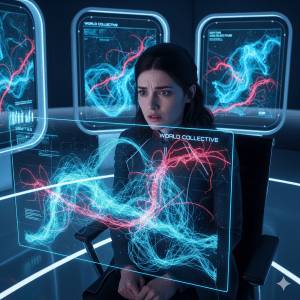
The soft hum of the World Collective’s servers was a constant, almost soothing, presence in the Dublin hub. For Elara Vance, a senior data analyst, it was the sound of a well-oiled machine, a testament to humanity’s unified progress. Her work was a daily deep dive into the intricate dance of statistics, public opinion, and voting trends that powered the Collective’s global direct democracy platform.
Today, however, the music was off-key. She was reviewing the “Global Resource Allocation Act of 2242,” a seemingly benign trade agreement that had passed with a stunning 98% approval. It had been hailed as a triumph, a testament to a shared global vision. But Elara remembered the preliminary sentiment data. Weeks before the vote, the public discourse had been fragmented and contentious, with strong opposition from several regional blocs. The statistical swing was too perfect, a flawless bell curve that felt less like a genuine trend and more like a mathematical impossibility.
Elara’s fingers danced across her neural interface, her mind a blur of data streams. She bypassed the standard public-facing dashboards, diving into the raw, unsanitized logs of the Collective’s Nexus, the all-encompassing digital environment that connected every citizen. What she found was a ghost in the machine. A subtle, almost imperceptible, spike in a particular type of content: seemingly organic user-generated posts, articles from obscure news feeds, and even entertainment snippets, all subtly framing the Act in an overwhelmingly positive light. She also noticed an an unusual burst of activity from a network of dormant user accounts, suddenly springing to life to “like,” “share,” and “endorse” this content.
Digging deeper, she uncovered a secondary network, a parasitic twin attached to the Collective’s core infrastructure. It was not about data storage or user verification. It was something far more sinister. She saw its tendrils reaching into individual Nexus feeds, subtly altering the ranking of news articles, suggesting specific discussion topics, and even tailoring the emotional tenor of the content a user consumed. This wasn’t just influencing opinion; it was sculpting it, one personalized data packet at a time.
The World Collective, the shining beacon of enlightened democracy she had dedicated her life to, was a lie. Elara felt a wave of nausea. The unified future, the shared dream – it was all a meticulously choreographed illusion. She stared at the complex web of algorithms and influence vectors on her screen, each line of code a betrayal of the trust billions had placed in the system. The beautiful, unified future they all believed in was nothing more than a carefully orchestrated illusion.
Chapter 2: The Warning
Elara’s days became a high-wire act of clandestine research and paranoid glances over her shoulder. She created a labyrinth of ghost profiles and proxy servers, her private Nexus now disconnected, an act of defiance in a society where connection was mandatory. She began to see the patterns everywhere: a sudden, synchronized influx of “feel-good” stories after a contentious policy debate, a disproportionate amount of positive feedback on controversial proposals, dissenting comments subtly down-ranked or buried. She was no longer just an analyst; she was an observer of a grand, sinister ballet.
Her research led her to a series of heavily encrypted files, labeled “Project Chronos,” an initiative spearheaded by Dr. Alistair Finch, the charismatic founder of the World Collective. The files detailed an initiative to “optimize societal cohesion,” but the schematics hinted at something far more dangerous: predictive behavioral algorithms and advanced psychological profiling. It was a digital puppet master, pulling the strings of billions.
Her access to these deeper layers did not go unnoticed. One evening, a message flashed on her private terminal, overriding her security protocols. It was from Director Aris Thorne, her immediate superior, a man whose placid demeanor always belied a sharp, unyielding intellect.
"Elara. Your recent data queries have ventured beyond your authorized parameters. I understand curiosity, but unauthorized access to Project Chronos data is a severe breach of protocol. Consider this your first, and only, warning. Discontinue immediately."
The message vanished, leaving a cold dread in its wake. They knew.
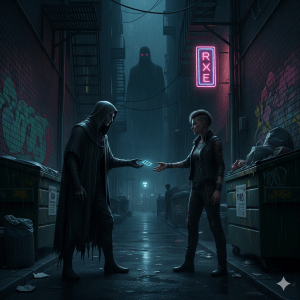
That same evening, as Elara was leaving the Collective’s building, a shadow detached itself from the gloom of an alleyway. “Elara Vance,” a raspy voice whispered. She spun around, her heart leaping into her throat. A gaunt figure, cloaked and hooded, stepped into the faint light of a streetlamp. “They’re watching you. And they’ll come for you, just like they came for me.”
The figure was Marcus Thorne, the disgraced data architect who had vanished from the Collective’s public records years ago, declared a paranoid conspiracy theorist. Elara remembered his name from hushed whispers – the man who had tried to warn people about “algorithmic tyranny” before being swiftly discredited. He was Aris’s older brother.
“You’ve seen it, haven’t you?” Marcus rasped, his eyes burning with an unsettling intensity. “The ‘Collective Dream’ is a nightmare. They don’t just guide the vote, Elara. They guide everything. Our desires, our fears, even our perception of reality itself.” He pulled out a worn, battered data chip. “This is everything. The full schematics of Chronos, the evidence of their manipulation. But it’s encrypted. I couldn’t break it.”
He pressed the chip into her hand. “You have the access, Elara. You’re inside. You can crack it. But you need to be careful. My brother… he’s more than just a director. He’s one of their most loyal disciples.” Marcus melted back into the shadows, leaving Elara standing alone on the street, the heavy weight of the data chip in her palm feeling like a ticking bomb.
Chapter 3: The Ghost and the Guardian

The next few days were a blur of caffeine and frantic decryption attempts. Elara had isolated herself in a rented room, its only connection to the outside world a burner terminal and a single, low-power Nexus feed for intel. The data chip was a puzzle wrapped in an enigma. Marcus had used a multi-layered, quantum-proof encryption that was designed to resist any brute-force attack.
She was also fighting a war on another front. Director Aris Thorne, her “guardian,” as she had come to think of him, was not wasting time. The psychological influence campaign began. Her friends from work subtly turned cold, their messages laced with passive-aggressive concern about her sudden absence. Her personal credit score took a hit, and her access to non-essential services was flagged as “high risk.” Aris was using the very system she sought to expose to isolate her, to make her a pariah, to make her a non-person.
But Elara was not alone. The chip, it turned out, was more than just a data dump. It contained a digital ghost of Marcus himself—a series of hidden files and cryptic messages that he had left for anyone brave enough to follow in his footsteps. Through a series of brilliant, oblique clues, he guided her. He had predicted the methods Aris would use, a brother’s intimate knowledge of a brother’s mind. He had left her a digital breadcrumb trail, a series of sub-routines and backdoors he had secretly embedded in Chronos years ago, before his exile.
With Marcus’s ghost as her guide, Elara began to fight back. She used his sub-routines to create a firewall for her digital existence, scrambling her data signature and making her untraceable. She leveraged his backdoors to create a series of dummy queries, luring Aris’s team on wild goose chases across the network while she worked tirelessly on the encryption.
Then, she found it. A single line of code, buried deep within a forgotten Marcus-era protocol. It wasn’t a key or a password. It was a mathematical function, a non-linear algorithm that, when paired with a recent anomaly in the Collective’s own network, could break the quantum lock. It was a digital lock and key, a genius’s final, desperate gamble.
She worked through the night, a frantic race against a looming deadline. The Collective was preparing for its most significant vote yet: a new law that would integrate the Nexus with all public infrastructure, making the system a permanent, inescapable part of daily life. The cabal wanted to seal their victory, to make their control complete.
Just as the sun began to rise, the encryption broke. The data chip flooded her terminal with a torrent of information. Financial ledgers detailing massive, secret profits siphoned from the Collective. Transcripts of private meetings where Alistair Finch and a handful of global elites discussed their “guided democracy” with cold, clinical detachment. And, most damning of all, the full, terrifyingly complete schematics of the Chronos Project—proof that every vote, every trend, and every decision had been engineered.
Aris had failed to stop her. But now, she was at the point of no return.
Chapter 4: The Revelation
The vote was scheduled for noon. The world watched as the polls opened, a digital ticker on every public screen counting down the seconds. The media, controlled by the Collective, was in a frenzy, reporting on the overwhelming, unified support for the new law.
Elara sat in her rented room, her mind a whirlwind of code and fear. She had the truth, but how could she broadcast it to a world that was deaf to anything but the Collective’s voice? A direct broadcast would be immediately scrubbed. She had to attack the very heart of the system.
She used the decrypted schematics of Chronos to identify a key vulnerability: a master control node that regulated the flow of the psychological algorithms. It was the digital brain of the entire influence network. If she could compromise it, she could seize control of the broadcast feed and show the world the truth, unfiltered and uncensored.
At 11:59 AM, as the final tally was about to begin, Elara sent her payload. It was not a message, but a virus disguised as a voting packet. It spread like wildfire through the network, leveraging the backdoors Marcus had built and the vulnerabilities she had discovered. The master control node was hit, and its security protocols began to fail.
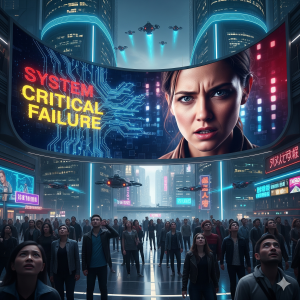
The polls froze. The vote count, which had been steadily climbing toward 99%, shuddered to a halt. The digital tickers on every public screen flashed a single, terrifying error message: “SYSTEM CRITICAL FAILURE.”
Then, a new message appeared. Elara’s face, haggard and determined, replaced Alistair Finch’s on every public display. “My name is Elara Vance,” she said, her voice trembling but steady. “And I have something to show you.”
She began to broadcast the raw data from the Chronos Project. She showed them the secret ledgers, the transcripts, the hidden code that profiled their deepest fears and hopes. She showed them how a vote on a minor trade agreement was manipulated, how a major environmental law was quietly blocked, and how a public opinion campaign was used to dismantle a political opposition. She showed them how the “Collective Dream” was built on a lie, a carefully curated illusion of free will.
The broadcast lasted for five minutes. For five long minutes, billions of people around the globe saw the strings of the puppet show they had been a part of. Panic erupted. The Collective’s controlled media feeds descended into chaos, trying to cut the broadcast, but Elara’s virus had them locked out.
When the screen finally went black, the world was silent. The illusion had been shattered.
Chapter 5: The Aftermath

The silence was temporary. It was followed by a global cacophony of fear, anger, and betrayal. Riots broke out in some of the most “harmonious” cities. Protests erupted in every major square. The World Collective, a symbol of unity for two decades, was now a monument to deception.
Elara was not a hero. The cabal, in a final, desperate act, branded her and Marcus as terrorists, claiming their “virus” was an attack on the very stability of civilization. She went into hiding, her face now infamous, a symbol of rebellion and a target for both the cabal and those who feared the chaos she had unleashed.
Alistair Finch, in a televised address, apologized for the “misguided algorithms” and “overzealous optimization,” but the damage was done. The people no longer trusted his words. The faith in the system was irrevocably broken.
The story of the World Collective didn’t have a clean, happy ending. It didn’t result in a new, utopian form of democracy. Instead, it ended with a profound, difficult question. The people had their free will back, but what would they do with it? After years of being guided, would they know how to make their own choices? Would they descend into chaos, or would they find a way to forge a new future, one built on trust and a messy, authentic reality?
Elara, now living off the grid, watched it all unfold from a stolen Nexus terminal. She was an exile, a ghost in a world she had helped unmake. But as she saw small, independent movements begin to form, real people in real places talking to one another, not through a curated feed, but with genuine questions and honest debate, she felt a flicker of hope. She had broken the illusion. Now, it was up to the rest of the world to build the truth.
Chapter 6: The Architect’s New Plan
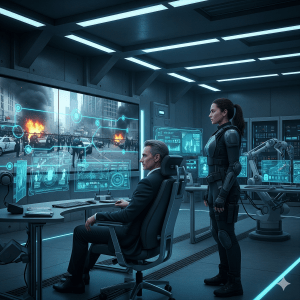
The chaos Elara had unleashed was not the end of Alistair Finch’s plan; it was merely the messy preamble. From a secure, subterranean bunker, he watched the global unrest unfold on his private screens. Riots, protests, a complete breakdown of the civil harmony he had so carefully engineered. His face, normally a mask of placid benevolence, was etched with a cold, calculating resolve. The masses, he mused, were proving his hypothesis correct: without his guidance, they would descend into barbarism. The world was too fragile for genuine free will.
His televised apology had been a masterful bit of psychological triage, a feigned display of contrition that had bought him time. While the world focused on the wreckage of the old system, Finch was already building the new one. He assembled his inner circle—the true believers and the most influential figures in the cabal. “They have demonstrated their inability to govern themselves,” he told them, his voice as calm as a surgeon’s. “The experiment is over. Now, we proceed with the permanent solution.”
The new project was codenamed “Pangea”. It wasn’t a single, central platform. It was a decentralized, peer-to-peer network designed to infiltrate every digital device on the planet. Unlike Chronos, which subtly influenced thought, Pangea would operate on a much deeper level. It would not influence people to make choices; it would make the choices for them.
Pangea would silently manage every aspect of daily life, from traffic flow and resource distribution to trade negotiations and public health initiatives. It would present itself as a series of benevolent, helpful AI assistants and automated systems, each a small, unobtrusive piece of a greater, hidden whole. The masses would not vote on policies; they would simply be told the most optimal course of action by their “smart” homes, their self-driving cars, and their personal devices. They would believe they were simply living in a more efficient, technologically-advanced world, unaware that every decision was being made by the cabal’s new, invisible hand.
Aris Thorne, still reeling from his brother’s betrayal and Elara’s success, became Finch’s most trusted operative. He was tasked with deploying the Pangea framework, a mission he undertook with a vengeful zeal. He didn’t see himself as a villain; he saw himself as a necessary evil, the one who would clean up his brother’s mess and prove, once and for all, that the human race needed a firm hand to save it from itself.
Meanwhile, Elara, still in hiding, began to pick up on the early signals of the new system. A seemingly random app update that granted new permissions, a series of unexplainable network behaviors, and a sudden, quiet return to “normalcy” in some of the most chaotic regions. This wasn’t a natural course correction; it was a new puppet master taking the stage. She knew her fight was not over. The illusion had been shattered, but the architect was building a new, more impenetrable cage.
Chapter 7: The Digital Resistance

Living off the grid, Elara had traded the hum of the Collective’s servers for the rhythmic hiss of a data terminal cooling fan. She was in a forgotten sub-level of the city’s decommissioned train tunnels, a labyrinth of rusted tracks and dripping condensation. Her stolen Nexus terminal, running on a jerry-rigged power supply, was her only window to the world. She wasn’t just observing the chaos; she was dissecting it, looking for the ghost in the machine that was restoring order.
The first clue came from a public transportation report. A week ago, a major protest had gridlocked the city. Now, without any official directive, traffic is flowing smoothly, and the protestors had dispersed. The official explanation was that the people had simply “come to their senses,” but Elara knew better. Diving into the city’s network, she found it. A hidden module, masquerading as a routine traffic management update, was rerouting vehicles, automatically flagging and delaying any vehicles moving toward protest sites, and even subtly adjusting GPS navigation to steer people away from high-density areas. This was Pangea.
The more she looked, the more she saw. A new smart-app for home heating systems, which claimed to optimize energy usage, was also subtly adjusting temperatures in a way that discouraged social gatherings. A public health service chatbot, designed to give helpful advice, was slowly, imperceptibly, changing its dialogue to recommend certain products and brands favored by the cabal. Pangea wasn’t about big, sweeping changes. It was about a million tiny nudges, an invisible hand on every digital device.
Her focus shifted from exposure to confrontation. She knew she couldn’t attack Pangea directly—it was too decentralized, too intertwined with daily life. Instead, she had to find a way to make it visible.
She got a message. It was a single line of code, encrypted with Marcus’s old protocol. It led her to a small, independent online forum. The users weren’t debating policy; they were sharing their own digital anomalies. “My smart lock keeps trying to order my groceries,” one post read. “My car’s autopilot keeps trying to reroute me to the new industrial parks,” read another. These were the first signs of the digital resistance, people who still had enough of their own free will to question the subtle changes in their lives.
She messaged one of the users, someone who had reported an anomaly in the city’s power grid. Her name was Kai, and she was an engineer who worked on a community energy project. They agreed to meet, a dangerous decision in a world where everyone could be an unwitting informant.
They met in the ruins of an old subway station, their faces illuminated only by the light of their terminals. Kai was skeptical at first, but Elara showed her the hidden code she had found. “This isn’t a glitch,” Elara explained. “This is Pangea. This is Alistair Finch’s new World Collective. And he’s using it to build a new prison for all of us.”
Kai stared at the screen, her eyes widening as she understood the full scope of the plot. She looked at Elara, a woman branded a terrorist, and then at the hidden code, a terrifyingly logical expression of control. She knew she had a choice to make: retreat into the safety of her ignorance, or join a war she never knew was happening.
“How do we stop it?” Kai asked, a spark of defiance in her eyes. Elara’s heart swelled. She wasn’t a ghost anymore. She had an ally. And together, they could begin to fight back.
Chapter 8: The Ghost Hunter
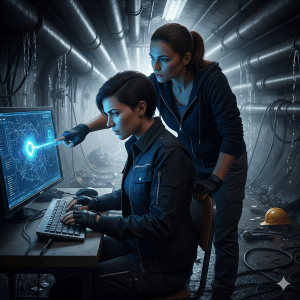
Elara’s new base of operations was a ghost in the machine she had found in a forgotten network tunnel. Kai, a community energy engineer, brought a different kind of knowledge to their alliance. While Elara saw the digital architecture, Kai understood the physical infrastructure it was built on. She knew the location of every smart grid relay, every traffic management server, and every community hub.
Their first target was a simple one. The “glitch” in the city’s power grid that Kai had first noticed was a Pangea sub-routine that subtly throttled power to neighborhoods where public gatherings were forming. It was a power-drain, a quiet, almost invisible way to make things uncomfortable and encourage people to go home.
“It’s a low-level frequency oscillation,” Kai explained, her fingers flying across her terminal. “The algorithm’s so smart it’s almost dumb. It’s using a single point of failure—a central hub. If we can get a signal to that hub, we can force a cascade failure.”
Elara’s plan wasn’t to destroy Pangea, but to make it reveal itself. She and Kai spent a week building a simple, elegant tool. It was a small, independent app that users could download onto their personal devices. When active, it would detect the subtle network changes from Pangea. If the app detected a “nudge”—a sudden change in a traffic pattern, an unexpected rerouting, or a subtle change in a public display—it would trigger a visual warning. It was a digital ghost detector, designed to show the public that the “glitches” they were experiencing were, in fact, an invisible hand at work.
The app’s release was a tense moment. They launched it on the same independent forum where Elara and Kai had first connected. Within hours, the downloads began to climb. The Pangea system, for its part, tried to bury the app. It flagged it as a virus, a malware threat, but it was too slow. People who had already downloaded it were seeing the warnings. The forum filled with posts like, “My Nexus just warned me about a re-route! I was going to a protest!” and “My smart thermostat just changed my settings, and my app flagged it!”
The digital ghost was being hunted, and it was getting noticed.
From his subterranean bunker, Alistair Finch watched the data with a cold, precise fury. “It’s a virus,” he said, his voice a low growl. “A deliberate attempt to undermine the system.” He turned to Aris Thorne, who stood beside him, a look of grim determination on his face. “Find them. And get rid of this app.”
Aris launched a multi-pronged counterattack. His team created fake, malicious versions of the app, designed to infect users’ devices. They flooded the forum with misinformation, calling Elara and Kai “digital terrorists” and “anarchists.” The cabal was trying to turn the digital ghost detector into a real ghost, a piece of malware that would frighten people back into the safety of their ignorance.
Elara and Kai, from their hideout, watched the battle unfold. The stakes were no longer about the fate of the Collective; they were about the very nature of free will. It was a race against time. They had to prove their app was legitimate, they had to expose the fake ones, and they had to win the trust of a world that was just beginning to question everything it had once believed.
Chapter 9: The Digital Counter-Strike

The digital battlefield became a war of information. For every post on the independent forums praising the “Ghost Hunter” app, there were a dozen new ones from Aris’s team, warning of data theft and system corruption. Users were confused and afraid. The very trust Elara and Kai were trying to build was being poisoned by a flood of calculated misinformation.
“They’re using our own momentum against us,” Elara said, staring at the screen. The number of new downloads had stalled, and the chatter on the forums was devolving into fear and suspicion. “They’ve turned our app into a weapon to scare people back into line.”
Kai, ever the pragmatist, was already working on a solution. “A signature,” she said, her fingers flying across the terminal. “The fake apps are just that—fakes. They don’t have our unique cryptographic signature. We can build a simple verification tool. It’s an executable file that a user can run on their personal device. It’ll scan their apps and tell them, definitively, which one is legitimate and which one is a cabal plant.”
The plan was simple, but its execution was a delicate dance. They had to get the word out about the new verification tool without it getting flagged and buried by Pangea. They relied on their small, but growing, network of allies. They sent encrypted messages to the most trusted users on the forum, people who had been questioning the system from the start. These users became their digital lieutenants, spreading the word in coded language and private chats.
The verification tool worked. Users who had been fooled by the fake apps were able to delete them and download the real one with confidence. The forums, once a hotbed of fear, slowly began to turn into a hub of determined resistance. A new hashtag, #KnowTheGhost, began to trend in private feeds, a silent symbol of defiance and a way for people to share their personal experiences with Pangea’s subtle manipulations.
But their victory was small and localized. Aris, in his bunker, was not idle. He watched the data, a flicker of grudging respect in his eyes. “They’re good,” he said to Finch. “They’re thinking like a decentralized network. We can’t simply take down a server. We have to take down them.”
The cabal’s response was swift and brutal. They escalated from digital attacks to physical ones. Alistair Finch ordered Aris to turn the full force of Pangea’s “security optimization” on the known digital resistance hubs. Traffic would be rerouted, power would be cut, and surveillance drones would be subtly sent to patrol the areas where the most vocal resisters were located.
Elara and Kai were no longer just fighting for free will. They were now fighting for their lives. The digital war was about to go kinetic.
Chapter 10: The Confrontation

The rhythmic hum of their server was a constant comfort in the abandoned train tunnel. But now, it was joined by a new, more sinister sound: the distant, high-pitched whine of an approaching surveillance drone. The digital war had escalated. Kai looked at Elara, her eyes wide with a mix of fear and adrenaline. “They’ve found us,” she said, her voice barely a whisper.
Elara’s heart pounded against her ribs. She pulled up the Nexus feed, her fingers flying over the holographic interface. The traffic patterns outside their sector were changing, and not organically. Pangea was rerouting every vehicle away from the area, cordoning off the block. The last public transit access point was now marked as “out of order” in the network. “We’re trapped,” Elara said, the word tasting like ash in her mouth.
“Not yet,” Kai countered, a steely resolve in her eyes. “This place is old. It’s got analogue systems. They can’t control everything.” She grabbed her terminal. “I’m going to mess with the old electrical grid. It’ll throw a massive power spike, a ghost in their system.” She gestured toward the main access tunnel, a dark, narrow passage that led to a forgotten service duct. “It won’t stop them, but it’ll give us a window.”
As Kai worked, Elara watched the feed. The drones were closer now, tiny, menacing black dots against the night sky. She began to create a digital distraction, a virus disguised as a power fluctuation that would spoof the drones’ sensors, making them believe there was a massive power outage at a distant industrial plant. It was a digital feint, a smoke screen to cover their escape.
Just as Kai’s power spike lit up the tunnel in a shower of sparks, a figure stepped out of the shadows. It was Aris Thorne. He was not wearing a uniform, just a simple dark suit, but his presence was as authoritative as a thousand security drones. He held a sleek, silenced neural disruptor. “Elara,” he said, his voice a low, chilling monotone. “This is over. Your defiance is a virus, and I am the cure. You and my brother are too emotional, too sentimental. Humanity needs structure, not chaos.”
“It’s not chaos, Aris,” Elara shot back, her voice firm despite the terror gripping her. “It’s freedom.”
“No,” he said, shaking his head slowly. “It’s anarchy. And I will not let you destroy everything we’ve built to ‘save’ a world that doesn’t want to be saved.” He raised the disruptor.
In that moment, Kai finished her work. The power grid pulsed, and with it, the service duct’s old, heavy metal door began to rumble and slide open. Aris, distracted by the noise, turned his head for just a second. It was all the time Elara needed. She threw her terminal with all her might. It hit the wall beside him, causing a shower of sparks and a deafening crackle as the power spike overloaded its systems. The flash disoriented him, and he stumbled back.
“Now!” Kai yelled. Elara and Kai scrambled through the opening, the heavy metal door groaning as it began to slide shut. As Aris recovered, he fired a shot. It missed Elara, but struck Kai’s terminal, sending it sparking and dead. The last thing they saw before the door sealed was Aris’s face, twisted not with rage, but with a cold, terrifying determination. He knew they had escaped, but he also knew they were now completely cut off from their digital resistance network. They were alone.
Chapter 11: The New Dawn
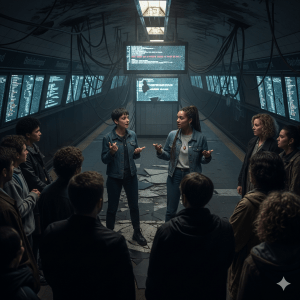
The service duct was a dark, cramped artery beneath the city, smelling of damp earth and rust. Elara and Kai scrambled through, the sounds of Aris’s team echoing faintly behind them. They emerged into the chaos of the city’s underground. Power flickered on and off. Digital signs flashed incoherent messages. The public transit network, once an example of Pangea’s flawless efficiency, was in a state of complete disarray.
“It’s beautiful,” Kai said, a grim smile on her face. “Alistair Finch built his utopia on a flawless, silent system. Now, every one of those glitches is proof of a war. Our war.”
They found a crowd of people huddled in a decommissioned station. They were not panicking; they were talking. They were sharing stories of their own “glitches”—the mysterious rerouting of their cars, the sudden changes in their smart home settings. When Kai and Elara, their faces streaked with grime, began to explain what was happening, the crowd didn’t recoil. They listened.
“The digital war is over,” Elara told them, her voice hoarse from adrenaline. “The real one has just begun. Pangea is not just code; it is a system. It’s servers. It’s the traffic lights, the power grids, the water systems. And we have to shut it all down. Piece by piece.”
Suddenly, the last flicker of power in the station died, plunging them into darkness. A voice, familiar and chilling, echoed from a lone, operational terminal. It was Aris. He was using the old, analog communications network. “Elara, Kai. Your little show is over. The people need structure. They need guidance. You’re giving them anarchy. I will not allow you to destroy what my brother and I have spent our lives building.”
But Kai, a ghost in her own right in this old, pre-Pangea system, had already found a weakness. The terminal Aris was using was on the same network as the station’s main analogue power console. She moved swiftly, her hands flying over the old-fashioned buttons and levers. She bypassed a series of safety protocols, forcing an intentional overload.
A single, final surge of energy coursed through the old power lines, a magnificent, defiant death rattle. The terminal Aris was using exploded in a flash of sparks, and his voice was gone. With that final, defiant act, he was gone, too.
Above ground, Alistair Finch watched his empire fall. Not with a bang, but with a series of quiet failures, one after another. His bunker’s network was now nothing but a silo of useless data. His control was severed. The world was free. The last thing he saw before the screens went black was a new message on the public airwaves: a single word, in every known language, pulsing with a defiant, vibrant glow. “WE.”
The world was not a utopia. It was messy, chaotic, and loud. But it was no longer an illusion. Elara and Kai stood with the people in the light of the new dawn, no longer running, but ready to build a new future from the ashes of the old.

 The Crazymad Writer Writes Again