The Moonlight Key and the Sky-Bottomed Square
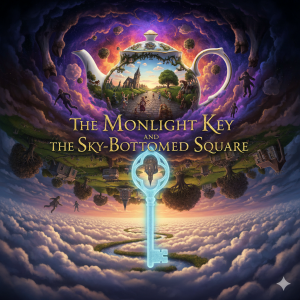
The Moonlight Key and the Sky-Bottomed Square
Chapter One: The Fumble
Liam didn’t believe in the “soft spots” of County Carlow. He was a man of spreadsheets and stone walls, a man who believed a field was for cattle and a lake was for fish. But there he was, three miles outside Ballykillduff, standing on a shelf of ancient granite where the air smelled like ozone and wet wool.
He had come to the limestone basin to find a stray calf, but instead, he found the Un-Lake.
It shouldn’t have been there. On every map Liam had ever seen, this was a dry, grassy dip. But to Liam’s eyes, it was a pool of liquid midnight, reflecting a version of the Blackstairs Mountains that was far too purple to be natural. He pulled his phone out to take a photo—proof for the lads at the pub—when his fingers slipped. His car keys and his phone tumbled toward the water.
Liam winced, bracing for the expensive ruin of his afternoon. Instead, a sound like a tuning fork struck against an anvil rang out across the valley. CLANG.
The keys didn’t sink. They bounced. They skidded across the surface of the water as if the lake were made of polished obsidian. Where they landed, a ripple spread—not in the water, but in the sky reflected within it. In the reflection, a flock of birds scattered; in the real sky above Liam, not a single wing moved.
He knelt at the edge. His hand hit something cold, vibrating, and dry. It felt like touching the side of a humming refrigerator. As he scooped up his keys, his fingers snagged on something caught in the ring—a second key he didn’t recognize. It was long, slender, and forged from frosted glass. It didn’t reflect the dull grey of the afternoon; it glowed with a soft, pale light.
He pulled his hand back, and the “water” snapped shut behind him with the sound of a closing book. He pressed the “unlock” button on his car fob. The car didn’t beep. It sighed. The indicators didn’t flash orange; they bloomed a deep, impossible violet.
Chapter Two: The Pint That Talked Back
As Liam drove toward town, the world began to unspool. He reached the outskirts of Ballykillduff, but his tires stopped touching the tarmac. He wasn’t flying; the road simply decided it would rather be six inches lower than the car.
He scrambled into O’Malley’s Pub, but the door expanded to swallow him. Inside, the world was “Sky-Bottomed.” The sawdust was swirling on the ceiling, and the heavy mahogany bar was floating three feet off the ground.
“Liam, ya sound idiot,” a voice gurgled. “Close the door, you’re letting the gravity out.”
Standing where Mr. O’Malley usually stood was a man-shaped volume of dark, frothy liquid. He was translucent, a deep ruby-black with a thick head of white foam where his hair should be.
“Mr. O’Malley?” Liam whispered.
“In a manner of speaking,” the Liquid Publican said. “I’m the O’Malley you expected to see. You’ve turned Ballykillduff into a Manifestocracy. You’re the Architect now. The Un-Lake is a vacuum, boyo. It’s sucking the ‘Boring’ out of Carlow and spitting the ‘Impossible’ back at us. If you don’t get to the Core and lock the leak, by sunset, Ballykillduff will just be a very loud, very confusing poem about your childhood.”
O’Malley pointed toward the town square. “It’s in the Floating Teapot. But watch out for the Yesterday-Men. They like being made of music and light. They don’t want to go back.”
Chapter Three: The Choir and the Key
Liam left the pub and was immediately intercepted. The air flickered like a film reel snagging in a projector. Standing on a piece of upturned limestone was a man in sepia tone. It was his grandfather, Seamus, looking exactly as he had in a 1974 Polaroid.
“Stay here, lad,” the Yesterday-Man whispered in a voice like a crackling vinyl record. “We’ll build a house out of old songs.”
Liam’s vision began to turn sepia. He felt the urge to sit down and forget the future. To break the spell, Liam did something entirely new. He used the Moonlight Key to “unlock” his own shadow. His shadow stood up, turned neon pink, and began a frantic breakdance. The Yesterday-Man, unable to process a “Future-Event,” glitched and dissolved into a pile of unexposed camera film.
But as he reached the square, he met the Choir of the Past. Hundreds of Echos stood in circles, singing a wall of “Un-Sound”—the vibration of every secret ever kept in town. The sound waves became visible as Golden Ribbons, wrapping around houses and pinning Liam in place.
Liam lifted the frosted-glass key to his lips and blew. It emitted a bright, neon-yellow noise—the sound of a dial-up modem and a child’s laughter. It was the sound of “What If.” The golden ribbons frayed. The medieval monks in the choir flickered like bad lightbulbs. The path was clear.
Chapter Four: The Architecture of Mercy
Liam climbed a staircase made of his own shadow into the Giant Floating Teapot that hovered over the square. Inside was a miniature galaxy, and at its heart, a single spinning drop of water from the Un-Lake.
Guarding it was Liam’s own Reflection, wearing a suit made of stars.
“Don’t lock it,” the Reflection said. “Stay here, and we can make the world a masterpiece.”
Liam looked down through the violet steam at his home. He saw the toddlers in oversized suits and the church bobbing in the wind. It was beautiful, but it was lonely. You couldn’t love a world that changed every time you had a stray thought.
“I like the rain,” Liam whispered.
He plunged the Moonlight Key into the spinning drop and turned it three times to the left. The teapot began to whistle—a high, piercing scream that sucked the violet steam, the sepia men, and the “Sky-Bottom” back into the key. With a sound like a rubber band breaking, the world turned black.
Epilogue
Liam woke up face-down on a patch of Carlow Granite.
The air smelled like damp grass. The sky was a stubborn, familiar gray. He walked back to his car. It was sitting on the tarmac. It didn’t sigh; it just made a tired clunk when he unlocked it.
He drove back into Ballykillduff. The pub was made of stone. Mr. O’Malley was made of flesh and bone, complaining about the price of electricity. Everything was exactly as it seemed.
Except… when Liam looked into the rearview mirror, his reflection winks at him. And in the cup holder of his car, there sits a single, tiny porcelain chip from a teapot that never existed. The “Out-There” wasn’t gone. It was just holding its breath, three miles down the road, waiting for someone to lose their keys.
Liam didn’t put the porcelain chip in a drawer, and he certainly didn’t throw it away. Instead, he did the most “Ballykillduff” thing possible: he treated it like a seed.
The Final Grain of Salt
A week after the sky had returned to its proper place, Liam walked out to his back garden. It was a sensible garden—neat rows of potatoes, a stubborn patch of kale, and a stone wall that marked the boundary of his world.
He dug a small hole near the base of an old, gnarled hawthorn tree. He dropped the porcelain chip into the dark Carlow earth.
“Just in case,” he whispered. “In case the world gets too heavy again.”
He didn’t water it with a watering can. Instead, he leaned down and whispered a secret into the soil—a small, inconsequential secret about a girl he’d liked in primary school. The earth seemed to shiver, just for a second.
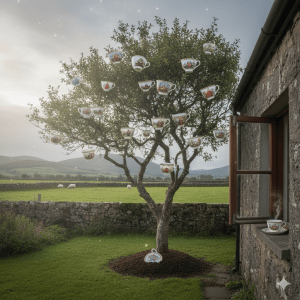
The next morning, Liam looked out his kitchen window while his tea was steeping. The hawthorn tree was still there, but it looked different. It wasn’t growing leaves. From its branches hung dozens of tiny, delicate porcelain tea cups, each one painted with a different scene of a life he might have lived.
One cup showed Liam as a famous deep-sea diver; another showed him as a king in a land made of clockwork. When the wind blew, the cups didn’t rustle like leaves. They clinked together, making the faint, silver sound of a tea party happening just out of reach.
Liam smiled, took a sip of his perfectly ordinary, boring tea, and went to work. He still had spreadsheets to finish and taxes to worry about, but now, every time the wind picked up, he could hear the music of the “Out-There” singing to him from the garden.
It was just enough whimsy to keep a man sane.
 The Crazymad Writer Writes Again