The Unsettled Hour
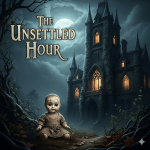
The autumn wind, sharp as a whetted knife, swept through the cobbled streets of London, tugging at the gaslights that flickered like nervous eyes. A pale, three-quarter moon hung in the sooty sky, casting long, skeletal shadows. It was the eve of All Hallows’, a night when the veil between worlds grew thin, and young Miss Eleanor Finch, a woman of unyielding logic, found herself in a carriage bound for her great-aunt’s home.
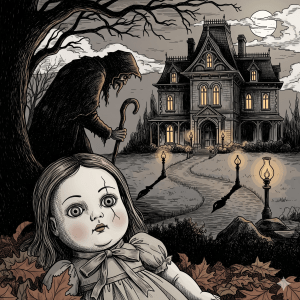
The Porcelain Pact (A Ballad of Logic and Loss)
Eleanor was a modern woman, an avid reader of scientific journals, and she scoffed at the superstitious tales whispered in hushed tones about this night. Still, as her carriage rattled through a particularly desolate part of town, she couldn’t shake the shiver that traced a line down her spine. The driver, a hunched man with a face obscured by shadow, had not spoken a single word since she had departed. She had only caught a glimpse of his gloved hand on the reins; they were as white as old bones.
The carriage lurched to a halt before a grand, ivy-choked townhouse. Eleanor paid the driver, who merely grunted, and hurried up the stone steps. The heavy oak door was ajar, and a cold draft pulled at her cloak. Stepping inside, she found the foyer empty, save for a single, flickering candle on a small table. A note lay beside it, scrawled in her aunt’s shaky hand: “Eleanor, my dear. I am feeling a touch of the vapors and have retired early. Make yourself at home.”
Eleanor sighed. She had hoped for a warm welcome and a cup of tea. She ascended the grand staircase, its wood groaning under her weight. The house was unnervingly silent, the kind of silence that seemed to hum with unseen life. On the landing, she noticed a collection of her aunt’s peculiar curiosities—a stuffed raven with glinting glass eyes, a dusty hourglass, and a small, porcelain doll. The doll, in a faded lace dress, was seated on a velvet cushion. Its face, painted with rosy cheeks and wide blue eyes, seemed to follow her as she passed.
Eleanor dismissed the feeling as a trick of the light and continued toward her room at the end of the hall. She was just reaching for the doorknob when a soft, melodic sound drifted from the landing. It was a music box. She turned, her heart giving a little lurch, and saw the small, porcelain doll. It was no longer seated on the cushion. Now it was at the edge of the table, its little hands outstretched as if reaching for the music box. The music box itself was still.
A chill crept up Eleanor’s neck. This was not a scientific phenomenon. This was… impossible. She took a step back, her hand flying to her mouth, as a second sound echoed through the silent house. It was a high-pitched, child-like giggle, thin and hollow, coming from the shadows at the bottom of the staircase.
Eleanor froze, every muscle tense. The giggle came again, closer this time, and a sliver of white appeared in the darkness. It was the driver’s gloved hand, beckoning. Eleanor’s breath hitched. She hadn’t imagined it. The driver’s hands were as white as old bones. And in that terrifying moment, she realized why. The driver was a puppet, and his puppet master was a child, or at least something pretending to be one.
She slammed her door shut and locked it, her heart thumping against her ribs like a trapped bird. Outside, the music box began to play a lullaby, the notes tinny and discordant. The small, porcelain doll appeared to be dancing on the other side of the door, its porcelain feet tapping out a rhythm. The giggling continued, and for the rest of the night, Eleanor Finch, a woman of unyielding logic, listened to a song and a dance that had no earthly explanation. And she knew, with a certainty that transcended all her scientific knowledge, that she was not alone in the house.
The Unsettled Hour, Part II: The Dollhouse
The first light of dawn did little to comfort Eleanor Finch. It bled through the curtains in her room, a weak, watery gray that did not chase away the shadows, but merely gave them shape. The music box had fallen silent hours ago, and the frantic tapping had ceased. Exhausted, Eleanor had finally drifted into a fitful sleep, her dreams a kaleidoscope of grinning porcelain and grasping, skeletal hands.
Now, with the sun finally rising, a new sound cut through the silence. A soft, rhythmic clicking, as of something being meticulously assembled, came from the floor below. Eleanor crept to her door, her ear pressed to the cold wood. It was coming from the foyer, from the very spot where she had seen the spectral carriage driver. It was a precise, methodical sound, nothing like the wild, chaotic tapping from the night before.
Swallowing her fear, Eleanor unlocked the door and stepped out onto the landing. The air was frigid, carrying the faint, sweet scent of old potpourri and something else… something like dust and forgotten things. She peered over the banister, her heart a drum against her ribs.
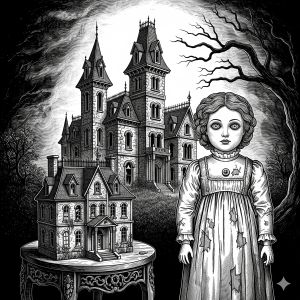
In the center of the foyer, under the morning light that streamed through the stained-glass window above the door, was a dollhouse. It was an exquisite, perfect replica of the very house they were in, down to the tiny, ivy-choked exterior and the miniature gaslights lining the walkway. And on the front porch of the dollhouse, standing perfectly still, was the miniature porcelain doll.
But it was not alone. Inside the tiny house, Eleanor could see a new figure. It was a doll of a woman, a replica of herself, wearing a miniature version of her own nightgown. The doll-Eleanor was standing in the miniature version of her bedroom, her tiny porcelain hands raised in a permanent gesture of terror.
The Unsettled Hour, Part III: The Pact
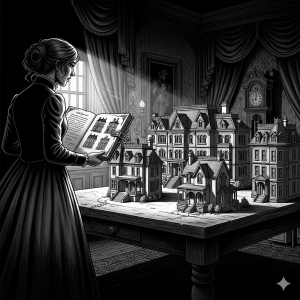
Eleanor’s blood ran cold. The miniature dollhouse on the table was more than a toy; it was a cage. And her tiny, porcelain likeness was not merely a symbol of her fate, but a piece of a macabre collection. She turned her attention to the rest of the foyer, her eyes adjusting to the wan morning light.
Arranged on a dark mahogany credenza were other dollhouses, each a perfect replica of a different Victorian home. And in each, Eleanor saw miniature dolls of her family members: a cousin in a tiny country cottage, an uncle in a grand city house, even her own parents in a miniature version of their home in Brighton. A horrible, sickening truth began to dawn on her. The sickness that had kept her aunt in her room was not “the vapors” at all. It was a symptom of a dark bargain. Her great-aunt had used the dollhouses to keep her family close… forever.
Eleanor’s gaze fell on a small, worn book lying on the credenza, next to a dollhouse that was a mirror image of the Finch family cottage. Its pages were brittle, filled with her great-aunt’s spidery, faded script. It was a ledger, a chilling record of the names and dates of those who had vanished from her family over the decades. The entries were chillingly brief: “Henry, the artist, 1867. A new wing for the house.” “Cousin Amelia, the seamstress, 1878. Perpetual youth.” Her aunt had made a deal with some entity, exchanging the freedom of her family members for her own personal gain.
A final, scrawled note, a recent addition, caught her eye. “My dearest Eleanor. It must be done. A beautiful, grand legacy for my favorite niece.” The note was not an apology, but a morbid celebration.
Eleanor looked from the book to the dollhouse of her own family home. She saw a miniature version of her brother, a small doll version of his dog by his side, both frozen in their tiny front yard. Her heart pounded in her chest. Her aunt wasn’t just trapping her; she was trapping everyone she loved.
The realization brought with it a horrifying choice. Eleanor could flee, leaving her family to their fate, and hope the pact didn’t follow her. Or, she could confront the source of the curse, knowing that to break the pact would likely require a terrible sacrifice of her own. The clicking sound began again, closer this time, and Eleanor looked up to see a shadowy figure emerge from the top of the grand staircase, its head tilted in silent, amused observation. The game had just begun.
The Unsettled Hour, Part IV: The Sacrifice

Eleanor’s hand trembled as she traced the lines of her own name in the ledger. It was a new entry, its ink still a deep, rich black against the yellowed paper. Her aunt had written, “For the Finch legacy. A beautiful, grand future.” A deal with an unknown entity, a pact sealed in the cold halls of the very house she now stood in.
The clicking sound grew louder, and Eleanor finally looked up to see her great-aunt descending the grand staircase. The old woman moved with a chilling grace, no sign of the “vapors” she had claimed. A faint, knowing smile played on her thin lips.
“It is a lovely collection, isn’t it, my dear?” her aunt said, her voice a dry whisper. “A legacy I have built for you. All the power and wealth of our family, contained right here. All you have to do is… accept it.”
Eleanor’s mind reeled. Her aunt wasn’t just a victim of a curse; she was its keeper, its willing servant. She had offered up her own family, piece by piece, to an unseen force in exchange for a life of luxury and power. And now, she was offering it all to Eleanor.
“But the cost,” Eleanor stammered, her gaze fixed on the miniature replica of her brother’s dog, a perfect, tiny figurine on a tiny lawn.
“A small price, darling,” her aunt replied, her voice filled with a chilling lack of empathy. “A mere trade. Their freedom for our destiny. All you must do is write the name of another, someone you do not need, someone you can afford to lose. The pact requires a new soul to be bound.”
Eleanor understood. Her aunt wasn’t just a monster; she was a temptress, offering her a way out of the trap, but at a horrifying price. She looked from the ledger to the collection of dollhouses, each a silent prison. Her family was there, waiting, forever frozen in time. And the shadowy figure of her aunt’s “chauffeur” stood in the corner, a silent witness to the terrible bargain being offered. The dollhouse of her own home was empty, its front door ajar, waiting for her to make her choice.
What will Eleanor do?
The Unsettled Hour, Part V: The Empty Page
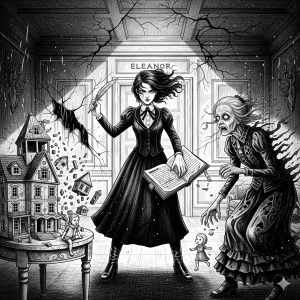
Eleanor looked from the sinister ledger to the collection of silent, miniature prisons. Her great-aunt’s voice, now a venomous hiss, broke the silence. “The choice is yours, my dear. Write a name, any name, and you are free. The house, the fortune, the power—it all becomes yours. Your family will remain, safe and still, and you will never have to lose them again. A small price, for such a grand life.”
The old woman’s eyes glinted with a feverish madness. Eleanor knew what she had to do. This was not a bargain to be made, but a sickness to be purged. She would not trade one soul for her own. But how could she break a pact she didn’t fully understand?
Her eyes fell upon the ledger. The last entry, her own name, was a fresh wound on the page. She knew her great-aunt’s power was tied to this book, to the very act of writing. If the curse was a ledger of names, perhaps the key was an empty page.
With a defiant resolve that steeled her racing heart, Eleanor snatched a quill from the inkwell on the table. She looked at her great-aunt, whose triumphant smile began to waver. She then looked at her tiny, porcelain likeness in the dollhouse, and the miniature figures of her family trapped inside their own little homes.
She would not play her aunt’s game. She would not write a name. Instead, she turned a fresh page in the ledger. With a deliberate stroke of the quill, she did the only thing she could think to do: she drew a single, clean line straight through the names of her entire family, from her parents to her brother, a black line striking out the pact’s power.
A terrifying shriek erupted from her great-aunt, a sound more animal than human. The house began to tremble, and the dollhouses on the table shook violently. The miniature doors flew open, and from the grandest of them all, a single, tiny figure—the porcelain doll—stumbled out, its blank eyes staring up at Eleanor.
The shadowy chauffeur in the corner vanished with a whisper of dust, and the grand staircase began to rot and crumble before her very eyes. Her great-aunt’s body, with a final, gasping cry, began to shrivel and decay, the skin pulling tight over her bones like a dying leaf. The pact was unraveling, but Eleanor was not certain she had truly won. For as the mansion around her began to fall apart, a new, cold air filled the room. The doll was walking. It was no longer a symbol of her fate, but something else entirely.
The Unsettled Hour, Part VI: The Last Curtain Call
The house groaned, a deep, mournful sound as if it were a dying beast. Plaster rained from the ceiling, and the grand chandelier above Eleanor swung precariously. But her focus was on the porcelain doll. It had tumbled from the table, a tiny, fragile thing, and was now standing on the decaying carpet. A low, static hum emanated from it, and Eleanor watched, horrified, as it began to grow. The lace on its dress thickened, the cracks on its face deepened, and its wide blue eyes seemed to fill with an ancient, malevolent light. It was no longer a doll; it was a vessel, an un-bound entity, the true master of the pact.
Eleanor backed away, her mind racing. Her great-aunt’s pact had been based on containment. The souls of her family were bound to the dollhouses. She had shattered that bond, but in doing so, she had released the ultimate force that had orchestrated the bargain. This was not about writing names anymore; this was about destroying the force itself, the essence of the curse.
The doll, now the size of a small child, took a slow, deliberate step towards her, its porcelain joints clicking with a sound like breaking bones. The air around it grew cold, and the eerie silence was replaced by a whispering chorus of lost voices. Eleanor realized the doll was not just the master of the pact, but a prison itself, a place where all the trapped souls were now screaming to be freed.
Suddenly, her scientific mind took over. The house, which had been a symbol of containment, was now a source of entropy. It was crumbling, a force of decay. She saw a weak point: the central staircase, already rotting from the curse’s unraveling. Eleanor ran, not from the doll, but towards the dying grand fireplace at the far end of the foyer, grabbing an old, heavy poker on the way. The doll, with a chilling, echoing giggle, followed her, its tiny porcelain hands reaching for her.
She didn’t try to fight it. Instead, she swung the poker at the grand, crumbling hearth. It was the heart of the home, a symbol of warmth and life, now corrupted. She struck it once, twice, with all her might. The stones shuddered, and a cascade of bricks fell from the chimney, blocking the entrance to the foyer. With a final, desperate heave, she plunged the poker into the last glowing embers in the hearth, sending up a shower of sparks that caught the dry wood of the old mantelpiece.
The doll stopped, its painted eyes fixed on the fire. It shrieked, a sound of pure agony, as the flames began to climb the wall behind it. The chorus of voices grew deafening, then, all at once, they fell silent. The fire spread, and the doll, now a terrifying inferno of porcelain and lace, did not move.
Eleanor did not stay to watch. She ran, her lungs burning, through the back of the house, dodging falling debris. She burst out into the cold night air as the first parts of the grand mansion began to collapse behind her with a sickening roar. She never looked back. Eleanor Finch, the woman of logic and science, had faced the impossible and won. But as she walked into the darkness, a single, lonely shiver remained—the cold reminder that the veil between worlds had never truly closed.
 The Crazymad Writer Writes Again