Voices in the Static: A Short, Scary Story
“Voices in the Static”
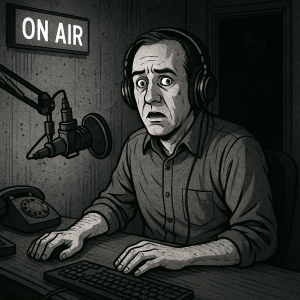
I’ve worked the night shift at a small-town radio station for years.
It’s lonely work — from midnight to 6 a.m., I’m the only person in the building. Just me, the dusty old soundboard, and a stack of “classic hits” CDs that smell faintly of mould.
The station’s audience at that hour is tiny. Truckers on the highway. Insomniacs. A few elderly folks who keep the radio on because silence makes their houses feel too empty.
The routine was the same every night — announce the song, play the track, read the weather, repeat. Until about a month ago.
That’s when I started getting… calls.
The first one came at 2:13 a.m.
The voice was faint, barely audible under static. I thought it was interference at first. Then I made out the words:
“Stop playing that song. He’s in my house.”
Before I could respond, the line went dead.
I figured it was a prank — we used to get them from bored teens. But then it happened again. Different night, different voice.
“Please help me. He’s in the room.”
After that, the calls kept coming. Always late at night, always faint, always begging for help. Some were men, some women. One night, I swear I heard a child whisper:
“Don’t let him find me.”
I tried tracing the calls. Our system is ancient, but I convinced a friend at the phone company to help. That’s when it got stranger.
None of the calls were coming from active numbers.
Some were disconnected years ago.
One belonged to a house that burned down in the 1980s, killing a family of four.
By the third week, I started keeping the radio’s microphone live during the calls, so listeners could hear. A few called in afterward, freaked out, swearing they’d heard footsteps in the background. One trucker said he heard heavy breathing — right before a scream that cut off suddenly.
Last night, the call came earlier — just after midnight.
It was the same static, the same faraway voice.
But this time, it spoke my name.
“Don’t turn around.”
I froze.
The line went dead.
And then I heard it — breathing — directly behind me.
 The Crazymad Writer Writes Again