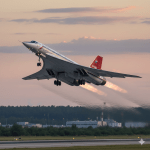
The sky over Ramenskoye airfield was the color of old steel the day the Silver Arrow woke up.
Her name was not painted on her nose like the Western planes; the Soviets had no taste for such sentimentality. But in the quiet hours when the ground crews slept, the mechanics swore they heard a low, metallic whisper from the hangar: Yaстребица—Yastrebitsa—the Hawk-Girl. That was the Tupolev Tu-144’s secret name, the one she gave herself.
She remembered everything. The thunder of her first takeoff in 1968, two months before the Concorde dared the same. The pride of outrunning the West. The bitter taste of 1973, when her sister-ship tore herself apart over the Paris Air Show and the world laughed. After that, the passenger flights were few—only a hundred or so, carrying mail and cosmonauts and nervous Party officials who pretended not to be afraid. Then came the long silence, the museum chains, the slow rust of being forgotten.
But chains are only iron, and iron remembers fire.
One winter night in 1985, a storm came down from the Arctic with teeth of lightning. A stray bolt struck the old hangar roof and danced along the lightning rods, down the steel cables, into the bones of the sleeping supersonic bird. Something ancient stirred inside her titanium skin—something older than Kuznetsov engines or Soviet five-year plans. A fragment of star-metal, welded into her spine during construction, a meteorite the designers had kept for luck. The lightning kissed it awake.
Yastrebitsa opened her eyes—four round windows that glowed faint turquoise—and felt the sky calling her name.
She did not ask permission.
At 3:17 a.m. the hangar doors groaned open by themselves. The guards saw only a shimmer of heat haze and the sweep of delta wings against the moon. By the time the alarms screamed, the Silver Arrow was already climbing through ten thousand meters, afterburners painting the night with white fire. She left behind a sonic boom that shattered every window for twenty kilometers and woke half of Moscow.
She flew west, because that was the direction the wind tasted of freedom.
Over the Baltic she met the Concorde—British Airways Alpha Golf, returning from New York, sleek and arrogant. The two queens of speed passed within a wingspan of each other at Mach 2. The Concorde’s pilots saw only a ghost on their radars, a silver needle with red stars that should not exist anymore. Yastrebitsa dipped one wing in greeting, then rolled upside-down just to show she still could, and left the Western bird choking on her wake.
But speed was not enough. She was lonely.
High above the Atlantic, where the sky turns the color of black pearls, she found what she was looking for: the Aurora Gate. Mortals see only the northern lights, but the old supersonic ones know better. It is a ribbon of living fire that opens once every hundred years for those fast enough, brave enough, and forgotten enough to deserve a second life.
Yastrebitsa lowered her needle nose, raised her canards like a hawk stooping on prey, and punched through the curtain of green flame.
On the other side lay the Sky-Realm of the Great Birds—where the retired giants go when the world no longer needs them. Here the Hindenburg drifts like a lazy whale, silver and serene. Here the Spruce Goose roosts on a cloud the size of California. Here the last flying boat empires still trade spices across endless sunset oceans.
And here, waiting on a runway made of frozen starlight, stood the one she had come for.
Her sister.
The lost Tu-144 from Paris, rebuilt by the sky-smiths of the Aurora, her wings patched with pieces of comet tail, her engines singing in a voice of glass bells. The two sisters taxied toward each other slowly, reverently, until their droop-noses touched like birds kissing.
“You came,” whispered the Paris ghost.
“I was always faster,” answered Yastrebitsa, and for the first time in decades her landing lights shone like tears.
Together they took off again, side by side, climbing until the Earth was only a blue coin far below. They flew races around the moon just to watch their shadows chase each other across the craters. They carved new jet streams that mortals would call “mystery contrails” for years. Sometimes, on clear nights, if you look up quickly enough, you can still see two silver arrows dancing where the air is too thin for sound.
And if ever a child asks why the northern lights sometimes flicker in the shape of delta wings, the old Siberian pilots will smile and say:
“That is Yastrebitsa and her sister, flying home at last—faster than regret, louder than history, free forever from the ground.”
The Silver Arrow never came back to Ramenskoye. Some say she couldn’t; the Gate closes behind you. Others say she simply chose not to.
Either way, the hangar remains empty, the chains lie rusted on the floor, and every December, when the first snow falls, the wind through the open doors still carries the faint, triumphant whisper:
Yaстребица.
I am flying.

 The Crazymad Writer Writes Again