The King of Blunderland’s Adventure
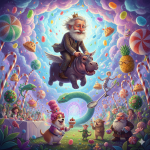
One crisp autumn morning in 2025, in a kingdom not so far from ours, King Theodore III, a monarch known for his meticulously organic gardens and his penchant for philosophical discourse with his prize-winning marrows, was deep in conversation with a particularly flourishing pumpkin at Highgrove House. “You see, my dear Gourdon,” he mused, adjusting his spectacles, “the key to a thriving kingdom, much like a thriving compost heap, is balance, biodiversity, and a healthy dose of microbial activity.” He was midway through explaining the virtues of wormeries when the ground beneath him gave a seismic shudder.
From behind a row of ancient yew hedges, a mischievous baby hippopotamus—a creature of improbable origin, having escaped from a traveling menagerie and developed an inexplicable fondness for the royal compost—burst forth like a living, snorting cannonball. Before Theodore could utter his signature exclamation of “Heavens to Betsy!”, the hippo, whom the King would later affectionately name Sir Reginald Waddlewick, scooped him up with its broad snout. Sir Reginald, with a mischievous glint in his eye, charged directly towards a shimmering, iridescent rabbit hole that had materialized amidst the King’s prize-winning dahlias.
“Unhand me, you amphibious rogue!” the King bellowed, his voice muffled by the hippo’s leathery hide. But it was too late. With an impressive, if undignified, leap, Sir Reginald plunged into the swirling vortex, carrying His Majesty, crown askew and ceremonial trowel flailing like a conductor’s baton, down, down, down into a kaleidoscopic maelstrom of colors and disorienting sensations.
They didn’t land in a burrow, but rather splash-landed in a vast, upside-down river where the water flowed upwards into crystalline clouds and schools of iridescent fish soared through the air like exotic birds. This was Blunderland, a topsy-turvy realm where the very fabric of reality was woven with threads of delightful absurdity. Theodore, thoroughly drenched and utterly disheveled, clung to Sir Reginald’s back as the hippo paddled with surprising grace against the gravity-defying current. “By my royal beard,” he gasped, “where in the name of all that is logical are we?”
Their first encounter was with a flotilla of floating teapots that bobbed along the riverbank, each spouting not steam, but perfectly formed riddles in a chorus of steamy whispers. “Why is a monarch like a perpetually brewing pot?” one hissed. “Because he’s always simmering with ideas, but sometimes boils over!” Before Theodore could formulate a response, a new character emerged from the river’s misty banks: the Quizzical Quibbler, a lanky figure in a suit of mismatched socks, whose every pronouncement was a paradox. “Welcome, oh waterlogged sovereign, to this realm of rhyme and reason’s ruin! To traverse this curious current, you’ll need a spoon that can sing a tune!”
With a flourish, the Quibbler presented Theodore with a spoon that, when tapped, emitted a surprisingly melodious hum, allowing them to glide effortlessly across the current. But as the King found his balance, Sir Reginald let out a mighty, bubble-filled sneeze, propelling them into a forest of candy cane trees where the leaves tasted of peppermint, but had the disconcerting effect of turning one’s tongue invisible. Here, they met the Grumbling Gardener, a gnome of formidable girth, whose beard was a tangle of living, sentient vines that whispered ancient secrets. “Plants don’t talk back in your world, eh?” the Gardener grumbled, meticulously pruning a topiary bush that shaped itself into the King’s bewildered likeness. “Mine do—and they’re currently plotting a rather elaborate coup against the local squirrel population using enchanted acorns.”
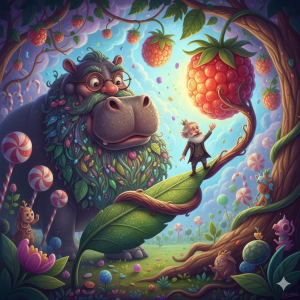
Theodore, ever the diplomat and passionate horticulturalist, attempted to mediate. “Perhaps a spot of ecological negotiation? A treaty of nuts and berries?” But the vines, pulsating with mischievous energy, coiled around him, glowing brightly, and with a pop, he shrank to the size of a thimble. Sir Reginald, now a colossal beast in comparison, gazed down with wide, concerned eyes. “This simply won’t do!” Theodore squeaked, his voice barely audible. The Grumbling Gardener chuckled, his belly jiggling like a bowl of enchanted jelly. “Fear not, Your Pint-sized Majesty! Consume this luminous berry, but be warned—it might make you merry… or hairy, or perhaps even a tad contrary!”
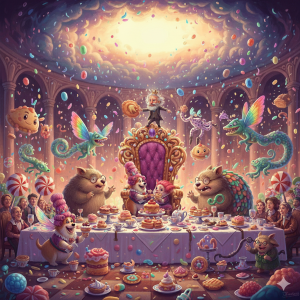
Desperate, Theodore swallowed the glowing berry. He immediately began to expand, ballooning to the height of a towering oak, his crown now a comically small cap perched precariously on his enormous head. He felt a sudden, inexplicable urge to recite Shakespearean sonnets in the voice of a foghorn. Twisting through the peppermint-scented forest, they stumbled upon a grand, albeit chaotic, banquet hosted by the Baroness of Blither, a flamboyant figure with a towering wig made of spun sugar and a court of animated pastries. “Off with their crumbs!” she boomed at any who dared disagree, but upon seeing Theodore, she curtsied with surprising grace, causing her sugar wig to wobble precariously. “A fellow royal! Do join our feast of fantastic follies! Today’s pièce de résistance: gravity-defying soufflés that make you float!”
At the endless table, Theodore encountered a menagerie of Blunderland’s most eccentric inhabitants. There was the Whispering Wombat, a furry philosopher who debated the intricacies of quantum physics in rhyming couplets (“Existence, a riddle / In the universe’s middle / We wiggle and we waffle / Oh, life’s a delightful baffle!”). Then there was the Chronological Chameleon, whose scales shifted not only in color but also in time, making him appear as a baby, an elder, and everything in between within the blink of an eye. The most unsettling was the Giggle-Goblin, a creature whose laughter was so infectious it could make even the most stoic monarch break into uncontrollable fits of mirth.
The feast descended into delightful anarchy when the soufflés, imbued with sentience, began to playfully pelt the guests with dollops of whipped cream. In the ensuing pandemonium, Theodore noticed something familiar about the Baroness of Blither. Amidst the meringue madness, he saw a flash of royal blue and a familiar, frantic wagging. To his astonishment, the Baroness, with a dramatic peel of her sugar wig, revealed herself to be his beloved, albeit slightly portly, corgi, Lord Fluffington! “Woof—I mean, Your Majesty!” the dog-baroness yipped, a blob of whipped cream adorning her snout. “I’ve been overseeing the baking guild since I chased a particularly enticing squirrel through a shimmering portal last equinox!”
But there was no time for joyous reunions. A sudden, swirling storm erupted, summoned by the Mischievous Mirth-Sprites, tiny, winged impish beings with grins like crescent moons and wings of shimmering rainbows. They danced around the banquet, casting illusions that transformed the remaining pastries into wriggling, jelly-filled eels. “Solve our riddles, or be forever tethered!” they chirped in unison. The game was a riddle relay where incorrect answers twisted reality. Theodore, still adjusting to his colossal height, guessed wrong on the first: “What has a heart but cannot love?” (He declared, “A stone,” but the answer was “An artichoke.”) Reality warped violently, and Sir Reginald Waddlewick suddenly gained the ability to fly, lifting them all into the stormy, jellybean-raining jungle chaos above.
Soaring precariously through thunderclouds that pulsed with psychedelic hues, they crash-landed in the Lair of the Labyrinthine Lizard, a serpentine beast with scales that shifted to form intricate, ever-changing mazes. “To pass my test,” the Lizard hissed, its voice like rubbing sandpaper, “you must navigate my belly—a puzzle of portals, perception, and paradoxical pathways!” Inside the Lizard’s enormous, maze-like innards, Theodore faced an onslaught of mind-bending challenges. Rooms that looped time, making him relive his coronation backwards, complete with his younger self making awkward small talk with foreign dignitaries. Mirrors that swapped personalities, briefly turning him into a haughty flamingo and Sir Reginald into a bewildered, crown-wearing squirrel. And a chamber of forgotten dreams, where he was forced to debate climate policy with ghostly versions of historical figures, all speaking in limericks.
Emerging victorious but thoroughly disoriented, Theodore stumbled out, only to face yet another twist. Blunderland, he learned, was not a separate world but a living, breathing dreamscape. It was a manifestation of his own overactive imagination and the stresses of monarchy, fueled by too much late-night reading of Lewis Carroll and an unhealthy obsession with parliamentary procedures. Just as this revelation sank in, the Quizzical Quibbler reappeared, his mismatched socks gleaming. “Not entirely, Your Majesty!” he chirped, a mischievous twinkle in his eye. “I am, in fact, a Chrono-Councillor from the year 2075, sent back to infuse the monarchy with a much-needed dose of delightful disarray! Your reign, sire, risked becoming as dry as a week-old scone without a sprinkle of whimsy!”
As a horde of clockwork crocodiles, summoned by the Lizard’s sore-loser tantrum, snapped at their heels, the group reached the Exit Vortex—a shimmering, swirling portal guarded by the final, most unexpected character: the Philosophic Pineapple. This wise, golden fruit, adorned with tiny spectacles, peeled away illusions with its every pronouncement. “To return to your world,” it intoned, its voice a soothing, tropical hum, “you must admit one truly mad truth, a truth that embraces the essence of Blunderland.” Theodore, his crown still askew, his hair a mess of leaves and jellybeans, took a deep breath. “Riding a flying hippopotamus,” he declared with conviction, “is undeniably the most sensible form of royal transportation!”
With a resounding POP! and a dizzying whirl, they tumbled back to Highgrove. Theodore awoke sprawled amidst his dahlias, Sir Reginald Waddlewick (now just a very ordinary, albeit compost-loving, baby hippo) contentedly munching on an heirloom tomato beside him. Was it all a dream? Perhaps. But Theodore found his ceremonial trowel inexplicably sticky with jellybeans, and from a nearby puddle, a single Mirth-Sprite winked before vanishing in a puff of rainbow mist.
From that day forward, King Theodore III ruled with a noticeable, and rather delightful, touch more madness. Royal decrees now included “Annual Hippo Appreciation Days,” and his tea parties frequently featured animated pastries and lively debates with his talking marrows. And if you listened closely in the gardens of Highgrove, you might just hear the faint, melodious hum of a singing spoon, reminding all that even the most grounded monarch needs a healthy dash of Blunderland to truly thrive.
The Meaning of the Story:
This expanded tale of Blunderland explores several themes:
- The Importance of Whimsy and Imagination: King Theodore, initially rigid and overly focused on order and logic, is forced to embrace the absurd. Blunderland teaches him that life, and even monarchy, can benefit from a touch of playfulness and spontaneity.
- Challenging Perceptions and Expectations: Blunderland constantly upends Theodore’s understanding of reality. This forces him to question his assumptions and look at the world from different perspectives. The shrinking and growing, the talking plants, and the flying hippo all serve to break down his preconceived notions.
- Stress and the Subconscious: The revelation that Blunderland is a manifestation of Theodore’s own mind highlights the importance of addressing stress and allowing for mental release. His “overworked mind” finds a creative, if chaotic, outlet.
- The Value of Different Forms of Intelligence: Theodore, a highly intelligent and logical king, encounters characters with vastly different “intelligences”—the paradoxical Quibbler, the philosophical Wombat, the emotional Mirth-Sprites. He learns to appreciate these diverse ways of thinking.
- Self-Discovery and Authenticity: The Chrono-Councillor’s mission to “loosen up” the monarchy suggests that sometimes, embracing one’s quirkier, less conventional side can lead to a more effective and authentic leadership. Theodore’s final “mad truth” is an acceptance of this newfound freedom.
- Finding Joy in the Unexpected: Despite the initial alarm, Theodore eventually finds joy and even wisdom in the chaos of Blunderland. The story encourages us to find humor and lessons in unexpected places.
In essence, the story is a playful reminder that sometimes, the most profound truths can be found in the most absurd situations, and that a healthy dose of imagination and a willingness to embrace the unexpected are crucial for a well-rounded life, even for a king. 
 The Crazymad Writer Writes Again