Wot and Nott’s Race Against Time
Prologue
Rioghbhardan and Fikri
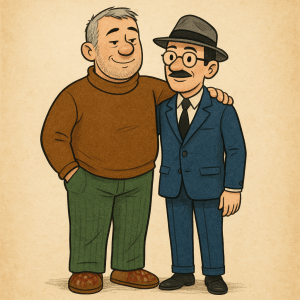
My name is Nott, and my best friend’s name is Wot. We have been inseparable for as long as either of us can remember. We grew up on the same street, sat in the same classrooms, shared countless adventures, and, truth be told, could never imagine life without the other. Even now, as adults, we spend most of our free time together. That’s just the way it’s always been—and the way we like it.
Of course, those aren’t our real names. Mine is actually Fikri, and Wot’s is Rioghbhardan. We never much cared for those names, though, and from the time we were small we spent entire afternoons trying to invent better ones. Nothing ever seemed to fit—until one summer’s day when our game turned a little giddy. In mock seriousness we sang together:
“What’s in a name? I do not know!
It’s not our aim to go on so,
Trying to find what’s best or not—
What must be resolved, or not.”
We stopped short, startled by our own rhyme. Then Rioghbhardan laughed and cried out, “That’s it! From now on we’ll be What and Not!”
I agreed at once, though with a small adjustment. “Better still,” I said. “We’ll be WOT and NOTT. And that’s that.” We had no idea how firmly those names would stick, but from that day onward we were Nott and Wot.
As we grew, we did not drift apart as many childhood friends do. In fact, we only grew closer. Not that we always see eye to eye—our differences are enough to make us quarrel like cats at times. Wot is a slow, steady soul, never hurried, always on his own timetable. I, on the other hand, am told I have a quick mind and an eagerness to see things finished at once. To me, delay is maddening. To him, haste is unnecessary. Between us, life is never dull.
Wot is larger than life, favouring earthy greens and browns, always clad in flared corduroy trousers (fashionable or not) and a polo-neck shirt. His prematurely greying hair, cropped short, gives him a look of easy distinction. But what truly sets him apart are the curious wrinkles across the back of his head—horizontal folds quite unlike anything I’ve seen on another man.
I am slighter, dark-haired, and wear a thin moustache. My usual attire is a neat blue suit, a crisp white shirt, a black tie, and my ever-present trilby hat, without which I would feel half-dressed.
We were, to all appearances, two ordinary friends leading ordinary lives. Yet little did we know that fate was about to turn our world upside down. For when Umahia’s call reached us, we were drawn into events so vast that, had we ignored it, both Onisha and the Earth itself would have been left far darker—and far more dangerous—than we could bear to imagine.
Chapter One
A Knock on the Door

24th December.
Wot sat comfortably in his favourite armchair before a roaring fire, contentedly awaiting a long evening of Christmas programmes on the television. He had already opened the present he had bought for himself: a pair of delightfully warm slippers patterned with festive scenes and holly motifs. Slipping them on, he sighed in satisfaction.
Before turning on the set, however, Wot withdrew a small notebook from his shirt pocket. For this was his greatest pastime, his private delight—writing poetry. He loved it more than anything, and unlike other poets he had heard of, he never seemed to suffer that dreadful malady known as writer’s block. Whenever pen touched paper, words came tumbling freely. Some poems were long, some short, some bright enough to make him laugh, others so sorrowful they brought tears to his own eyes.
For years he had recorded these verses—little fragments of thought, little pieces of himself—and he had always felt, deep down, that this gift was something he must never neglect. Tonight, as the logs crackled and sparks drifted up the chimney, he took up his pen and wrote:
Christmas Eve so still I know,
But something’s in the wind.
There’s a sense of magic about—
It’s now we need our friends.
When he finished, Wot frowned. The words puzzled him. What did they mean? Why had they come to him so strangely, without explanation? He tried reading the lines aloud, hoping their sense would reveal itself, but they remained a riddle. With a small sigh, he closed the notebook, tucked it back into his pocket, and leaned once more into the warmth of the fire.
It was the perfect start to Christmas. He could have stayed there forever.
Then came a knock.
At first Wot thought he must have imagined it, half-asleep as he was. But then came another—louder this time. With a groan, he heaved himself up from his chair. “Who on earth can it be, so late on Christmas Eve?” he muttered, stifling a yawn.
As he shuffled toward the door, his eyes fell upon the coat stand in the hallway. There, propped against the wood, was a peculiar little Christmas card he had received earlier that day—from his old friend Nott.
The card was unusually small. Its picture was stranger still: not a snowy church or a sprig of holly, but a perfect summer scene. A whitewashed cottage with weathered beams and roses climbing around its door stood in the midst of a rambling garden. There was a duck pond, a rustic arbour, a shed, and even a shining white picket fence—all drenched in the colour of high summer.
“What a curious choice for Christmas,” Wot murmured, studying it more closely. His eyes were drawn to the house’s stout wooden door, dark brown and fitted with a large brass knocker. “They don’t build them like that anymore,” he said without thinking.
“It’s a bloody good job they don’t,” said a voice.
Wot started so violently he almost leapt out of his brand-new slippers. The card fell from his hands onto the floor.
“Take it easy!” the voice boomed again. “You could have killed me!”
Wot spun about, searching the hallway for the prankster, but there was no one. The fire still crackled, the night was still, and yet the voice rang clear. He stood frozen, hardly daring to breathe.
Then the voice came once more: “Are you listening, Wot? I am speaking to you!”
His knees wobbled. Was it a ghost? Or—horrifying thought—was he going mad?
“Pick me up!” ordered the voice.
“Wh-where are you?” Wot whispered, his courage deserting him.
“On the floor! At your feet!”
He glanced down. There lay only the little card. “I can’t see you,” he stammered.
The voice sighed with exasperation. “Wot, I always thought you were a bit slow, but now you’ve proved it. I AM IN THE CARD. Pick it up—carefully!”
Trembling, Wot bent down and gingerly lifted the card. He opened it, half expecting to see some tiny figure squeezed between the folds, but there was nothing beyond the ordinary printed greeting.
“LOOK IN THE WINDOW, you berk!” snapped the voice.
Something clicked. The voice was beginning to sound awfully familiar.
Closing the card, Wot stared once more at the picture on its front. His eyes fell upon the cottage windows—fine little leaded panes—and to his astonishment he saw movement within. A shadow, a figure—then a face.
It was Nott. His best friend, staring out at him from the painted window, waving frantically.
The sight was too much for poor Wot. With a strangled cry he toppled backwards, dropping the card as he fainted clean away.
Chapter Two
Cereal that Tastes like Sawdust

For nearly an hour Wot lay sprawled on the cold hallway floor, stunned into silence. At last reality began to seep back into his dazed mind, though it felt quite unlike the reality he had always known.
“Oh, my head,” he groaned, rubbing his temple. “What happened?”
The draught whispered down the hallway, but no answer came. In a hushed voice he ventured, “Was I dreaming? … Nott?”
Silence.
He tried again, louder this time. “Nott?”
Still nothing. The silence was unbearable. Panic began to creep into his bones, and he shouted at the top of his lungs: “NOTT! ARE YOU THERE?”
Only then did his eyes fall upon the small Christmas card lying on the floor. He snatched it up, staring hard at the window where he had earlier seen his friend waving. The panes showed nothing now but painted glass.
“Was it all my imagination?” he whispered. “And if it was… what a strange thing to imagine.”
After several minutes of fruitless scanning, Wot placed the card carefully back on the coat stand and shuffled into the kitchen. He filled the kettle, muttering, “A nice cup of tea will clear my mind.”
Steam hissed and curled as he poured boiling water into the teapot. Soon he was cradling a mug of hot tea and nibbling at a mince pie in his favourite chair. The fire popped and crackled, and he tried to make sense of it all. Had he slipped and bumped his head? Dreamed the whole thing while unconscious?
“Yes,” he said firmly, though without conviction. “Yes, that must be it.”
The clock read a little after eleven. With a yawn, Wot declared it bedtime. He prepared himself a mug of cocoa to carry upstairs. “A good night’s rest will sort me out,” he told himself. “I’ll be back to normal in the morning.”
But as he mounted the first step, the mysterious voice boomed louder than ever:
“It might help you, old friend—but it certainly won’t help me!”
The shock was so great that Wot’s cocoa leapt into the air, performed two perfect somersaults, and exploded like a brown Catherine Wheel, showering him in scalding spray. He tumbled down the staircase in an undignified heap. The mug ricocheted off his temple before shattering into a thousand pieces on the hard floor.
“Nott?” Wot whispered, rubbing his head and licking cocoa from his cheek. “Is that you?”
“Of course it’s me! Who else were you expecting—the Queen of Sheba?” came the sarcastic reply.
Grabbing the card, Wot peered at the painted window. There was Nott, waving wildly from behind the glass.
“So I wasn’t imagining it!” Wot cried in triumph. “I thought I was losing my marbles!”
“That’s assuming you had any marbles to begin with,” Nott quipped. “And tell me—why did you drop the card again?”
Sheepishly, Wot explained that the shock had been too much for him, and he’d fainted. He had called out countless times, he said, but received no reply. “Finally I decided it must all have been a dream.”
“The reason I didn’t answer,” Nott said pointedly, “is that I was also unconscious! Knocked out cold when you dropped me, remember? It’s a miracle I haven’t been killed with all this tossing about.”
Wot blushed. “You’re right, old friend. I’m sorry.”
“Well then,” Nott said more gently, “are you going to help me out of here, or not?”
“Of course I will,” Wot said at once. “But first—you must tell me how you got into this predicament. And what is it like in there? Is it a real house? What’s it like being so small? And was it you knocking at the door in the first place?”
Nott only rolled his eyes and muttered darkly.
25th December
Christmas morning dawned clear and cold.
Wot, bruised and battered from the previous night’s tumbles, nevertheless declared that he had never slept so well. “Like a baby,” he said cheerfully. “I feel completely refreshed!”
Nott, however, had spent the night cramped in the draughty little card. “Difficult to sleep inside a Christmas card,” he muttered. “Especially when one’s been abandoned on a coat stand.”
Ignoring the complaint, Wot fried himself a glorious Christmas breakfast—sausages, bacon, eggs, pudding, mushrooms, toast. The smell drifted through the house, curling past the card now propped on the kitchen table.
“That’s right!” shouted Nott from inside. “Torment me! Drive me mad with the smell while I sit here with nothing but dried-up cereal that tastes of sawdust!”
“I’m sorry, old friend,” Wot said through a mouthful of sausage. “But it is Christmas, and I was starving.”
When Wot had finished eating and tidied the plates, he returned to the card. “Right then, Nott. Tell me everything—how you got in there, why you can’t get out—and we’ll put our heads together.”
Nott agreed, but only on one condition: “You must not interrupt me. Not even once.”
And so Nott began his tale.
He described the envelope with no address, no stamp, only his name—NOTT—scrawled across it. He spoke of the sudden roaring wind that had filled his room, the vortex swirling around the card, and how he had been pulled, helpless, into its grip. He told of the old-fashioned house where he landed with a thump: dreadful wallpaper, rickety stairs, and a grandfather clock with only one working hand.
And then, lowering his voice, he spoke of the voice that had greeted him there. A solemn promise. A shadowed figure in an armchair. The tick-tock of the clock counting away the moments as sweat poured down his face.
“I was too frightened to move,” Nott said softly. “Too frightened even to breathe. And all the while, that terrible clock ticked on…”
CONTD
 The Crazymad Writer Writes Again