RSS

Daily Archives: August 18, 2025

Saint Patrick

Saint Patrick

The Forgotten Saint

It is often said that Saint Patrick came to Ireland to drive out the snakes.
But what if the snakes were never snakes at all?


Long ago, when the mist lay thick upon the valleys and the bogs whispered like breathing things, a foreign stranger landed upon the shores of Ériu. He was no gentle man of God, as later tales would tell, but a strange figure whose eyes gleamed green like fire in a peat bog, and whose staff was carved from bone, not wood.

The druids, keepers of the old ways, saw him first. They whispered that he was neither Roman nor Briton, but something far older — a being who had walked the shifting places between this world and the Otherworld. He did not ask for shelter. He demanded it. He did not preach of salvation. He spoke instead of banishment.

“Your land harbours them,” he said in a voice that carried like thunder.
“Serpents,” he called them. But the people knew no snakes slithered upon Ireland’s soil. What, then, did he mean?

Some said he was hunting the “serpents” of knowledge — the ancient wisdom of the druids, who bent the wind and called to the stars. Wherever he walked, holy groves withered, and sacred wells ran dry. The old gods faded like smoke before him, as though swallowed.

Others whispered a darker tale: that the “snakes” were not druids, nor gods, but the Fae themselves. Those shimmering beings of hollow hills who danced in moonlight, who whispered to mortals and led them astray. He fought them with prayers unknown to mortal tongues, binding them beneath stones, driving them into the hollow mounds, locking them where no sun might touch.

But if you go to certain places in Ireland — quiet valleys where the grass grows too green, or ringforts where no farmer dares plough — you can hear them still. The hiss beneath the soil. The laughter in the wind.

And some say Patrick never left.

For on storm-ripped nights, a tall figure is seen wandering among ruined monasteries, cloak ragged, eyes burning faintly green, still searching for the last of the “serpents” he never caught.


Perhaps he was a saint. Perhaps he was a conqueror of spirits.
Or perhaps Patrick was something far stranger:
not a man at all, but a hunter from beyond, whose work in Ireland is not yet finished.

The Forgotten Saint

 
Leave a comment

Posted by on August 18, 2025 in druid, saint patrick


Tags: , , ,

The Midnight Mass of Haroldstown

The Midnight Mass of Haroldstown

The Midnight Mass of Haroldstown

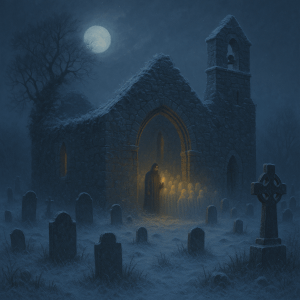
On Christmas morning, long before the living stir, Haroldstown lies heavy with frost. The moon still hangs in the sky, pale and watchful, and the ruined church is black against the whitened fields.

It is then, the old ones say, that the congregation gathers. Not the living parish, but the other one — the flock that never left. Their procession begins in silence, rising from the graves where frost glitters like stars. From every crooked headstone they come, from beneath the yew roots and from the bog earth beyond the wall. Their feet make no mark in the snow.

They enter through the broken arch, and inside the roofless nave they take their places. Shoulder to shoulder, row upon row, a congregation of pale faces lifted toward the altar. From the southern wall comes a sound like breath — the little door hidden by ivy sighs open, and out steps the priest. None remember his name. His vestments are black, edged with silver thread, and in his hand he holds no book, no chalice, only a bell that has not rung in centuries.

When he lifts it, the toll spreads across the valley. Dogs shiver in their kennels, cattle shift in their stalls, and sleepers dream of voices whispering at the foot of their beds. The service begins, not in Latin, not in English, but in a tongue older than either, the syllables rolling like water over stones.

Those who dare to listen from the lanes say the dead reply in one voice, low and unearthly. They kneel, rise, and kneel again, as if the ruined church still had pews, as if the roof still sheltered them from the snow. Some claim the very air glows faintly within the walls, as if candlelight burns where no candle stands.

And then, just before the first cock crows, the bell tolls once more. The priest lowers his hand, and the congregation fades. The altar stands empty. The frost lies unbroken again.

When the villagers wake and walk to their own Christmas Mass in Tullow, the church at Haroldstown is silent, its ruin unchanged. But if you lean close to the stones, you may find them faintly warm, as though hundreds of hands had rested there only moments before.

midnight mass


Tags: , ,

The Old Church of Haroldstown

The Old Church of Haroldstown

The Old Church of Haroldstown

The church at Haroldstown was never finished. Its stones were laid, its walls rose straight and sure, but the roof was never set. Each time the builders tried, storms rolled in from nowhere, tearing timbers down before a slate could be fixed. After the third attempt, the masons abandoned their work, leaving the ruin to the ivy and the wind.

The graveyard grew around it all the same. Crooked headstones tilt in the long grass, names half-vanished or lost to time. A black yew tree bends low over the altar, its roots tangled in the very stones.

At dusk, locals give the place a wide berth. They tell of a bell that tolls where no bell ever hung, and of figures drifting among the graves, faces pale and eyes unblinking. A farmer once swore he saw his grandmother kneeling at her own headstone, her lips moving in silent prayer. He left Haroldstown that very week and never came back.

The darkest tale is of the door in the southern wall. Hidden by ivy, too small for a grown man to pass through, it breathes a damp, cold air like the mouth of a cave. Old folk say it leads not to the fields beyond, but down — into hollows older than the church, older even than the dolmen by the roadside.

From time to time, some daring child squeezes inside. The ones who return are never quite the same. One wandered home white-eyed, whispering in a language no one knew. Another was never found at all, save for his cap snagged high on the yew’s lowest branch.

And when the moon rides low over Haroldstown, villagers swear the ruin does not stand empty. Through the gaps in the walls, they glimpse a congregation crowding shoulder to shoulder, their faces turned upward, waiting for a sermon that has lasted seven hundred years.

church ruins

 
Leave a comment

Posted by on August 18, 2025 in carlow, church, haroldstown, ruins


Tags: , ,