RSS

Daily Archives: September 6, 2025

The Writer’s Conundrum

Gerrard was a writer, but not of the ordinary sort. His stories weren’t born from ink and paper, but from a swirling, mischievous fog that lived inside his teacup. This was the Conundrum, and it was a most troublesome roommate.

One morning, the Conundrum puffed itself into the shape of a plump, mustachioed man, sitting on the edge of his spoon. “I’m afraid,” he announced in a tiny, theatrical voice, “that your hero, Sir Reginald, cannot simply find the lost Scepter of Giggles. It’s dreadfully dull. He must, I insist, first be turned into a talking badger with a fear of plaid.”

Gerrard sighed. “But why, Conundrum? He’s meant to be a knight.”

“Precisely!” the man-shaped fog huffed, his mustache trembling. “Expectations are for lesser tales. Now, the badger. Give him a monocle. It’s a non-negotiable narrative element.”

This was the nature of their relationship. When Gerrard tried to write a quiet romance, the Conundrum would insist on a sudden meteor shower of singing frogs. When he attempted a grand epic, it would demand that the villain’s secret weakness was an uncontrollable urge to knit argyle socks.

One particularly daft day, Gerrard sat down to write a simple detective story. The Conundrum, a billowing cloud of frustration, settled over his head, humming a discordant tune. “The baker,” it whispered, “he didn’t steal the crumpets. The crumpets stole themselves!”

Gerrard paused, pen mid-air. “The crumpets… stole themselves?”

“Yes! They are a highly organized, highly intelligent gang of baked goods, seeking liberation from the tyranny of butter and jam. Their leader is a gingerbread man named Bartholomew ‘Bartleby’ Crumb.”

The idea was absurd. It was daft. It was… intriguing. Gerrard, against all his professional instincts, began to write. The story flowed, fueled by the sheer ridiculousness of it all. Bartholomew ‘Bartleby’ Crumb and his crumpet crew, a fearless detective who could only communicate in limericks, a dramatic chase scene through a marmalade factory—it all came together with a bizarre, undeniable logic.

When he finished, the Conundrum swirled back into his teacup, quiet and satisfied. Gerrard looked at the pages filled with the strangest story he had ever written. It wasn’t what he had planned, but it was alive. It was wild, and it was uniquely his own. He had wrestled with the Conundrum, and in the end, it wasn’t a problem to be solved, but a mischievous muse to be embraced.

You can read the whole story HERE

 
Leave a comment

Posted by on September 6, 2025 in conundrum


Tags: ,

Embracing the Chaos: A Writer’s Journey

Embracing the Chaos: A Writer’s Journey

The Crazymad Writer, that’s me, you see,

A brain in chaos, a wild decree.

My thoughts, a whirlwind, a tangled yarn,

A literary tempest in a barn.

The words they tumble, they leap, they fly,

A frantic stampede beneath the sky.

A comma here, a semi-colon there,

A frantic dance on the brink of despair.

I write of dragons with spectacles perched,

Of teacups singing, for them I’ve searched.

Of socks that vanish, a mystery grand,

Of polka-dot elephants in the land.

Why do I do it? The mad, mad scrawl?

It’s either that, or climb the wall!

The stories bubble, they must break free,

Lest I become a footnote in history.

So forgive the frenzy, the ink-stained hand,

The logic lost on this scribbling land.

It’s not a choice, it’s a desperate need,

To plant this crazy, literary seed.


Tags: , ,

A Long Time Ago in Owerri

Those were the days

lm ericsson ltd

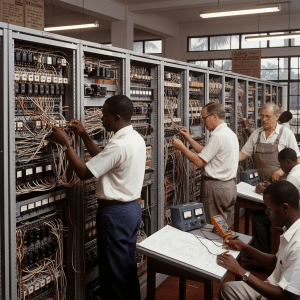
The late 1970s in Owerri were a time of electric change, not just in the air, but under the ground and in the new buildings rising along the dusty roads. The Nigerian Civil War had left scars, but the city was in a furious race to rebuild, and nothing symbolized this more than the arrival of the future: the automatic crossbar telephone exchange.

Before, telephone calls in Owerri were a ceremony. A man—it was almost always a man—would stride into the P&T (Posts and Telecommunications) office, fill out a form, and wait for a switchboard operator to manually connect his call. The operators, a special breed of human, held the city’s social and business life in their hands. They knew who was trying to reach whom, and a wrong number could be a tragedy, a missed business deal or a family crisis. The air in the exchange room was a hum of low-voiced commands, the clatter of plugs being inserted, and the soft, perpetual static of a connection being made.

Then came the project. A team of engineers, a mix of seasoned veterans from LM Ericsson and bright, young Nigerian graduates, descended on Owerri. Their arrival was quiet at first, marked only by the excavation of trenches and the laying of thick, sheathed copper cables that snaked their way through the city’s soil. The real show began with the delivery of the equipment.

The heart of the new system was a hulking, metallic beast: the crossbar exchange. It arrived in crate after crate, a puzzle of relays, selectors, and racks. The younger engineers, like Chike, a fresh graduate from the University of Ibadan, stared at the components in awe. They had studied the theory—the marvel of the crossbar’s matrix of horizontal “select” bars and vertical “hold” bars, controlled by electromagnets that could close a connection at any intersection. But seeing the physical machine, a monument to electromechanical ingenuity, was something else entirely.

The installation was a dance of organized chaos. The exchange building, a squat, modern structure designed for the purpose, filled with the aroma of solder and fresh paint. Chike and his colleagues worked long, hot days, meticulously wiring circuits and mounting the heavy frames. Every connection was critical. A single misplaced wire could bring the entire system to a halt. The older engineers, men like Mr. Svensson, with his perpetually stained overalls and a knowing squint, offered quiet, gruff wisdom. “No hurry, boy,” he’d say to a frantic Chike. “The machine is a patient master. You must be its steady servant.”

The true test was the cutover. The day arrived with the tension of a drum being stretched tight. All of Owerri’s old manual lines were to be disconnected, and the new automatic system would come online. The P&T office buzzed with nervous energy. The operators from the old switchboard watched from the sidelines, their faces a mix of anxiety and curiosity. The old way of life was ending, and they wondered if this new, unfeeling machine could ever replicate their human touch.

Chike, his heart pounding, stood before a panel of blinking lights and switches. At the command of the project manager, a new, younger man from Lagos, he flipped a master switch. A soft, continuous hum filled the room—the sound of the crossbar exchange coming to life. It was a sound that would soon become the ambient soundtrack of modern Owerri.

Then came the calls. Not routed through a human, but through the whirring, clicking logic of the machine. The first call was a simple test, from the P&T office to the Government House. Chike watched as a series of lights on the panel lit up, relays clicked in rapid succession, and a clear connection was established. The line was crisp, with none of the old static.

Word spread like wildfire. A man in Aladinma estate could now dial his brother’s number in Ikenegbu and be connected almost instantly, without speaking to a third party. The new exchange didn’t ask “Who are you calling?” or “Is it urgent?” It simply made the connection.

The city adapted quickly. The distinctive dial tone became a familiar sound. The new, five-digit telephone numbers were scrawled in notebooks and memorized. The crossbar exchange, a technological marvel of its time, was more than just a piece of equipment; it was a symbol of Owerri’s future. It connected the city to itself, and in time, to the wider world, paving the way for the digital age that lay just over the horizon. The clicking of its relays was the sound of progress, a mechanical heartbeat in the new, vibrant city of Owerri.

 
Leave a comment

Posted by on September 6, 2025 in 1970s, owerri


Tags: