Alice in the Cogwork Kingdom
Alice in the Cogwork Kingdom
Chapter One: The Cogwork Garden
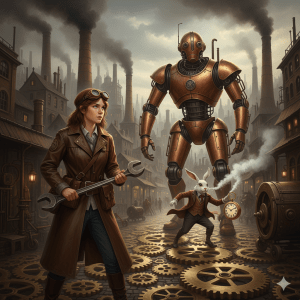
This is the first Steampunk Alice song in this story. I hope you like it.
The air in Wonderland City was thick with the scent of high-pressure steam and burnt coal. Alice, her leather aviation jacket creaking and the brass rims of her goggles digging into her brow, adjusted the wrench-spanner on her utility belt. She wasn’t following a rabbit anymore; she was following a breakdown.
The White Rabbit, a nervous gentleman whose magnificent gold-plated chronometer was now emitting frantic whistles and puffs of superheated vapor, skittered past a towering automaton sculpted entirely of polished copper.
“I’m late! I’m dreadfully, desperately behind schedule! My internal regulator is redlining!” the Rabbit shrieked, his voice tinny from the perforated speaker grill beneath his bow-tie.
Alice pursued him down a winding lane paved not with dirt, but with intricate, interlocking brass gears that spun slowly underfoot. She finally followed him through a rusted, iron archway labeled “THE QUEEN’S MECHANICAL MAZE.”
Inside, it was a garden of industrial horror and beauty. Instead of roses, there were enormous steam-powered turbines that whirred with hypnotic speed, their exhaust ports dripping with oily coolant. The hedges weren’t green; they were walls of riveted boiler plate, occasionally moving and reshaping themselves with the groan of hydraulics.
The Rabbit vanished behind a monstrous, clicking Clockwork Caterpillar, whose segmented brass body was exhaling perfect rings of smoke.
“Excuse me,” Alice called out, approaching the massive metal beast. “Sir, I’m trying to find the man whose timepiece seems about to overpressurize.”
The Caterpillar’s thousand lenses, like polished obsidian, swiveled to face her. A deep, metallic voice vibrated through the structure. “Overpressurize? Everything here is perfectly calibrated, child. You, however, appear to be running on low-grade human ambition.”
Before Alice could retort, a mechanical screech split the smog. A formation of the Queen of Hearts’ Card Soldiers, now six-foot-tall, articulated Clockwork Enforcers of stamped iron, marched around a hedge. Their faces were painted playing cards—Ace of Spades—and their arms ended in heavy, intimidating piston-driven clubs.
“Halt! Unauthorized organic presence in Sector Seven!” their synchronized speakers blared.
Alice didn’t hesitate. She grabbed a small, polished brass capsule from her belt—a dose of “Eat Me” stimulant she’d brewed herself. She popped it open, inhaling the chemical mist. Her eyes widened, her senses sharpened, and the metallic world seemed to slow just enough.
She saw the exact moment the lead Enforcer’s governor gear would engage its attack sequence. Alice knew she didn’t need a sword, just precision.
With a grunt, she pulled the heavy wrench-spanner from her belt, charged forward, and aimed not for the soldier, but for the exposed, spinning escape wheel at its ankle joint.
Clang!
The gear seized. The Enforcer’s rigid march became a stuttering collapse of hissing valves and clicking ratchets, sending a shower of tiny, critical screws across the brass-paved garden. Alice grinned, wiping a smudge of grease from her cheek. She was ready to dismantle this world, one precise turn at a time.
Chapter Two: The Caterpillar’s Calibration

Steampunk Alice Song #2 -The Clang Dies Down.
The clang of Alice’s wrench still echoed in the industrial garden. She stepped back as the defeated Clockwork Enforcer settled into a heap of sparking wires and shattered brass.
The enormous Clockwork Caterpillar let out a slow, resonating sigh of compressed air.
“Low-grade human ambition,” the machine repeated, its hundreds of obsidian lenses fixed on the destroyed soldier. “Efficiently executed, however. You have a knack for finding the weakest link in the timing sequence.”
Alice adjusted her goggles and approached the massive metal form. “I need to know where the White Rabbit went. His chronometer is about to explode—he needs an immediate pressure release.”
“Ah, the Master of the Moment,” the Caterpillar rumbled, its voice deep and metallic. “His dilemma is simple, child. His internal clock is running fast. The momentum of Wonderland is too much for his delicate springs of sanity.”
“And how do I slow him down?”
The Caterpillar’s segmented body began to shift, a great groan of hydraulics accompanying the movement. A small, hinged panel on its side snicked open, revealing a bewildering array of gauges, levers, and tiny, glowing vacuum tubes.
“In a world built on precision,” the Caterpillar instructed, “you do not slow an engine with resistance. You re-calibrate the power source. He seeks the only place in the Maze where time is not a master, but a pet.”
Alice leaned in, her eyes scanning the diagrams etched onto the exposed metal. “And where is that?”
“Follow the harmonic resonance,” the Caterpillar commanded, pointing a slender, multi-jointed appendage towards a rusted, iron doorway nestled in the next boiler-plate hedge. “The Rabbit has run for the Mad Tatter’s Refueling Station. They are attempting a permanent shutdown of the clock cycle there. Be warned, child: they are fond of reversing the polarity of everything, including logic.”
As Alice thanked the machine, the Caterpillar sealed its panel with a hiss. “And Alice? When you see the Tatter, tell him his primary flywheel is out of alignment. He needs to check his internal balance.”
With the new instructions secured, Alice darted toward the doorway. The air here was vibrating with a bizarre, off-kilter rhythm—like a dozen different songs being played at once, all slightly out of sync.
She pushed through the archway, her jaw dropping at the scene.
It was a Tea Workshop, not a party. Under a canopy rigged with flickering gaslights, the Mad Tatter (a wiry man in patched denim and a towering top hat studded with salvaged clock parts) and the March Hare (a twitchy engineer whose ears were replaced by a pair of articulated radio antennae) were furiously working.
The centerpiece was a chaotic workbench built from stacked oil drums, covered not with teacups, but with miniature steam engines and soldering irons.
And the White Rabbit? He was strapped into a custom-built, high-backed leather chair. His massive chronometer had been removed and lay on the table, its brass casing glowing molten red. The Tatter was holding a giant, smoking soldering iron, preparing to fuse the clock’s main time-spring shut, while the Hare was desperately trying to dampen the runaway mechanism with a steady stream of cold engine oil from a modified teapot.
The Mad Tatter looked up, his goggled eyes catching Alice’s. He lifted the soldering iron, grinned maniacally, and bellowed, “Just in time! We were just about to break time forever! Do you take milk, sugar, or a full system reboot?”
Alice pulled her wrench free from her belt, ready for a new kind of fight—one against utter mechanical madness.
Chapter Three: The Calibrated Heart

Steampunk Alice Song #3. Superior Engineering
Alice didn’t pause for the Mad Tatter’s demented hospitality. She had seen that look before—the gleeful madness of an engineer who has found the perfect, terrible solution.
“Stop!” Alice shouted, sprinting toward the table. “That chronometer isn’t running fast because of insanity, it’s running fast because of friction! Fusing the mainspring will just make a spectacular bomb!”
The Tatter only laughed, his breath smelling of ozone and black tea. “Friction is boring, Alice! Chaos is the solution! We need to un-wind time completely!”
The March Hare, whose articulated radio antennae were vibrating with anxiety, hissed, “He’s right, Alice! The pressure is too high! We have to find the escape route!”
Alice leaped onto the workbench, scattering soldering irons and miniature steam engines. The Hare, startled, momentarily turned the modified teapot away, stopping the flow of coolant oil onto the chronometer. That was all the opening Alice needed.
Ignoring the Tatter’s furious bellows, she pressed the point of her wrench against the glowing brass casing of the White Rabbit’s timepiece. Her eyes, sharpened by the “Eat Me” stimulant, scanned the superheated metal for the key: the tiny, hidden pressure release valve that she knew all high-spec Wonderland mechanisms must possess.
She found it, a small, barely visible gasket-screw near the winding post. The temperature was scalding, but Alice braced herself and applied the wrench-spanner.
CLANG-TINK!
She gave the screw a precise, quarter-turn counter-clockwise.
A terrifying, high-pitched screeee ripped through the air as a jet of steam, superheated and shimmering purple, blew out from the tiny valve. The sound was immediately followed by a wave of relief: the molten-red glow of the chronometer faded, settling back to a dull, manageable bronze. The whole mechanism gave a deep, final sigh and slowed to a comfortable, tick-tock.
The White Rabbit, strapped in the chair, blinked. His rapid-fire breathing slowed. “Oh,” he said quietly, his voice restored to its normal, high-strung pitch. “I appear to be… exactly on time.”
The Tatter stared at the intact, gently ticking chronometer. His massive soldering iron clattered to the floor. “You fixed it? You didn’t reverse the polarity? You didn’t embrace the inevitable heat death of the universe? That’s dreadfully… organized!”
“Sometimes,” Alice said, dropping the wrench back into her belt, “the only way to beat madness is with superior engineering.”
She turned to the Tatter, remembering the Caterpillar’s warning. “And speaking of superior engineering, the Caterpillar asked me to tell you your primary flywheel is out of alignment. You need to check your internal balance.”
The Tatter gasped. He snatched the smoking iron back up and began frantically inspecting the components of his own top hat, muttering about “imbalanced momentum” and “cracked ceramic bearings.”
The March Hare, now calm, offered Alice the teapot. “Engine oil?”
“Thank you, no,” Alice said, finally hopping off the bench. “I think I’ll stick to a glass of water. Now, Mr. Rabbit, if you’re quite finished with your crisis, I believe there’s a Queen who needs a maintenance check.”
The Rabbit, now free and feeling his own internal spring-tension return, adjusted his jacket. “Ah, the Queen! Her court runs entirely on fear and faulty clockwork. She’s bound to be the biggest repair job in the entire kingdom!”
Alice smiled, her goggles reflecting the flickering gaslight. The Cogwork Garden was teaching her how to tinker. With a quick salute to the still-muttering Tatter and the now-peaceful Hare, Alice and the White Rabbit stepped out of the Refueling Station and deeper into the smoky, gear-driven city.
Chapter Four: The Executioner’s Gauge
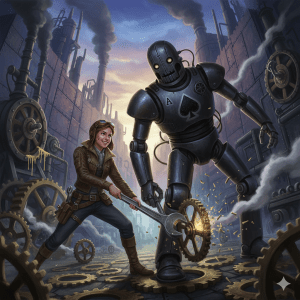
Steampunk Alice Song #4. The Superior Physics
Alice and the White Rabbit exited the winding maze, the smoky air of the Cogwork City giving way to the oppressive silence of the Royal Sector. The pavement changed from interlocking brass gears to polished red enamel tiles, slick with a perpetually leaking fluid that smelled strongly of vinegar and rust—the essence of the Queen’s domain.
“We have to be quiet,” the Rabbit whispered, clutching his newly calibrated chronometer. “This area is monitored by the Hush-Bots—tiny, spider-like drones with acoustic sensors. One false footfall and…” He didn’t finish the threat. He didn’t need to.
They paused behind a towering fence of wrought iron, forged into a repeating pattern of stylized hearts and clubs. Through the bars, Alice saw the palace courtyard—and the source of the terrible silence.
It was the Executioner Robot.
It stood three stories high, a monolithic figure cast in dark, riveted iron. Its head was a featureless dome with two deeply recessed, glowing red optical sensors. Its chest was a single, massive boiler, its brass gauge needle perpetually twitching near the red line, threatening a catastrophic rupture. Instead of hands, its enormous arms terminated in a heavy, curved executioner’s blade on one side and a thick, hydraulic-driven grapple on the other. It moved with a slow, grinding inevitability, each step accompanied by a loud WHUM-PSHH of escaping steam.
At its feet, beneath a banner reading “OFF WITH THEIR GEARS,” stood the Queen of Hearts. She was a woman of rigid, painted precision, her massive gown constructed from thousands of layered, lacquered playing cards. She wasn’t yelling; she was lecturing a kneeling Card Soldier about the improper torque setting on his elbow joint.
“That thing is terrifying,” Alice muttered, pulling her goggles down.
“That thing is the ultimate expression of the Queen’s neuroses,” the Rabbit corrected. “It’s not just a weapon; it’s her masterpiece of overkill. It only runs on pure steam and fear. If the fear drops, the boiler pressure falls, and the whole thing slows down.”
“So we have to terrify the Queen, or make the people brave?”
“Neither is possible,” the Rabbit sighed. “We must disrupt the fear mechanism. The entire machine is controlled by a single, pulsing control crystal mounted high on its back, protected by a network of high-voltage cables. The Queen uses a special, magnetic control key she wears on her girdle to keep the voltage active.”
The Queen finished her lecture, gave the soldier a sharp kick, and pointed at the robot. “You! Executioner! Patrol the perimeter! And be sure to check the oil levels in the knees!”
Alice watched the great robot turn, the steam hissing violently from its joints as it began its slow march toward their hiding spot.
“It will be upon us in sixty seconds,” the Rabbit whispered, his small, calibrated hands shaking. “What is your Superior Engineering plan for that?”
Alice pulled out a handful of the tiny screws and fragmented metal pieces she’d salvaged from the defeated Card Enforcer in Chapter One. She was looking at the ground, not the massive robot.
“The Queen’s security relies on precision,” Alice murmured. “Look at the floor. Polished enamel. We don’t beat a siege engine with a wrench. We beat it with friction.”
She looked at the Rabbit. “I need you to cause a distraction—a very specific, very loud distraction—in exactly 45 seconds. Can you manage a precise burst of chaos?”
“I need you to cause a distraction—a very specific, very loud distraction—in exactly 45 seconds,” Alice instructed, her eyes locked on the enormous robot.
The White Rabbit swallowed hard but straightened his vest. “Forty-five seconds. A precise burst of chaos. I can do that. It’s a matter of regulating the disorder.”
As Alice knelt, scattering the sharp pieces of metal she’d salvaged from the Card Enforcer across a twenty-foot patch of the slick, enamel tile, the Rabbit prepared his timepiece.
The robot’s rhythmic WHUM-PSHH of steam was getting closer—thirty seconds.
The Rabbit opened his gold-plated chronometer, exposing its magnificent, whirring brass gears. He pressed a tiny, hidden lever and watched the internal regulator spin wildly, deliberately pushing the clock to a state of controlled overload.
Twenty seconds.
The Queen, still focused on lecturing her Card Soldier, pointed her lacquered hand at the robot. “And see to the blade’s sharpening motor! I want that edge ready for—”
Five seconds.
The Rabbit threw his whole body into the action, aiming for the Queen’s communications booth, a small, ornate copper box set against the palace wall.
CRACK-TZZZZT!
The chronometer, reaching its perfect peak of self-inflicted chaos, unleashed a brilliant white electromagnetic pulse. It wasn’t an explosion, but a silent, blinding wave of energy. The Queen’s copper communication booth went dark with a sputtering hiss. Every small, spider-like Hush-Bot drone patrolling the perimeter instantly fell from the air, dropping onto the pavement with a shower of tiny, dead sparks. The air was filled with the sudden, disorienting silence of dead electronics.
The Queen shrieked, her rigid composure cracking. “My comms! My surveillance! Treachery!”
The Executioner Robot, momentarily confused by the sudden electronic outage, continued its heavy stride—right onto the patch of enamel Alice had primed.
FSSSSHH… SKREECH!
The tiny, salvaged screws and fragments acted like metallic ball bearings on the highly polished, oil-slicked floor. The giant robot’s immense weight, combined with the lack of traction on the slick surface, caused its forward momentum to betray it.
The massive figure didn’t stop; it didn’t slow. It began to slide.
Alice, who had managed to scramble behind a barrel of oil just in time, watched as the three-story Executioner Robot slipped uncontrollably toward the wrought-iron fence.
The Queen, recovering from the pulse, looked up just in time to see her metallic masterpiece heading for disaster. “Stop! Adjust your gait regulators!”
The robot couldn’t. Its own weight was now its enemy.
With a deafening crash—the sound of tons of iron and brass meeting brittle metal—the Executioner Robot slammed into the heart-and-club fence, crushing a twenty-foot section of it flat. The impact caused its overstressed boiler to finally crack, releasing a thick, violent column of black smoke that briefly blotted out the sun.
The Queen of Hearts stood amidst the wreckage, her meticulously lacquered gown coated in soot and her electronic control key useless. She was utterly powerless, her reign of mechanical terror literally disassembled by the forces of superior engineering and superior physics.
Alice picked up her wrench, looked at the White Rabbit (who was breathing heavily but smiling), and stepped over the fallen iron fence.
“I think, Mr. Rabbit,” Alice said, dusting off her hands, “it’s time we talk to her about proper safety inspections.”
The end.
Coming soon.
Alice’s Next Adventure: The Logic Labyrinth
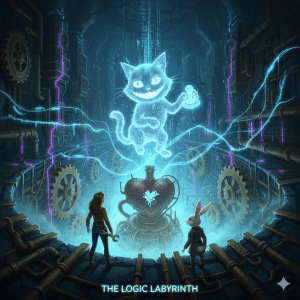
With the Queen’s final Executioner Robot reduced to a heap of scrap metal, Alice and the White Rabbit believe the Cogwork Kingdom is saved. But as they examine the smoking wreckage, a cryptic pattern of light pulses from the destroyed robot’s core—a signal pointing down, not up.
The true source of Wonderland’s madness lies beneath the city: a vast, subterranean network of pneumatic tubes and clockwork gears known as the Labyrinth of Logic. To truly liberate the kingdom, Alice must descend into the darkness and confront the fragmented, grinning entity known as the Aether-Cat, who controls the very code of reality itself.
The only way out is to hack the grid. But how do you debug a nightmare?
 The Crazymad Writer Writes Again