Alice in the Land of Unreason
Alice in the Land of Unreason
(Book One of the Pocket Worlds)
A note: About the Pocket Worlds
There are places so small that no map can find them, and so vast that no explorer ever returns quite the same. They hide inside pockets and teacups, mirrors and raindrops, clocks and candle flames. They are stitched from dreams, folded from thoughts, and opened only by curiosity.
These are the Pocket Worlds — small universes of wonder and strangeness, where questions grow like flowers and answers are never quite what they seem.
Every traveller who finds their way inside leaves a mark, and every mark tells a story. This is Book One, the tale of a girl named Alice, who fell through her own pocket and discovered that sense and nonsense were only ever two sides of the same coin.
Chapter One — Through the Pocket
It began, as so many disasters do, with a speck of jam.
Alice had been warned not to eat toast while sitting on the best armchair, but warnings, she had found, were simply invitations disguised as advice. So she sat, and she nibbled, and when the jam decided to explore the sleeve of her dress, she sighed and reached for her handkerchief.
That was when her fingers brushed the inside of her pocket, and didn’t stop.
It was an ordinary pocket at first glance, lined with blue cotton and perhaps one or two crumbs of forgotten biscuit. But it stretched deeper than it had any right to, like a polite smile hiding a scream. Alice leaned in a little farther. She could feel something beyond the fabric: a cool breeze, the scent of peppermint, the echo of distant laughter.
“Well, that’s peculiar,” she murmured, pushing her hand further until her wrist vanished entirely.
The pocket gave a polite slurp.
“Excuse me?” said Alice, to the pocket. But the pocket, being newly omnivorous, said nothing.
She tried to pull her arm out, only to find the pocket had taken a sudden interest in keeping her. The tug became a pull, the pull a swallow, and before Alice could think this sort of thing really shouldn’t happen before breakfast, she had been entirely pocketed.
The world turned upside-in. Buttons spun past like planets, and somewhere far below a faint humming rose — not quite a tune, not quite a sigh. Then, from every stitch and thread around her, the pocket began to sing.
🎵 The Pocketfall Ballad
I fell past thimble, needle, thread,
Past peppermints the Hatter fed,
Past copper coins that chimed like rain,
And every stitch remembered pain.
Chorus
Oh pocket, pocket, deeper still,
You’re wider than the world at will;
You turned my hem into a sky,
And made my buttons learn to fly.
The lining sighed, “A tidy fall,”
Then folded into velvet hall;
A spool of night rolled past my knees,
Unraveling its moonlit breeze.
Chorus
Oh pocket, pocket, deeper still,
You’re wider than the world at will;
You tuck away what won’t comply,
And save it for another try.
A dropped key rang, a ribbon bowed,
A safety pin became a road;
A crumb became a mountain pass,
A tear turned sea in drops of glass.
Final Chorus
Oh pocket, pocket, take me through,
To where the small becomes the true;
I’ll sew a path with lullabies,
And stitch my heart to stranger skies.
The song drifted away like a dream closing its eyes.
Then the tumbling stopped, and she found herself sitting at the bottom of what appeared to be an enormous handbag, or perhaps a country disguised as one.
Buttons grew on trees. Rivers of ink slithered between the roots, writing and rewriting themselves. A pair of socks argued over which one was left, and a wind passed carrying the faint scent of forgotten errands.
“Hello?” called Alice, her voice sounding slightly inside-out.
“HELLO!” replied her echo, quite rudely.
“Oh, are you me?”
“ARE YOU ME?”
“No, I’m—oh, really, must you?”
Her echo snickered and ran off into the distance, leaving muddy footprints on the air.
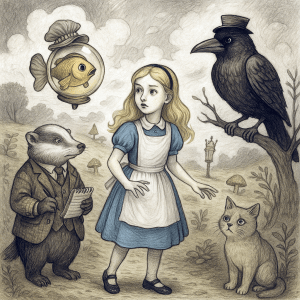
The first creature she met was half badger, half radio announcer. It wore a tie of walnut shells and carried a notebook that was clearly writing by itself.
“Good afternoon, listeners!” the Badger boomed, though there was no one to listen but Alice and a somewhat disinterested tree. “Today’s top story: local girl falls through pocket, claims innocence. Weather: slightly peculiar, with a chance of talking furniture.”
“I didn’t fall, exactly,” said Alice.
The Badger blinked, tuning his whiskers. “Correction: girl denies everything. Now, tell us, how does it feel to be unreasonable?”
“Unreasonable?”
“Of course! You’re in the Land of Unreason. No one with proper logic would visit on purpose.”
Alice looked around. The sky was the colour of unwashed teacups. Clouds drifted sideways. In the distance, a brass lamppost wore a crown.
“I suppose it is a bit odd,” she admitted.
“Odd?” The Badger laughed. “My dear girl, odd is up. Around here, nothing makes sense unless it refuses to.”
Before Alice could ask what that meant, a small explosion of light approached, a glass bubble floating through the air, containing a golden fish wearing a feathered bonnet.
“Don’t mind Lady Lampfish,” whispered the Badger. “She’s very bright, but not quite all there.”
“Who’s not all there?” demanded the fish in a tinkling voice. “I am entirely illuminated, thank you. My glow is world-famous. I once lit a ballroom!”
“An aquarium, surely?” said Alice.
“Ballroom!” cried the fish. “And I shall not hear otherwise!”
Her light flickered dangerously.
Alice thought it best to change the subject. “I’m very pleased to meet you, Lady Lampfish. Could you tell me where I am, exactly?”
“You are precisely between Maybe and Why Not,” said Lady Lampfish grandly. “North of Sense, and several inches south of Sanity. If you reach Certainty, you’ve gone too far.”
“That’s… very helpful,” said Alice, though it wasn’t.
Lady Lampfish glowed a little brighter, basking in the compliment. “You’ll be wanting to see the Queen of Questions, I suppose. Everyone new does. She’s hosting a guessing game tonight; only those who know nothing are invited.”
“That should make me quite welcome,” said Alice.
The Badger scribbled notes furiously. “Girl plans audience with Queen. Possible unrest in Unreason. Tune in at ten.”
“Do stop that,” said Alice. “You’re making me feel like a headline.”
“Everyone’s a headline somewhere,” muttered the Badger. “Even socks.”
And off he trotted, broadcasting nonsense to a field of listening mushrooms.
Alice sighed. “Well,” she said to herself, “I suppose I must find this Queen, and perhaps she can tell me the way out.”
But as she took her first step, the ground politely stepped aside, and she fell, again, into another layer of pocket.
Chapter Two — The Crow Who Quoted Soup
The second fall was shorter, or perhaps she had become better at falling. Either way, when Alice landed this time, she did so neatly on her feet and was immediately accused of it.
“Show-off,” muttered the ground.
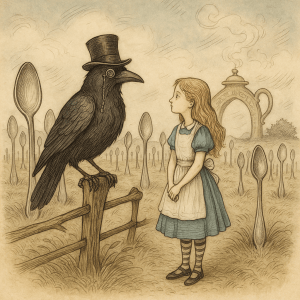
She apologised to it, just in case, and looked about. The air shimmered with the scent of pepper and pretension. Ahead stood a pair of gates made entirely of cutlery. Every spoon bent slightly forward, as if eager to listen.
A brass plaque announced: COURT OF CULINARY LOGIC — ALL ARGUMENTS TO BE SERVED HOT.
A crow in a threadbare judge’s wig sat upon the topmost spoon, reading solemnly from a cookbook. His beak tapped the page like a gavel.
“To make a proper soup,” the Crow intoned, “one must first determine what proper means. Only then may the stock be seasoned with sincerity.”
He looked up and noticed Alice. “Ah! A witness. Or perhaps an ingredient. Approach!”
“I’m neither,” said Alice, though she wasn’t entirely sure. “I only fell in by accident.”
“Accidents,” said the Crow, “are the universe’s favourite recipe. Come in.”
The gates clattered open, and Alice stepped into a hall that smelled of both justice and gravy. The Queen of Hearts presided from a throne carved out of a giant mixing bowl. Steam rose around her like fury made visible.
Her Majesty was engaged in a violent dispute with her kitchenware. Knives trembled. Forks stood rigid with fear. Spoons pretended to faint decorously in their saucers.
“You there!” the Queen barked at a soup ladle. “You’ve been stirring without reason. Explain yourself!”
The ladle bowed with a clank. “Your Majesty, I was merely ensuring equality among the ingredients.”
“Equality?” thundered the Queen. “This is my broth! There will be no democracy in dinner!”
She slammed her sceptre—possibly a rolling pin—upon the bench. “Call the next witness!”
A teapot shuffled forward on spindly legs, lid quivering. “Your Majesty,” it squeaked, “I only whistled in self-defence.”
The Crow scribbled notes on a napkin. “Whistled in self-defence,” he repeated. “Interesting precedent.”
Alice stepped closer. “Perhaps,” she began timidly, “the spoon didn’t mean to stir up trouble—”
The Queen’s gaze swung round like a guillotine. “Who speaks out of turn?”
“I do, though I’d rather not,” said Alice quickly.
The Queen leaned forward. “And what are you?”
“I’m Alice,” she said, “and I don’t belong here at all.”
“Then that makes two of us,” muttered the teapot.
The Crow cleared his throat. “Permission to quote soup, Your Majesty?”
“Granted,” snapped the Queen.
He raised one claw dramatically and read:
“A clear broth is a guilty conscience that forgot its vegetables.”
The courtroom applauded politely. The Queen dabbed at her eyes. “Beautiful. Ten years for the ladle.”
“But, Your Majesty,” gasped the utensils, “that’s unreasonable!”
“Exactly,” she said with satisfaction. “Case closed.”
Alice thought it best to curtsy. “If it’s all the same to you, I should be going. I’ve an appointment with a Queen already.”
“Another Queen?” The Queen of Hearts frowned. “How many of us does this place need?”
“As many as it takes to confuse me completely,” said Alice.
“Then you’ll fit in beautifully,” said the Crow. “Unreason is fond of the bewildered.”
The courtroom dissolved into steam. The Crow fluttered down beside her, his wig sliding over one eye. “A word of advice, traveller,” he said softly. “In this land, logic spoils faster than milk.”
Then he winked, folded himself into a recipe card, and vanished with a pop! that smelled faintly of parsley.
Alice stood alone among the cooling pots. Somewhere beyond the hall a bell chimed—not for dinner, but for something she couldn’t yet name. The sound rippled through the air like a question mark.
“Well,” she said, “perhaps I’ll find dessert at the end of this nonsense.”
And with that she followed the bell’s echo into the next improbable turning.
Chapter Three — The Mines of Meaning
The corridor that led from the Court of Culinary Logic narrowed into a seam of silence. Even the echo of her shoes refused to follow. The air smelled faintly of ink and candle smoke, as though someone were editing reality behind a closed door.
Alice found a wooden sign nailed to nothing at all:
WARNING — UNSUPERVISED THINKING BELOW.
A small rope ladder hung from the darkness, swaying as if beckoning. She gripped it, glanced upward once (where the ceiling would have been if Unreason obeyed ceilings), and began to climb down.
The ladder went on far longer than her sense of comfort allowed. She passed through layers of punctuation — commas hanging like bats, semicolons blinking sleepily as she brushed past. A loose participle fluttered by her ear and escaped into the dark.
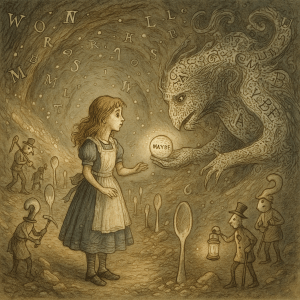
Finally, her shoes struck something solid. She stood on a platform of polished slate that glowed faintly with carved letters. A group of miners, pale as old paper and dusted with graphite, were working the walls with delicate chisels.
“Mind your words, miss!” called one without looking up. “We’ve just stabilised this paragraph.”
Alice peered over his shoulder. The rock face was veined with shining veins of text, each line pulsing softly. When the miner’s chisel tapped one, it rang like glass, and a word fell loose — Perhaps — glowing golden before fading into smoke.
“What are you mining for?” asked Alice.
The miner rubbed his beard, which was full of commas. “Meaning, of course. We extract it from context. Difficult work, especially when the language keeps changing.”
She looked around. Caverns stretched in every direction, lit by the phosphorescent glow of adjectives stacked like gemstones. Nouns were heavier — she could feel them in her shoes.
Another miner approached, pushing a cart piled high with tangled sentences. “Careful where you step, love. One misplaced clause and the whole thought could collapse.”
Alice nodded solemnly. “I’ll try to be careful.”
He squinted at her. “You’re new, aren’t you?”
“I fell through a pocket.”
“Ah,” he said, as if that explained everything. “We get a few of those.”
The sound of picks and pens filled the air — a strange kind of harmony, part rhythm, part argument. Farther in, a group of apprentices were blowing dust off what looked like enormous fossilised words.
“What are those?” Alice asked.
“Old truths,” said the overseer, appearing beside her. He wore spectacles that glowed with definitions. “Most of them are extinct, but occasionally we find one that still moves.”
He gestured toward a massive stone tablet carved with the word WHY.
It shimmered faintly, like a creature breathing in sleep.
Alice stepped closer. The surface reflected her face, but as she stared, her reflection began mouthing questions faster than she could think them.
“What happens if I touch it?” she asked.
The overseer smiled thinly. “Try it and see.”
She laid a fingertip on the word. The cavern shuddered; punctuation rained down like confetti. For an instant, she heard a thousand voices speaking every question she’d ever wanted to ask. Then the WHY splintered and reformed itself into a trembling question mark.
“That happens,” said the overseer, brushing dust from his sleeve, “when you think too loudly.”
“I didn’t mean to.”
“No one ever does. That’s why we dig quietly.”
He pointed to a narrow tunnel lined with inkstones. “You’d best move on before the paragraph closes. The meaning here’s unstable.”
Alice hesitated. “Do you ever find answers?”
“Sometimes,” he said. “But they never last. Once exposed to daylight, they fade to opinion.”
That seemed desperately sad to Alice. She looked down at the glowing shard of Perhaps still lying near her shoe. Gently, she picked it up and slipped it into her pocket.
“Keep it,” said the overseer. “Every traveller should carry one.”
She nodded her thanks and followed the tunnel upward, where the air began to brighten and the words thinned into whispers. Behind her, the steady rhythm of the miners’ tools echoed like a heartbeat beneath thought.
As she climbed, the meaning in her pocket pulsed faintly against her hand, warm and uncertain.
By the time she reached the surface, she wasn’t sure whether she’d learned anything at all — or merely been learned by the place itself.

Chapter Four — The Surface of Supposition
When Alice emerged from the tunnel, the air had changed. It felt lighter, as though every breath were half a thought that hadn’t decided whether to finish. She stood at the edge of a broad plain made entirely of mirrors, each one tilted at a peculiar angle, reflecting sky, soil, and nothing at all.
A sign leaned crookedly in the dust.
THE SURFACE OF SUPPOSITION — WALK CAREFULLY; IDEAS ARE SLIPPERY.
Alice placed one foot onto the nearest mirror and gasped. It held her weight, yet rippled like water. Beneath her, reflections formed and scattered: a dozen Alices walking in slightly different directions, each carrying on as if she were the real one.
“Do try to keep to your lane,” said one reflection primly. “You’re causing existential congestion.”
“I beg your pardon,” said Alice. “But you seem to be walking the wrong way.”
“That depends which way is wrong.”
And with that, the reflection turned into a breeze.
She tried another step. The surface hummed faintly beneath her shoes, a sound like distant reasoning. When she crouched to listen, she could hear murmurs rising through the glass:
“If every truth has two sides, does that mean we are all coins?”
“What if gravity is just nostalgia for the ground?”
“Suppose… suppose…”
Each phrase drifted away before it finished, as though the sentences had lost their nerve.
Further on, she came to a cluster of figures standing knee-deep in their own reflections. They were made of mist and logic, wearing coats stitched from conjecture. Each carried a notebook filled with half-sentences that kept erasing themselves.
“Good day,” said Alice politely. “Is this the way to the Queen of Questions?”
One of the figures looked up. His face was blurred, like an answer crossed out. “That depends entirely on how you phrase the question.”
“I don’t know how to phrase it,” she admitted.
“Then you’re almost there.”
They stepped aside, and she walked on, the mirrors brightening under her feet. Soon the plain sloped downward into what might have been a reflection of the sky or the sky pretending to be a reflection. It was impossible to tell.
At the centre stood a small table set for tea — one cup, one saucer, one pot of what appeared to be liquid probability. Beside it sat a chair, and in the chair a gentleman made entirely of assumption.
He rose and tipped an invisible hat. “Welcome to the Surface. I am Supposition.”
Alice curtseyed. “You don’t look very certain.”
“Of course not,” he said, mildly offended. “Certainty is dreadfully arrogant.”
He poured two cups of translucent tea. “Do sit. It’s best taken with a question.”
Alice obeyed. The tea tasted like something she had once almost remembered. “It’s quite good,” she said cautiously.
“Of course it is,” said Supposition. “It might be dreadful, but you’ll never know for sure, and that’s the flavour.”
He smiled and leaned closer. “Tell me, why are you here?”
“To find the Queen of Questions.”
“Ah.” He nodded gravely. “The most uncertain of monarchs. You’ll find her easily enough; she’s everywhere she hasn’t been yet.”
Alice blinked. “That doesn’t sound convenient.”
“It isn’t,” he agreed. “But it keeps her interesting.”
The tea rippled in her cup. She saw shapes moving in it: her own face, then another, older one, the features soft and luminous. For a heartbeat she thought it looked like the woman she would someday become — the one with answers she hadn’t earned yet.
She set the cup down quickly. “Thank you for the tea. I should go before I drown in it.”
“As you wish,” said Supposition. “Mind the edge. Ideas have a tendency to fall upwards.”
Alice stood, curtsied again, and stepped carefully from the mirrored plain onto a narrow bridge of thin air. The mirrors beneath reflected her dwindling shape, multiplied into infinity.
As she crossed, her reflection whispered faintly from below:
“Remember — questions are only answers that grew wings.”
When she reached the far side, the plain dissolved behind her with a sigh, leaving only a single echo that shimmered like light on water.
Alice turned toward the distant hills, where the horizon curved like the edge of a page.
Whatever lay beyond, she felt certain it would be beautifully uncertain.

Chapter Five — The House that Argued with Itself
The road beyond the mirror-plain wound upward between hedges that seemed to rearrange themselves whenever she wasn’t looking. After some time—or perhaps after none at all—Alice came upon a small grey house sitting in the middle of the lane. It looked tired in the way that houses sometimes do: one shutter drooped, the chimney leaned away from the roof as if in quiet disgust.
She was about to knock when the door shouted, “Don’t bother! She’s not speaking to me.”
“Who isn’t?” asked Alice, stepping back.
“The windows,” the door snapped. “They think they’re superior because they let in light.”
From somewhere above, a voice of brittle glass replied, “At least I see what’s going on, which is more than can be said for you.”
“See? Insolent as ever,” the door grumbled. “If it weren’t for me, nobody would enter this house.”
Alice coughed politely. “Excuse me, but may I?”
“Ask the windows!” said the door. “They think they own the place.”
The roof groaned. “Could you all keep it down? Some of us are supporting this argument.”
Alice frowned. “This can’t be comfortable, living in constant disagreement.”
The door sighed. “We were built on speculation. What do you expect?”
A set of steps unfolded itself with a weary creak. “If you’re determined to go in, child, mind the hallway. It changes its mind more often than the weather.”
Alice climbed the steps and entered before the door could reconsider. Inside, the hallway indeed looked indecisive: two staircases led upward in opposite directions, both labelled DOWN. A fireplace sat uncertainly between two walls, neither of which appeared sure they wanted it.
A clock on the mantel clicked forward, backward, and then sighed. “Pointless, all of it. I measure time, and still nobody agrees what it is.”
“Perhaps you’d be happier without hands,” said Alice kindly.
“Wouldn’t we all?” the clock murmured.
A corridor branched into rooms whispering behind half-closed doors. From the nearest came the sound of conversation—one voice loud, the other quiet, though both unmistakably the same.
Alice peeked in. The parlour was quarrelling with itself: one half immaculate, the other in perfect disarray. A velvet chair stood nose-to-nose with its own reflection, arguing about posture.
“I told you,” hissed the tidy side, “presentation is everything.”
“And I told you,” the messy side retorted, “authenticity matters more.”
A vase of flowers attempted to mediate but fainted instead.
Alice slipped away before the debate could recruit her opinion.
She found a narrow staircase spiralling upward—or perhaps inward—and followed it to the attic. There she discovered the heart of the dispute: the house’s mind, a ghostly outline shaped roughly like its floor plan, pacing in agitation.
“It’s hopeless,” it moaned. “Every beam contradicts another. I was designed by a committee of architects, each one certain the others were wrong.”
“Couldn’t you all compromise?” asked Alice.
“Compromise?” The house’s voice splintered into echoes. “That’s what created me in the first place!”
The floorboards trembled underfoot. Dust drifted like unshed thoughts. She realised with a small shiver that the whole building was thinking itself apart.
“Please don’t collapse,” she said softly. “You’re quite beautiful, even when you disagree.”
The house paused. The timbers exhaled. A warm wind moved through the rooms, straightening shutters, soothing hinges. Even the door outside murmured a grudging apology.
“Beautiful?” the house repeated, surprised. “I’ve been called many things—structurally unsound, aesthetically paradoxical—but never that.”
“Well,” said Alice, “perhaps beauty is just balance waiting to happen.”
For a moment, the rafters glowed faintly with approval. Then, somewhere deep in the foundation, a voice whispered, Possibly, and the whole house settled with a contented sigh.
When Alice stepped outside again, the sky had turned the colour of unfinished thoughts. The road curved away between fields of glimmering chalk. Behind her, the house creaked one final observation.
“Do come again,” it said. “Next time we’ll argue about doors versus thresholds.”
“I look forward to it,” said Alice.
And as she walked on, the house began humming to itself, quietly practicing the art of agreement.

Chapter Six — The Mountain of Forgotten Questions
The road climbed until it could no longer decide whether to be a road at all. Grass gave way to grey shale, and then to a shimmer of unanswered thoughts lying like mist along the slopes. The sky pressed low and close, its colour that of unsent letters.
At the mountain’s base, a sign had been carved into a slab of doubt:
MOUNTAIN OF FORGOTTEN QUESTIONS
ASCEND QUIETLY — ANSWERS ARE SLEEPING
Alice placed a hand upon the stone. It was warm, as if thinking beneath her fingers. The moment she began to climb, whispers rose from every ledge.
“Why did I leave the window open?”
“What becomes of a wish that nobody keeps?”
“Where do the missing hours hide?”
Each voice faded before she could locate it, and every time she glanced back the path below had rearranged itself, folding away unnecessary certainties.
Halfway up, she met a man sitting on a rock, wrapped in a coat of question marks that shifted like restless birds. His hat was tilted over his eyes, and beside him lay a pile of blank notebooks.
“Are you the keeper of the mountain?” she asked.
He nodded without looking up. “Caretaker, perhaps. The questions come here to rest when they’ve grown tired of being ignored.”
Alice sat beside him. “Do they ever wake?”
“Sometimes. Usually when someone asks them again, but never quite the same way. It startles them.”
He lifted his head. His eyes were two tiny punctuation marks, commas caught mid-pause. “You’re carrying one, aren’t you?”
She remembered the glowing shard from the mines. “Only a perhaps.”
He smiled faintly. “That’s how every question begins.”
From somewhere above, thunder murmured in the shape of curiosity. The clouds were thick with thought. Alice continued upward, and the air grew sharp with wonder. Every stone she stepped on hummed with inquiry.
At the summit stood a thin spire of rock, pierced clean through by wind. Through its hollow centre drifted voices—not loud, but endless.
“How small is forever?”
“What colour is silence?”
“Who first decided what impossible meant?”
Alice approached cautiously. The sound drew her closer until she could see, lodged inside the hollow, a small wooden box held shut by a question-mark–shaped latch. It pulsed like a heartbeat.
She hesitated. “If answers are sleeping,” she whispered, “then what happens if I wake one?”
The caretaker’s voice floated up from below. “Only one way to find out.”
Her fingers brushed the latch. The box opened itself with a sigh. Inside lay nothing visible—only a breath of wind that smelled of chalk and time. Yet in that moment she heard, as clearly as a voice in her own head:
“The answer is never lost. It is merely waiting for the right listener.”
She closed the box gently, bowed to the mountain, and began her descent. Each step downward left a faint glow on the stones behind her, as though the path itself were asking her to remember.
At the base again, she turned for one last look. The mountain stood unchanged, yet she felt certain it now knew her name.
“Well,” she said, brushing the dust from her skirt, “if the questions can rest, perhaps I may too.”
The wind answered with a whisper that could have been agreement—or another question entirely.

Chapter Seven — The Valley of Half-Forgotten Dreams
The mountain sloped downward into mist so thick it muffled her own heartbeat. The air felt hushed, as though it belonged to someone else’s sleep. The ground was soft, covered in a carpet of faded petals and discarded yesterdays.
Alice walked slowly, not wanting to wake the valley. She could feel dreams brushing past her ankles—thin and cold, like ribbons trailing through water. They had colour, these dreams, but not shape; she glimpsed half-built castles, broken teacups that still remembered laughter, faces she was sure she’d met but could not name.
A sign appeared, hanging crookedly from nothing at all:
THE VALLEY OF HALF-FORGOTTEN DREAMS
PLEASE TREAD LIGHTLY — MEMORY IS FRAGILE
She obeyed.
Further on, she found a girl sitting by a pool of glassy water. The girl was her own reflection, but a little older—her eyes calmer, her smile uncertain. The reflection looked up and said, in a voice like the other side of silence, “I was wondering when you’d arrive.”
Alice knelt by the pool. “Are you me?”
“I’m who you almost became,” said the reflection. “Or who you might yet be, if you don’t wake too soon.”
“That sounds confusing.”
“It’s Unreason. Confusion is how we communicate.”
The reflection stood, and the pool rippled into music. The melody rose from the ground itself, slow and circling, like a thought that refused to fade.
Then they both began to sing.
🎵 The Sleeper’s Waltz
I dreamed I was dreaming and woke in between,
Where nothing was everything polished and clean;
I lifted a lantern of borrowed intent,
And followed the footprints my future had sent.
Chorus
Turn once for sorrow, turn twice for delight,
Turn thrice for the answer that hides in the night;
If I am your shadow, then lend me your eyes,
We’ll waltz through the question that never quite dies.
You spoke with my mouth and I listened with yours,
We traded our names at invisible doors;
A mirror remembered the laugh of the rain,
And handed it back with a ribbon of pain.
Chorus
Turn once for sorrow, turn twice for delight,
Turn thrice for the answer that hides in the night;
If I am your echo, then teach me your sky—
We’ll dance till the boundaries loosen and sigh.
Bridge
Hold to the hand that is also your own,
Sing to the silence that gardens a stone;
Dreams are the stitchwork that fastens a seam,
Waking is simply the lining of dream.
Final Chorus
Turn once for sorrow, turn twice for the light,
Turn thrice and the morning will enter the night;
If I am your future, then leave me your why—
We’ll finish the waltz when the questions run dry.
When the last note faded, the reflection smiled faintly. “You see? We’ve always been the same song, only sung in different directions.”
Alice reached toward her, but her fingers met only cool water. The reflection blurred, then steadied again—older now, wiser, fading like a dream that knows it must let go.
“I don’t want to forget this,” said Alice softly.
“You won’t,” said the other Alice. “You’ll just remember it differently.”
The reflection stepped backward into the water and dissolved into ripples that gleamed like silver thread. The pool darkened, then went still.
Alice stood alone in the valley. The mist lifted slightly, and the first edge of dawn—if dawn existed here—glowed pale and kind.
She looked down at her hands. They were trembling, though she wasn’t sure whether from sorrow or from understanding.
“Perhaps both,” she whispered. And Unreason, being polite for once, did not contradict her.

Chapter Eight — The Library of Lost Tomorrows
The valley narrowed into a corridor of stone that seemed to hum softly to itself. At its end stood a door carved with hourglasses, each one flowing upward instead of down. A single word was etched across the lintel: ENTER.
Alice hesitated. “That’s not very specific,” she said.
But the door, being impatient with hesitation, opened of its own accord.
Inside was twilight—endless, weightless twilight. Rows upon rows of bookshelves reached higher than she could see, their ladders dangling into clouds of dust and forgotten ambition. Each shelf was labelled not by subject, but by feeling:
Regret (Uncatalogued)
Hope (Untested)
Plans Made on Tuesdays
Possible Miracles, Misplaced Section
A librarian glided silently between the stacks. She was tall, made entirely of paper, her face creased into gentle lines of punctuation. A quill hovered at her shoulder, scribbling notes that vanished into smoke.
“Good evening,” said Alice politely. “Is this a library?”
“It was,” the Librarian replied. Her voice sounded like the turning of pages. “Now it’s a waiting room for stories that never happened.”
Alice looked around at the endless shelves. “All of these books are unwritten?”
“Oh no,” said the Librarian. “They were written, but then their tomorrows were cancelled. We keep them here until someone dreams them again.”
She gestured to a table where a dozen books lay open, their words shifting like restless sleepers. “See there? That one nearly became a legend once, but the storyteller lost his nerve halfway through a sentence.”
Alice leaned closer. The ink swirled into a single unfinished line: Once upon a time there would have been…
“What happens if no one dreams them again?” she asked.
The Librarian closed the book gently. “They fade into silence, which is not the worst fate. Most things end that way, eventually.”
Farther down the aisle, something stirred—a sigh, perhaps, or a turning page. She followed the sound to a balcony overlooking the whole vast library. From here, she could see that the shelves formed an enormous spiral, curling inward like a question mark. In its centre glowed a single lamp whose flame pulsed in rhythm with her heartbeat.
“What’s that light?” she asked.
“That is the unwritten end of everything,” said the Librarian. “It brightens each time someone dares to imagine how their story might go differently.”
“Is it dangerous?”
“Only to certainty.”
They stood together in the quiet, the air heavy with might-have-beens. Somewhere below, a book snapped shut, startled by its own conclusion.
Alice touched the banister, and a small current ran through her fingers—a whisper of unwritten time. For a moment, she saw herself much older, sitting at a desk, pen poised, pages before her glowing faintly. The vision faded before she could read what she had been writing.
“I think,” she said softly, “I’d like to remember this place when I wake.”
The Librarian inclined her head. “That is what every dreamer says. But remembering is only half the task. The rest is to keep imagining.”
Alice turned to thank her, but the Librarian was gone, melted into the rows of waiting futures.
She descended the staircase slowly. Each step left a faint mark of light behind her—temporary, like a promise.
At the foot of the stairs, the door opened again without being asked. Beyond it lay a clock-tower skyline trembling in a copper sunset.
Alice looked back one last time. The Library sighed, shelves shifting in gentle applause.
“Goodbye,” she whispered. “Or perhaps—see you someday.”
Then she stepped into the fading light.

Chapter Nine — The Clock That Ticked Backward
The sun had been a slow, copper coin sinking into the horizon when Alice stepped through the library door.
By the time she reached the next hilltop, the coin had risen again, spinning slowly in the wrong direction.
Below her stretched a city that pulsed like a heart wound too tight.
Every street curved around itself; every tower leaned against its own shadow.
And from somewhere within came the steady hum of ticking — not forward, but backward.
A sign at the city gate read:
WELCOME TO TICKTOCK TOWN
WHERE YESTERDAY IS TOMORROW’S PAST
The gate opened of its own accord, and a gust of cool air swept through, smelling faintly of oil and old minutes.
Alice entered cautiously.
The streets were paved with clockfaces, their hands spinning in reverse.
The people moved carefully, each step matching the rhythm of the ticking around them.
A small child carrying a watch the size of a dinner plate stopped her.
“You’re out of step,” he said gravely.
“I didn’t know there was a step,” said Alice.
“There always is,” he replied. “It’s how we stay behind ourselves.”
She tried to match his pace — backward, then forward, then backward again — but it felt unnatural, as though she were walking through her own memory.
From above, bells began to chime in a pattern that made her dizzy.
Shop windows displayed time bottled like perfume: Five o’clock in a jar, A moment before dawn, Three seconds of laughter.
Every label read: Limited supply; may expire prematurely.
She stopped at a corner where a group of workers were winding a clocktower taller than the sky.
Its pendulum swung lazily from one century to another.
And then, as the bells slowed, she heard the city itself begin to sing.
🎵 The Song of Ticktock Town
Tick for a truth and tock for a tale,
Time wears a waistcoat buttoned with hail;
Hours on hinges, minutes on springs,
Seconds with silver mechanical wings.
Chorus
Hush, hear the metronome moon on the crown,
This is the song of the Ticktock Town;
Forward is sideways and backward is fine,
So long as you walk on the dotted line.
Clocks in the windows practice their waltz,
Some keep perfection, others keep faults;
Shopkeepers measure the weight of delay,
Selling lost Tuesdays two pennies a day.
Chorus
Hush, hear the metronome moon on the crown,
This is the song of the Ticktock Town;
Borrow a minute and pay with a sigh—
Change is a chime that won’t tell you why.
Bridge
A child in a bonnet of brass and of blue
Whispers, “Take care, or time will take you.”
Alice replies, “I’ll borrow the beat,”
And dances the cobbles to quicken her feet.
Final Chorus
Hush, let the metronome soften its sound,
Step off the mark where the moments are found;
Pocket your courage, don’t barter your crown—
Dreams set the pace in the Ticktock Town.
When the last note faded, the city sighed as if relieved to have emptied its lungs.
The gears beneath the streets slowed, the bells quieted, and the clocks—every one of them—paused for a heartbeat.
In that stillness, Alice heard whispers rising from the cobblestones:
fragments of time returning to where they’d been borrowed.
She looked up at the great clocktower.
Its hands no longer turned backward; they hovered between one second and the next, uncertain which direction to choose.
“Perhaps,” she said aloud, “time isn’t supposed to go anywhere at all. It just circles until we learn something worth repeating.”
The tower’s bells gave a single, thoughtful ding — a sound not of warning, but of agreement.
When she turned away, the city began to unwind behind her.
The streets folded into themselves; shopfronts blinked out one by one, leaving only a quiet shimmer of possibility.
Ahead lay a gate of ivy and fractured light, and beyond that, she thought she saw the first trembling leaves of a garden — one where seasons had apparently given up keeping order.
Alice smiled faintly. “At least,” she said, “it will be late in every direction.”
And she stepped through.
Chapter Ten — The Garden of Unfinished Seasons
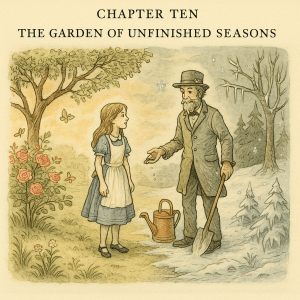
Beyond the gate lay a garden stretched thin across time.
Spring tangled with autumn, snow drifted between blooming roses, and the air carried the scent of ripened fruit that refused to fall.
Trees argued softly with their own branches about whether to bud or shed, and the wind couldn’t decide if it was warm or cold.
Alice stood in the middle of it all, utterly bewildered.
A daffodil sneezed frost onto her shoe.
“Bless you,” said Alice automatically.
“Thank you,” said the daffodil. “Though I’d rather be thanked in sunshine.”
“Sunshine is unavailable at present,” muttered a tulip dusted with snow. “We’re behind schedule.”
A crocus yawned and replied, “Speak for yourself; I’ve been awake since last November.”
The path ahead was lined with hedges of every colour, each trimmed into a different month of the year.
A bench sighed under the weight of last summer’s memories, and a nearby sundial was sulking because nobody was keeping still long enough to cast a shadow.
From behind a cluster of peonies came a sharp, indignant voice.
“Do stop gossiping, all of you! The Queen will be most displeased to find us wilting in conversation.”
“Which Queen?” asked Alice hopefully.
The flowers hesitated.
“The weather one,” said a violet.
“No, the reason one,” said a rose.
“The one who hasn’t arrived yet,” added a dandelion.
And that seemed to end the matter entirely.
Alice sighed. “Perhaps while you wait, you could tell me where the seasons went wrong.”
The flowers shuffled their leaves, embarrassed.
Then, with the air of performers who had been waiting all year for an audience, they began to sing.
🎵 The Flowers’ Argument
Said Rose: “Observe my royal red—
A queen belongs upon a bed!”
Said Lily: “White is wiser, dear,
It goes with everything but fear.”
Chorus
Bloom and boom, we all perfume,
We quarrel for our share of room;
If beauty’s proof, then hush and see—
The best of best is obviously me.
Said Violet: “Modest truth is sweet;
I whisper colour at your feet.”
Said Tulip laughed with double lip,
“I’m two of you in one fine sip!”
Chorus
Bloom and boom, we all perfume,
We quarrel for our share of room;
Ask any bee with proper taste—
It’s me, not you, it’s no-time-waste.
Bridge
Then Dandelion, wild and gold,
Declared, “The fields are mine to hold.”
The wind agreed and blew them wide—
They argued still, but could not hide.
Final Chorus
Bloom and boom, the seasons loom,
We fade and fight and make more room;
Yet when the moon lifts up the dew,
We sing because the world is you.
When the last petal’s note faded, the garden fell silent.
A soft snowflake landed on Alice’s sleeve and immediately turned into pollen.
“Well,” she said, “that was very lovely, though I’m not sure who won.”
“Won?” said the rose indignantly. “It wasn’t a competition!”
“Of course it was,” sniffed the tulip. “I came second, just after myself.”
The violets sighed in harmony, a sound like velvet sulking.
“I think,” said Alice gently, “that you’d all be happier if you grew together.”
“Outrageous suggestion!” the rose declared, but several smaller blooms looked thoughtful, which in a garden is the first step toward reform.
Alice smiled and moved on.
The air brightened as she walked; the quarrelling blossoms faded into murmured gossip behind her.
Ahead, the path sloped down toward a silver river crossed by a bridge that shimmered between sunlight and shadow.
She felt, quite suddenly, that her journey was drawing toward its end.
Unreason, it seemed, was almost ready to make sense.
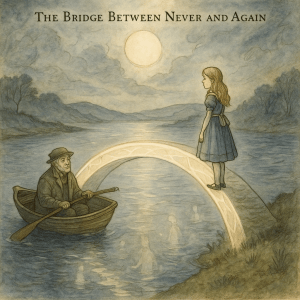
Chapter Eleven — The Bridge Between Never and Again
Evening had gathered itself into the folds of the river.
The water shone like melted glass, drifting with reflections that weren’t quite its own: faces half remembered, places that might never have existed, colours that belonged to feelings instead of light.
A narrow bridge arched across it — not wood or stone, but something luminous and shifting, as if it were made from the breath of a sigh.
Each plank glowed briefly when she stepped upon it, leaving a fading trail of her footprints behind.
At the bridge’s near end sat a ferryman in a smoke-coloured coat.
He was mending his oar, though Alice could see no boat.
“Are you the ferryman?” she asked.
“I was,” he said mildly. “But the current learned to row itself. Now I mostly watch.”
He gestured to the bridge. “You’ll find it steadier than it looks, though it prefers to be crossed only by those who don’t know where they’re going.”
“I suppose that’s me,” said Alice.
He smiled, the kind of smile that knew more than it admitted.
“The river doesn’t lead forward or back,” he told her. “It only reflects. Most who cross it discover which memories still float.”
She gazed into the current. Shadows drifted by — the March Hare chasing teacups, a flash of the White Rabbit’s waistcoat, the shimmer of a mirror she’d once stepped through.
Each one flickered and was gone, like fragments of a dream remembering itself.
“What happens if I fall?” she asked softly.
“You won’t,” said the ferryman. “Not unless you start believing you can’t.”
She took her first step.
The bridge hummed beneath her, a low, steady note that reminded her of heartbeat and lullaby both.
Halfway across, she looked back — but the far bank had already changed places with the one she’d left.
The ferryman raised a hand in farewell. “Mind the middle,” he called. “That’s where the truth likes to hide.”
She nodded and walked on. The bridge carried her above the shimmering water, and as she reached its heart, the reflections below began to sing.
Not a song of words, exactly — more the sound of memory unfolding.
She closed her eyes and listened.
Each note seemed to lift something from her shoulders: a worry, a question, a tiny forgotten name.
When she opened them again, the far bank was waiting — a hill covered in light that looked like pages turning.
She turned to thank the ferryman, but he had vanished, leaving only the oar resting against the air, still dripping with silver.
Alice stepped onto the grass, and the bridge behind her rippled once, then dissolved into the river’s skin.
She didn’t look back this time.

Chapter Twelve — The Hill of One Thousand Endings
The hill rose like a question mark drawn against the pale sky.
Each blade of grass shimmered with faint ink, as if words had been written there and then forgotten.
At its summit stood a wooden desk, and upon the desk an open book that glowed softly from within.
Alice climbed slowly. The air tasted of paper and candle wax, and each step felt lighter than the last.
When she reached the top, she found someone already seated at the desk.
It was herself — older, perhaps only by a thought, but unmistakably her.
The woman’s hair was silver threaded with sunlight, and her eyes held the quiet knowing of dreams remembered well.
She looked up and smiled.
“I was wondering when you’d arrive,” she said.
Alice’s heart fluttered. “You’re me?”
“I’m the part of you that writes the endings,” the woman replied. “And it’s nearly time for ours.”
Alice looked down at the open book. Its pages were filled with words that drifted and rearranged themselves as she read. Some glowed brightly, others blurred into light and disappeared.
“Is it finished?” she asked.
“Never quite,” said the Writer. “Every ending leaves space for another beginning to find it.”
She lifted her pen — invisible, yet its movement left trails of golden ink in the air — and began to write again. As the nib traced the final lines, the wind caught the words and carried them skyward, scattering them like petals of light.
Alice watched, transfixed.
They rose higher and higher until the whole sky seemed to be made of letters.
The Writer began to hum softly, and the hum shaped itself into a song — the last and gentlest of Unreason’s melodies.
🎵 The Writer’s Farewell
I’ll close the page the long way round,
Where footfalls turn to floating sound;
Where every ending learns to be
A little door with one more key.
Chorus
Goodnight, good-bye, begin again—
The road remembers where you’ve been;
The ink that dries will bloom by noon,
A secret seed, a second moon.
I’ll lay the pen where dawn can see,
And leave a margin wide and free;
For children of the after-then
To write the rest and start again.
Chorus
Goodnight, good-bye, begin again—
The road remembers where you’ve been;
A story sleeps but does not end,
It only waits to be your friend.
Bridge
Take what you need—a name, a thread,
A crumb, a bell, the word you said;
And if you meet me down the lane,
We’ll trade our maps for rain.
Final Chorus
Goodnight, good-bye, begin again—
The heart goes out and back, and then
It finds the door it passed before…
And knocks, and sings, “One page more.”
The last line faded into silence, though the air still seemed to hum with its echo.
The Writer closed the glowing book and looked up at Alice.
“Every story finds its listener,” she said. “Now it’s your turn to tell it.”
Alice wanted to ask what that meant, but the words drifted away before she could speak them.
The hilltop shimmered. The desk, the book, the Writer — all began to dissolve into a soft brightness that smelled faintly of home.
A breeze brushed her cheek, and for an instant she felt the weight of her own pocket again — the one she’d fallen through, so long ago.
When she looked down, it was only fabric and dust, and the faint glow of a single word stitched into the seam:
Perhaps.
She smiled. “That will do,” she whispered.
Then the light folded her gently inward, like the closing of a well-loved book.
 The Crazymad Writer Writes Again