Alice and the Museum of Missing Things
Alice and the Museum of Missing Things
Chapter One: The Door Behind the Linen cupboard
It was a very dull afternoon, the sort of afternoon that tries very hard to be interesting by being damp and slightly windy, but never quite manages it. Alice was indoors, which was terribly disappointing for the wind, and had taken to rearranging her teaspoons in alphabetical order.
“It goes: Alphabet Spoon, Buttercup Spoon, Chatterley Spoon…” she muttered, tapping each one with the precision of a slightly obsessive librarian. “Though I’m not entirely certain where the Egg Spoon fits in. E for Egg, or S for Spoon? What a confusing contradiction.”
She sighed.
Outside, the rain couldn’t decide whether it was drizzle or drama. Inside, the house ticked and tocked and creaked the way houses do when they think no one is listening. The wallpaper was peeling in one corner, rather dramatically, like it hoped to reveal a secret passage. But Alice had already tried climbing in there and had only found a grumpy spider named Trevor.
So she turned to the linen cupboard.
It wasn’t an especially adventurous cupboard. Mostly towels. A few pillowcases that resented being ironed. A mysterious bundle of socks that had fused into a single, immovable sock-brick.
But today, behind a slightly lopsided stack of tea towels with embroidered ducks on them, she found something she had never seen before.
A door.
Not an ordinary door, no. This door had no knob, no keyhole, no hinges. Instead, it shimmered faintly and smelled of forgotten birthdays. Etched upon it in curly silver letters were the words:
“To the Department of Detritus, Dust, and Dreams Mislaid.”
Alice raised an eyebrow. “That doesn’t sound like it leads to the pantry.”
Without a moment’s hesitation—because hesitation had taken the afternoon off—she reached out and touched it.
The door didn’t open.
It remembered how to open.
There was a curious sound, like a librarian sneezing into a velvet cushion, and then Alice stepped through.
What she saw was impossible.
Which meant it made perfect sense.
A great, vaulted hallway stretched out in every direction, as if someone had taken an entire city’s worth of architecture and forgotten to give it walls. Stained-glass windows floated unsupported. Stairs spiraled up to nowhere in particular. Labels hung in midair describing things that weren’t there at all.
“Display 34-B: The Last Breath of a Forgotten Lullaby.”
“Display 7-Q: That Feeling You Had on a Wednesday in June, 1993.”
“Display 108-Prime: Every Left Glove Ever Lost.”
Alice wandered slowly forward, mouth slightly open, taking it all in. On a plinth to her left was a single slipper, quietly sulking. A small sign read: “Misplaced during a midnight cheese raid. Owner never confessed.”
“Hello?” she called. Her voice echoed oddly, as though it wasn’t quite sure what mood to be in.
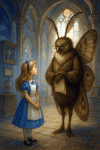
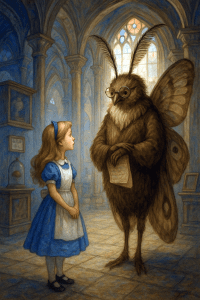
Then came a fluttering, a gust of dusty wind, and from behind a stack of filing cabinets shaped like teapots, emerged a six-foot-tall moth wearing half-moon spectacles.
He was dabbing his antennae with a lace kerchief.
“Oh dear, oh dear,” said the moth, “this simply won’t do at all. We haven’t had a visitor in decades! Or perhaps it’s only been minutes. Time likes to hide here, you know. Very inconsiderate of it.”
Alice did a polite curtsy, because she remembered it from a book and it seemed the sort of thing one ought to do when meeting a well-dressed insect.
“My name is Alice,” she said.
“Of course it is,” said the moth. “Who else would come through that door? I am Mister Mothworth, Curator of the Museum of Missing Things. And you, dear girl, are precisely what we need.”
Alice perked up. She had always suspected the world might need her at some point, she just hadn’t been sure for what.
“We have a problem,” said Mothworth gravely. “Nothing’s been going missing. Not a single sock, not a scribble, not even a fleeting sense of wonder.”
He gestured to the empty display shelves. “The Museum is starving, my dear. The world is remembering everything.”
Alice blinked. “Is that bad?”
Mothworth flapped his wings and sighed. “It’s unnatural! People are remembering birthdays, finishing books, keeping track of their umbrellas! If this keeps up, we’ll have to shut down the Department of Lost Sandwiches. And we only just refurbished the mayonnaise exhibit.”
He adjusted his spectacles.
“We need someone clever. Someone curious. Someone… slightly out of their depth.”
Alice beamed. “That’s me exactly.”
“Good,” said Mothworth. “Then your tour begins at once. Watch out for the Hall of Misheard Goodbyes. It echoes in peculiar ways.”
And with that, Alice plunged into the Museum’s first corridor—where memory, mischief, and meaning all went missing together—and thus began her strangest adventure yet.
Even stranger than the time she played croquet with a flamingo named Gerald who had strong political opinions.
Chapter Two: The Room of Misplaced Blame
The corridor was long, dim, and full of muttering.
Alice walked carefully. The floor was tiled with forgotten apologies, and they made a sort of squelchy whispering sound as she stepped—like old letters trying to change their meaning.
Every few feet, a bronze plaque floated in the air.
They read things like:
“This was not my fault.”
“I only did it because of the mushrooms.”
“Technically, the blame should go to Bernard.”
As she entered a vast, domed chamber, a great groaning filled the space.
This was The Room of Misplaced Blame—and it was full of… pointing fingers. Not statues, not carvings—actual, floating, disembodied fingers, all spinning slowly through the air, frozen mid-accusation.
Some pointed left, some pointed right, and at least three were locked in a furious standoff with each other in a triangle of mutual condemnation.
“He did it!” cried a voice.
“No, she did!” yelled another.
“It was that sheep with the clipboard!” added a third.
Alice looked around.
No sheep. No clipboard. Just a sea of fluttering excuses, hovering like moths in a storm. They rustled past her ears in urgent little flurries:
“I wasn’t even there.”
“It slipped.”
“I thought it was Tuesday.”
“Nobody told me it was plugged in.”
She was beginning to feel quite itchy with all the guilt floating about. Then a polite cough came from behind a tower of overdue apologies.
It was Mister Mothworth again, holding a cup of tea that shimmered slightly as though it had opinions.
“Ah, there you are,” he said. “Blame gets lost here more than anything else. It’s terribly sticky stuff—clings to the wrong person and never quite comes off.”
He handed her the cup. “Chamomile and forgetting. Very calming.”
Alice took a sip. It tasted like dreams you can’t quite remember.
“But why are there so many fingers?” she asked, dodging one that was wagging dramatically in her direction.
“Ah yes,” Mothworth said, adjusting his spectacles. “That’s Section P. The Department of Pointing. You wouldn’t believe how many arguments are started simply because someone pointed in the wrong direction and refused to admit it.”
He led her further in. They passed a shelf of Unclaimed Regrets, one of Unsent Complaints, and a particularly dusty corner labelled “Sorry, Not Sorry.”
Alice paused beside a large glass display case.
Inside floated a single sentence, made of brass letters:
“I suppose it was all my fault after all.”
It was heavily chained, locked, and surrounded by velvet ropes.
“Rare specimen,” Mothworth whispered reverently. “Fully-accepted personal accountability. Found in a forgotten diary wedged behind a toaster.”
Alice nodded solemnly. “Is it contagious?”
“Not in the slightest,” he sighed. “We tried passing it around, but people just accused the jar of poor communication.”
A loud clatter rang out, interrupting them.
From behind a wall of old blamelessness forms, a great blame beast emerged.
It looked like a cross between a slug and a tax form. Covered in sticky post-it notes, with scribbled accusations like:
“Because of YOU, I missed my dentist appointment!”
“I wouldn’t have eaten the cake if YOU hadn’t said it was low-fat!”
“YOU started it!”
The beast oozed forward, growling something about spilled milk and missing birthdays.
“Oh dear,” said Mothworth, backing away. “Someone’s let loose a fully-formed Misblamer. Nasty things. They multiply in office meetings.”
Alice, not one to back away from the absurd, grabbed the nearest available item—which turned out to be a rubber stamp marked “Null & Void”—and held it aloft.
“Bad beast!” she said sternly. “You’re making things awkward!”
The Misblamer paused. No one had ever spoken to it like that.
“You can’t just go around blaming everyone because you lost your train of thought,” Alice continued. “Own your own mistakes! Or at least some of them. Honestly, this is the sort of behaviour that leads to grudge-rot and emotional mildew!”
The Misblamer whimpered. One post-it note dropped off.
Alice stamped it with “Null & Void.”
The beast gave a great belchy sigh, deflated like a bagpipe at rest, and slithered quietly into a nearby filing cabinet labelled:
“Unhelpful Emotional Responses — To Be Reviewed Never.”
Mothworth clapped. “Splendid work, Miss Alice! You’ve defused a Class Four Blameball with only a stamp and a stern word. Remarkable!”
Alice grinned. “I once shouted down a Jabberwocky using only a tea-cosy and a metaphor. This is nothing.”
“Well then,” Mothworth said, gesturing to a curving stairwell that had just grown itself from memory foam. “Onwards. Next stop: The Department of Things Said in Haste. Bring your helmet.”

Chapter Three: The Department of Things Said in Haste
The stairs leading to the Department of Things Said in Haste were made of tongues.
Not real tongues, of course. That would be ghastly. These were sculpted from soft rose-coloured marble, each one curling up into the next, whispering phrases as Alice passed:
“I didn’t mean it!”
“It just slipped out!”
“You know I was joking, right?”
Mister Mothworth, flapping gently beside her, wore a woolly hat with earmuffs sewn on. “Protective gear,” he said solemnly. “This department is dangerously opinionated.”
Alice tiptoed forward.
They entered a room shaped like a mouth. Literally. The walls were pink and ridged, with a tongue-shaped red carpet unfurled down the centre. High above, instead of a ceiling, there was a gigantic pair of lips, constantly moving, mumbling, shouting, blurting—
“WELL I NEVER LIKED YOU ANYWAY!”
“YOU’RE JUST LIKE YOUR MOTHER!”
“NO, YOU SAID IT FIRST!”
“Gracious,” whispered Alice. “It’s like being inside an argument.”
“Exactly,” said Mothworth. “This is where all the hasty things live. Words spoken without thought. Remarks that should’ve stayed inside heads. Quips with no brakes. It’s rather volatile.”
He led her past a display case containing a single floating sentence:
“I was only being honest.”
It flickered like a faulty lightbulb.
Alice peered inside another glass dome and saw an entire conversation chasing its tail in circles, repeating the same four lines over and over, increasingly louder each time. The plaque read:
“He Said / She Said – Loop #2,448”
Further on was a great swirling column of mist labelled “Sarcasm Unrecognised as Such”, which hissed when she passed and muttered “Nice shoes” in a voice dripping with spite.
Alice caught sight of a peculiar fellow sitting at a desk, furiously scribbling down sentences and stuffing them into little bottles.
He was tall, thin, and wore seven scarves despite it being neither chilly nor stylish.
“That’s the Bottler,” Mothworth said. “He’s trying to capture hasty things before they escape. It’s mostly hopeless. Haste is quicker than sense.”
Just then, a large bottle shattered, and a sentence leapt free:
“Well, maybe I shouldn’t have come at all then!”
The sentence flapped around like a bat made of fonts before flying out the nearest exit.
The Bottler sighed.
Alice approached a heavy wooden door labelled:
CAUTION: Regret Chamber – No Takebacks Beyond This Point
Naturally, she opened it.
Inside was a strange echoing space filled with hanging phrases that bobbed in the air like jellyfish. Some were small and sad:
“I didn’t mean it like that.”
“It came out wrong.”
Others were enormous and pulsing red:
“You ALWAYS ruin everything!”
“I wish I’d never met you!”
Alice took a step back as one sentence brushed her ear, and suddenly she remembered something she’d once said to her cat:
“You’re the worst cat I’ve ever had.”
It hadn’t been true. Dinah had scratched her drawing of a teacup, that was all. But now, in this room, the sentence hovered beside her, replaying itself again and again with the weight of a thousand unsaid apologies.
“That’s how they work,” Mothworth murmured. “Words once loosed, never forget themselves. They hang about, waiting for someone to truly hear them.”
Alice swallowed. “Is there no way to undo it?”
“There are,” Mothworth nodded. “But they’re tricky.”
He pointed to a tiny box in the corner of the room, made of something fragile and glowing. It was labelled:
Forgiveness (Conditional Use – Handle with Heart)
Alice reached toward it—but before she could touch it, the floor suddenly rumbled beneath them.
“Oh no,” Mothworth gasped, antennae stiffening. “Not now. Not here.”
The words around them began to swirl and speed up. The lights flickered. The air grew thick with rapidly repeating remarks and slippery rebuttals. A glowing red siren on the wall began to flash:
WARNING: ARGUMENT FORMING. EVACUATE IMMEDIATELY.
From the shadows came a grumbling roar.
A monstrous cloud of tangled sentences began to form—snarling phrases wrapped around each other in knots. It had eyes made of “I’m just saying!” and teeth shaped like “You always do this!”
“RUN!” Mothworth yelled, yanking Alice’s hand.
They sprinted, ducking under airborne insults and slipping on slippery half-apologies. A tide of sarcasm flooded the corridor. Irony clung to her shoes. The Argument-Beast howled:
“YOU NEVER LISTEN TO ME!”
Just as it lunged—mouth open, ready to engulf them in its hot-breathed blame—Alice hurled the first thing she could find: a small bottle marked:
“Let’s agree to disagree.”
It struck the beast square between the brows. With a thunderous puff of logic, the Argument-Beast fizzled out into silence.
A long, tired pause.
Then Mothworth wheezed, “That was too close.”
Alice panted, hair askew, half a sarcasm stuck in her sock. “Are all the departments this dramatic?”
“Oh no,” Mothworth said. “Some are much worse. Next up is The Lost Crumbs of Thought—but let’s take the scenic route through The Teacup of Unfinished Conversations first. It’s… slightly less hostile.”
Alice grinned, brushing off a passing insult that read “You always think you’re right.”
“Lead the way.”

Chapter Four: The Teacup of Unfinished Conversations
After the Argument-Beast had fizzled into a poof of sulky silence, Alice and Mister Mothworth took a long corridor paved with hesitant apologies and half-formed thoughts. The lamps overhead flickered in Morse code, unsure if they meant to be bright or gloomy.
They passed doors marked:
- “The Pantry of Forgotten Punchlines”
- “The Room Where You Almost Said It”
- “Department of Hesitations and Nearlys”
At the end of the corridor stood a small door no taller than a marmalade sandwich, labelled:
The Teacup of Unfinished Conversations – Stir Gently
Alice looked doubtful. “How am I supposed to fit through that?”
“Ah,” Mothworth replied, producing a teaspoon and tapping her gently on the forehead. “This door operates on conversational physics. Just ask it nicely.”
Alice crouched. “Excuse me, little door. Would you please let me in?”
The door blushed (which is quite difficult for wood), sighed, and slowly grew to Alice-sized proportions with a sound like a kettle being thoughtful.
Inside, they found… a teacup.
A single, enormous porcelain teacup, wide as a ballroom, with steps carved into its handle and tiny chairs set along its rim. Inside the cup was a gently swirling brew of amber conversation, murmuring softly as steam curled into question marks.
The entire room smelled of nostalgia, chamomile, and missed chances.
“What is this place?” Alice breathed.
Mothworth flapped gently beside her, his wings refracting memories. “Every unfinished conversation ends up here—every ‘we’ll talk later,’ every ‘not now, dear,’ every ‘what was I saying?’”
They descended the spoon-shaped staircase and sat beside a floating sugar cube that whispered, “If only I’d told her…”
Around them, tiny figures shimmered into view—ghostlike images caught in eternal pause:
- A girl with a violin, forever asking, “Do you think I’m good enough?”
- A man mid-sentence: “I never meant to hur—”
- Two friends staring at the floor, unable to finish “I miss you.”
Each voice swirled into the tea, creating ripples and whorls. The liquid changed colour depending on the emotion: blue for sorrow, gold for hope, violet for regret.
Alice leaned over the rim and whispered into the tea:
“I’m sorry I let go of your paw, Dinah. I thought you’d follow.”
A small ripple fluttered across the surface. Somewhere deep in the brew, a gentle mew replied.
“That one finished itself,” Mothworth said softly. “They do, sometimes. When someone finally says what they meant to.”
Then something curious happened. A loud bubbling. A gurgling sound like a teapot trying to recite poetry under pressure. The tea darkened, and the cup trembled.
“Oh no,” said Mothworth, reaching for his emergency napkin. “We’re brewing a full-blown Repressed Conversation.”
Indeed, rising from the centre of the teacup came a massive teabag, billowing like a jellyfish and leaking unspoken feelings at an alarming rate.
The air grew thick with phrases like:
- “Why didn’t you ever say it?”
- “You never listen to what I need!”
- “I was afraid you’d laugh…”
The murmuring grew louder. The steam twisted into tangled thought-bubbles. A thunderous SLURP echoed around the room, and then—
BOOM!
The Repressed Conversation burst, raining unexpressed emotions all over the place. Sadness hit Alice like confetti. Disappointment puddled in her shoes. Hope clung to her like glitter.
“We’ve got to redirect it!” shouted Mothworth. “Quickly—use the saucer!”
A giant saucer floated down from the ceiling, wobbling like a nervous pancake. Alice leapt aboard, clutching a biscuit-shaped rudder.
“Steer for Clarity!” Mothworth shouted.
They careened around the teacup, collecting scattered fragments of unfinished conversations. As they swept each one up, the tea grew lighter, calmer, warmer.
Alice caught a final shard:
“I forgive you.”
She dropped it into the centre of the cup—and the storm subsided.
The tea turned soft gold. The steam sighed. The room glowed like an old lamp remembering bedtime stories.
“Well done,” said Mothworth, removing his now-soggy hat. “That’s the first time someone’s cleared a Repressed Conversation without accidentally triggering the Guilt Sprinkler.”
Alice smiled. “I’m getting better at this.”
“Oh, you’re just warming up. Next stop—The Corridor of Forgotten Names. Bring a pencil. Things get… vague.”

 The Crazymad Writer Writes Again