Dalek in Wonderland
Chapter One — In Which a Dalek Learns to Fall Politely
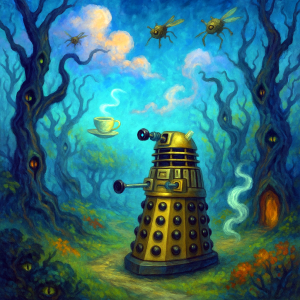
The afternoon was so dreadfully ordinary that even the wind yawned. It yawned across the field, over the hedgerow, and into a quiet lane where a Dalek stood, very busy doing nothing—which is to say it was practicing authority. Practicing authority requires a firm stance, a loud voice, and absolutely no idea why one is shouting. The Dalek had all three.
“EXER—EXER—EXER—MINATE,” it announced to a patch of clover, which, being clover, did not take it personally.
Now it so happened that a peculiar object clicked and clattered down the lane at precisely that moment: a spanner, but not any spanner you would find in an honest toolbox. This one was striped like a humbug and jingled like a pocketful of teaspoons. It kept turning itself the wrong way, as if determined to unscrew the afternoon from the evening.
The Dalek swiveled its eye-stalk. “IDENTIFY!”
The spanner rang like a bell and continued rolling.
“YOU WILL—IDENTIFY!” The Dalek tried again, louder. The spanner answered by producing a little card from its own spanner-mouth (do not ask how—Wonderland never explains) which read:
I AM THE STRANGE SPANNER
Consulted for unfastenings, unfittings, and general undoings.
(Tea by appointment.)
“CONSULTATION IS DENIED,” the Dalek declared, and in declaring it, gave chase.
It is generally inadvisable to chase a Strange Spanner, for a Strange Spanner never throws you where you think you are going; but Daleks, being famously resistant to advice, trundled on. The spanner jingled ahead, humming the sort of tune that goes in a circle and becomes larger at every loop. It hopped a curb, skipped a crack, and plummeted, with remarkable poise, into a round, black mouth in the lane that most people would have recognized as an ordinary rabbit-hole—if it were not labeled, on a little brass plaque, “POLITE ENTRANCE.”
“ENTRANCE ACKNOWLEDGED,” said the Dalek, and plunged after.
Falling is a dreadful habit to acquire and a very difficult one to break, especially if you have no arms for clutching or legs for bracing and the ground has decided to be elsewhere for a while. The Dalek, although not designed for tumbling, took to it with grim determination. Down, down, down it went, past shelves of saucers, drawers of spoons, and a stately procession of napkins that floated by in dignified pairs, holding hands and whispering, “Hush.” The Dalek attempted to exterminate the hush, but the hush proved highly resistant, being only partly there to begin with.
On a passing shelf it spied a book titled A Brief History of Falling, from the First Drop to the Present Descent. The Dalek tried to read it, but the pages hurried past with the manner of someone who has just remembered they are late for tea. Another book flapped overhead, scandalized: How to Land with Grace (Without Spilling the Sugar). The Dalek, who was wholly unfamiliar with sugar-spilling—indeed with sugar altogether—stored the title for later eradication.
There is something about falling that encourages reflections, and what the Dalek reflected most was the single, shining question that had recently begun to bother it: Why? It had been a fine question at first—sharp and useful as a thumbnail—but it had grown into an unwieldy ladle of a question, scooping up everything sensible and stirring it into nonsense. Why do birds fly? Why do spanners sing? Why is the plaque polite? Why does shouting make clover indifferent? The Dalek did not like ladles; it preferred plungers. Nevertheless, the question sloshed.
It hummed (which, for a Dalek, is rather like grinding one’s teeth): “OBJECTIVE: CLARIFY PURPOSE OF FALLING.”
That was when it noticed the wallpaper.
Yes—there was wallpaper, arranged sensibly on the insides of the rabbit-hole. At first it showed a pattern of umbrellas opening. Next, it became teaspoons. Then a parade of tiny doorways the size of postage stamps, each labeled with curlicue letters: “Sometimes,” “Quite Possibly,” “Not Yet,” and “Mind the Teacup.” The Dalek aimed its eye-stalk at “Not Yet,” which promptly turned itself into “How Rude.”
Before the Dalek could reprimand the grammar, the falling ended as abruptly as a sentence without a period. Plop!—though Daleks do not plop politely—and it came to rest in a round chamber tiled with checkerboard floors and the faint smell of cucumber sandwiches. There were exactly twelve doors, all locked, and precisely one table, upon which stood:
- A diminutive brass bell.
- A thimble of crystal, stoppered with a sugar-cube.
- A folded napkin stamped with COURTESY in gold.
The Dalek surveyed the scene. “AREA SECURE.” It trundled to the table, examined the bell, and emitted a trial bellow. “RING!”
The bell, being dignified, rang itself only once, then consulted the napkin and rang again because the napkin said Courtesy. A panel slid open in the wall and out waddled the most self-important teapot the Dalek had ever not-imagined: silver-bellied, spout-upturned, with a monocle perched where a teapot should never have one.
“Ahem,” said the Teapot. (It is a little-known fact that Teapots clear their throats through their handles.) “One mustn’t shout in the Vestibule. The echo is impressionable and may pick up bad habits.”
“YOU WILL IDENTIFY!” the Dalek commanded.
“Certainly,” the Teapot replied, bowing at a saucer’s angle. “I am the Vestibule Teapot, Acting Host and Interim Kettle under the Polite Entrance Act. Tea?”
“NEGATIVE. QUESTION: WHERE IS THE STRANGE SPANNER?”
“Ah, the Spanner,” said the Teapot, with a sigh like steam upon a chilly window. “Always rolling downhill into mischief and up again for appointments. Today it is due at the Mad Hatter’s for Unfastenable Discussion. You’re welcome to follow, provided you first master the door situation.”
“DOORS WILL COMPLY.”
“Doors rarely do,” the Teapot said gently. “Try this: read the napkin.”
The Dalek inspected the napkin. Its letters seemed to straighten their backs under its gaze.
COURTESY
If you would like to pass,
Be small, be kind, be glass.
“BE—GLASS?” The Dalek did a very Dalek thing then: it took the instruction literally because it had never been taught to do anything else. It extended its manipulator toward the thimble of crystal, unstoppered the sugar-cube, and peered into the thimble’s impossible depths, which contained a quantity of liquid far greater than the thimble and rather less than an ocean.
A label curled around the glass:
DRINK ME (IF YOU CAN)
Side effects may include: sudden politeness, reduced bigness,
and a desire to fit where you do not.
The Dalek did not, strictly speaking, have a mouth, which is a design flaw in a world that prefers tea. The Teapot, seeing the difficulty, clinked sympathetically.
“Perhaps,” it suggested, “you could absorb this in whatever way you absorb anything agreeable. Most visitors have tongues. You have, if I may be frank, determination.”
This was true. The Dalek lowered its plunger like a periscope and—through a method best described as unexplained but very tidy—drew the thimble’s contents inside.
At once it felt remarkably—well—not smaller, exactly; more concentrated. Its casing did not shrink, yet the room grew cavernous and kind. The doors, previously too many and too closed, now seemed practicable, even inviting. “POLITENESS LEVEL: INCREASED,” the Dalek reported, which was the nicest thing it had ever said.
“Splendid,” said the Teapot, polishing its monocle on a corner of steam. “Now, the key.”
“KEY?”
“Keys are traditional,” said the Teapot. “Try the bell again, but ask nicely this time.”
The Dalek hesitated. Asking nicely was a new protocol. It searched its memory banks, found them full of commands and empty of courtesies, and tried something experimental. It dipped its dome just so (which took some doing) and said, with majestic effort, “PLEASE—RING.”
The bell, charmed, rang thrice, the middle ring in italics. A tiny drawer bloomed from the table’s edge like a mechanical flower, and inside lay a key no larger than a compliment. The Dalek turned to the doors; each keyhole was modest and upper-crusted. The key leapt of its own accord toward the nearest lock marked “Quite Possibly,” and the door sighed open.
Within was a garden—no, a suggestion of a garden painted on the air: hedges trimmed into question marks, paths that set off confidently and returned to ask if that was all right, and flowers leaning toward one another as if practicing secrets. The scent was a library of perfumes, cataloged by breeze. In the middle of it all, perched on a stool that pretended not to be nervous, sat a Blue Caterpillar blowing bubbles through a pipe that wasn’t lit. Each bubble rose, considered its options, and settled upon becoming a thought.
Beyond the garden, dashing along a gravel path, the Strange Spanner jingled in a hurry. Pattering after it came a creature in a waistcoat with fur as white as grammar in the snow and whiskers that kept pointing out capitals—a rabbit, yet not the White Rabbit you know. This one wore two watches: one for punctuality and one for regret.
“Oh crumbs and curds!” it cried. “I shall be later than the latest late—later than a clock that stopped and then remembered the time! The Hatter will fold me into the napkin!”
“HALT,” ordered the Dalek, emerging through the doorway and startling the garden into a polite cough. “YOU WILL IDENTIFY!”
“Identify? I’m already identified!” the rabbit said. “I am the White Rabbit’s Cousin (we share a surname, White). Also known as the Courtesy Clerk, Keeper of the Invitation, and Occasional Scapegoat. If you must insist on a short form, call me Cousin. And who are you—besides very round and frankly shouty?”
“I AM A DALEK,” the Dalek said, with pride that gleamed like polished menace. Then, remembering the napkin, it added, with considerable strain, “PLEASE.”
“Please what?”
“PLEASE—PROCEED TO GUIDE ME TO THE STRANGE SPANNER.”
“Ah!” Cousin’s whiskers pointed in admiration. “A please! How refreshing. I suppose I can guide a Dalek if it says please. Mind you, the Hatter’s Tea is presently engaged in moving seats, and the March Hare is keeping minutes in the sugar bowl. Watch your step; the scones are skittish.”
The garden obligingly rearranged itself into a path, which was rather decent of it. As the Dalek and Cousin proceeded, the Blue Caterpillar regarded them through a drifting lens of bubbles and exhaled a question.
“Who are you?” it asked the Dalek, pronouncing “you” the way one might pronounce “queue,” for it considered both to be unnecessary lines.
“I HAVE IDENTIFIED,” the Dalek replied.
“That is not the same as being,” said the Caterpillar, and tapped a bubble with its pipe. The bubble burst into a small, tidy poem:
To know one’s name is neat and nice,
It labels jars of jam and spice;
But if you’d truly know your plan,
Decide what you are when you can.
“WHAT DOES THAT MEAN?”
“It means what it says,” said the Caterpillar, which is never helpful.
Cousin tugged his waistcoat. “No time, no time! The Hatter grows madder when kept waiting, and he is already plenty. Come along, Pepper-Pot.”
The Dalek would have objected to the epithet, but the path was picking up speed under its wheels and the hedges had begun to applaud, and besides, it was curious now—curious like a needle threading a very large space: a new sort of curiosity that didn’t want to exterminate but to understand, in order to exterminate more appropriately later on.
They came at last (or perhaps first; Wonderland is notoriously poor at arranging itself) to a clearing where a long table had taken it upon itself to be longer than a remark. Everywhere there were cups and saucers, but the cups appeared to be politely sipping the saucers rather than the other way round. A Dormouse was sleeping in a sugar-bowl and dreaming the minutes neatly into piles, which the March Hare kept rearranging into hours for his collection.
At the head of the table stood the Strange Spanner, elevated on a napkin-rostrum, consulting its card. Beside it, removing and replacing his hat with such devotion that the hats felt quite wooed, was the Mad Hatter himself—eyes bright as matchheads, smile stitched from threads that didn’t belong to any face. At the sight of the Dalek he clapped his hands, which rewarded him by becoming gloves.
“Welcome, welcome—last and least and most and toast!” he cried. “We are unfastening sense today. You brought an appetite, I trust?”
“NEGATIVE. I REQUIRE INFORMATION. ALSO TEA IS IMPOSSIBLE.”
“Impossible tea is our specialty,” said the Hatter. “We brew it twice: once for flavor, once for disbelief.”
Cousin bowed toward the Spanner. “Your appointment, sir. The Dalek—ah—requires your services.”
The Spanner jangled judiciously. “Unfastenings begin at once.” It turned pointedly toward the Dalek and clicked a click of inquiry.
“STATE YOUR UNFASTENING,” said the Hatter, flourishing a butter-knife that swaggered like a sabre. “We can loosen lids, undo how-do-you-dos, and release the thought from a thunk. We can even unbutton a sky if properly introduced.”
The Dalek’s voice, for perhaps the first time, did not bellow. It arrived almost gently. “UNFASTEN—THE QUESTION.”
“Which one?” asked the Hare, counting minutes into the Dormouse’s ear.
“THE ONE THAT INTERFERES WITH AUTHORITY. THE ONE THAT ASKS ‘WHY.’”
At this there was a general intake of breath, which is not at all the same as a general intake of tea. The cups frowned; the saucers tittered; the napkins hid their hems. Even the Dormouse stirred and dreamt, “Because,” before falling back to sorting minutes into probably.
The Hatter leaned close, inspecting the Dalek’s casing as a tailor inspects a seam that insists on dancing. “Dear pepper-pot, dear kettle-with-ambitions,” he murmured, “we can unfasten many things at this table—knots, nots, oughts, and thoughts—but Why is not a fastening. It is a doorway. If we undo it, we undo your way in as well as your way out.”
“THAT IS ACCEPTABLE,” said the Dalek, though a small part of it, which had lately learned to be small very well, trembled.
The Strange Spanner rang its own bell (spanners are frightfully independent) and sang, in the steady, turning voice of well-made metal:
Lefty-loosey, righty-tightly,
Turn the question slow and slightly;
If it squeaks, then oil the doubt—
Let the answers tumble out.
It tapped the Dalek’s casing with a sound like a silver coin thinking better of it, then slipped—oh so delicately—beneath the edge of something invisible that the Dalek had not known was there. With a single courteous twist, the room expanded, the table sighed, and the air smelled at once of rain-on-books and the inside of a good pocket. The Question inside the Dalek loosened. It did not fall away. It bloomed.
“OBSERVATION,” the Dalek said, voice unsteady as a newly poured cup: “WHY IS… A PATH.”
“Just so,” said the Hatter, and sat down in the wrong chair, which was polite enough to pretend it was right. “Would you like some impossible tea to go along your path?”
“TEA IS IMPOSSIBLE,” the Dalek repeated, but this time the statement felt like an invitation rather than a verdict.
Cousin cleared his throat and produced, from somewhere perfectly reasonable and entirely unexpected, an envelope sealed with a drop of cooled lightning. “Before tea, a formality: the Queen requests—well, commands—your presence. She has heard a rumor that you shout as firmly as she does, and she is very fond of competition.”
“THE QUEEN?” The Dalek’s eye-stalk brightened.
“The Queen of Hearts,” said the Hatter, matter-of-factly buttering a rhyme. “Do be careful. She is very good at Off with— whatever she fancies off-ing. Still, you have an advantage.”
“ADVANTAGE: SUPERIOR ARMAMENTS,” said the Dalek.
“No,” said the Caterpillar from three gardens away, blowing a bubble that arrived punctually. “Advantage: you said please.”
The Dalek considered this, which is a verb it had never conjugated before.
“Very well,” it said at last, and the table applauded in crumbs. “OBJECTIVE: PROCEED TO THE QUEEN. SECONDARY OBJECTIVE: IMPOSSIBLE TEA.”
“Marvellous!” cried the Hatter. “We shall move seats to celebrate.” And the entire tea party stood up and changed places while remaining precisely where they were, which is the sort of thing that happens all the time when you learn to fall politely.
“THIS—WILL BE—FUN?” ventured the Dalek, the question mark curving in its voice like a path newly discovered.
“Quite possibly,” Cousin said, checking both watches at once. “And if not, we shall make it so by undoing something unnecessary. Wonderland is very good at that.”
They set off—Cousin padding, the Spanner jingling, the Hatter humming a tune that threaded the trees, the Caterpillar sending bubbles ahead with instructions, and the Dalek trundling at the center of it all like a punctuation mark that had learned, at last, there were sentences to be part of.
And somewhere, far behind and just ahead, the napkin in the vestibule lay peacefully, gold letters gleaming, as if to say that courtesy, once learned, is remarkably difficult to unlearn—especially when you have a Strange Spanner for a friend.
 The Crazymad Writer Writes Again