The Fête That Was Never Announced

The Fête That Was Never Announced
There are no posters for it.
No laminated notices in the window of Murphy’s shop.
No mention in the parish bulletin.
No banner strung across the square.
And yet — once each year, on a day that shifts without consultation — Ballykillduff wakes knowing.
Not remembering.
Knowing.
I. The Uneven Morning
The morning begins slightly off.
Milk tastes faintly sour though it was fresh the night before.
A spoon slips from a saucer.
The church bell gives a single note and then, apparently satisfied, falls silent.
Mrs Doyle stands at her window and says to no one in particular,
“Well then. We’d best not be late.”
Across the village, others say similar things, though none can say late for what.
By ten o’clock, small rearrangements are underway.
The butcher closes early.
The baker sets aside two trays of scones “just in case.”
The schoolmaster announces an unexpected half-day, claiming weather that has not yet arrived.
The children drift first.
They head toward the old quarry field at the edge of the village — the field that once nearly held foundations for something grand and never did.
The adults follow.
II. The Field at Noon
At breakfast it was only grass.
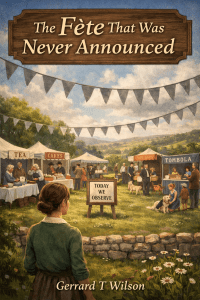
By noon, it is unmistakably a fête.
White bunting stretches between wooden posts that were not present that morning.
Except this year, the bunting is not white.
It is pale grey.
Not gloomy.
Not cheerful.
Simply undecided.
Long trestle tables stand beneath fluttering fabric. Lace cloths ripple gently. A tea urn breathes steady steam.
The brass band — assembled from men who insist they are “out of practice” — tunes beneath the largest hawthorn tree. The trumpet is sharp. The tuba is optimistic. The drum begins before anyone agrees on tempo.
Children test the sack race course with unofficial enthusiasm.
The hoopla stall leans slightly to the left.
A tombola drum, rescued from some earlier decade, squeaks with each hopeful turn.
It is, by every visible measure, a proper Ballykillduff fête.
Alice stands at the edge of the field and notices the bunting.
Grey.
She says nothing.
III. The Stalls
The cake tent is first to draw a crowd.
Victoria sponges — some perfectly symmetrical, others gently aspirational — sit beneath handwritten labels. Lemon drizzle glistens bravely. A fruitcake dense enough to anchor a boat waits with quiet dignity.
The jam table gleams in sunlight: strawberry, blackberry, rhubarb, one experimental gooseberry no one entirely trusts.
At the produce stall, three marrows lie like candidates for office.
The dog show gathers near the hedge. One terrier refuses to sit. A collie performs tricks unrequested. A dachshund appears to judge everyone in attendance.
There is laughter.
There is gentle rivalry.
There are whispered assessments of icing thickness and lawn maintenance.
Everything is exactly as it should be.
Except—
The bunting shifts almost imperceptibly when someone laughs too sharply.
It lightens slightly when a child is lifted high to see better.
It deepens a shade when a compliment sticks in someone’s throat.
No one notices.
Except perhaps Alice.
IV. The Quiet Measurements
The tests do not announce themselves.
They hide in small things.
A boy wins the sack race twice. The third time, he slows deliberately so another may win. The bunting pales.
At the cake judging, two identical sponges stand side by side — one baked by Mrs Doyle, one by a woman new to the village. The applause hesitates.
Mrs Doyle tastes the newcomer’s cake and says, quite sincerely,
“Well now, that’s better than mine.”
The bunting lightens further.
At the tombola, a child draws a winning ticket twice in succession. The stallholder glances at the queue.
He clears his throat.
“Well then, luck’s luck,” he says, and hands over the second prize.
Grey fades toward pearl.
The terrier knocks over a display of jam jars. Its owner kneels immediately, laughing, gathering glass, apologising without defensiveness.
The bunting flutters almost white.
V. The Sign
Near the centre of the field, beside the tea urn, a small wooden placard stands.
No one remembers placing it there.
It reads:
TODAY WE OBSERVE.
No one comments.
They assume it refers to judging categories.
Best Cake.
Best Jam.
Best in Show.
The brass band strikes up something nearly recognisable.
The tea tastes sweet again.
VI. The Ticket
Near Alice’s shoe, a small paper square slips unnoticed from a child’s pocket.
It reads:
Admit One.
No date.
No explanation.
The child walks on.
Alice sees it.
She could retrieve it easily.
She could correct the moment.
Instead, she waits.
Three steps.
Four.
The child pauses.
Turns.
Looks down.
Sees the ticket.
Smiles faintly.
Picks it up.
The bunting, which had been lingering at the palest grey, settles into clean white.
Alice exhales softly.
The village must pass itself.
VII. The Mirror at Dusk
As afternoon leans into evening, the competitions conclude.
Prizes are awarded: a ribbon for sponge, a jar of honey for the marrow, a modest rosette for the collie who behaved.
The brass band finds harmony at last.
At the edge of the field, a mirror stands where no mirror stood before.
Each villager passes it on the way home.
They do not see medals or crowns.
They see direction.
A kitchen a little warmer.
A gate held open without calculation.
A habit of listening extended by half a heartbeat.
When Alice steps before it, she sees the quarry field empty, bunting white and still, grass undisturbed by record or regret.
She smiles.
VIII. The Reset
The bell rings once.
The bunting gleams bright white in the lowering sun.
By morning, the quarry field is only grass again.
No posts.
No stalls.
No tombola drum.
In the village, doors open quickly. Greetings linger. The dog with the unsteady temper is patted kindly.
No one mentions the Fête.
But Ballykillduff feels aligned.
Alice leaves the field last.
At the gate, she glances back.
For the briefest moment, she thinks she sees something resting on the centre table.
Not a cake.
Not a ribbon.
A book.
Closed.
Waiting.
When she blinks, there is only grass.
The bunting was grey this year.
But it did not darken.
And so the Fête will return.
On a day no one advertises.
On a day everyone will know.
Author’s Note
Ballykillduff has always held its gatherings in a particular way.
Some are advertised loudly — with chalkboards outside Murphy’s shop and bunting strung optimistically across the square. Others are remembered long after the tables have been folded and the tea cups washed.
And then there are those that are neither announced nor forgotten — only known.
The Fête That Was Never Announced belongs to that quieter category of village memory. It grew from a simple thought: what if a community did not require posters to gather? What if belonging itself were enough? And what if, beneath the sponge cakes and sack races, something gentler — and more exacting — were taking note?
In villages, character is not revealed in grand gestures. It appears in smaller reflexes: who steadies the chair, who shares the prize, who laughs first and who listens longer. I have long believed that such moments shape a place more deeply than monuments or headlines ever could.
The quarry field in this story has appeared before in other Ballykillduff tales. It is a field of near-things and almost-things — foundations that never quite set, plans that did not harden into brick. It felt right that the Fête should gather there, in a space that remembers possibility.
As for the bunting — well, bunting rarely lies.
This story sits comfortably among the quieter pieces in the Strange Corners of Ballykillduff cycle. It does not shout. It does not warn. It simply watches — much as the village itself seems to do.
If, one year, you wake with the feeling that something is scheduled but never advertised, I would suggest you go.
There may be cake.
And you may be observed — kindly, I hope.
— Gerrard T Wilson
 The Crazymad Writer Writes Again