RSS

Category Archives: Fairy tale

A Slug Called Reilly

A Slug Called Reilly

The Day Reilly the Slug Learned Nothing (and Then Something, but Not for Long)
A Ballykillduff Story


In the village of Ballykillduff—where the post box is green, the wind occasionally argues with itself, and even the paving stones have been known to sigh—there once lived a slug called Reilly.

He lived, if such a word can be used generously, beneath a damp and rather opinionated stone at the edge of the village square. The stone had been there longer than most of the villagers and was known to mutter, particularly about moisture levels and passing beetles.

Reilly, however, had very little interest in stones, beetles, or indeed anyone at all—except when they were useful.

He was, by all accounts, incredibly slimy.

Not merely in the physical sense (though that was undeniable), but in the manner of his dealings. He borrowed dew and never returned it. He left trails where trails were expressly unwelcome. He once told a very small mushroom that it would grow into a grand oak tree, which was both untrue and unnecessarily upsetting.

“Morning, Reilly,” said Mrs Flannery one day, sweeping the step of her shop.

Reilly slid past without reply, leaving behind a glistening remark that required two buckets and a firm word to remove.

“Uncivil,” said the broom, which had seen better slugs.


Reilly preferred the night.

At night, he thought himself clever.

At night, he thought no one saw him.

At night, he could glide where he pleased, whispering unkind things to unsuspecting leaves and rearranging small piles of gravel purely for inconvenience.

“I am a creature of great intelligence,” Reilly once announced to a puddle, which, to its credit, did not respond.


It was on one such night—quiet, dark, and slightly too proud of itself—that Reilly made a mistake.

He was gliding along the edge of Currans Lane, composing what he believed to be a particularly cutting remark about a passing dandelion, when—

slip.

slide.

plop.

Reilly vanished.

He had fallen into a hole.


Now, holes in Ballykillduff are rarely just holes.

This one, for instance, was deeper than it should have been, darker than it needed to be, and faintly echoing in a way that suggested it had opinions about those who fell into it.

Reilly landed with a soft, undignified sound.

It was very dark.

It was very quiet.

And, most troubling of all—

there was no one to be unkind to.


At first, Reilly was annoyed.

“This is inconvenient,” he said to the darkness.

The darkness, being thorough, did not respond.

After a while, annoyance gave way to something less familiar.

Thinking.

Reilly began, for perhaps the first time in his life, to think about himself.

He thought about the mushroom.

He thought about the beetles.

He thought about the puddle, which had always been rather patient with him.

He thought about Mrs Flannery’s step.

He thought about the trail.

“Oh,” said Reilly, quietly.

It is a small word, “oh,” but in Ballykillduff it has been known to change entire weather patterns.

“I have not been… very good,” he admitted.

The hole, which had been waiting for this moment, seemed to grow just a little less dark.

“I shall change,” Reilly declared.
“I shall be kind. I shall be thoughtful. I shall be… less Reilly.”


Time passed.

(No one in Ballykillduff was quite sure how much, as the clocks occasionally took personal days.)

Then, quite suddenly—

thunk.

A stick fell into the hole.

It landed beside Reilly, leaning at just the right angle, as though it had been sent with purpose—or at least with good timing.

Reilly looked at it.

The stick looked at Reilly.

“Well,” said Reilly, “this seems promising.”

With some effort, and a great deal of sliding, Reilly climbed.

Up he went.

Up past the thinking.

Up past the promises.

Up into the light.


Reilly emerged from the hole.

The world was as it had always been.

The stone was still muttering.

The post box was still green.

Mrs Flannery was still sweeping.

And Reilly—

Reilly paused.

He remembered his promise.

He remembered his thoughts.

He remembered his oh.

For a moment—just a moment—he considered keeping it.


Then he didn’t.

“Well,” he said, “one mustn’t be unreasonable.”

And off he went, leaving a trail that suggested nothing at all had been learned.


Days passed.

Reilly returned to his habits.

The mushroom was confused again.

The beetles avoided him.

The puddle grew slightly less patient.

And Reilly, as ever, did not notice.


Until one day—

a very hot day.

A day so bright that even the shadows considered taking cover.

Reilly, having spent the morning being particularly disagreeable to a passing daisy, returned to his home beneath the stone.

Only—

he forgot to cover it properly.

He left the entrance open.

He did not think.


The sun did.

It shone.

And shone.

And shone.

Down into Reilly’s damp little world.

The stone muttered something about “consequences.”

Reilly began to feel… uncomfortable.

Then dry.

Then very dry indeed.

“Oh,” said Reilly again.

But this time, it was a different sort of oh.


By the time the shade returned, Reilly was no longer quite himself.

He had, in a manner of speaking, been reduced to a lesson.


And in Ballykillduff, lessons do not go to waste.

The children of the village, passing by the stone, would sometimes pause.

“Was that Reilly?” one might ask.

“It was,” said the stone, which had decided to be helpful for once.

“What happened to him?”

The stone would consider this.

Then say:

“He remembered something important.
But not for long enough.”


And so, if you ever find yourself in Ballykillduff—

where the post box is green, the wind occasionally argues, and even the smallest creatures are given their moment—

you may hear the quiet moral whispered by stones, puddles, and particularly thoughtful sticks:

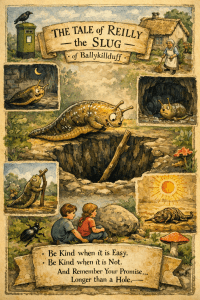
Be kind when it is easy.
Be kind when it is not.
And if you promise to change—
do try to remember it longer than a hole.

 
2 Comments

Posted by on March 25, 2026 in Fairy tale, fantasy story


Tags: , ,

The Penguin Who Met a Polar Bear (Quite by Accident)

In the far, far south, where the sea freezes into bright white plains and the wind sings across the ice, there lived a penguin named Percival.

Percival was a very thoughtful penguin.

He liked to wonder about things.

Why snow squeaks underfoot.
Why fish never seem to shiver.
And why the world had two ends.

“Surely,” Percival once said to himself, “if there is a South Pole, there must be a North Pole too.”

And that thought stayed with him.


A Journey Begins

One breezy afternoon Percival stood on the edge of a large iceberg.

He looked out across the endless ocean.

“I suppose,” he said, “the only way to find out what is at the other end of the world… is to go there.”

Now penguins are excellent swimmers.

But Percival was not planning to swim the whole way.

Just then a large iceberg cracked loose from the shore.

It floated gently into the sea.

Percival blinked.

“Well,” he said, stepping aboard,
“That seems convenient.”

And so the iceberg carried him away.


A Very Long Drift

For many days Percival sailed across the ocean.

He passed whales.

He passed curious seals.

Once he passed a rather confused albatross who asked,

“Are you supposed to be here?”

“I’m exploring,” Percival replied proudly.

The albatross shook its head and flew away muttering something about geography.


The North at Last

At last the air grew colder again.

Ice returned.

Snow blew across the sea.

Percival stepped off his iceberg onto a wide frozen plain.

“Well,” he said, “this certainly looks familiar.”

Just then a large white creature appeared over a ridge.

The creature stopped.

Percival stopped.

They both stared.

The creature tilted its head.

“You,” said the creature slowly, “are not a seal.”

“No,” said Percival politely. “I’m a penguin.”

The creature blinked.

“A penguin?”

“Yes.”

“But penguins live at the South Pole.”

“That is correct,” said Percival.

The creature scratched its head.

“Well,” it said, “polar bears live at the North Pole.”

“Then,” said Percival cheerfully,
“I suppose we are both exactly where we belong.”


A Curious Friendship

The polar bear sat down.

“My name is Bernard,” he said.

“I’m Percival,” said the penguin.

They thought about the situation for a moment.

“Well,” Bernard said finally,
“since penguins and polar bears never meet…”

“This is rather special,” Percival finished.

So they spent the afternoon talking.

Bernard explained snowstorms and northern lights.

Percival explained ice shelves and penguin colonies.

And both agreed on one important thing:

The world is a very big place.

But sometimes, if you drift far enough—

The most unlikely friends can meet.


And somewhere, far to the south, a group of penguins were still wondering where Percival had gone.

But that is another story entirely.

 
Leave a comment

Posted by on March 6, 2026 in Fairy tale


Tags: , , ,

The Camel Who Misplaced His Hump

The Camel Who Misplaced His Hump

The Camel Who Misplaced His Hump

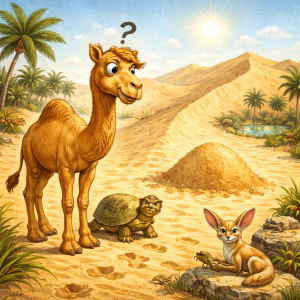
In a wide golden desert where the sand rolled like waves upon the sea, there lived a camel named Cedric.

Now Cedric was, in almost every way, an ordinary camel.

He had long legs.
He had long eyelashes.
He had a rather thoughtful expression.

But one morning Cedric woke up and discovered something most alarming.

His hump was gone.

Completely gone.

Cedric turned his head to the left.

No hump.

He twisted to the right.

Still no hump.

He even tried peering straight over his shoulder, which caused him to fall over sideways into the sand.

“This,” said Cedric solemnly, “is not ideal.”


A Most Peculiar Problem

Cedric wandered across the desert, asking everyone he met.

First he asked a lizard.

“Excuse me,” said Cedric politely, “have you seen a hump anywhere?”

The lizard blinked slowly.

“I’ve seen many things,” said the lizard.
“Sand. Rocks. The occasional biscuit dropped by travellers.”

“But not a hump?” asked Cedric hopefully.

“Not today,” said the lizard.

Cedric sighed.


Next he asked a desert owl who was dozing in the shade of a cactus.

“Have you seen my hump?” Cedric asked.

The owl opened one eye.

“What colour was it?” she asked.

“Sandy,” said Cedric.

The owl looked around the desert.

“Well,” she said, “that certainly narrows it down.”


The Wise Tortoise

At last Cedric met Terrence the tortoise, who was the oldest creature in the desert.

Terrence listened carefully.

“A missing hump,” said Terrence slowly.
“Hmm.”

Cedric waited nervously.

“Tell me,” said Terrence, “what were you doing yesterday?”

“Well,” said Cedric, thinking hard,
“I walked to the oasis…
I ate three palm leaves…
I had a nap…”

“And?” asked Terrence.

“I rolled down a very large sand dune,” Cedric admitted.

“Ah,” said Terrence.


The Discovery

They walked together to the dune.

And there, halfway down the slope, was the most peculiar sight.

A perfectly round hump-shaped lump in the sand.

Cedric blinked.

“That looks familiar.”

Terrence nodded.

“You appear to have left it behind.”

Cedric leaned carefully against the lump.

There was a gentle pop.

And suddenly—

boing!

His hump bounced neatly back into place.

Cedric stood up straight.

“Oh!” he said happily. “That feels much better.”


A Valuable Lesson

Cedric thanked Terrence and began walking home.

From that day onward he was very careful when rolling down sand dunes.

Because losing one’s hat is embarrassing.

Losing one’s lunch is unfortunate.

But losing one’s hump, as Cedric discovered—

Is extremely inconvenient.

 
Leave a comment

Posted by on March 6, 2026 in Fairy tale


Tags: , , , ,

The Grasshopper and the Fly

The Grasshopper and the Fly

The Grasshopper and the Fly

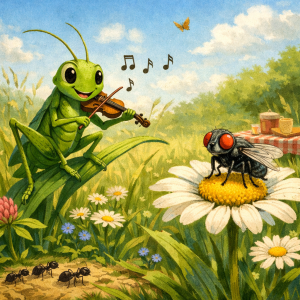
On a bright summer morning in a meadow that hummed gently with life, a grasshopper sat upon a tall blade of grass, playing the fiddle.

Now this was no ordinary grasshopper.
He played with such enthusiasm that the grass itself seemed to sway in time with the music.

Fiddle-dee-dee, fiddle-dee-dum,
went the bow as the grasshopper scraped out cheerful tunes for anyone who cared to listen.

A fly, who had been buzzing lazily through the warm air, happened to hear the music and landed on a nearby daisy.

“Good morning!” buzzed the fly.

“Good morning!” chirped the grasshopper, still fiddling away.

“Why are you making such a racket so early in the day?” asked the fly, tilting her head.

“It is not a racket,” said the grasshopper proudly. “It is music.”

“Well,” said the fly, “I prefer something a little quieter. But you do seem to be enjoying yourself.”

“I enjoy it greatly,” said the grasshopper. “Music makes the day brighter.”

The fly buzzed thoughtfully.

“I suppose that is true,” she admitted. “But you might consider doing something useful instead.”

“Useful?” said the grasshopper, lowering his fiddle.

“Yes,” said the fly. “I spend my time investigating things. Exploring. Visiting places. Finding interesting smells. It is very productive.”

“Productive?” asked the grasshopper.

“Certainly,” said the fly. “For instance, I discovered a magnificent jam sandwich on a picnic table yesterday.”

“That does sound interesting,” said the grasshopper politely.

“It was,” said the fly proudly. “And there were crumbs everywhere.”

The grasshopper considered this.

“Well,” he said at last, “that may be productive for you. But I believe music is useful too.”

“How?” asked the fly.

“Because,” said the grasshopper, lifting his fiddle again, “it makes people smile.”

Just then, a breeze drifted through the meadow.

The grass rustled.

The daisies nodded.

And a group of ants paused in their marching to listen.

The grasshopper began playing again.

Fiddle-dee-dee, fiddle-dee-dum.

The fly listened for a moment.

Then she buzzed gently in the air.

“You know,” she said, “that tune is rather pleasant.”

“Thank you,” said the grasshopper.

The fly hovered thoughtfully.

“I believe I shall stay and listen for a little while.”

And so she did.

For the rest of the morning the grasshopper played his fiddle, and the fly buzzed softly in time with the music.

And the meadow, which had already been a cheerful place, became just a little bit happier.

Which proves something rather important:

Even a fly who prefers jam sandwiches can enjoy a good tune on a sunny day.

 
Leave a comment

Posted by on March 6, 2026 in Fairy tale


Tags: , , , ,

Little Red Riding Hood


Little Red Riding Hood and the Dalek

Chapter One: The Basket of Cakes

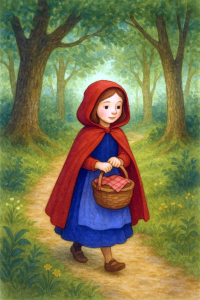
Once upon a time, there lived a cheerful little girl who wore a cloak the colour of bright cherries, with a hood that framed her round face. Because she wore it so often, the neighbours called her Little Red Riding Hood.

One fine morning, her mother packed a basket with cakes, butter, and a flask of hot chocolate.
“Take these to your grandmother, dear,” she said. “She has not been well. But remember—stay on the path. And don’t talk to strangers.”

Little Red Riding Hood promised she would be good, although she was secretly curious about the forest. She kissed her mother’s cheek, hoisted her basket, and set off humming into the green, leafy world.

What she did not know was that a strange new visitor had arrived in the forest—a creature made of shining metal, whose voice echoed like thunder.


Chapter Two: The Stranger in the Woods

The path twisted beneath tall oaks. Birds should have been singing, but they were silent. Even the squirrels kept to their holes.

Suddenly, there came a grinding, wheezing noise, followed by a screech:
“IDENTIFY! IDENTIFY!”

Red stopped in her tracks. Before her stood something unlike any fox, wolf, or bear. It was shaped like a giant pepperpot, plated in bronze and gold, with a single glowing eye.

“I—I’m Little Red Riding Hood,” she stammered. “Who are you?”

“I—AM—A—DALEK!” the creature boomed. “WHERE—ARE—YOU—GOING?”

“To visit my grandmother in her cottage, with cakes and hot chocolate.”

The Dalek’s dome swivelled. “WHERE—IS—THE—COTTAGE?”

Red pointed, still polite though her knees were shaking. “Over the hill, through the glade, by the old stone well.”

Without another word, the Dalek spun round and rolled away, faster than seemed possible.


Chapter Three: The Cottage in Danger

Grandmother’s cottage was small, with roses round the door and a chimney that puffed like a kettle. Inside, the poor woman was knitting by the fire when—CRASH!—her door burst open.

The Dalek burst in, screeching:
“EXTERMINATE! EXTERMINATE!”

Granny dropped her knitting and dived under the bed. The Dalek considered blasting her to pieces but then remembered a half-broken file in its databank titled “HUMAN FAIRY STORIES: STRATEGIC USE.”

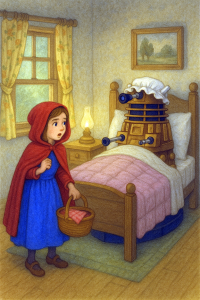
“NEW STRATEGY: DECEPTION!” it bellowed. With difficulty, it plucked Granny’s nightcap with its plunger and balanced it on its dome. Then it reversed awkwardly into her bed, pulling the blanket up to its grille.

The disguise was… questionable.


Chapter Four: “What Big Lights You Have!”

Little Red Riding Hood soon arrived, her basket swinging. She pushed open the cottage door, surprised that it hung off its hinges.

Inside was smoke, scorch marks, and splintered wood. But on the bed lay her “grandmother,” strangely lumpy under the quilt.

“Oh, Grandmother, what bright blue lights you have!”

“THE BETTER—TO—SEE YOU WITH!” screeched the Dalek.

“Oh, Grandmother, what a terrible voice you have!”

“THE BETTER—TO—COMMAND YOUR EXTERMINATION WITH!”

And with that, the Dalek threw off the quilt, cap flying, and aimed its death-ray straight at Little Red Riding Hood.


Chapter Five: The Hot Chocolate Surprise

hot chocolate surprise

Red gasped. She stumbled backward, clutching her basket. In her fright, the flask of hot chocolate slipped from her hands. The lid popped, and steaming cocoa splashed across the Dalek’s grille.

Instantly, sparks flew.
“WARNING! COCOA—INTRUSION! CIRCUITRY COMPROMISED!”

The Dalek spun in circles, smashing Granny’s dresser, knocking over the kettle, and shouting, “MALFUNCTION! MALFUNCTION!”

With one last fizzing shriek, it toppled into the fireplace, where sparks and smoke finished the job. The Dalek went silent, its single eye fading to black.


Chapter Six: Safe at Last

safe at last

From under the bed, Grandmother crawled out, trembling but alive.
“Oh, my dear child!” she cried. “You have saved me—from that dreadful… whatever-it-was!”

Little Red Riding Hood smiled shyly. “It seems hot chocolate can defeat more than just a cold day.”

They sat together, nibbling cakes and drinking what cocoa remained. And though the cottage was rather scorched and in need of repair, both were glad to be alive.


Epilogue: The Moral

From that day forth, Little Red Riding Hood never wandered through the forest without a flask of hot chocolate, just in case. And the villagers told the story for generations: how a girl in a red cloak defeated a terrifying Dalek with nothing more than kindness, quick thinking, and a very sticky drink.

Moral: Even the smallest comforts can triumph over the greatest terrors.


Tags: , , , , ,