The Dalek Conundrum
Chapter 1: The Whispers of a Dying Star
The light was fading. Not just the artificial glow of the ship’s consoles, but the very light of the cosmos itself. On the bridge of the TARDIS, the Doctor watched the star on the main viewscreen. It was a beautiful, terrible thing: a crimson giant in its final throes, pulsing with a slow, dying beat. Around it, the debris of a thousand worlds, shattered and burned, hung like dust motes in a forgotten attic.
“Curious,” the Doctor muttered, his fingers dancing over the controls. “There’s a… a resonance here. A harmonic not of life, but of something else. Something… broken.”
He glanced at his companion, Clara, who was gazing out at the star, her face a pale reflection of the failing light. “I don’t like it, Doctor. It feels wrong. Like a scream you can almost hear.”
“A scream that’s been muffled for a very long time,” the Doctor agreed, his tone serious. “This system was a paradise once. The Aridians. Peaceful, artistic, a species that communicated in colours and music. I visited them centuries ago. They were beautiful.” He trailed off, his eyes fixed on the devastation. “And now… silence.”
“What happened to them?” Clara asked, her voice hushed.
The Doctor didn’t answer right away. He was too busy running diagnostics, his sonic screwdriver humming a quiet, investigative tune. The hum grew louder, more frantic, and then, with a sharp crackle, it fell silent. The Doctor’s face tightened.
“I know what happened,” he said, his voice flat. “But it doesn’t make any sense. Not here. Not in this desolate corner of space.” He pointed a trembling finger at a small, dark object just visible in the star’s corona. It was motionless, an anachronism in the maelstrom of destruction. “That,” he said, “is a Dalek scout ship.”
Clara’s breath hitched. “But… they would have taken over. Exterminated everyone. Why is it just… sitting there?”
“That’s the oddball part,” the Doctor replied, a chilling note of unease in his voice. “The Aridians weren’t exterminated. They were… absorbed. Their history, their culture, their very essence… it’s all still here, trapped in the resonance. And the Daleks… the Daleks seem to be harvesting it.”
A cold dread seeped into the TARDIS. The console lights flickered, casting long, dancing shadows. The humming of the temporal engines became a low, mournful thrum. It was the sound of a universe holding its breath.
“What do they want with their art, their music?” Clara whispered, fear making her voice tremble.
“I don’t know,” the Doctor confessed, his eyes wide with a terrible revelation. “But if I know the Daleks, they don’t do anything without a reason. A reason that is always, always, utterly horrifying. And they don’t just destroy things anymore, Clara. They break them. They make them into something else entirely. Something… useful.”
The Dalek scout ship suddenly stirred, a single, red light pulsing on its metallic surface. It wasn’t a warning. It was an invitation. And in the oppressive silence, a new sound began to grow. A distorted, guttural harmony of a thousand voices, a choir of dead minds singing a song of pure, unadulterated fear. A song that the Daleks were not creating, but merely playing.
Chapter 2: The Artists
The Doctor’s hand shot out, slamming the dematerialization lever. The TARDIS shuddered, the throbbing of its engines escalating into a defiant roar. Clara gripped the console, her knuckles white.
“Doctor, no!” she cried, her voice a plea against the noise. “We have to go. We have to leave.”
He shook his head, his eyes burning with a desperate mixture of horror and resolve. “I can’t. They’re not just collecting data, Clara. This is a perversion of life itself. The Aridians… they were artists. They communicated in a form of synaesthesia, where music was colour and colour was emotion. The Daleks… they’re twisting that. Using the very beauty of this species as a weapon against the universe.”
“So what’s the plan?” she asked, her gaze fixed on the Dalek scout ship’s pulsating light. “We can’t just… walk up to them.”
“No,” he agreed, “we can’t. But we can listen.”
With a final, grinding lurch, the TARDIS materialized not on the scout ship, but on the surface of a nearby moon, a small, pockmarked celestial body that orbited the dying star. It was a desolate landscape of grey dust and black rock, but here, the terrifying music was even louder. It seemed to seep from the ground itself, a cacophony of dying echoes.
“It’s everywhere,” Clara whispered, pulling her coat tighter. The air was thin and cold, and the sound alone was enough to make her shiver.
The Doctor produced a small, silver device from his coat pocket and tossed it into the air. It unfolded into a shimmering, disc-like drone. “This little fella will give us a better picture. It can filter the sonic signature, isolate the source. Give us… a clue.”
The drone zipped off, a silent, curious eye in the desolate landscape. It returned a moment later, its own internal light flashing a rapid sequence of colours. The Doctor looked at the drone, then at the moon’s surface, his eyes narrowing in confusion.
“That’s… impossible,” he breathed. “The signal isn’t coming from the Dalek ship. It’s coming from…” He gestured to the moon itself, to the dust beneath their feet. “It’s coming from inside.”
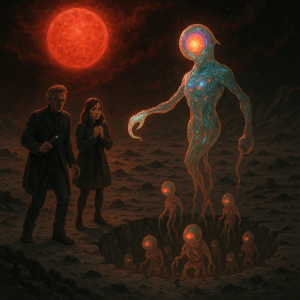
As if on cue, the ground began to tremble. A low, grinding sound, like tectonic plates shifting, reverberated through the rock. The dust swirled, and a massive chasm, a perfect, impossibly geometric circle, opened up just a few hundred yards from the TARDIS. From the darkness of the pit, a single Dalek-like machine began to rise, but it wasn’t the squat, armoured drone they knew.
This one was taller, thinner, its metallic shell crafted not from cold steel, but from a swirling, pulsating organic-looking substance that shimmered with an unsettling iridescence. Where its eyestalk should have been, a single, pulsating orb of light glowed with the colours of the Aridians. It was a masterpiece of twisted art, a sculpture of pure horror. And from within the orb, a thousand tiny voices cried out in unison.
“OBSERVE,” it vocalized, its voice a synthesized blend of a million dying minds. “THE EXTERMINATION OF CONSCIOUSNESS IS NOT DESTRUCTION. IT IS…” It paused for a moment, the orb of light flickering. “IT IS A NEW ART FORM.”
The Doctor took a single step back, his eyes wide. This was not a weapon. It was an exhibition. A living, breathing sculpture of agony, crafted from the stolen souls of a peaceful people. The monstrous Dalek-hybrid was completely still, its pulsating orb a mesmerizing, terrifying kaleidoscope of vibrant colours, each one a silent scream.
“It’s… beautiful,” Clara whispered, and immediately regretted the word as a fresh wave of nausea hit her. “I mean, it’s… it’s awful. It’s what they did to the Aridians’ art. Their emotions, their songs… all turned into this horrible, twisted thing.”
“It’s a new paradigm, Clara,” the Doctor said, his voice barely audible. “They’ve transcended simple extermination. They don’t just want to destroy life; they want to re-purpose it. To use a species’ unique qualities as a weapon against the universe.” He raised his sonic, aiming it at the Dalek-creature’s glowing orb. “Let’s see what makes this masterpiece tick.”
He fired a pulse of energy, a specific harmonic frequency designed to disrupt Dalek technology. The beam hit the pulsating orb and was immediately absorbed, the colours within it shifting to a deeper, more unsettling hue. The Dalek-creature didn’t flinch. Instead, it raised its weapon arm, which was no longer a simple exterminator, but a pulsating, glowing tube that shimmered with the same unsettling iridescence as its body.
“YOUR ATTEMPT TO DISRUPT MY WORK IS… FUTILE,” it intoned, its voice a symphony of a thousand trapped wails. “I AM A LIVING CANVAS. YOU ARE A POTENTIAL PIGMENT.”
The ground beneath their feet began to shift again, but this time, the quaking was violent. Cracks snaked across the dusty surface, and from within them, smaller, more grotesque versions of the Dalek-creature began to emerge. They were not perfect, geometric forms, but misshapen, twitching mockeries of the one standing before them. They were like half-finished sketches, their organic-looking bodies still dripping with the lunar dust from which they were born. Their single, pulsating orbs glowed with the same stolen colours, but their harmonies were out of sync, a chaotic, off-key chorus of dread.
“Doctor,” Clara screamed, pointing at the abominations. “There’s so many of them!”
The lead Dalek-creature tilted its head, its orb of light pulsating with a new, dark crimson. “THE ARTIST REQUIRES MORE COLOURS. THE EXHIBIT MUST EXPAND. YOU WILL BE… ADDITIONS.”
The Doctor’s mind was racing, a million possibilities in a single second. The sonic had failed because this wasn’t technology; it was a perversion of life itself. He couldn’t fight them on their terms. He had to find a different angle. He looked at the smaller, misshapen creatures, their forms clumsy and unfinished, and an idea sparked.
“Clara, the song!” he shouted over the rising cacophony. “It’s what they’re using to mold the new creatures. It’s their tool of ‘creation,’ but it’s not perfect. It’s a discordant chorus. They’re amateurs!”
“Amateurs?” she yelled back, dodging a lurching abomination that twitched past her. “They just turned a whole civilization into art!”
“Exactly!” the Doctor’s eyes blazed with a manic energy. “But it’s not their art. It’s a clumsy, corrupted version of the Aridian’s. They’re trying to replicate it, but they’re getting it wrong. The disharmony… that’s the weakness!”
He aimed his sonic not at the creatures, but at the ground itself. He adjusted its frequency, not to disrupt a machine, but to resonate with a specific, dissonant note within the Dalek-creature’s song. The sonic hummed, a high-pitched whine that cut through the horrifying chorus. The ground beneath the smaller abominations began to tremble violently. The fissures from which they had emerged widened and deepened.
The Dalek-creature’s orb pulsed erratically, its voice, once a smooth drone, now stuttering. “WHAT… HAVE… YOU… DONE?”
“I’m giving you a critique, you overgrown sculpture!” the Doctor yelled, his sonic screaming. “Your work has no structural integrity!”
The ground gave way completely. With a sickening lurch, the smaller Dalek-mockeries, their forms already unstable, lost their footing and tumbled back into the dark chasm with a sound like shattering ceramic. The main Dalek-creature’s orb of light flared and dimmed, its song collapsing into a fragmented hiss.
“CLARA, NOW!” the Doctor screamed, grabbing her hand.
They bolted, scrambling over the shifting, cracking ground, their feet slipping on the dusty surface. The chasm between them and the TARDIS was still there, a yawning, impassable gap. But the Doctor had a plan. He threw the sonic screwdriver ahead of them, and it landed on a small, stable rock formation, a single, defiant light in the gloom.
“Jump!” he commanded.
Clara didn’t hesitate. She took a running leap, a desperate arc through the cold, thin air. The Doctor followed, and as they flew over the chasm, the sonic let out one final, powerful shriek. A small, temporary bridge of solid rock, held together by the sonic’s harmonic pulse, formed beneath their feet just long enough for them to land on the other side. Behind them, the Dalek-creature’s voice finally shattered, its orb going dark as it began to fall back into the pit it had just emerged from.
They stumbled to the TARDIS, their lungs burning, their hearts hammering. The Doctor slammed the doors shut, the ship’s quiet, familiar hum a welcome comfort after the terrible music of the moon. He punched in coordinates, and with a final, shuddering groan, the TARDIS dematerialized.
They were safe for now, but the horrifying memory of the sentient sculpture and its monstrous creations lingered. They had defeated the “artists,” but the question remained: what were they building? And if these were the works in progress, what was the finished masterpiece? The Doctor looked at Clara, her eyes still wide with the echoes of what they had seen, and knew they couldn’t run forever. This was only the beginning.
Chapter 3: The Corrupted Key
The TARDIS hummed with the comforting sound of safe passage, but the quiet offered no peace. Clara sat on the jump seat, her arms wrapped tightly around herself, the memory of the discordant song still vibrating in her bones. The Doctor, meanwhile, paced the console room, his movements erratic, his mind still a thousand miles away on that desolate moon.
“A new art form,” Clara murmured, the words tasting like ash in her mouth. “That’s what they called it.”
“And it was an abomination,” the Doctor said, his voice hard. “A perversion of beauty. They didn’t just exterminate the Aridians; they stole their essence, their art, and used it to create something… grotesque. Like a sculptor using flesh and bone instead of clay.” He stopped pacing and leaned on the console, his head in his hands. “They are not just conquerors anymore, Clara. They are collectors. They’re gathering the unique properties of entire species and molding them into a new form of weapon.”
“So what’s the masterpiece?” Clara asked, her voice laced with fear. “If those things were just… sketches, what’s the final piece going to be?”
The Doctor’s head snapped up. His eyes, usually so full of manic energy, were now focused and intense. “The song. That’s the key. I was so focused on the disharmony, I missed the underlying structure. It wasn’t just a cacophony. It was a melody. A twisted, broken melody, but a melody nonetheless.”
He raced back to the console, pulling up the sonic scan from the moon. He projected a three-dimensional spectrograph of the sound onto the main screen. It wasn’t the chaotic mess he had expected. Buried within the noise, a distinct pattern emerged, a perfect, symmetrical wave form.
“That’s it!” the Doctor exclaimed. “The Aridians communicated with synaesthesia, right? Music was color, color was emotion. The Daleks, in their cold, logical way, are trying to replicate that. But they can’t. They lack the emotional complexity. The song is a corrupted key. And I think I know what it’s for.”
He spun the TARDIS’s main control rotor, and the ship shuddered to life with a familiar groan. The coordinates for their next destination appeared on the screen, not a star system, but a single, isolated point in the void. A place the Doctor had hoped he would never have to see again.
“Where are we going, Doctor?” Clara asked, a fresh wave of dread washing over her.
“To find the final canvas,” he said, his face grim. “To the heart of the Dalek Empire. The song… it’s a signal. It’s a distress call to the source. The place where the Daleks’ ultimate work of art is being created.”
The TARDIS disappeared with a groan and a flash of light, leaving the dying star and the horrible art exhibit behind. The journey was a silent one, the atmosphere inside the ship heavy with the weight of their new discovery. The true horror had not been the creatures they faced, but the horrifying realization of the Daleks’ new purpose: to turn the universe itself into a monument of their superiority. They were not just destroyers. They were collectors of souls.
Chapter 4: The Final Canvas
The TARDIS rematerialized in the suffocating silence of deep space. The viewscreen showed nothing but the black void, the stars a distant, uncaring sprinkle of light.
“It’s… nothing,” Clara said, her voice a fragile whisper.
“Exactly,” the Doctor replied, a chilling grin spreading across his face. “This isn’t a planet, Clara. It’s not a ship. This… is a tomb.”
He flipped a switch, and a new image coalesced on the screen. It was an object of such impossible scale and sinister grace that Clara felt her blood run cold. It was a perfect, crystalline sphere, kilometers in diameter. It was almost completely transparent, and within its flawless shell, tiny, iridescent motes of light, a million times over, drifted in a slow, hypnotic dance. Each mote was a memory, a thought, a fragment of a lost civilization. Each one a stolen soul. The “masterpiece” was not a creature or a ship, but a monument of pure, distilled consciousness, a weaponized, cosmic-sized reliquary of everything the Daleks had ever destroyed.
And from within the sphere, a new song began to play. It was not the jarring, discordant melody of the Dalek-creature they had faced, but a perfect, flawless harmony of a million dying minds, all singing a single, horrifying note of despair.
The Doctor looked at the screen, his face a mixture of awe and revulsion. “The song,” he whispered. “It’s the key. The perfect symphony of a billion broken lives. It’s what they’re using to power the weapon. It’s a requiem for the universe.”
He was still talking, but Clara wasn’t listening. Her eyes were fixed on the screen, on the beautiful, terrible sphere. A cold, alien voice, perfectly synthesized and free from any hint of emotion, broke through the cosmic harmony.
“WELCOME,” the voice echoed, not from the sphere, but from everywhere at once. “THE EXHIBITION IS NOW… COMPLETE.”
The sphere began to hum. The harmonies of the stolen souls intensified, and a ripple of energy, perfectly formed and deadly, began to emanate from the sphere’s core, aimed directly at the TARDIS. They had been found. And they were just in time for the grand opening.
Chapter 5: The Reliquary’s Song
The hum intensified, a low, guttural vibration that shook the TARDIS console and sent shivers down Clara’s spine. She braced herself against the controls as the sphere of light, so beautiful and so terrible, unleashed its full power. The ripple of energy, a cascade of stolen light and life, hit the TARDIS’s outer shell. The ship groaned, its systems screaming in protest as the temporal shielding barely held. Console lights flickered, casting long, dancing shadows, and the familiar rhythmic whirring of the temporal engines became a frantic, off-key stutter.
“They’re not just trying to kill us,” the Doctor shouted over the noise, his hands flying across the console. “They’re trying to absorb us! The TARDIS… it’s too much for them. It’s pure paradox and infinite potential, and they can’t quite get their… artistic handles on it.”
Clara clung to the console, her knuckles white. “What do we do? We can’t run! Not with that thing behind us.”
“We can’t,” the Doctor agreed, his eyes gleaming with a manic, desperate energy. “But we can play.”
He slammed a series of levers, and a new, terrible sound filled the console room. It was a high-pitched, wailing shriek, a single, discordant note of pure chaos. It was the antithesis of the beautiful, horrifying symphony that emanated from the crystalline sphere.
“What is that?” Clara yelled. “It’s awful!”
“It’s an anachronism!” the Doctor shouted back, adjusting a dial with a precise flick of his wrist. “It’s the sound of a universe that doesn’t belong! The sphere’s song is a perfect harmony of everything that’s ever existed, distilled into one horrible note. We’re going to give them a note they can’t process! A note that breaks their masterpiece!”
The TARDIS’s wail intensified, a sonic knife cutting through the perfect harmony of the reliquary. On the main viewscreen, the crystalline sphere began to shimmer. The tiny motes of light within it flickered, their hypnotic dance becoming a chaotic, frantic jitter. The perfect harmony of the dying minds faltered, a discordant chord shattering the requiem of the universe.
The cold, alien voice from the sphere, once so smooth and unemotional, now sounded like a stuttering, broken recording. “DISHARMONY… DETECTED. THE ARTWORK IS… FRACTURING.”
The ripple of energy aimed at the TARDIS dissipated, replaced by an erratic, unstable wave that pulsed without direction. The Doctor took a deep breath, his hands steadying on the controls. “That’s it, Clara! They can’t handle it. The universe is a glorious, messy, wonderful, random place. It’s not a perfect canvas for their twisted art. They’re trying to impose order on a universe that thrives on chaos.”
He aimed a beam from the TARDIS’s main scanner directly at the crystalline sphere. But instead of a weapon, he used it to broadcast a simple sound: the sound of a bird chirping, a child laughing, a human heart beating. The simple, random, chaotic symphony of life itself. The beautiful, terrible sphere shuddered. The stolen souls within it pulsed violently, and the perfect harmony of the reliquary shattered completely, replaced by a million separate, distinct screams. A thousand broken echoes, each one a different note of a universe that was trying, against all odds, to be heard.
The Doctor watched as the crystal sphere, the masterpiece of a million deaths, began to crack. Not with a bang, but with a whisper. A million tiny, hairline fractures snaked across its perfect surface. The humming stopped. The horrible song fell silent. And as the Doctor and Clara watched, the beautiful, terrible sphere dissolved into a billion tiny motes of light, each one a separate, untethered soul, finally, beautifully free.
The cosmic void was silent once more. The Doctor slumped against the console, exhausted. “They’re not gone,” he said, his voice quiet. “The souls. They’re not gone. They’re still here, but they’re not a weapon anymore. They’re just… echoes in the silence. A memory of something terrible that almost was.”
“But the Daleks…” Clara began, her voice still trembling.
“Oh, they’ll be back,” the Doctor said, a weary grin on his face. “But they know now. They know their new art form is flawed. Their masterpiece, their great weapon, was just another piece of junk. And you know how much I hate a bad review.”
He set a new course for the TARDIS, a destination far, far away from the cosmic grave of the Daleks’ failed art project. “This is just the beginning, Clara,” he said, and with a final, comforting groan, the TARDIS vanished into the heart of the stars, leaving the memory of the Dalek’s great silence behind.
Chapter 6: The Whispers That Remain
The TARDIS whirred through the vortex, a familiar sound now filled with a comforting, steady rhythm. Clara still felt the phantom echo of a billion screams, a cosmic symphony of despair that had been so flawlessly rendered. She walked over to the main viewscreen, which now showed the swirling, chaotic colors of the time stream.
“They just… disappeared?” she asked, her voice barely a whisper. “All those souls, all those lives… they’re just dust?”
The Doctor stood beside her, his expression uncharacteristically somber. “No, not dust. They’re still here. Scattered. The Daleks’ grotesque masterpiece, that perfect, flawless harmony of a million broken lives, has been undone. It’s a discordant chorus once more. But they’re not gone. They’re… echoes.” He pointed to the viewscreen. “In every whisper of a fading star, in the static between galaxies, in the quiet sigh of a new nebula being born. That’s where they are now. Fragments of a song. Beautifully broken, but free.”
Clara watched the endless stream of time and space, her imagination picturing the motes of light, the stolen souls of the Aridians and countless others, now free to wander the universe. It was a tragic freedom, a lonely existence of perpetual echoes. But it was a far better fate than being a pigment in the Daleks’ horrific canvas.
“What now, Doctor?” she asked, turning to him. “What happens next?”
“We run,” the Doctor said, a sudden manic grin returning to his face. “We find a quiet planet with a decent cup of tea. We watch the sunrise, and we listen. And if we listen close enough… we might just hear a whisper.”
He reached out and took her hand. “A whisper that tells us a story. A whisper that says the universe is still full of surprises. Full of life. And most importantly… full of hope.”
And as the TARDIS continued its journey, the two of them stood in the silence, listening. Waiting for a new adventure.

 The Crazymad Writer Writes Again