Doctor Who and the Midnight Feast
Doctor Who and the Midnight Feast
Chapter One
The Endless Banquet
The TARDIS gave its familiar, grinding wheeze, and then all was still. The great column at the centre of the console rose and fell one final time before settling into silence.
Susan was already at the doors, her eyes bright with anticipation. “It’s snowing, Grandfather! I saw it on the scanner!”
The Doctor fussed with a lever as if he had not heard her. “Snow, hmm? At this point in the timeline, it could mean anything. Frost fairs on the Thames, blizzards in Russia, or simply an overenthusiastic weather vane.” His eyes twinkled, though, and he adjusted his cape about his shoulders. “Well, my dear child, we mustn’t keep the elements waiting. Out we go.”
Ian exchanged a wry glance with Barbara. “I suppose it’ll be the Himalayas this time.”
Barbara smiled faintly as she pulled on her coat. “Or perhaps just Christmas in London. Wouldn’t that be nice?”
The doors creaked open. A breath of cold air swirled in, carrying with it the unmistakable crispness of falling snow.
The travellers stepped out into a wintry night. Snow lay thick upon the ground, unmarked by footprints, and flakes drifted steadily from a velvet sky. A long gravel drive wound up towards a manor house ablaze with lamplight. In the frosted windows, candle flames wavered like stars caught in glass.
“Well!” the Doctor declared, eyes darting keenly about. “A fine residence indeed. Victorian by the look of it. Yes. A well-to-do family, celebrating the season in proper style.”
From within came the muffled strains of music, laughter, and the clink of glass. It was unmistakably a Christmas feast.
“Do you think we should go in?” Barbara asked.
The Doctor bristled, then allowed himself a small smile. “It would be positively rude not to, hmm?” He tapped his lapels and led the way, crunching through snow with surprising vigour.
The hall of the manor was everything Susan had dreamed Christmas should be. Garlands of holly and ivy decked the banisters. Candles burned in silver sconces, throwing soft light on the portraits that lined the walls. Somewhere a fire crackled, its warmth spilling across polished wooden floors.
A butler in livery appeared, his expression utterly calm, as though strangers emerging from the night were the most natural occurrence in the world. “Good evening. You are most welcome. The feast awaits.”
Without waiting for a reply, he opened the doors to the dining hall.
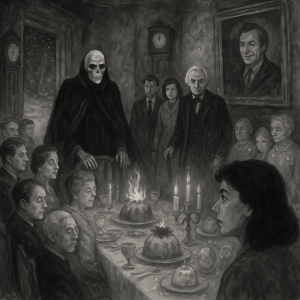
It was a glittering sight: a table stretched the length of the room, heavy with roast goose, pheasants, bowls of steaming potatoes, flaming puddings, and silver dishes piled with fruit. Glasses sparkled with wine. Around the table sat gentlemen in tailcoats and ladies in silks, their laughter polite, their faces composed in perfect cheer.
“Goodness,” Barbara murmured. “It’s like a painting.”
At the head of the table sat Lady Caversham, a tall woman in a gown of green velvet, who rose to greet them with a practised smile. “New guests!” she declared warmly. “How wonderful. Please, take your places.”
The Doctor bowed politely, though his sharp eyes missed nothing. “A most generous welcome, madam.”
The travellers sat. A servant poured wine into their glasses. The food was excellent, yet somehow it gave Barbara pause. The roast goose was perfectly carved, the potatoes golden, the pudding aflame with just the right flourish of brandy — but it was too perfect, as if each detail had been painted in advance.
Susan glanced about the table. “Grandfather, don’t you think—”
The Doctor silenced her with a small shake of his head.
A toast was raised. Everyone drank. Laughter followed, ringing a little too precisely in time. And then, just as Susan reached for her fork, something strange happened.
The room blurred. The laughter ceased.
And then — as though nothing had occurred — the feast began again.
The same toast. The same laughter. The same perfect carving of goose.
Barbara’s hand trembled. “Ian… we’ve done this already.”
Ian frowned. “Yes. I could swear—”
The Doctor leaned forward, eyes blazing. “Indeed. We are caught, my friends, in a loop.”
And once again the laughter rang out, as though the house itself demanded its guests to be merry.
Chapter Two
The Hungry House
Ian rose quietly from the table. “Excuse me a moment,” he said, slipping away from the chatter. He pushed open a side door, finding himself in a long corridor lined with portraits. But as he walked, the corridor seemed to bend and twist.
A moment later he stepped through another door — and found himself back at the dining hall, standing beside the very chair he had left.
Barbara tried next, with the same result. Wherever she went, whichever passage she chose, she returned always to the feast.
Susan, meanwhile, had befriended a boy her age seated further down the table. His face was pale, his eyes hollow yet gentle. He leaned close and whispered: “Don’t talk too loud. The house listens.”
“What’s your name?” Susan asked.
“Edward,” he said. “I’ve been nine years old for as long as I can remember.”
Her breath caught. “That’s not possible—”
He shook his head. “Don’t say it. If you say it, it makes the storm worse.”
Across the table, Lady Caversham met Barbara’s gaze. Her smile was serene, but her eyes trembled. “It is always Christmas here,” she said softly.
Barbara whispered back, “Don’t you want it to end?”
Lady Caversham’s fork hovered above her plate. For a moment it seemed she might answer honestly. But then she gave a brittle laugh, as if silenced by something unseen.
The Doctor, meanwhile, had been studying the clocks. He tapped his cane against the mantlepiece, eyes narrowing. “Yes, yes, I thought so,” he muttered. “Every clock in this house… stuck at eleven fifty-nine. Time is not moving forward at all. We are repeating a single moment.”
The butler appeared at his elbow. “Dinner is served, sir.”
The Doctor’s eyes flashed. “Indeed it is — served again, and again, and again! And tell me, my good man — to whom is it served?”
The butler said nothing. His lips smiled politely, but his eyes were empty.
At the head of the table, Susan stared in horror. One of the portraits — a tall, skeletal figure seated at a banquet table — had just turned its head. Its painted eyes were upon her, and its lips curved slowly into a smile.
Chapter Three
The Master of the Table
Susan’s scream cut across the laughter. The others followed her horrified gaze to the portrait at the far wall.
The figure was painted in oils: tall, thin, draped in black. Its bony hands rested upon a feast that seemed half-shadow, half-meat. Where its eyes should have been, the artist had daubed only black pools. Yet now those eyes were fixed upon Susan — and the smile that spread across its painted mouth was far too real.
The Doctor was on his feet at once, cane raised. “So! There you are. I wondered how long you would hide.”
The portrait rippled, as if paint were suddenly liquid. A chill spread through the hall. The lights flickered, the guests froze mid-gesture — and then the figure from the painting stepped forward into the dining room.
It was taller than any man, its limbs jointed too long, its face pale as bone. Its black robe trailed along the floor like a shadow that had learned to walk.
Lady Caversham’s fork clattered to her plate. “The Host,” she whispered.
The Doctor squared his shoulders, his sharp old eyes defiant. “Indeed. And pray tell — why should these poor people sit here year upon year, trapped in your masquerade?”
The Host’s voice was deep and hollow, like wind through a crypt. “They serve. They remember. Their memory feeds me, their ritual sustains me. Christmas — forever repeated — is the sweetest of banquets.”
Ian clenched his fists. “You’re draining their lives! You’re keeping them prisoners!”
The Host tilted its head, amused. “They are willing prisoners. Look at them.”
The guests laughed again, every face plastered in brittle cheer. Forks rose and fell. Puddings flamed. The moment reset.
Barbara knocked over her glass. It righted itself, wine unspilled. Ian tore the tablecloth free — but in an instant it lay flat again, plates perfectly arranged. Every disruption smoothed itself into obedience.
“It’s like the house repairs the story,” Barbara whispered. “The feast must go on.”
The Doctor nodded grimly. “A parasite bound to pattern. It cannot create, it can only repeat. A story told until the tongue forgets whose words they were.”
Susan reached for Edward’s hand. His small fingers were icy. “Why don’t you fight it?”
The boy’s voice was no louder than a breath. “Because we’re so very tired.”
The Host leaned across the table, its shadow stretching over them all. “And you, Doctor. You and your companions. You will sit. You will eat. And if you refuse… you will serve.”
It raised its hand. At once, the walls shimmered. The air filled with faint cracking sounds. Susan cried out — her skin paling, her hands stiffening. Porcelain crept across her fingers. She was turning into a doll.
Edward too was stiffening beside her, his face a frozen mask.
The Doctor’s cane struck the table. “No!” he thundered. “You shall not have them.”
Chapter Four
The Breaking of the Feast
The dolls lined the walls, dozens of them. Once they might have been guests, servants, children. Their porcelain eyes gleamed. Their painted smiles were wide and cruel.
Susan struggled, porcelain creeping up her arms. Ian dragged her from her chair, pulling her close. “Fight it, Susan! Don’t give in!”
Barbara clutched Edward, who whimpered as his skin glazed like ice. “Doctor, help him!”
The old man’s face was tight with fury. He stood at the head of the table, glaring up at the Host. “Yes, yes, I see it now. You cannot endure rejection, can you? You need their agreement. Their compliance. Without it, you cannot feed!”
The Host hissed, shadows writhing.
The Doctor turned to the frozen diners. “You hear me? You have a choice! Push away your plates. Refuse the food. Deny it!”
Lady Caversham trembled. “I tried once before,” she whispered. “When I refused, the storm outside grew worse. I feared the world would be swallowed.”
“Better the storm than this prison!” the Doctor roared.
Ian swept plates from the table. Barbara overturned a pudding, flames dying on the floor. Susan, with a cry, flung her goblet to the ground. Edward stared at his untouched plate — then shoved it away with all his might.
The hall shook. Cracks split the walls. The Host howled, its form unravelling like smoke in the wind. The dolls along the walls toppled, their porcelain shattering.
The guests rose from their seats, their smiles faltering. Age rushed upon them in an instant — children growing into adults, adults withering into grey-haired elders. Years they had been denied came flooding back, merciless and swift.
The Host staggered, its black robe disintegrating. “You break the story,” it hissed. “You break me.”
“Quite so,” the Doctor said coldly. “Now begone.”
With a final, furious scream, the Host dissolved into a whirlwind of ash. The candles guttered out.
The house shuddered once — and then was gone.
Chapter Five
The Empty Hill
The travellers stood in the snow. Where the manor had stood, there was only a bare hill, empty save for drifting flakes. The footprints of the guests were already fading into whiteness.
Susan clung to Barbara, her eyes wet. “Edward… he’s gone. The house took him.”
Barbara held her close. “He’s free now. That’s what matters.”
Ian turned to the Doctor. “So that’s it? All finished?”
The old man’s face was unreadable. “Finished, yes. But never forgotten. Memory is the coin this creature sought, and it nearly made the world its purse. Hmph!” He tugged at his lapels. “Gluttony, greed, repetition… Mankind is quite capable of trapping itself without help. But sometimes, monsters make themselves comfortable all the same.”
He turned and strode back to the TARDIS, his cloak whipping in the wind. Ian and Barbara followed, Susan lingering one last moment.
She looked at the hill, at the empty snow where a boy had once smiled. For a moment she thought she saw him there, waving. But when she blinked, there was only the snow.
The TARDIS wheezed, shimmered, and vanished, leaving only the soft hush of falling flakes.
And if, on Christmas Eve in the years that followed, travellers passing that hill sometimes heard faint laughter, or the clink of glass carried on the wind — well, Christmas has always been a season for ghosts.
THE END
 The Crazymad Writer Writes Again