The Air Raid Shelters of Saint Ignatius School

The Air-Raid Shelters of Saint Ignatius
Back in the 1960s, when summers were endless and jam sandwiches tasted like heaven, I attended Saint Ignatius Primary School in Sunbury-on-Thames. To a child of that era, it was more than just a school—it was a small world of its own, nestled between old brick houses, the River Thames, and the great hum of a town that still carried the echo of wartime sirens.
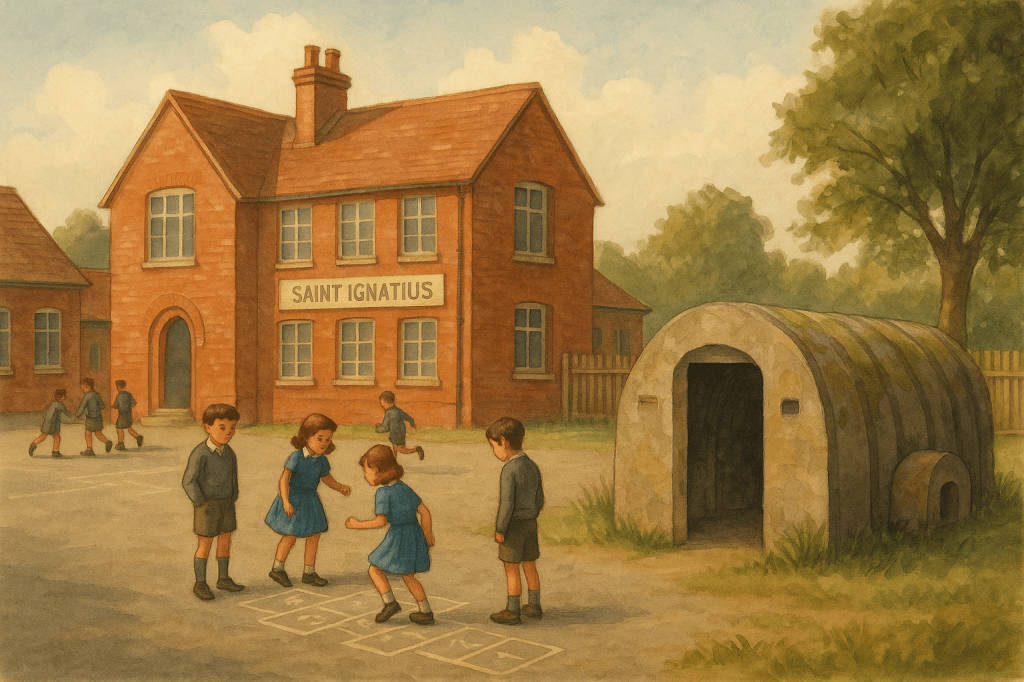
The school itself was a solid, reassuring place. Red-bricked and Victorian in spirit, with squeaky floorboards and coat pegs that bore generations of names scratched into the wood. The classrooms had tall windows that let in golden light on sunny days—or the fog, on the not-so-sunny ones. Our desks had lids you could lift, inkwells no one used anymore, and the occasional half-sucked toffee stuck underneath. That, we were told, was history.
But what made Saint Ignatius truly special—at least to us children—were the air-raid shelters.
Behind the school field, just beyond the hopscotch squares and the old sycamore tree that dropped sticky pods into our hair, lay a cluster of strange, half-buried shapes: moss-covered concrete bunkers with rusting doors and narrow vents like the snouts of giant moles.
“They’re from the war,” whispered Jimmy Fretwell, the self-proclaimed expert on all things mysterious. “They were built in case the Luftwaffe dropped bombs on the school. Miss Davies says they used to have benches in ’em. Wooden ones. And buckets.”
“Buckets?” we asked.
“Toilets,” he said, with a look of solemn horror. “Just imagine the smell.”
We never had lessons down there, of course. Health and safety wasn’t quite the religion it is today, but even in the 60s, letting children loose inside a crumbling war relic was pushing it. But that didn’t stop our imaginations. The shelters were sealed with big iron padlocks, but we’d peek through cracks or invent stories of what lay within—bats, ghosts, even a secret tunnel leading under the school to the Thames.
One winter, after a particularly big storm, a caretaker discovered one of the old shelter doors hanging open. The next morning, every boy in Year Four had to line up while Miss Gallagher—who had eyes in the back of her head—grilled us. Apparently, someone had gone inside and written “Winston woz ‘ere” in chalk on the far wall.
I still claim it wasn’t me.
Inside the school, life was a rhythm of bells, hymn practice, warm milk in glass bottles, and times tables barked out in unison. We wore grey shorts and scabby knees with pride. Sister Benedict taught us handwriting with a fierce devotion to curls and loops. Mr Thomas, the music teacher, always had chalk on his elbow and a voice like an opera singer who’d swallowed a frog.
But it wasn’t all discipline and dusty textbooks. Saint Ignatius had warmth. Real warmth. Teachers knew our names—and our mums and dads and whether we were due for a smack or a sweet. The playground rang with laughter, skipping ropes slapped the concrete, and every Friday we had assembly in the hall, followed by a secret hope that the headmaster might forget we had double maths.
Years later, when I walked past the school as an adult, it looked smaller than I remembered. The tree seemed less grand, the playground less vast. The air-raid shelters were gone—demolished or buried, probably. But I could still hear our voices echoing through time, calling each other names, trading football cards, and daring one another to touch the haunted bunker.
Saint Ignatius wasn’t just where we learned our ABCs. It was where we learned friendship, wonder, and the subtle art of staying just out of sight when trouble came looking.
And every now and then, I still dream of those shelters—cool, damp, and filled with the ghostly laughter of children who knew no fear, only stories.
St Ignatius School
 The Crazymad Writer Writes Again