The Story of Mad Mr. Viscous
Chapter 1: The Viscous Truth
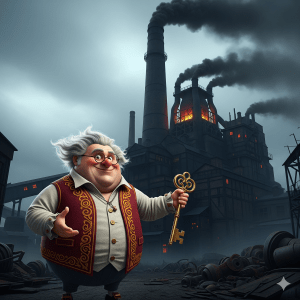
Mad Mr. Viscous ran the Glue Factory, a place that was less a business and more a monument to his own distorted genius. From the outside, it was a hulking, soot-stained brick fortress with a towering smokestack that vomited dark, putrid clouds into the otherwise clear sky. The air around it hung thick with a smell that was cloyingly sweet, a scent that hinted at boiled-down sugar but held a greasy, unsettling undercurrent that made your stomach churn.
Mr. Viscous himself was a man built to match his factory’s unseemly ambition. His waistcoat, a garish maroon, was perpetually stretched tight over a spherical stomach that seemed to have a gravitational pull of its own. He moved with a waddling, self-important gait, his chin held high as if he were constantly inhaling the fumes of his own superiority. His face, often flushed with a mad kind of glee, was framed by wild tufts of white hair and a pair of spectacles perpetually slipping down his bulbous nose.
“They’re all sentimental fools, you know,” he’d scoff to anyone who would listen, and many who would not. He’d stand in front of his prize possession—a wall-sized chart detailing his factory’s growth—and jab a fat finger at a rising line. “Crying over a broken-down old nag. I’m a visionary! Giving them a new life, a useful one!” He would chuckle, a wet, guttural sound that seemed to bubble up from the depths of his vats.
Jimmy and Eric, two boys bound by the kind of friendship only a long, lazy summer can forge, knew the river better than anyone. They had a small canoe they’d saved up for, and their days were spent fishing, exploring, and building secret forts in the woods. But one afternoon, their carefree adventure was soured. A single, battered horseshoe floated past them, then another. Soon after, a splintered wooden post with a frayed piece of rope attached. It was the rope that caught their attention; it looked exactly like the lead rope from the old mare at Farmer McGregor’s barn. He had sold her off a few weeks ago, but the rumors of what happened to “unfit” horses were now confirmed. Mr. Viscous’s factory was a slaughterhouse, and its products were finding their way to the river.
The discovery hit them hard. Eric, who had a special bond with animals, felt his fists clench at his sides. “We have to do something, Jimmy,” he said, his voice a low growl.
Jimmy, ever the strategist, nodded. “He thinks he’s so smart, so untouchable. We have to show him he’s not.”
Their first plan was born of pure, righteous indignation and the limited resources of two determined boys. They would sneak into the factory and ruin his precious glue. Their target was the central office, a place of almost mythical arrogance, where Mr. Viscous held court. From a distance, they had spied his desk, a shrine to himself and his gruesome success, complete with a framed award and bottles of his adhesive. The plan was simple, if a little rough around the edges: douse his office in water and hope it would ruin the glue.
That night, they scaled the fence, their hearts pounding in their chests. They tiptoed past the silent, hulking vats and found the office window ajar. With a grunt and a heave, they hoisted a bucket of river water up with a length of rope, aiming for the window. But as they lifted it, a sudden flash of light inside the office made them freeze. The office door opened. Mr. Viscous was there, rummaging through some papers.
In their haste and panic, they lost their grip. The bucket, a heavy pendulum, swung wildly and smashed against the window frame. A shower of water, glass, and a single, unruined bottle of Mr. Viscous’s glue splashed onto the factory floor, missing his head by inches. He looked up, his face a mask of furious confusion, just in time to see two small forms darting away into the darkness. Their first attempt had failed. Mr. Viscous would only become more wary, and more arrogant, from this close call. He laughed to himself, a low, triumphant sound. “Fools,” he muttered, “they have no idea who they’re dealing with.”
Chapter 2: The Sticky Situation

The broken window was more than a mere nuisance to Mr. Viscous; it was a declaration of war. He fumed for a full day, not because of the cost of the pane, but because of the audacity. Someone had dared to challenge his empire. His arrogance, once a simple trait, curdled into a bitter paranoia. He had a security camera installed that very day, a single, unblinking eye mounted above the main office door, its red light a beacon of his newfound vigilance. He also hired a new night watchman, a burly, sleepy man who sat in a small booth by the main gate, illuminated by the glow of a small television screen.
Jimmy and Eric, having observed these new defenses from their vantage point across the river, knew their old tactics wouldn’t work. “He’s expecting us to come back, to break something else,” Jimmy said, skipping a flat rock across the water.
“Yeah, but what if we don’t?” Eric replied, his gaze fixed on the factory’s large discharge pipe that jutted out from the base of the building, dribbling a viscous, brownish goo into the river. “What if we attack the glue itself, before it’s even made?”
The boys’ new plan was born of their knowledge of the river. They would clog the factory’s primary outflow pipe. This pipe, they reasoned, was where the waste water from the initial rendering process was expelled. A good blockage would mess with the whole system, causing pressure to build and production to slow, if not stop entirely. Their tools were simple: a long, sturdy branch they found in the woods, and a massive bundle of river weeds, fallen branches, and a few old, slimy rags they’d collected.
Under the cover of a moonless night, they paddled their canoe quietly towards the factory’s riverbank. The new security camera swiveled back and forth, but its limited range couldn’t see the water’s edge. The night watchman was snoring softly in his booth. They slipped out of the canoe and, working together, pushed the makeshift dam into the gaping mouth of the pipe. It was a perfect fit, and as they heard the sickening squish of the weeds and muck being shoved into place, a grin spread across Jimmy’s face.
But Mr. Viscous, with his newfound obsession, was not sleeping soundly. He was in his office, glued to a monitor that displayed the factory’s internal gauges. He had installed a new flow meter on the outflow pipe, a paranoid afterthought. As he watched, the needle on the meter began to drop, then held steady at zero. “Ah-ha!” he shrieked, his voice muffled by the thick glass of the window. “They’re back! The little wretches!”
He didn’t bother to call the night watchman. He saw this as his moment to prove his own superior cunning. He crept outside, carrying a heavy wrench, his grin wide with anticipation. He would catch them red-handed and make an example of them. He stalked to the riverbank, peering into the darkness. But there was no one. Only the thick, slimy bundle wedged in his pipe.
“Fools!” he shouted into the night. “Thinking you could outsmart me!” His victory was so exhilarating that he decided to take care of the problem himself, a final, definitive show of his power. He knelt down, jammed the wrench into a protruding branch, and pulled.
The pressure that had been building inside the pipe was immense. The bundle of weeds and gunk shot out with the force of a cannonball, narrowly missing his head, but it was followed by a pressurized jet of thick, gelatinous waste. It slammed into Mr. Viscous, coating him from head to toe in the foul, brownish slime. He was a statue of reeking, rendered-down gunk, his arms splayed out in a futile attempt to shield himself.
From a clump of bushes across the river, Jimmy and Eric watched. They hadn’t stopped the factory, but they had forced a direct, disgusting confrontation. As they saw their enemy dripping with his own foul product, a victory cheer, silent and satisfying, passed between them. The war had just begun, and the boys had just won the first true battle.
Chapter 3: The Empty Road

The slime-soaked humiliation of his last encounter only served to fuel Mr. Viscous’s arrogance. He had been tricked, not defeated. This was not a defeat; it was a mere lesson in the cunning of his enemies. He had his office professionally cleaned, his wrench replaced, and his paranoia escalated to a new, industrial scale. The night watchman was fired, replaced by a much younger, more alert guard who patrolled the grounds with a fierce-looking German Shepherd. Mr. Viscous also had his perimeter lights doubled, turning the factory into a fortress of blinding light at night.
“They think they can stop me?” he cackled to himself, rubbing his hands together. “They have no idea what it takes to run a business of this magnitude. You have to be… resourceful.”
He was expecting his largest delivery yet, a shipment of fifty of the oldest, most broken-down horses from a farm a hundred miles away. The delivery was scheduled for the following afternoon, and Mr. Viscous had already arranged for a police escort, a preventative measure he paid for with an astonishingly large “donation” to the local precinct. His plan was foolproof, and he knew it. He would be there to receive the horses himself, just to bask in his victory.
Jimmy and Eric, however, were not deterred. Their defeat was bitter, but it had revealed a new truth: Mr. Viscous was a creature of habit. The horses always came by the same main road, the one that ran past the old railway bridge and straight to the factory gates. The boys figured if they could stop the delivery before it even reached his property, Mr. Viscous would be powerless. The police escort was a problem, but Jimmy, with his knack for improvisation, had a solution.
They planned to block the road at the railway bridge, where the road narrowed to a single lane. They spent the morning gathering a large pile of old scrap metal and discarded tires, hauling them on a small cart they’d found. Their timing would have to be perfect. As the truck with the horses approached, they would push their heap of junk into the middle of the road. With the truck stalled and the police unable to get around, they would have a window of opportunity to unlatch the back of the truck and free the horses into the adjacent fields.
But the truck never came. The rumbling faded, and the flashing lights vanished. Confused, they peered around the bend, expecting to see a traffic jam, a detour, anything. The road was empty. The police car and the truck had simply vanished, as if they had taken a turn into thin air.
Suddenly, a loud, triumphant cackle echoed from the distance. They looked toward the factory, and there, perched on a new, elevated platform near the factory’s entrance, was Mr. Viscous himself, a comically large pair of binoculars to his eyes. He waved them in the air like a mad conductor, his grin wide and malevolent.
From behind him, a different sound could be heard—the high-pitched whine of a hydraulic lift. The boys watched, horrified, as a massive tractor-trailer pulled up to a hidden side entrance they had never seen before. It was a private dirt road, obscured by thick foliage, that bypassed the entire main thoroughfare. Mr. Viscous had a secret way in, a back door to his fortress. As he directed the drivers with grand gestures, the boys watched as the first of the horses, old and weary, was led down the ramp and into the factory’s dark interior. Their plan had been a spectacular failure. They had lost.
Or had they? As the last horse was being led inside, Eric noticed a peculiar detail on the side of the truck. A small, circular logo of a family crest, a silver knight on a green background. He hadn’t been paying attention to it before, but now it seemed to leap out at him. It was the crest of the local historical society, a group that was vehemently against Mr. Viscous’s business. Why would their crest be on the side of a truck delivering horses to him? The police escort was one thing, but this was an entirely new and different kind of deception. It was a thread, a single, tiny weakness in the madman’s perfectly designed web. A flicker of hope ignited in their eyes. This time, they wouldn’t just be stopping the delivery; they’d be unraveling the entire operation from the inside out.
Chapter 4: A Friend in Low Places
Defeat tasted bitter, but the revelation of the historical society crest was a morsel of hope. Mr. Viscous’s arrogance had led him to overcomplicate his deception, and in doing so, he had provided the boys with their first real lead. They left their junk pile behind and hurried to the local library, a quiet, dusty place filled with the smell of old paper and the solemn whispers of its librarian, a perpetually tired woman named Mrs. Peterson.
Mrs. Peterson, it turned out, was the historical society’s secretary, and she was fiercely protective of its reputation. When Jimmy and Eric approached her with a nervous, breathless story about the truck and the crest, her eyes, usually hidden behind thick glasses, sharpened.
“The historical society?” she said, her voice a hushed but firm tone. “Using our crest on a… a truck like that? It’s preposterous! We’ve been trying to stop that man’s vile business for years.”
The boys explained their theory about Mr. Viscous using the crest as a deceptive cover to make the delivery look more legitimate. Mrs. Peterson’s indignation was a tangible thing, a simmering rage that quickly transformed into a cool, calculating determination. She didn’t call the police; she knew how little the local law enforcement cared about what happened to old horses when Mr. Viscous was greasing their palms. Instead, she opened a large, leather-bound book with a flourish and a cloud of dust. “There are other ways to get to a man like Mr. Viscous,” she said, her voice a low conspiratorial whisper. “He’s not just a glue manufacturer. He’s also a collector.”
She showed them an old, grainy photograph of a man standing next to an ancient, rusted-out train car. It was Mr. Viscous, much younger, with the same arrogant smirk. The caption beneath it read: “Mr. Viscous with his prized possession, the last remaining railroad car from the old town of Gleamwood.”
“He bought it years ago,” Mrs. Peterson explained. “The historical society tried to acquire it for a museum, but he outbid us. He claimed it was for a ‘personal preservation project,’ but we all know it’s just so he can lord it over us. He keeps it in a side shed on his property, away from the rest of the factory.”
This was the new plan. No longer were they going to stop the deliveries; they were going to strike at the heart of Mr. Viscous’s pride. The train car was the most vulnerable part of his operation, a place he would never expect them to target. The shed was old and rickety, tucked away in the deepest corner of his property. The boys figured they could sneak in and cause some serious damage to his “prized possession,” forcing him to divert his attention and resources away from the glue-making operation.
They waited until a Saturday afternoon, when the factory was mostly shut down for the weekend. The new night watchman and his dog were long gone, and the afternoon sun was a silent accomplice. They slipped past the main gate and skirted the bright perimeter lights, moving through the shadows cast by the huge vats and machinery. They found the shed with little trouble, its rusty lock a pathetic attempt at security. A well-placed rock from Jimmy and a solid kick from Eric, and the lock burst open with a satisfying clatter.
Inside, the train car was a ghost from a bygone era, its red paint faded and peeling, its windows boarded up. As they stepped inside, the air was thick with the scent of mildew and decay. They were about to begin their work when they heard a low, metallic clanking from the back of the car. Puzzled, they peered into the darkness and saw a section of the floor had been pried up. It was a false floor, and beneath it was a small metal hatch with a padlock on it.
A new twist in the story had just appeared, one that went far beyond what Mrs. Peterson knew. Mr. Viscous wasn’t just storing a train car here; he was hiding something. The old, rusty car wasn’t a monument to his arrogance, it was a secret vault. They had found the perfect leverage, and they had just entered his most private lair. The real game was about to begin.
Chapter 5: The Secret in the Shed
The padlock on the hatch was thick and old, a rusty beast that would not yield to a simple rock or kick. Eric’s frustration was a quiet, seething thing. “Of course he’d have a lock on it,” he grumbled, tugging at the steel loop. “He probably thinks we’re just a couple of meddling kids.”
Jimmy, ever the pragmatist, saw the challenge not as an obstacle but as an invitation. “He does, and that’s why we’ll beat him,” he said, his eyes scanning the interior of the train car. The walls were lined with dusty shelves, holding a chaotic jumble of discarded tools, empty oil cans, and old ropes. He rummaged through a pile of what looked like old mining equipment until his hand closed around a long, heavy metal bar with a flattened, chisel-like end. A perfect lever.
He worked it under the lip of the hatch, and with a grunt, he leaned his full weight on the bar. The rusted metal shrieked in protest, but the old lock held fast. They tried again, this time with both of them pulling together, but the padlock was unmovable. Mr. Viscous had a new, much more advanced lock on this, his most prized secret.
A loud, piercing alarm suddenly blared from the direction of the factory. The sound was not the standard fire alarm, but a high-pitched, metallic scream that could only mean one thing: a breach of the factory’s security system. The boys froze, their blood running cold. They had been so focused on the shed that they hadn’t considered Mr. Viscous might have a separate alarm system for his prized possession. They were caught.
They heard the sound of the German Shepherd’s frantic barking, growing louder, closer. The watchman, no doubt, was on his way, and this time, he was not asleep. They abandoned the useless pry bar and scrambled out of the train car, pulling the old shed door shut behind them and doing their best to make it look untouched. They darted behind the train car just as the watchman rounded the corner, his dog straining at the leash, its nose to the ground.
The watchman scanned the area with a powerful flashlight. His gaze swept over the shed door, pausing for a moment, but he saw nothing out of the ordinary. The alarm, however, was still blaring. He looked toward the factory’s main gates, puzzled. The alarm was coming from there, not here.
The boys, watching from behind a rusty boiler, felt a wave of confusion wash over them. They heard a voice yell from the main gates, “False alarm! A fox got into the wire!” Mr. Viscous’s paranoia had worked against him. He had installed so many security measures that one of them had finally malfunctioned, giving the boys a cover to get away.
As the watchman and his dog headed back to the main gates, Jimmy and Eric slipped back into the train shed. But they were no longer interested in the padlock. The scare had made them realize the clock was ticking, and they had to find a different way in.
They looked around the shed again, but this time with a frantic, new energy. Eric noticed a loose-looking plank of wood on the train car’s wall. It seemed to have come free from its frame. He jiggled it gently, and it gave way, revealing a small gap between the car’s outer shell and its inner wall. He peered inside and saw a loose wire, connected to a small metal box. It was a fuse box for the lock.
With a triumphant whisper, Eric motioned to Jimmy. They had found the real key to the vault, and it wasn’t a physical one. They had bypassed the lock entirely. The fuse box hummed with a low current, and they could see a single, blinking red light. They had to figure out how to disable the lock from the inside without triggering another alarm.
Their newest and most dangerous gamble was about to begin, and Mr. Viscous, with his false sense of security, was completely unaware.
Chapter 6: The Final Ingredient
The blinking red light in the fuse box was a tantalizing mystery. Eric, with his nimble fingers, carefully reached into the small gap. “There are three wires,” he whispered. “A red, a blue, and a yellow. Which one do we cut?”
Jimmy hesitated. He wasn’t about to take a guess and risk a louder, more direct alarm. Instead, he scanned the interior of the train car, his mind working quickly. The space was filled with old, forgotten things—rusted tools, cobweb-covered maps, and a strange, elaborate system of brass pipes and gauges. One of the gauges was labeled with a faded inscription: “Memory Pressure.”
He saw a small, leather-bound book on a dusty shelf. He pulled it out and opened it. The pages were filled with Mr. Viscous’s frenzied, looping handwriting. They were his journals, detailing his experiments in “preservation.” Jimmy’s eyes widened as he read. The passages were not about glue, but about memories, about how to extract them from living things and preserve them.
“It’s not glue,” Jimmy said, his voice a tremor of disbelief. “He’s not just killing them for glue, he’s… he’s taking their memories.”
He pointed to a page with a diagram that showed the factory’s full layout, including a separate, hidden chamber with vats labeled “Memory Vats.” This chamber was connected to the railroad car by a series of underground pipes, powered by the very fuse box they were looking at. The yellow wire, the journal indicated, was a fail-safe, a way to cut the power to the entire system.
“The yellow wire,” Jimmy breathed, his heart pounding in his chest. “Cut the yellow wire, and the lock will open.”
Eric, with a small pair of wire cutters they had brought, carefully snipped the yellow wire. The red light blinked once, then went dark. The humming stopped. With a gentle click, the padlock on the hatch below them released. They pulled the hatch open, revealing a small, dark tunnel leading deeper into the earth. The air was colder here, and it carried a faint, sweet smell, like old memories.
They crawled through the tunnel and emerged into a vast, cavernous room, a secret chamber hidden beneath the factory. It was not a storage room, but a gallery. Along the walls were hundreds of glass jars, filled with a cloudy, golden liquid. Inside each jar, a tiny, swirling image could be seen: a horse running through a field, a child’s laughing face, a pair of hands knitting a blanket. These were the memories, preserved and trapped. In the center of the room, a large, ornate jar stood on a pedestal. Its golden liquid was churning violently, and a hundred different images of a horse—a majestic stallion—swirled within it.
Suddenly, a light flipped on, blinding them. Standing in the doorway was Mr. Viscous, his face contorted in a triumphant sneer. “Bravo,” he said, clapping his hands slowly. “You’ve finally found my true masterpiece. Not glue, my dear boys, but forever. The world wants to forget, but I… I preserve.” He gestured to the large jar. “That, my friends, is the stallion from the historical society crest. I didn’t just buy the truck, I bought the very last memory of Gleamwood’s golden age. I am the collector of all that is forgotten.”
His victory was so complete he failed to notice the small glass jar Eric had snatched from a shelf. It was the memory of a puppy playing with a little girl. Eric held it up. “Let’s see if this one sticks, Mr. Viscous,” he said, and with a swift, powerful throw, he smashed the jar against the wall.
The golden liquid splattered everywhere, and from the broken memory, a phantom, wispy form of a puppy appeared and began to spin wildly through the air, barking. Mr. Viscous stared, transfixed, his eyes wide with a strange mix of rage and terror. He had never seen a memory come unglued. The more of the liquid the puppy touched, the more memories began to break free from their jars, swirling around the room in a chaotic, beautiful, and terrifying dance. Mr. Viscous’s masterpiece was unraveling before his very eyes, and the final battle was just beginning.
Chapter 7: The Unraveling
The room erupted into a beautiful, terrifying maelstrom. Wispy, golden tendrils of light and memory flowed from the shattered jars, forming a swirling storm. The air crackled with a mix of emotions—a horse’s peaceful canter across a field, the joyous cry of a child, the warm touch of a blanket being woven. These were not just images; they were sensations, and they were all crashing into each other, and into Mr. Viscous.
Mr. Viscous, his mouth agape, was utterly unprepared for the sensory assault. The initial shock gave way to pure, unadulterated panic. He swatted at the swirling mists, his hands passing uselessly through the intangible memories. He was being bombarded with the very feelings he had stolen. The memories of the horses he had processed, the old and weary ones, seemed to target him with particular malice. A herd of spectral, golden horses galloped through the room, their intangible hooves passing through him, each a painful, chilling reminder of what he had done.
The magnificent stallion from the historical society crest, the jewel of his collection, was now the chief tormentor. Its memory, once a source of his supreme arrogance, now manifested as a phantom beast, its head held high, its eyes burning with a silent, majestic rage. The image of the stallion reared up on its hind legs directly in front of Mr. Viscous, its whinny a cacophony of lost voices. It was a memory of freedom and life, and it was a direct contradiction to everything he had built his empire on. He screamed, not in rage, but in a raw, animalistic terror.
Jimmy and Eric, seeing the chaos they had unleashed, realized they didn’t need to do anything else. Mr. Viscous was a captive in his own masterpiece, a victim of his own vile ambition. As the memories swirled and combined, a chaotic symphony of life and death, they knew this was their moment to escape. Jimmy snatched a single jar that hadn’t been broken, the memory of a tiny, fluffy puppy, and stuffed it into his backpack. It was their proof. They scrambled back through the tunnel and emerged, breathless, into the quiet, starlit night.
The factory’s lights still blared, but the silence was deafening, save for the distant, muffled screams of Mr. Viscous, trapped in his secret chamber. They ran straight to Mrs. Peterson’s house. She was up, poring over a new historical society document, and she let them in with a stern look.
“Mrs. Peterson,” Jimmy said, his voice trembling with exhaustion and excitement. “You won’t believe what we found. It wasn’t glue at all.”
He pulled the journal from his backpack, and then, with a shaking hand, placed the single, unbroken jar on her desk. She peered inside at the tiny, swirling memory, her face a mask of disbelief and horror. The truth was out. The era of Mad Mr. Viscous was over, his reign of terror ended not by a police raid or a newspaper exposé, but by two boys and a single, broken memory.
Chapter 8: The Echoes of Gleamwood
The sun rose over Gleamwood as if nothing had changed, but the town itself was a strange, new place. A golden, almost imperceptible mist hung in the air, a silent testament to the memories that had escaped the night before. Jimmy and Eric, having spent the night at Mrs. Peterson’s house, were the only ones who knew the cause.
The first sign came when the town’s elderly baker, Mr. Finch, walked out of his shop looking utterly bewildered. He held a loaf of bread that was perfectly shaped like a horse, its ears made of crust and its tail a twisted knot of dough. “I don’t know why,” he mumbled to his wife, who was staring at him in disbelief. “My hands just… did it.” The memory of the stallion, its magnificent form etched in gold, had found a home in his baker’s hands.
The strangeness only grew. The postman, a grumpy man who rarely smiled, suddenly felt a surge of joy he couldn’t explain and started whistling a tune he’d never heard before. The tune was so catchy that everyone he passed began to hum it too. Later, Mrs. Peterson identified the song from a grainy photograph in the historical society’s archives—it was a popular song from the 1920s, a memory that had escaped one of the jars and found its way to the postman’s mind.
The biggest change came to the children. The dogs of Gleamwood, once a cacophony of barking, now stood in a quiet circle in the town square, their tails wagging in a slow, synchronized rhythm. They were reliving the memory of a peaceful afternoon spent in a sunny field, a memory Mr. Viscous had taken from a weary old farm dog.
Jimmy and Eric, watching from the library steps, looked at each other with a mix of awe and dread. They had won, but their victory had unleashed something beautiful and chaotic. The town was now a living, breathing museum of stolen memories, a place where people were no longer just themselves but also brief, fleeting echoes of a hundred forgotten lives. They had a new problem on their hands, one far more complex than a madman and his glue factory. They had to figure out how to put a town back together when its very memories were not its own.
Chapter 9: A New Kind of Trouble
The chaos of the morning solidified into a strange new normal. It wasn’t dangerous, but it was deeply unsettling. A plumber, halfway through fixing a pipe, would suddenly stop and begin to meticulously arrange his tools in a pattern of a blooming flower. A teacher, mid-lecture, would pause and begin to gracefully dance a waltz. The town’s animals, too, were affected. Cats would sit patiently by the road, their fur twitching with the urge to give a ride, as if they were ponies. Cows in the fields would suddenly let out an exuberant bark. No one was hurt, but no one was truly themselves, either. The police force, finding themselves spontaneously re-enacting an old vaudeville routine, was in no shape to investigate anything.
Mrs. Peterson, hunched over Mr. Viscous’s journal at her kitchen table, was the only one in Gleamwood who understood the scope of the problem. “He didn’t just collect memories,” she murmured, tracing a line of Mr. Viscous’s cramped handwriting. “He also cataloged their release patterns. He called it ‘sympathetic resonance.’ If enough of a certain kind of memory is released, it can resonate with a living mind and manifest itself.”
Jimmy and Eric sat across from her, their faces pale. The single intact jar—the memory of the puppy playing with the little girl—sat on the table, glowing faintly. “So… we made everyone else a little bit of a memory monster, just to get back at him?” Eric asked, his voice filled with guilt.
“We were fighting a war we didn’t understand, boys,” Mrs. Peterson said gently. “Mr. Viscous was not just a madman, he was a mad scientist. The factory wasn’t a glue factory at all, but a massive machine for stealing and storing emotions. We stopped the flow, but we didn’t stop the spread.”
Their objective had shifted from simple revenge to a grand, and terrifying, rescue mission. They had to find a way to contain the memories, to give Gleamwood back its own identity. They turned their attention back to the jar on the table. If a single memory could be a weapon, maybe a single memory could be the cure. They knew they couldn’t just open it; they had seen what happened to Mr. Viscous. But the journal held the key to a much more delicate process—a way to gently coax a memory out without letting it run wild.
“We have to go back to the factory,” Jimmy said, his resolve firm. “And this time, we’re not breaking anything. We’re putting things back together.”
Mrs. Peterson nodded, her eyes fixed on the journal. “And we have to figure out how to use this.” She held up the single, intact jar. “This little puppy might be the only hope Gleamwood has left.”
Chapter 10: The Mending of Gleamwood
The morning light was a soft, pale gray as Jimmy, Eric, and Mrs. Peterson made their way back to the factory. The air, thick with the cloying sweetness of the previous night’s chaos, now felt heavy with a sense of purpose. The factory, once a towering fortress of industry and greed, now seemed like a silent, broken monument to a man’s madness. They slipped through the open gate, the hired watchman nowhere to be seen, and made their way to the shed that housed the train car. The rusty lock lay on the ground where it had fallen, a sign that Mr. Viscous’s precious secrets had been exposed.
They descended into the secret chamber, their flashlights cutting through the thick, musty air. The scene was even more chaotic than they had left it. Golden motes of memory swirled and danced, clinging to every surface like a fine, glittering dust. The room was alive with a ghostly golden dance of a thousand forgotten moments. In the center of the room, on the very pedestal where his prized stallion’s memory had been, Mr. Viscous lay huddled in a fetal position, rocking back and forth. He was covered in a thin, shimmering film of gold, babbling incoherently. The once-arrogant collector was now a victim of his own collection, trapped in a maelstrom of memories that were not his own.
Mrs. Peterson, her face grim, opened the journal to the diagram of the chamber. “He called it the ‘Sympathetic Resonator,’” she said, her voice a low whisper. “The pedestal in the center is the key. It’s what he used to broadcast a memory’s emotion to the town. To reverse it, we have to introduce a memory with a stronger, purer emotion and use it to re-stabilize the others.” She looked at the single intact jar, the memory of the puppy playing with the little girl, and a ghost of a smile touched her lips. “He was so obsessed with the grand and the majestic, he completely overlooked the power of something so simple as a puppy’s joy.”
They carefully placed the jar on the pedestal, its golden liquid glowing with a faint, steady light. The swirling memories in the room seemed to pause, drawn to the quiet calm of the puppy’s joy. Jimmy, following the instructions in the journal, flipped a series of brass switches on the side of the pedestal, and a low, resonant hum filled the air. Slowly, the golden liquid in the jar began to rise, its light intensifying. It formed a perfect, swirling sphere of pure, unadulterated happiness.
As the puppy’s memory began to radiate outward, the chaotic, frantic memories in the room began to subside. The spectral horse memories faded first, their forms becoming less defined, their rage replaced with a quiet, peaceful glow. The fragments of human memories—the joy, the sadness, the fear—slowly began to coalesce and reform, settling back into their shattered jars like tiny golden ghosts returning to their graves.
Meanwhile, back in Gleamwood, the chaos was receding. The plumber looked at his flower-shaped arrangement of tools and shook his head, a look of utter confusion on his face, before getting back to work. The teacher, mid-pirouette, suddenly found herself back at the front of the class and went on as if nothing had happened. The dogs in the town square, after a final, synchronized wag of their tails, broke apart and began to chase a squirrel.
The memory of the puppy, having done its work, began to settle back into its jar. The swirling in the room had stopped, replaced by a quiet, expectant calm. The factory was once again just a factory, silent and still. Mr. Viscous, however, remained a figure of golden, glistening pity. His mind was no longer a battlefield, but a quiet, peaceful field where a puppy was eternally playing. He had been so obsessed with preserving memories that he had become a memory himself.
The three of them looked at each other, their faces filled with both relief and a new sense of responsibility. They had won. Gleamwood was safe. But the factory remained, along with its hundreds of jars filled with a hundred lives. The true work had only just begun.
Chapter 11: The New Museum
The days that followed were a blur of hushed conversations and careful planning. Jimmy, Eric, and Mrs. Peterson became the reluctant caretakers of Mr. Viscous’s dark legacy. They couldn’t simply smash the remaining jars; the chaos that had been unleashed on Gleamwood was a powerful reminder of the danger of such actions. With the help of the police chief, who, after his inexplicable spontaneous waltz, was now more sympathetic to their cause, they cordoned off the factory and began the delicate process of cataloging its contents. The police chief, a no-nonsense man named Henderson, had stared at the single jar with the puppy’s memory and had said, “Get me a team. This is not a crime scene. This is a problem.”
The problem, as they soon discovered, was that each jar was a locked box. Mr. Viscous’s journal revealed that the memories could only be released through a controlled process, one that required a specific kind of emotional key for each jar. For example, a jar filled with the memory of a horse running would only yield to an emotion of pure, unbridled freedom. A jar of a child’s laughter would only open to a feeling of profound joy. The trio realized the task was impossible for them alone.
Mrs. Peterson proposed a solution that was so audacious it could only have come from a librarian. “We’ll turn it into a museum,” she declared at a town meeting. “A museum of forgotten things.” The townspeople, still reeling from the strange events and desperate for an explanation, agreed to hear her out. Mrs. Peterson explained that the factory would become a place of remembrance, a place where people could come and, through a special process guided by a newly formed “Memory Guild,” unlock and briefly experience the memories within the jars.
The first public event was a disaster. The townspeople, eager to help, tried to release a jar of a wedding party from the 1950s. Their emotions, a chaotic mix of excitement and curiosity, were the wrong key. The jar pulsed with light, but instead of releasing the memories, it simply turned a man’s suit jacket into a garish, bright pink tuxedo. They learned a valuable lesson: sympathetic resonance was a delicate, precise process.
The “Memory Guild” was formed, a small group of townspeople led by Mrs. Peterson, Jimmy, and Eric. The guild spent weeks poring over Mr. Viscous’s journal, refining the process, learning to identify the emotional “keys” for each jar. They discovered that some jars held memories that were too painful or too powerful to be safely released, and these were carefully put into storage. The factory was slowly transformed, its monstrous vats and pipes covered in beautiful murals, its dark corridors lined with the glowing jars of memories. The old, soot-stained building became a place of wonder and remembrance.
In the end, Mr. Viscous was never arrested. The police chief, after consulting with a team of doctors, determined he was no longer a threat. He was placed in a sanatorium, where he spent his days in quiet contemplation, a perpetual, gentle smile on his face. The puppy’s memory had not only restored the town’s sanity, it had completely unmade the madman’s mind, leaving behind a blank, peaceful slate.
Gleamwood was forever changed. It was no longer just a small town, but a town of shared memories. A visitor could go to the museum, stand before a jar, and feel the powerful memory of a town’s first harvest, the collective pride and joy of a community coming together. Jimmy and Eric, no longer just boys, but the heroes who had saved their town, spent their afternoons at the museum, teaching others how to unlock the jars. They had started a war with Mr. Viscous, and in the process, they had discovered a way to make peace with the past.
The end.
 The Crazymad Writer Writes Again