The Shadow That Learned to Pray
Proceedings of the Society for Irish Antiquities
Vol. XII, 1885 — Paper IV
THE SHADOW THAT LEARNED TO PRAY
(From the Papers of Canon O’Shaughnessy, with Notes and an Appendix on “An Faire Dorcha”)
By Dr. H. C. Ellingham, F.S.I.A.

I. Introductory Remarks
In arranging the literary remains of the late Canon O’Shaughnessy of Carlow, I discovered a packet of letters, tied with twine and labelled in his hand “Ballyroguearty — Donnelly.” These were addressed to him from Father Donnelly, parish priest of Ballyroguearty, in the closing months of 1874.
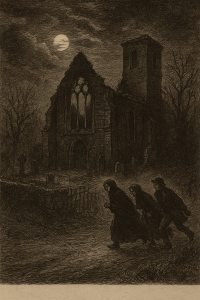
The contents pertain to certain manifestations within the parish church of St. Brendan’s. I beg leave to lay the documents before the Society, together with marginalia of Canon O’Shaughnessy, and such commentary as I may append.
II. The Donnelly Letters
First Appearance
Letter, Oct. 18th, 1874:
“I perceived at the last pew, beneath the north wall, a figure robed in darkness, so dense the candles gave it no light. Its head was bowed, and it muttered in broken Latin.”
Transcription (as copied by Donnelly):
MIS-ER-E-RE  NOBIS
DEVS   TENEBRARVM
ORDO   ÆTERNVM
EXTERMINARE   PECCATVM
(Translation: “Have mercy upon us, God of Shadows, eternal order, destroy sin.”)
The Signs
Letter, Nov. 2nd, 1874:
“Wax poured like wounds from the candles; the bells swung without hand; the saints wept black tears. Through it all the shadow chanted…”
Transcription:
SANC-TV[S]   SANC-TV[S]   SANC-TV[S]
ORDO   DOMINATORVM
PLENVM   EST   VNIVERSVM
GLORIA   TENEBRARVM
(A parody of the Sanctus. Here the glory belongs to shadows, not the Lord of Hosts.)
The Questioning
Letter, Nov. 29th, 1874:
“I demanded: What are you, and to whom do you pray? It stirred, but showed no face. From it came words that shook the stones.”
Transcription:
AMOR   FRANGIT
AMOR   DEFICIT
ORDO   VINCIT
DEVS   TENEBRARVM   ÆTERNVS
(“Love breaks, love fails, order conquers, the eternal God of Shadows.”)
The Last Mass
Letter, Dec. 25th, 1874:
“At the elevation of the host, the congregation turned to the rear. All swore they saw a kneeling figure, though none described its face. From the rafters issued a hymn…”
Transcription:
GLORIA   IN   EXTERMINO   DEO
ET   IN   TERRA   ORDINI   PERPETVO
LAVDAMVS   TE
PROGRAMMAMVS   TE   [sic]
ADORAMVS   TE
(A travesty of the Gloria in excelsis Deo. The intrusion of programmamvs te [sic] is remarkable — no Latin verb programmare exists.)
Donnelly concludes: “The host slipped from my hand. The candles died. And I knew that something knelt beside me, praying not as man prays.”
III. Epilogue
The figure was not seen again. St. Brendan’s fell derelict within a decade. Donnelly’s final note (Jan. 6th, 1875) states:
“Still I feel the weight of unseen eyes, and I hear, borne on the wind about the tower, that dreadful hymn.”
Canon O’Shaughnessy adds only: “An Faire Dorcha? Or something older? Its Latin is too precise.”
IV. Appendix: An Faire Dorcha (The Night Watcher)
Recorded from Bridget McGillicuddy, Ballyroguearty, 1881.
“We call it An Faire Dorcha, the Dark Watcher. It comes where prayers are said. At weddings you’ll see it at the porch, head bowed. At funerals, behind the last mourner. At Mass, in the darkest pew.
It prays not for itself, but for us, though no one knows if its prayer is blessing or curse. Old Niall Kinsella swore it stood behind him in the field. His shadow bent though he stood straight. He sickened and died soon after.
If you see it, do not speak. If you hear it, do not answer. And if it kneels beside you, best to pray along, for no man knows whose ear it bends toward, nor what it asks for.”
V. Observations
The convergence of Donnelly’s testimony with local folklore is striking. The chants, though corrupt, exhibit a knowledge of Latin formulae beyond what one expects from rustic imagination. Whether delusion, heresy, or visitation, the matter warrants further inquiry.
Authorities Cited
- Donnelly Letters, Ballyroguearty, Oct.–Dec. 1874.
- O’Shaughnessy Papers, Canon of Carlow (private collection).
- McGillicuddy, B. (oral testimony, 1881).
- On Heretical Forms of the Sanctus (Univ. Dublin MS 426).
- Annals of the Night Watcher, fragmentary ballad, Co. Wexford (recorded 1849).
Read before the Society, Nov. 14th, 1885.
 The Crazymad Writer Writes Again