Saint Patrick: A Cycle of Thirteen Visions
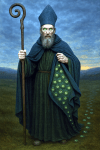
Saint Patrick: A Cycle of Thirteen Visions
(gathered by an unnamed pilgrim who swears he walked behind the saint and never once saw his face)
I. The River of Eyes
They said Patrick came to teach, but the truth is this: he walked backward into Ireland.
Each heel-print filled with a cold white eye that blinked up at the rain. Crows flew down to peck at the blinking; he lifted his staff and the flock calcified mid-wing, a grey garland strung above the fields.
At the Shannon he whispered. The water stood like a glass tunnel and he stepped inside. Hands—far too many—pressed from within the river-skin, and every fish looked suddenly human with a sorrowful mouth. “Close,” he said to the water, and the tunnel sealed over him like a lid on a jar. When he emerged on the other bank, the hands were gone—but the current remembered and to this day the river drags at the ankles of anyone who tries to wade it, as if longing to hold a wrist again.
II. The Stone Flock
On the plains of Meath he passed beneath that necklace of petrified crows. The farmers whispered: “Birds don’t die that way.” “Birds don’t stop that way.” Patrick touched the nearest with two fingers and blessed it with a word no one knew.
Night fell in one blink. The stone birds beat their stone wings once, twice, and rose gratingly, a quarry taking flight. They circled like a millstone sky and when they passed over the fields, seeds burst from the earth all at once—wheat heads, hazel catkins, rushes—with the speed of a time-lapse miracle and the panic of a stampede.
“Order,” he said softly, and every blade of grass lay down like a dog.
III. The Cloak of Silence
There were druids on a ridge above Boyne, their fires loud with wolf-shadows. They called him heretic, thief of names. Patrick opened his cloak. Nothing inside—no light, no darkness, only a plush absence like a theatre whose audience has stopped breathing. The wolves fell still, as did the men.
One druid tried to curse him, but the words slid off his tongue as smooth as eggs and could find no air to hatch in. “Return,” Patrick told their breath, and it went back into the earth. Sometimes the wind drops in the valley without reason. You think it’s weather. It is the valley trying to speak, and remembering it has no mouth.
IV. The Wind That Forgot Its Name
On Skellig’s bitter ladder the monks made a line like beads on a punishing rosary. Patrick told the wind to be still; it refused him, laughing through its teeth, and shoved at the cliff. So he took its name.
For three days the island heard nothing at all. Waves mouthed the rocks in helpless mime. Gulls flapped like ash. The monks cried without sound and saw their tears float sideways. When Patrick relented, the wind returned—meek, nameless, and newly obedient, though every so often it gropes the sea as if hunting for the label it once wore. On such days fishermen come home with nets full of blank, eyeless fish. They cannot sell them. They bury them, and the sand hisses.
V. Newgrange: The Sun Behind the Door
He came to Brú na Bóinne and knocked on winter. The passage was locked by light itself. Patrick put his ear to stone and listened to the oldest heartbeat.
“Open,” he said, and the sun answered like an obedient animal, crawling inside the hill before dawn, staining the chamber bones with honey. Then he pressed two fingers to the lintel and held the sun there longer than it wished. It grew sulky, then afraid, then still. Outside, the valley went milk-pale. Cocks crowed once and never found the next note.
Only at his whisper did the sun stagger out and resume its correct sky. The year has been on a leash ever since. This is why solstices feel like doors: he taught them.
VI. The Feast Beneath the Hill
They invited him under the sidhe, perhaps in parley, perhaps to weigh him; the invitation came written on bracken, and a fox delivered it.
Patrick took no bread, only salt. The People of the Hollow gave him meat that was not meat and wine that sang in the cup. He set the salt down and it crawled off the plate like a winter insect, spelling words on the table: Stay. No. Stay. No.
He raised the cup; the wine confessed in a hundred voices—boys lost for a century, cattle borrowed, brides changed at the cradle, a whole empire of small thefts. Patrick drank anyway and left the cup upside-down. It keeps trying to fill itself beneath the hill. Some nights the ground rings like a bell and cattle kneel.
VII. Croagh Patrick, Where the Ash Falls Upward
Pilgrims follow the Reek with bare feet and apologies. In the oldest year the mountain erupted with ash that did not fall; it ascended, like soot remembering the chimney. Patrick climbed through it, backwards as ever.
At the summit he tapped the stones and out crawled snake-shaped maps—ink that wriggled, rivers and roadways to nations not yet born. “Not today,” he told them. The maps hissed, folded themselves into rosary beads, and slipped into the pockets of the wind. When empires later went looking for Ireland, the land pretended not to know itself and the wind handed back only bead-strings: decades of penance in exchange for directions.
VIII. The Bog Alphabet
On the edge of Clonmore a peat-cutter found him kneeling in the moss, fingers black to the knuckle. Patrick was writing. Each turf-brick split to reveal letters, wet and brown, smelling of tea and old fires.
“Name them,” he told the cutter. The man tried: a, b, c—ordinary little boats on an ordinary river. But the alphabet wouldn’t stay lined up. It coiled. It braided. It shaped itself into words that wriggled away when you looked straight at them: sheeprain, candlebone, godhunger, nevernot.
Patrick placed a letter on the man’s tongue and said, “read.” The man spoke a word that made the bog sigh and the sky lean closer. He spat the letter immediately and went home to live a blameless silent life.
IX. The Dolmen That Remembered
Two children spent a night by a capstone not far from Haroldstown, dared by cousins who knew better. At midnight Patrick arrived with a lantern that burned a cool green, more seeing than flame.
He asked the dolmen its name. It answered by turning slightly, which took it a century. The children felt time crack like ice; they saw spring lambs hopping across winter fields and heard a harvest being put away by people not yet born.
Patrick pressed his palm against the stone as if checking a fever. “You carried the dead,” he said. “Now carry the door.” The dolmen tilted a fraction more. There is a moment out there, if you stand just right, when the view through the stones is not your field at all but a shoreline where something large is breathing.
Leave bread. Leave whether you believe.
X. The Well That Ran Clockwise
In a parish so small it clung to the edge of its own shadow, there was a holy well that spun the wrong way. The priest considered writing to Rome; instead he wrote to Patrick’s memory.
The saint appeared in the dew as a tall wet absence. He unspooled a silver thread from his staff, dropped one end into the well, and reeled. Up came minutes, then hours—wet as eels, twisting, fighting the spool. He wound them neatly around his wrist until the well stood empty and terrified, a stone throat with nothing to say.
“Begin,” he told it. He let the hours fall back in, and the water turned politely counterclockwise.
But on the last Sunday of every month, time still slithers the old way for one hour and everyone in the village dreams of their own birth.
XI. The Choir Beneath the Floorboards
In a tavern that had never been quiet, Patrick rapped his staff once on a knot in the boards. The sound went down—a hammer descending a well—and from the cellar rose a low singing.
“Not ghosts,” he said. “Not yet.”
He sent everyone home with their ears buzzing. Then he lifted the floor like a lid. Below: not a cellar but a choir loft reversed, with empty robes hanging in the air as if remembering bodies. “Take up your places,” Patrick told the absent. The robes inhaled. They sang—notes like moths, dusting the beams with a soft grey faith.
When he closed the boards the tavern forgot its words for a year. People tapped on the counter to speak. To this day the first song at any wake there is hummed, not sung, so the dead can guess the tune and come in on time.
XII. The Sea That Knelt
At Blacksod, at Howth, at Dunmore, he walked to the edge of the island and held out his palm like a traffic warden of immensities. The Atlantic bowed.
Eels lifted their blind faces. A drowned city shook the mussels from its shoulders. A bell rang down where the light can’t follow.
“Stand,” Patrick commanded, and the sea stood, though it hated to. You can tell on certain mornings by the way the waves line up—too straight, too obedient—that water still remembers kneeling and despises the memory. On those days, boats behave; people don’t.
XIII. The Last Vision: The Backward Sun
He grew old without arriving at an age. The land had learned the trick from him. On a storm-skinned evening he came to a field that had once been a battlefield and would later be a playground. The air made that click of throat you hear before a name.
Patrick faced west and walked backward east. The sun, unsure whom to follow, hesitated. It tried something it had never tried: it took a half-step backward too. Dusk peeled both ways; for one trembling moment every shadow pointed to its own mouth.
He lifted his staff, but it was only a bone of light now. He lifted his cloak, and the plush silence inside had become a nest of soft green eyes, blinking, blinking. He put the cloak on like a hood, and the eyes became a constellation.
Then—no farewell, no miracle to cap them all—he simply reversed into the horizon, becoming his own footprint in the air, becoming the river that closes over a man you cannot prove was there.
Children woke all over the island at the same second, staring at their doorways. Their parents lit lamps. There was nothing to see. There was always nothing to see. Yet the grass in the morning lay down in one direction as if politely making way.
Marginal Note of the Pilgrim
I have kept these visions as a beekeeper keeps bee-stories: knowing they will sting, saving them anyway. If you ask me whether Patrick was a saint, a thief of names, a hunter of serpents-that-are-not-serpents, I will answer with the only honest blessing I learned at his back:
May the world behave itself a little while longer, and may you never stand on the exact spot where it decides to practice something new.
 The Crazymad Writer Writes Again