The Riddle of the Librarian

The Riddle of the Librarian
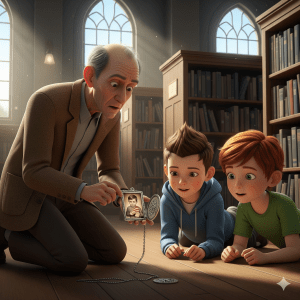
The end of the school term brought with it the annual library book collection, a task overseen by the school’s new librarian, a gaunt, quiet man named Mr. Abernathy. Unlike the previous librarian, a jolly, bespectacled woman who smelled of tea and old paper, Mr. Abernathy was a figure of profound mystery. He never smiled. He wore a single, frayed velvet waistcoat, even on the hottest days. And most puzzling of all, every time a student returned a book, he would inspect it with a magnifying glass, then press a small, silver locket to the cover before placing it back on the shelf.
To the other boys, it was just Mr. Abernathy’s peculiar way of doing things. To Tony and Gerard, it was a profound riddle. “That locket isn’t just a locket,” Tony declared, his eyes narrowed in suspicion as he peered through the library window. “It’s a magical device. He’s not just checking the books in; he’s casting a spell on them! A spell to… to make them disappear!”
Gerard, the taller and more cautious of the two, had a different theory. “It’s a secret code, Tony. He’s a spy. Each book contains a different piece of a secret message, and the locket is the key that unlocks it.”
Their plan, naturally, was to return a book and get a closer look at the locket. They chose a very old copy of Gulliver’s Travels, a book so dusty it had almost certainly never been opened. The next day, they approached the library counter with a concoction of nerves and excitement.
Mr. Abernathy looked up, his expression as impassive as ever. He took the book, placed it on the counter, and carefully, meticulously inspected it. As he was about to bring the locket to the cover, Tony, in a burst of unplanned genius, sneezed a loud, theatrical sneeze. “Sorry, sir! Allergic to dust!”
The sneeze startled Mr. Abernathy, who fumbled the locket. It fell to the floor and popped open. Tony and Gerard rushed to help, and as they did, they saw what was inside the locket.
It wasn’t a spy’s microfilm or a magical crystal. It was a faded, sepia-toned photograph of a little boy holding up a small, hand-knitted sock. The sock had a tiny hole in the toe. As Mr. Abernathy picked up the locket, a rare, soft smile touched his lips.
“That’s me,” he said, his voice surprisingly gentle. “My mother knitted me that sock. It was my favourite, but I lost it in the garden. I’ve been looking for it for years.” He then pressed the locket to the book, as if performing a private, gentle ritual.
Just then, the Headmaster walked in. “Ah, Mr. Abernathy. I see you’re using the new device I gave you. How is the book-stamping tool working out?” he asked, holding up a small, leather-bound book.
“Very well, Headmaster,” Mr. Abernathy replied, closing the locket. “The infrared light is surprisingly effective at detecting forgotten pencil marks and small imperfections.”
Tony and Gerard’s mystery was solved. The locket wasn’t a magical device or a spy’s tool; it was a high-tech (for the 1960s) book-stamping tool, with a small, private sentimental item tucked inside. Mr. Abernathy’s “ritual” was simply the process of checking for damage.
As the boys walked away, Tony turned to Gerard, a look of awe on his face. “The librarian wasn’t a wizard or a spy,” he whispered. “He was a person who just missed his mum.”
Gerard smiled. “And all he needed to find was a sock.”
 The Crazymad Writer Writes Again